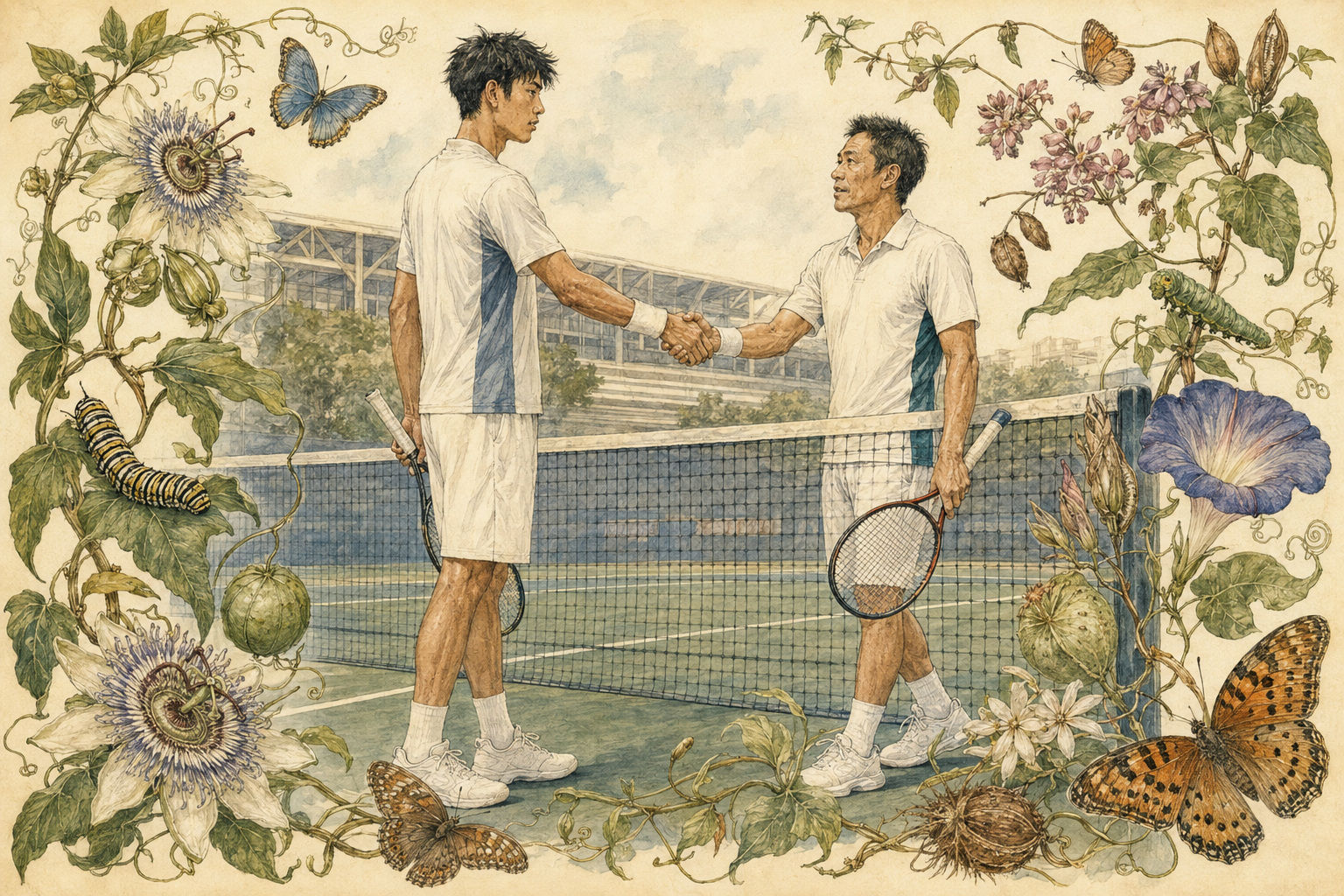
ONE side of the net held a first US Open main draw. The other held the end of a Grand Slam career. Rei Sakamoto beat Kei Nishikori 6-4, 7-6(3) in the final round of men’s qualifying on August 28, turning a match heavy with Japanese tennis history into a result earned in straight sets.
Sakamoto won three qualifying matches to reach the New York singles main draw for the first time. After taking the opening set 6-4, he won the second-set tiebreak 7-3 and denied Nishikori a return to the main event.
Nishikori has announced that he will retire after the 2026 season. The US Open held an on-court ceremony after the match and identified it as the final Grand Slam contest of his career. His last major therefore ended in qualifying at the same venue where he became a finalist 12 years earlier.
A Main-Draw Place Won in a Tiebreak
Nishikori kept the second set level through 12 games after losing the first, but Sakamoto controlled the short decider 7-3. Closing the match there mattered: he avoided giving an opponent celebrated for escapes and extended contests a third set.
In the ATP’s post-match account, Nishikori credited Sakamoto’s pace and serve with preventing him from finding rhythm. He also explained that the two had known each other for years and had practised together at IMG.
The relationship added meaning, not an exception to the rules. This remained an official qualifying final with a scarce main-draw position at stake. Nishikori competed to extend his major career; Sakamoto had to defeat him to advance.
Three Wins, Three Different Problems
Sakamoto’s campaign began badly against Jay Clarke. He lost the first set, then recovered for a 4-6, 6-3, 6-4 victory. In round two, he produced the cleaner result, beating 23rd-seeded Alexandre Muller 6-3, 6-3.
The final posed a different test: familiarity, expectation and an opponent playing his final major. Sakamoto took the opening set and then survived the pressure of a tiebreak rather than allowing the match to stretch into a deciding set.
The ATP includes him among its #NextGenATP group. The official main draw placed him against Australia’s Aleksandar Vukic in the first round, turning qualification from a milestone into immediate preparation for best-of-five-set tennis.
| Player | Qualifying round 1 | Qualifying round 2 | Qualifying final |
|---|---|---|---|
| Rei Sakamoto | Beat Clarke 4-6, 6-3, 6-4 | Beat Muller 6-3, 6-3 | Beat Nishikori 6-4, 7-6(3) |
| Kei Nishikori | Beat Ofner 6-1, 2-6, 6-2 | Beat Antonius 6-4, 6-4 | Lost to Sakamoto 4-6, 6-7(3) |
From Admiration to the Same Training Base
IMG Japan says Sakamoto moved to the IMG Academy in the United States at 15 with support from the Masaaki Morita Tennis Fund, inspired by Nishikori. He won the 2024 Australian Open junior boys’ singles title and the US Open junior boys’ doubles title before turning professional that September.
At 195 centimeters, Sakamoto possesses the obvious geometry of a powerful server. His official profile also stresses the ambition to become a low-error, resilient all-court player. The qualifying sequence supported that broader picture: recovery in round one, control in round two and concentration at the end of round three.
The Japan Tennis Association’s 2026 roster lists Nishikori on the men’s national team and Sakamoto in the men’s Next Gen development group. Their training paths overlap, but their competitive identities and career stages remain distinct.
The Standard Nishikori Set in New York
Nishikori’s relationship with the US Open is inseparable from 2014. He reached the men’s singles final, becoming the first Asian man to reach a major singles final, according to the ATP. He climbed to a career-high No. 4 the following year.
His record also includes 12 ATP Tour singles titles and a bronze medal at the 2016 Rio Olympics. The achievement was not one extraordinary fortnight alone; it was a sustained demonstration that a Japanese man could contend near the top of the global game.
His final New York appearance began with a qualifying wild card, not a ceremonial main-draw place. Nishikori beat Sebastian Ofner 6-1, 2-6, 6-2 and Michael Antonius 6-4, 6-4 before meeting Sakamoto. He was still trying to qualify, not simply appearing to receive applause.
- Runner-up in the 2014 US Open men’s singles event.
- Career-high world ranking of No. 4 in 2015.
- Twelve ATP Tour singles titles.
- Men’s singles bronze medal at the 2016 Rio Olympics.
- Retirement announced for the end of the 2026 season.
Nishikori Looks Beyond His Own Career
After the match, Nishikori said, “I was really excited to play Rei.” He praised Sakamoto’s fast game and serve while acknowledging that he had been unable to produce his best level.
He also turned toward a wider concern: the scarcity of Asian men near the top of the rankings. “I hope I can help, especially Japanese or Asian tennis,” he told the ATP, while naming Sakamoto among those with the potential to become a leading player.
That was an aspiration, not an announcement of a coaching role or formal post-retirement position. Nishikori said he had no immediate plan. The distinction matters: a possible future contribution should not be reported as an appointment that has not happened.
What the Generational Story Leaves Out
A 20-year-old defeating a retiring 36-year-old invites a generational headline. But a single head-to-head result does not appoint a successor. It establishes that Sakamoto was better in this match and that he qualified for this draw.
Nishikori’s ranking peak, tour titles and repeated major appearances cannot be transferred by ceremony. Nor should Sakamoto’s career be judged as an attempt to reproduce them. His task is to develop a return game, physical durability and a five-set identity around tools that differ from Nishikori’s.
The more transferable part of Nishikori’s legacy is structural. International training, private funding, junior Grand Slam experience and a route through the Challenger Tour helped make Sakamoto’s opportunity possible. Japanese tennis can evaluate whether that route is open widely enough for the players behind him.
The Next Test Starts in the Main Draw
Qualification already marks progress. Sakamoto lost in the second qualifying round in 2025; one year later, he solved three different matches and entered the main field.
The draw paired him with Vukic. The immediate question is whether the serve and pace that constrained Nishikori can hold through a longer main-draw contest, and whether Sakamoto can protect his level when an opponent has more time to adjust.
Nishikori’s last US Open and Sakamoto’s first New York main draw met in one match. The emotional connection is real. The competitive record is simpler: on August 28, Sakamoto won, Nishikori’s major career ended, and a new opportunity began.
2014 Nishikori reaches the US Open men’s singles final.
2024 Sakamoto wins Australian Open junior singles and US Open junior doubles titles.
APRIL 30, 2026 Nishikori announces that the season will be his last.
AUGUST 28, 2026 Sakamoto beats Nishikori and qualifies for his first US Open main draw.
MAIN-DRAW ROUND 1 Sakamoto is drawn against Aleksandar Vukic.
- US Open — Nishikori honored after his final Grand Slam match
- ATP Tour — Nishikori’s post-match reaction, August 28, 2026
- ATP Tour — US Open qualifiers and final-round results
- Official US Open men’s qualifying draw / men’s singles main draw
- IMG Japan — Official Rei Sakamoto profile
- Japan Tennis Association — 2026 national-team rosters
This English report was written independently from tournament, ATP, Japan Tennis Association and athlete-management primary material available through August 29, 2026. Names, affiliations, scores, draws, career milestones and retirement timing were checked against those records. No interview quotation has been reconstructed or translated as direct speech.