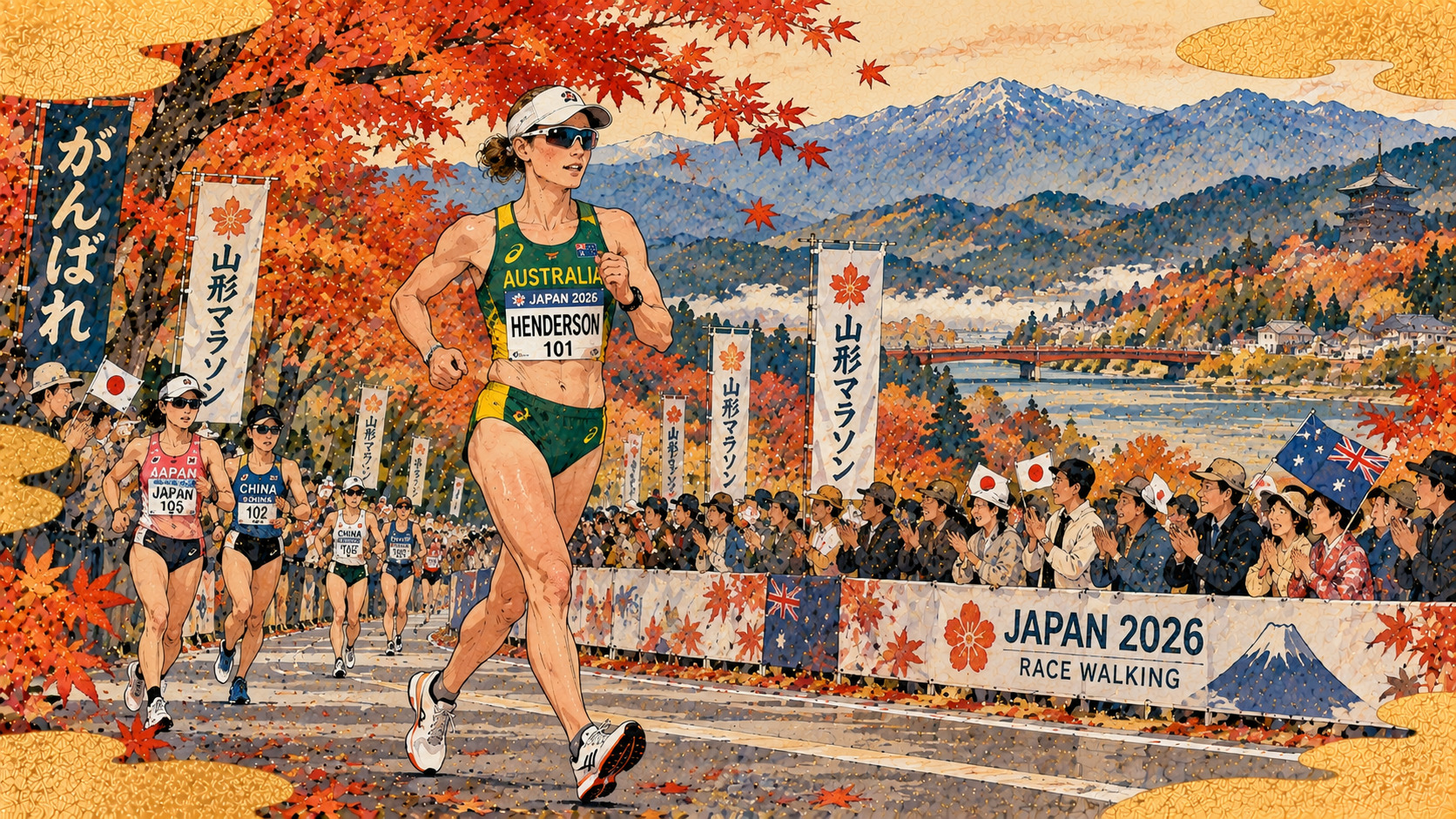
One woman, one rhythm, a new mark
In driving rain in Takahata, Japan, on October 25, Australia’s Rebecca Henderson completed her first marathon race walk in 3:14:52, improving the women’s world-record performance by 19 seconds. World Athletics reported the result as a world record, subject to the standard ratification procedure. Her victory was not the product of a dramatic final sprint against a close rival: she raced largely alone, managing her pace for more than three hours across 42.195 kilometres.
The race that unfolded in the rain
By 20.195 kilometres, Henderson had recorded 1:33:39 and built a margin of more than six minutes over Japan’s Ayane Yanai. That advantage exceeded eight minutes by 25 kilometres. In a crowded field of competitors on a lapped course with a slight incline and decline, Henderson maintained her cadence, passing many men as the race settled. World Athletics described her performance as steady, commanding and solo from start to finish.
Nineteen seconds, and the importance of precision
Henderson displaced the 3:15:11 mark set by Italian Sofia Fiorini at August’s European Championships in Birmingham. Over the marathon distance, 3:14:52 represents an average speed of about 12.99 km/h and roughly 4 minutes 37 seconds per kilometre. That is fast enough to surprise many recreational runners, yet race walkers must meet specific contact and knee-straightening rules throughout. The comparison is a measure of athletic intensity, not an equivalence between walking and running.
The Australian whose beginnings were accidental
The Australian Olympic Committee traces Henderson’s involvement in athletics to an early visit to watch a cousin compete. She discovered race walking as a child and continued developing through local clubs. Her hometown is Berwick, Victoria, and her senior club is Mentone Athletics. Tokyo 2020 was her first Olympics; she returned for Paris 2024, where she raced the 20 km and the mixed marathon race-walk relay. The record comes after years of progression rather than a sudden arrival.
From Glasgow bronze to Takahata gold
Henderson secured bronze in the 10,000 m race walk at the 2026 Commonwealth Games in Glasgow, according to Oceania Athletics and her Victorian Institute of Sport profile. She was ninth over 35 km at the 2025 World Championships, and her official profile lists a 1:32:25 half-marathon race-walk best from March 2026. In October she translated those shorter-distance and championship experiences into a debut marathon performance that shifted the women’s standard.
Why this record exists only now
International race walking has repeatedly reconfigured its long-distance programme. The 50 km walk was long a defining Olympic men’s event. The 35 km then replaced it in major world championship programming. From January 1, 2026, World Athletics made the half-marathon and marathon distances official. Henderson improved an existing women’s 2026 record; by contrast, Japan’s Masatora Kawano met the qualifying benchmark for the inaugural men’s marathon race-walk record on the same day. Those two achievements are different in how their record histories are defined.
The rules that turn endurance into technique
Race walking is not simply running more slowly. Under World Athletics rules, an athlete must not lose visible contact with the ground, while the advancing leg must be straight from first contact until it reaches the vertical upright position. Judges apply those rules even deep into a marathon race. Maintaining efficient movement under fatigue and scrutiny is a defining part of the achievement, not an incidental constraint.
Why a Japanese national championship lists another winner
Japanese domestic reporting lists Henderson as an open entrant. Ayane Yanai of Fujitsu won the domestic women’s marathon race-walk classification in 3:29:10. World Athletics lists Henderson first in the international race, followed by Yanai. Both descriptions are compatible: the open-entry designation concerns eligibility for the domestic title, not Henderson’s actual race performance. Treating Yanai as second in the Japanese national championship, or Henderson as its domestic champion, would misstate the classification.
Yanai’s home record tells a second story
Yanai’s 3:29:10 on her marathon race-walk debut improved Japan’s previous top performance of 3:33:47 by 4 minutes 37 seconds, according to Japanese athletics reporting. Because the distance was newly recognized in 2026, ratification of a national record follows the Japanese federation’s transitional procedure and the year’s final performances. This distinction matters for accurate coverage: one rainy Japanese road witnessed an Australian world benchmark and a separate domestic Japanese milestone.
A provincial Japanese course on the global stage
Takahata’s meeting is part of the World Athletics Race Walking Tour at Bronze level. It is a place where Japanese corporate-team athletes and visiting international competitors can test themselves in an established event setting. The wet conditions and repeated small changes in elevation offered no obvious advantage. Yet the 2026 meeting produced both Henderson’s women’s mark and Kawano’s inaugural men’s record performance—a powerful reminder that sport’s significant moments do not have to occur in capital-city stadiums.
What remains before the history books close
World Athletics places an asterisk on Henderson’s 3:14:52 for a reason: the mark remains subject to ratification. Its significance is already clear as a performance, but official recognition is a separate process. What makes the result memorable is not only its place in a young record category. It is the profile of a two-time Olympian, now at 25, finding a new distance and setting the pace for the next generation of race walkers.
Sources and verification
Verified against World Athletics, Oceania Athletics, Japanese meeting reports and Australian sport bodies. Pending ratification; no original athlete interview conducted.
- World Athletics: official Takahata report
- World Athletics: official meeting results
- World Athletics: women’s marathon race-walk rankings
- Oceania Athletics: Henderson’s record
- Australian Olympic Committee: athlete biography
- Australian Athletics: Rebecca Henderson
- Japan Association of Athletics Federations: event information
- Monthly Athletics (Japan): Henderson and Yanai
- Monthly Athletics (Japan): full meeting results
- Victorian Institute of Sport: athlete results