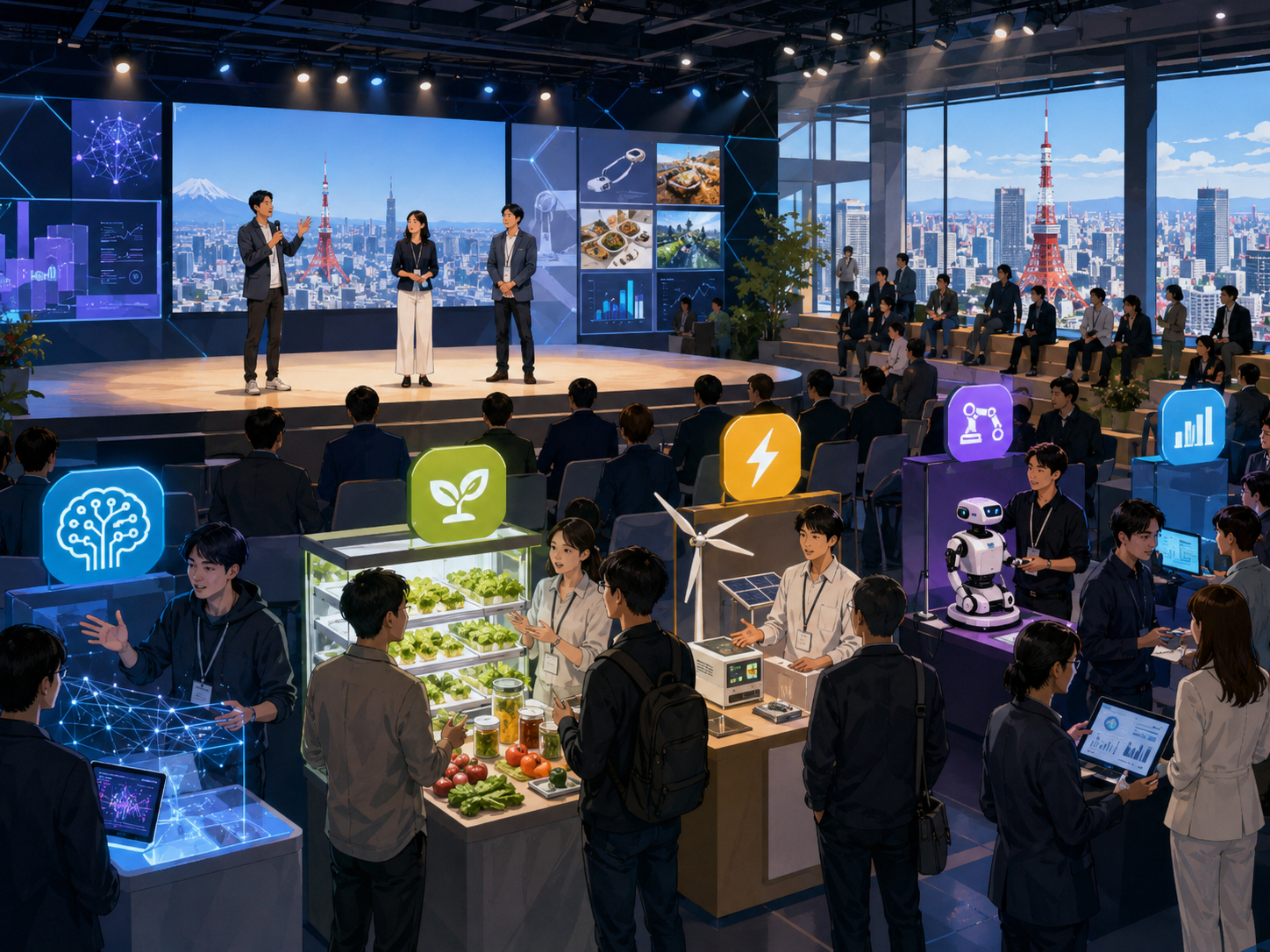
The future Japanese companies are seeking appears in 42 startups
Japanese corporations are looking for the future: AI, electricity, healthcare, insurance, logistics, robotics, food, materials, regional challenges, data, factories, and mobility. In boardrooms, words like new business, DX, and open innovation appear in slide decks. But the future does not live only in slides. It lives in prototypes, labs, demos, and pitch decks built by small companies.
Plug and Play Japan’s Summer 2026 Batch, announced in June 2026, looks like an inventory of that future. The company selected 42 startups from Japan and abroad for an accelerator program running from June to September 2026. More than 260 startups applied. The final group is split evenly: 21 Japanese startups and 21 overseas startups.
The six program areas are AI Center of Excellence, Deeptech, Energy, Health, Insurtech, and Mobility & Physical AI. Together they reveal what Japanese corporations are seriously watching: how to use generative AI, how to handle energy transition, how to support aging and healthcare, how to change insurance, how to connect mobility and robotics, and how to turn research into business.
A startup list is not merely a list. It is a clue to what Japan’s industrial economy fears, wants, and hopes to buy next.
What is Plug and Play Japan?
Plug and Play is an innovation platform that began in Silicon Valley. It connects startups, corporations, investors, universities, and governments through accelerators, investment, business development, and matching. Plug and Play Japan was established in July 2017 and expanded from Tokyo into a broader Japanese network.
Its early Japan programs focused on areas such as Fintech, Insurtech, IoT, and Mobility — sectors where corporate partnerships were likely. That matched the Japanese market. Japan has many large companies with capital, technology, customers, and brand trust. But many struggle to build new businesses quickly from inside.
Plug and Play Japan sits between the two sides. It gives startups a doorway into major companies. It gives corporations a window onto startups around the world. In other words, it creates a place where Japanese companies can encounter external technology they might not find alone.
For the Summer 2026 Batch, Plug and Play Japan points to more than 1,200 startups supported and a network of over 60 global offices. An accelerator is no longer just a place to encourage young companies. It is part of corporate procurement, proof-of-concept, investment, and commercialization infrastructure.
The 50-50 Japan-overseas split matters
Of the 42 selected startups, 21 are Japanese and 21 are from overseas. Overseas selection breaks down into nine from the Americas, nine from Europe, the Middle East, and Africa, and three from Asia-Pacific.
That balance matters. The goal is not only to grow Japanese startups. It is to show foreign technology to Japanese corporations and introduce overseas startups to Japanese customers, test sites, and corporate partners. The accelerator becomes an industrial device for both import and export.
Japanese corporations cannot track global technical change entirely from inside. AI, energy, deeptech, robotics, insurance, and healthcare move too quickly. A small foreign startup may reach a new method before a major company does.
For overseas startups, Japan is attractive: major corporations, manufacturing sites, insurers, banks, healthcare systems, energy operators, and logistics networks. If a test succeeds, the customer can be long-term. But Japan also has friction: slower decision-making, language, and business customs. Plug and Play Japan acts as a translator for that friction.
The AI Center of Excellence reveals corporate urgency
One major feature is the newly established AI Center of Excellence, launched on May 21. Selected startups include Crafting, hootfolio, KAGUYA, rubi labs, SYSLEA, and Tenchijin.
Since the rise of generative AI, Japanese corporations have felt urgency. Using a general tool such as ChatGPT is easy. Integrating AI into internal data, business processes, customer service, factories, sales, legal, and R&D is hard. AI is both a tool and a mirror that reveals organizational weakness.
The phrase AI Center of Excellence shows what corporations are really asking for. They do not want isolated experiments. They want a specialized function that can move AI into business and management. Prompt experiments must become AI agents, workflow automation, data foundations, security, governance, and field deployment.
The true AI problem for Japanese companies is not only model performance. It is whether the organization can change work, organize data, train employees, and explain responsibility.
Deeptech is where Japan should have been strong
The Deeptech group includes startups in space resources, materials, photonics, displays, semiconductor-related technology, medical testing, and actuators: Ascension Earth Resources, LiSTie, Phosio, Photon Bridge, Swave, Taiwan Ruomei Technology, VisCure, Yplasma Actuators, and others.
Japan should be strong in deeptech. Materials, precision machinery, semiconductor manufacturing equipment, optics, robotics, chemistry, and electronic components are areas where universities, corporate laboratories, and manufacturing sites have built deep capability.
But turning deeptech into business is difficult. R&D takes time. The gap between prototype and mass production is large. Customers are specialized and sales cycles are long. Capital and talent are needed. In Japan, good technology has often stalled before commercialization.
An accelerator handling deeptech is useful because it can build bridges between research and markets. The question is not only whether the technology is impressive, but who buys it, where it can be tested, and which company can help bring it to market.
Energy is not only an electric-utility problem
The Energy group includes climate tech, storage, electricity trading, grid technology, resource recovery, heat management, and AI: Atierra, EQUIUM, Exnaton, FloatSync, GreenPow, Greenfluidics, a Kyushu University team, Oktogrid, Phoenix Tailings, Terraton Industrial, Bolo AI, and others.
Japan’s energy challenge is not only an electric-utility problem. Manufacturing, data centers, EVs, housing, local governments, disaster resilience, renewable energy, batteries, transmission, and resource security all connect.
With the yen weak and imported energy costs affecting households and companies, Japan must think more seriously about efficiency and domestic resource circulation. A USD/JPY level of ¥160.57 affects the cost of overseas energy, equipment, and technology procurement.
Energy startups are not only about the ideal of decarbonization. They affect electricity bills, resources, resilience, and factory competitiveness. It makes sense that Japanese corporations are paying attention.

Health cannot escape Japan’s aging society
The Health program includes Quadlytics, Quantum Flowers & Foods, Rebio Health, and Senno Therapeutics. Medical care, food, biotech, health data, treatment, and prevention are drawing closer together.
Japan is one of the most aged societies in the world. Healthcare costs, caregiving, labor shortages, rural medicine, prevention, and healthy lifespan are not only business opportunities; they are questions of social maintenance.
For major corporations, partnering with health startups is both new-business development and social-problem response. Food companies, insurers, pharmaceutical firms, medical-device makers, local governments, hospitals, and data companies all intersect.
Health also requires caution. Regulation, clinical data, personal information, medical operations, and evidence matter. Moving fast is not enough. Trustworthy validation is necessary.
Insurtech turns insurance into a life service
The Insurtech group includes Chai, MAX NOW, KH Strategy, and Tsukumo Labs. Insurance may look old, but it fits AI, data, rewards, behavior analytics, and embedded finance.
Japanese insurers have huge customer bases and long trust. They also face new issues: younger customer relationships, digital experience, health data, prevention, disaster risk, cyber insurance, and the shift from cars to mobility.
Insurtech tries to move insurance from something that pays after accidents to something that manages daily risk. Points, apps, behavior change, real-time data, AI assessment, personalization — insurance becomes a life service as well as a financial product.
In Japan, regulation and trust are critical. Insurance is connected to money and life. New technology must be not only easy to use, but explainable and reassuring.
Mobility & Physical AI points to the next robot stage
The Mobility & Physical AI group includes Calmarion, Every WiLL, Foundation LLM Technologies, Imiron, Lightwheel AI, NanoResonance, Phononic Vibes, Refined Robotics, SYNRA, and others.
The phrase Physical AI is interesting. AI has long been discussed as something inside screens: writing text, making images, helping code. The next stage gives AI a body: vehicles, robots, factory machines, logistics equipment, sensors, sound, vibration, and spatial awareness. It is AI operating in the real world.
Japan has reasons to care. Aging, labor shortage, logistics constraints, factory automation, caregiving, disaster response, and regional transport all demand real-world AI.
But Physical AI is difficult. AI making a mistake on a screen and AI moving an object in the real world are different risks. Safety, responsibility, insurance, regulation, sensors, durability, and field training all matter. Japanese corporations are understandably cautious.
Connecting to regional industrial clusters is new
One of the most important details in the announcement is that Plug and Play Japan will use its domestic bases in Kyoto, Osaka, Kobe, Tokai, and Fukuoka to strengthen connections with regional industrial clusters.
Startup support in Japan has often been Tokyo-centered. Capital, talent, media, headquarters, and investors gather in Tokyo. But many industrial problems are regional. Manufacturing sits in Tokai and Kansai. Healthcare and aging are regional realities. Energy, agriculture, logistics, and disaster resilience are deeply local.
If startups do not see real sites, their solutions can become abstract. Factory lines, hospital counters, port warehouses, farmland, transmission equipment, care homes, regional banks — seeing the field changes how technology is used.
Plug and Play Japan’s regional-cluster push suggests a shift from Tokyo pitch events toward real-site validation.
Why open innovation is hard in Japan
Japanese companies have used the phrase open innovation for years. Actually doing it is difficult. Large companies can be slow to decide, legal and procurement processes can be heavy, pilots can end without adoption, and business units may not truly commit. Startups have limited time and capital; moving at corporate speed can exhaust them.
This structure is often called the graveyard of proof-of-concepts: lots of experiments, little deployment. The corporation says it learned. The startup gets no revenue. Both sides are frustrated.
Accelerators like Plug and Play are expected to reduce that friction: connect decision-makers directly, clarify purpose, set timelines, cross industries, show global examples, and turn small tests into contracts.
But programs alone cannot perform magic. In the end, the question is whether corporate Japan is ready to change.
Startups show corporations inconvenient truths
Startups often show large companies inconvenient truths. The customer may want something different. Technology may be moving faster than expected. A new global standard may already be forming. Internal procedures may be too slow. Data may be unusable. Understanding of field problems may be shallow.
That means meeting startups is not only fun. It can hurt. It can force corporations to see their weaknesses.
Startups also learn. In Japan, trust, quality, compliance, long-term relationships, field response, maintenance, and responsibility after installation all matter. Speed alone is not enough. To work with Japanese corporations, startups need operations and trust as well as technology.
True open innovation requires both sides to change.
The list of 42 is a diagnosis of Japan’s economy
Look at the Summer 2026 Batch and it starts to resemble a diagnosis of Japan’s economy. AI is needed. Energy transition is needed. Healthcare and health are needed. Insurance must change. AI that moves in the real world is needed. Deeptech must be commercialized.
It is a hopeful list and also an anxious one. The sectors where Japan was strong are under pressure: manufacturing, finance, energy, healthcare, distribution, insurance, transport. They look stable, but change is arriving.
Anxiety is not always bad. Because companies worry, they search for new companies. Because work is inconvenient, technology enters. Because labor is scarce, AI and robots move into the field. Because resources are uncertain, energy and materials are reconsidered.
The startup list is not yet the answer. But it shows the questions Japanese corporations are asking.
The future begins after the pitch
Accelerator announcements are always a little glamorous: startup logos, theme areas, pitch events, and program dates. The important part comes later.
Can startups enter the field? Do decision-makers move, not only project managers? Does a proof-of-concept become a business? Can Japanese and overseas startups learn from Japanese customers? Can regional bases expose them to real problems? Do AI, energy, health, insurtech, and physical AI become tools in the field rather than words in a slide deck?
Plug and Play Japan’s 42 startups will not transform Japan’s economy all at once. But 42 small needles can press into the hard surface of large companies. Some will break. Some will be removed. Some will go deep enough to create change from inside.
Japanese innovation will not come from one genius company alone. It will come when large companies, startups, regions, universities, local governments, investors, and real sites connect. Summer 2026 Batch is one experiment in that process.
The future does not begin on the pitch stage. It begins afterward, in the field.
- Plug and Play Japan selected 42 startups for its Summer 2026 Batch running from June to September.
- More than 260 companies applied, with 21 Japanese and 21 overseas startups selected.
- The six areas are AI Center of Excellence, Deeptech, Energy, Health, Insurtech, and Mobility & Physical AI.
- The program will strengthen links with regional industrial clusters through bases in Kyoto, Osaka, Kobe, Tokai, and Fukuoka.
- The list shows what Japanese corporations want from AI, energy, health, insurance, and real-world AI.
Sources and references
This feature is based on Plug and Play Japan’s official announcement, PR TIMES, company information, past batch announcements, and public startup and fintech ecosystem sources.
- Plug and Play Japan: Summer 2026 Batch announcement
- PR TIMES: Summer 2026 Batchで国内外から42社を採択
- Plug and Play Japan official site
- Plug and Play Japan: 2017 first batch application announcement
- Plug and Play Japan: Summer/Fall 2024 Batch context
- Japan Financial Services Agency: Japan Fintech Week 2026
- Plug and Play Japan: Summer 2025 Batch context