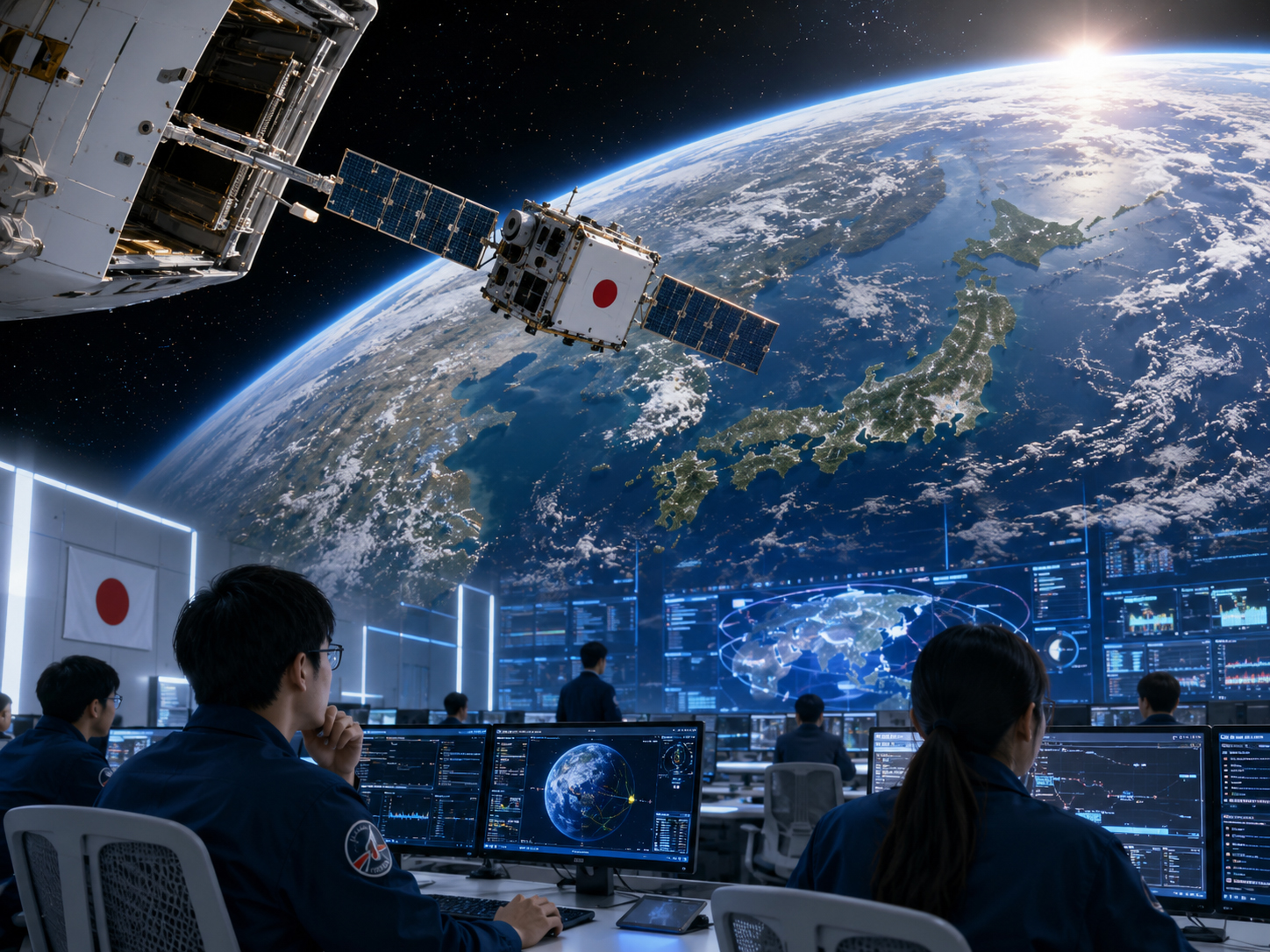
Space is moving from national project to industry
For decades, Japan’s space program was mainly a national story. Rockets were planned by government agencies, satellites were launched as public missions, and astronauts traveled to orbit as representatives of the country. Space was a place of flags, research, and national prestige.
Now space is beginning to show another face. Small satellites, Earth observation, communications, materials testing, drug discovery, education, and talent development are turning space into something more practical: a business environment where companies build services, find customers, raise money, and meet schedules.
Space BD is one of the companies that represents this shift. In June 2026, the Tokyo-based space business operator announced the final close of its Series C round, bringing the total raised in that round to more than ¥3.5 billion and total funding to date to ¥6.68 billion. It is not a flashy rocket manufacturer. It is closer to a space trading company — a connector of rockets, satellites, the ISS, experiments, hardware, education, and customers.
The hard part of space business is not only technology. Who carries what? Which rocket can take it? What orbital environment is needed? How do permits, testing, transport, insurance, vibration, schedules, and customer expectations fit together? Space BD’s business lives in that difficult and important space between idea and orbit.
What the ¥3.5 billion round signals
The Series C final close is more than a financing headline. Space BD first announced ¥2.4 billion in Series C funding in January 2026, then added more investors to bring the total above ¥3.5 billion. The stated priorities are strengthening the organization, expanding launch services, and enhancing fabless manufacturing capabilities.
Those three phrases say a great deal about the reality of the space business. Organizational strength means hiring and developing people who understand both space technology and business execution. Launch-service expansion means securing opportunities and coordinating missions for customers. Fabless manufacturing means designing, planning, and managing quality while working with external manufacturing partners instead of owning every factory function.
The word “space” invites dreams. But as an industry, space is made of paperwork, testing, transport, contracts, coordination, components, and deadlines. Unless companies can handle those practical layers, space remains stuck between laboratory and launch pad.
From the JAXA era to private utilization
Japan’s space foundation grew from the histories of ISAS, NASDA, and NAL, three organizations that merged in 2003 to form JAXA. Science missions, rockets, satellites, aviation research, and human spaceflight came together under one national agency.
JAXA has shown Japan’s capabilities through Hayabusa, Hayabusa2, H-IIA, H3, Earth-observation satellites, and the Japanese Experiment Module “Kibo” on the International Space Station. Kibo is especially important. It is Japan’s first long-duration human space facility, one of the ISS’s largest experimental modules, and a platform for both pressurized and exposed space-environment experiments.
Kibo is also central to the Space BD story. In 2018, JAXA selected Space BD and Mitsui & Co. as private service providers for small satellite deployment from Kibo. JAXA had previously provided paid services itself, but the selection shifted part of that role to private companies in order to expand domestic and international demand.
That was a larger change than it may have appeared. It meant that a national space facility could become a platform for private customers, private sales, and private demand creation. It was an entrance to the era of using space, not just reaching it.
Why Kibo became a gateway to commercialization
Kibo is a laboratory for using space. In microgravity, researchers can study life sciences, materials, fluids, combustion, medicine, and education experiments. Its airlock and robotic arm also make it possible to deploy small satellites into space.
This became increasingly important as small satellites grew more capable. Universities, research institutes, startups, foreign agencies, and companies began using smaller spacecraft for Earth observation, communications, technology demonstration, and education missions. Space was no longer only for large satellites.
Space BD connects those customers to orbit. It finds launch opportunities, organizes technical requirements, coordinates with the ISS or rocket providers, and builds a path for satellites and experiments to reach space. A company does not have to build the rocket to sit at the center of the space economy. In many cases, the connector is what allows the market to grow.
H3 and the meaning of commercial rideshare in Japan
In June 2026, Space BD said it had completed launch-integration support for all six payloads carried by the H3 Launch Vehicle Flight No. 6, 30 configuration test vehicle. The company described the achievement as the realization of the first privately led rideshare launch service using Japan’s flagship rocket.
That matters. For Japan, a domestic commercial rideshare service is not only a technology milestone. It shows the ability to collect customers, manage multiple payloads, coordinate schedules, and turn a national rocket into a usable commercial service.
H3 is Japan’s new flagship rocket, developed as the successor to H-IIA. After early setbacks, Japan has been trying to build a lower-cost, commercially competitive launch system. The global launch market is fiercely competitive and dominated by SpaceX. To keep independent space transportation, Japan needs reliability, cost control, launch cadence, customer service, and flexible mission design.
Companies like Space BD help fill that gap. They connect rocket developers, satellite builders, and customers who want to use space, moving launch closer to a repeatable service rather than a national spectacle.

A space trading company — a very Japanese role
Space BD is difficult to describe in one phrase. It supports satellite launches, ISS utilization, microgravity experiments, protein crystal growth, fabless space hardware development, education, and talent development. It does not manufacture everything itself, and it does not live only inside a laboratory.
Its role resembles a Japanese trading-company function. It listens to customer needs, connects them with engineers, finds transport routes, negotiates with overseas partners, structures contracts, and manages quality and schedules. As the space industry becomes more complex, that connection role becomes more valuable.
Japan is strong in manufacturing. But in space business, making a good component or satellite is not enough. The question is where it goes, who buys it, how it is used, and how one mission creates the next customer. Space BD’s “BD” stands for business development, and the name itself states the problem it is trying to solve.
670 experiment samples and another way to use space
When people think of space business, they often think of satellites and rockets. But another important Space BD area is microgravity utilization. As of June 2026, the company says it has supported more than 670 space experiment samples and over 40 in-orbit demonstration experiments.
This is the idea of space not as a destination, but as an environment. In microgravity, crystal growth, fluid behavior, cellular reactions, and material behavior can differ from what happens on Earth. For drug discovery, life sciences, and materials research, space can become a special experimental condition.
Not every space experiment becomes a large business immediately. Costs are high, transport takes time, and experimental design is demanding. But without service providers that make space environments easier for universities and companies to use, the research market cannot expand. Again, the key is not the spacecraft alone. It is the ability to turn access into a service.
Talent is the hidden bottleneck
The growth of Japan’s space industry is not limited only by rockets. It is also limited by people. The industry needs engineers who can design satellites, specialists who understand vibration testing, quality managers who understand space environments, business developers who understand technical risk, and people who can handle international contracts.
That is why Space BD’s HURDLES program and other practical training efforts matter. Companies, local governments, technical high schools, and universities may want to enter the space economy, but experienced talent is limited. Space is a new industry, and it requires a redesign of education and workforce development.
Japan’s space economy will not be built by a few star companies alone. It will depend on technical high schools, university labs, small manufacturers, banks, insurers, logistics companies, software firms, and regional industries being able to participate.
Japan’s space industry is interesting because it is unfinished
Japan’s private space industry is not moving forward through success alone. Small-rocket failures have continued. Launch frequency remains low compared with the United States. The funding environment is still developing. Market expectations are high, but the path to profit is long.
That unfinished state is precisely why the sector is interesting. Japan has JAXA’s technical base, the H3 and Epsilon rocket lineages, Hayabusa’s exploration legacy, Kibo’s ISS utilization platform, precision component and materials companies, university small-satellite programs, and a group of startups trying to commercialize space.
The challenge is to connect those points into lines and those lines into an industry. Space BD is one of the companies trying to draw those lines.
The future of space is not decided only at the launch pad
Space news naturally focuses on the launch moment: flame, sound, white smoke, blue sky, countdown. Rockets make good pictures. Success and failure are dramatic.
But the future of the space industry is not decided only at the launch pad. It is decided by how launch slots are sold, how experiments are designed, how companies use space environments, how engineers are trained, how capital is raised, and how data or demonstrations become the next business.
Space BD’s Series C final close shows money moving toward those less glamorous but essential parts of the system. If Japan’s space sector is shifting from space to explore toward space to use, it will need more than heroes. It will need people who turn the road to orbit into industrial infrastructure that can be used again and again.
Space is far away. But space as an industry is also found in contracts, parts lists, test plans, training programs, investor meetings, and the desk of a young engineer holding a small satellite.
- Space BD is not a rocket company; it connects satellites, the ISS, experiments, talent, and customers.
- The Series C final close shows capital moving toward the practical infrastructure of the space economy.
- Private use of JAXA’s Kibo module helped shift space from national facility to commercial service.
- Commercial rideshare on H3 moves Japan’s domestic space transport closer to a repeatable customer service.
- Talent and business development may become the next bottlenecks for Japan’s space industry.
Sources and references
This feature is based on public information from Space BD, JAXA, NASA, AP, Reuters, and related public sources.
- Space BD: Series C final close, June 17, 2026
- Space BD: ¥2.4 billion Series C initial close, January 23, 2026
- JAXA: Selection of Kibo small-satellite deployment service providers
- JAXA: Private-sector utilization of Kibo
- JAXA: Japanese Experiment Module Kibo
- AP: H3 rocket and commercial competitiveness
- Reuters: Challenges in Japan’s private rocket sector