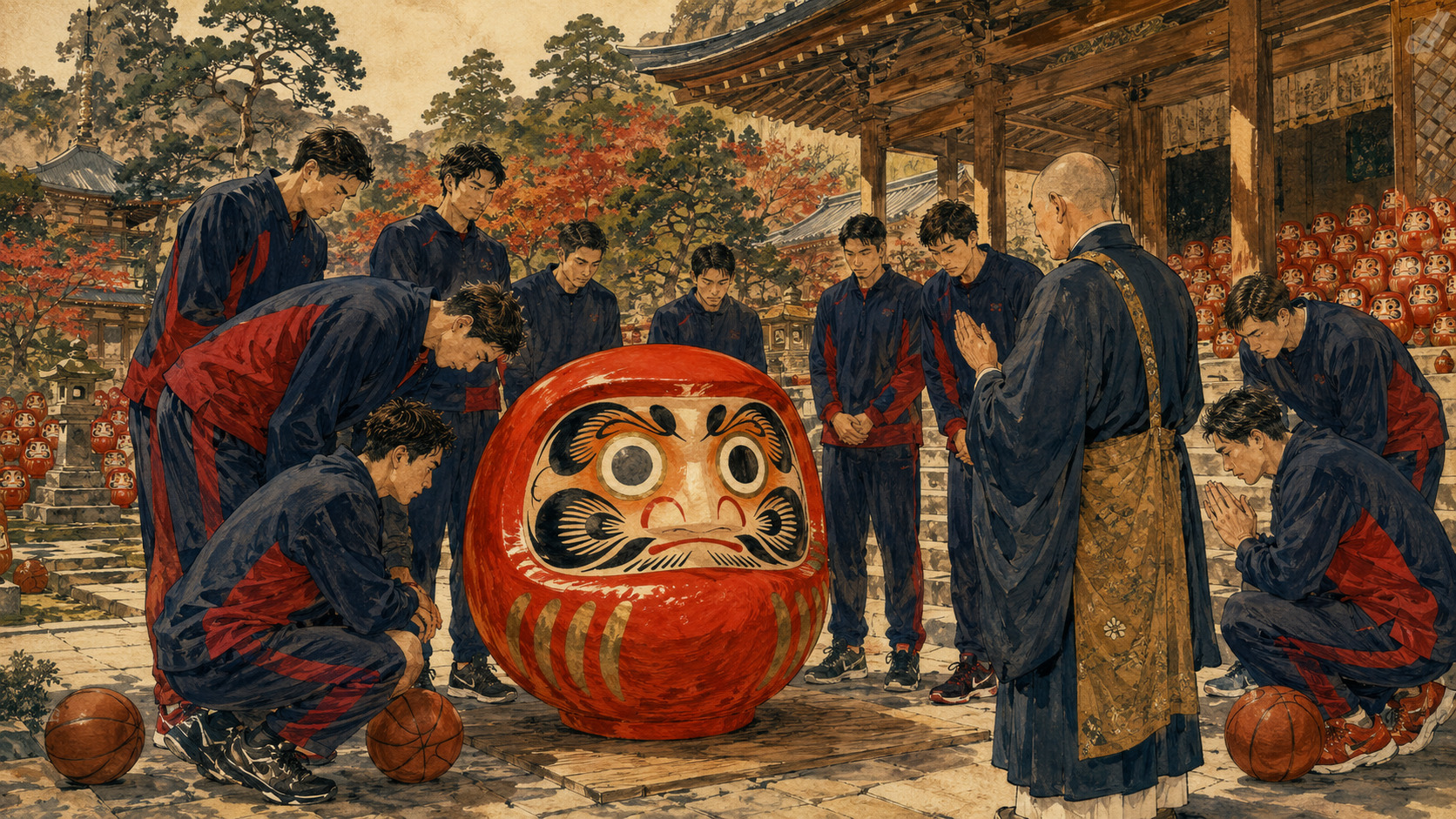
The black brush touched the white socket of a large red daruma. When Osaka Evessa general manager Shota Konno finished the circle, one eye was open. The other remained empty. It was not an eye that could see the future. It was the blank space of a season in which nothing had yet been proved.
On August 17, Konno went to Ōchōzan Katsuoji Temple in Minoh with Rei Goda, Takuya Hashimoto, James Palmer Jr. and Hayato Maki. Representing the team, they wrote the season’s goal on the daruma, received prayers in the main hall and performed the first eye-painting. Before the inaugural B.PREMIER season, which opens league-wide on September 22, Osaka chose to mark its new beginning inside a mountain temple with nearly 1,300 years of remembered history.
Who went, and what was actually done
The club’s announcement identifies the date, participants, place and actions. It does not publish the words written on the daruma. A Sports Nippon report says the group prayed to win B.PREMIER and complete the season safely, while Goda spoke of becoming a team able to contend for the title. Those reported aspirations should be distinguished from the club release’s more general phrase, “this season’s goal.”
| Question | Published information | Necessary qualification |
|---|---|---|
| When and where? | August 17 at Ōchōzan Katsuoji in Minoh, Osaka Prefecture | The club announced the visit on August 18 |
| Who attended? | GM Shota Konno; Rei Goda, Takuya Hashimoto, James Palmer Jr. and Hayato Maki | Five representatives, not the entire roster |
| What happened? | Writing the goal, a prayer ceremony and painting the first eye | Media reports say Konno filled the eye |
| What was the goal? | The club calls it the season goal | A separate report names a championship and safe completion; the full inscription is unpublished |
| What comes next? | The club hopes to return with good news after the season | No ritual can guarantee a competitive result |
At Katsuoji, victory is not defeating somebody else
Katsuoji’s own explanation places an unexpected limit on a sports team’s prayer for victory. To “win,” it says, is not primarily to beat another person. It is to face oneself and overcome a weak heart. The daruma does not grant the wish. Writing a purpose and a goal and filling one eye amounts to signing a promise to make the necessary effort.
Under that interpretation, a loss need not represent a failure of faith. The meaningful questions are controllable: Did a defender fail to get back? Was a box-out abandoned? Did the offense hurry a decision with a late lead? The strength of an opponent, an official’s judgment and chance cannot be erased. The next possession can still be chosen.
Konno’s post-ceremony statement closely echoes the temple. He said Osaka would look beyond the result and value each day and each step of the process. An enormous championship aspiration is broken down into practice, film, recovery and communication. A religious ritual was translated into the language of team operations.
From a mountain hut in 727 to the “temple that surpassed the king”
According to temple tradition and Minoh City’s account, Katsuoji began in 727, when the monks Zenchū and Zensan built a modest retreat in the mountains. Prince Kaijō, a son of Emperor Kōnin, later joined them and established Mirokuji. The copying of 600 volumes of the Great Perfection of Wisdom Sutra and construction of temple buildings made the site a center of mountain belief and Kannon pilgrimage. It is now the 23rd temple of the Saigoku Thirty-three Kannon circuit.
The character for “victory” was not part of the original name. In the Heian period, tradition says, the sixth abbot Gyōjun prayed for the recovery of the ill Emperor Seiwa. Impressed after recovering, the emperor offered the name Katsuoji written as “temple that defeated—or surpassed—the king.” The temple considered the wording too presumptuous and replaced the character for “king” with one meaning “tail,” retaining the pronunciation. This is a religious origin account, not a modern medical record. Its importance lies in how it shaped the temple’s identity over centuries.
727 — Zenchū and Zensan are said to establish a mountain retreat.
Late eighth century — Prince Kaijō founds Mirokuji and completes 600 sutra volumes, according to tradition.
Heian period — The story of Abbot Gyōjun, Emperor Seiwa and the name “Katsuoji” emerges.
Medieval to early modern eras — Kannon pilgrimage and belief in kachi-un, or victory fortune, spread.
Modern era — Visitors bring goals involving examinations, health, work and sport, with victory defined as overcoming weakness.
2026 — Osaka Evessa brings its first B.PREMIER season goal to the temple.
The victory daruma is also a system for managing a year
In a common Japanese daruma custom, one eye is painted when a goal is set and the other when it is fulfilled. The round papier-mâché figure represents Bodhidharma, the legendary founder of Zen; its ability to return upright after being knocked over made it a symbol of perseverance. But eye order and the method of returning or memorializing the doll vary by temple, region and maker. There is no universal rule that every daruma must begin on the same side.
Katsuoji publishes a particularly detailed sequence. The owner writes a life purpose on the base and a goal to reach 365 days later on the back. Gratitude toward every person and thing connected to that goal is placed into incense and its smoke is allowed to surround the daruma. The first mark is then put in the doll’s right eye—on the viewer’s left—as a signature pledging the effort. A companion “hourglass of life” calendar asks the owner to review each day and fill a circle only when able to say the day was fully lived.
| Katsuoji step | Religious action | Possible team translation |
|---|---|---|
| Purpose | Write the larger direction of one’s life on the base | Define why the club exists beyond one result |
| 365-day goal | Write a concrete destination on the back | Title contention, postseason qualification and a healthy completed season |
| Gratitude | Acknowledge everyone and everything supporting the goal | See players, staff, supporters, sponsors, government and families as part of the season |
| First eye | Sign the pledge to make the effort | State the goal publicly and accept accountability |
| Daily review | Assess how the day was used | Review training, film, physical load and decisions |
| Report and offering | Return with the outcome and gratitude | Explain what was done, whether the final target was reached or not |
The sequence connects a grand desire to daily behavior. The familiar sports phrase “trust the process” is turned into 365 circles. The unpainted eye does not merely wait for a final score; it asks for a record of the work.
The name Evessa was already a piece of Osaka belief
A temple visit is not spirituality pasted onto the club for a preseason photograph. Osaka Evessa’s name comes from Ebisu, one of the Seven Lucky Gods and the patron of commerce. In Osaka speech, Ebisu is affectionately called Ebessan. The club adapted that sound into “Evessa” in 2005, hoping to enliven a city associated with trade, humor and human warmth.
The club has conducted prayers at Imamiya Ebisu and Fuse Ebisu shrines and used the Tōka Ebisu festival as a uniform and arena motif. Its mascot, Maido-kun, dreams of becoming a basketball god while training in admiration of Ebessan. The club’s red, the merchant city’s lucky god and Katsuoji’s red daruma form an existing cultural line rather than a new promotional invention.
Katsuoji adds a second Osaka meaning. Ebisu represents prosperity; Katsuoji emphasizes the struggle with oneself. A professional club has to win games, but it is also a business that must sustain tickets, partners, an arena and community work. B.PREMIER deliberately links competitive strength and organizational strength. Two kinds of victory meet inside the same daruma.
A club assembled in months became a league’s first champion
Osaka Evessa did not emerge from years of orderly preparation. The invitation to create an Osaka team arrived around February 2005. The operators committed within roughly a month, announced the company and name in May, and assembled coaches and players from an empty starting point. On November 5, they played in the opening weekend of the new bj-league, Japan’s first men’s professional basketball league.
Osaka lost its first game to Oita 100–95, won the next day and later produced an 18-game winning streak. On April 30, 2006, Evessa defeated Niigata 74–64 to become the bj-league’s first champion. The club won again in 2006–07 and 2007–08, completing a three-peat. It also made the Osaka harisen—the folded paper fan associated with comedy—a basketball cheering device, joining sport, noise, humor and entertainment from the start.
But after the bj-league and NBL merged to form B.LEAGUE in 2016, Osaka has not won the league title. The memory of being the original champion is both pride and burden. To seek another first championship under a new system, the club must do more than reenact a twenty-year-old origin story. It has to rebuild championship standards for the present competition.
From 23–37 to title contention: the distance between wish and position
Osaka finished 23–37 in 2025–26, a .383 winning percentage and ninth place among 13 clubs in the B1 West. It scored 4,868 points and conceded 4,988, a differential of minus 120. The club did not reach the eight-team championship field. Talking about title contention at the temple is audacious when placed beside that immediate record.
The roster has changed. Korean international Song Kyo-chang, Spanish international Sebastian Saiz and European scorer James Palmer Jr. have joined. Hiroki Fujita returns for a third season as head coach, saying the “DOG FIGHT” culture built over two years must now become a result—first a championship berth, then a run beyond it.
| 2025–26 reality | 2026–27 change | What the open eye should measure |
|---|---|---|
| 23–37, ninth in the West | Entry into the 26-club B.PREMIER West | Late-game execution, defensive efficiency, turnovers and rebounding |
| Minus-120 point differential | Saiz, Palmer and Song added | Whether combinations and health matter more than names on paper |
| Outside the postseason | Third season under Fujita | Whether “DOG FIGHT” becomes repeatable habits and tactics |
| 81.1 points per game; 44.2% field goals | A league with foreign-player on-court freedom | Whether Osaka can handle larger and more varied opposing lineups |
The daruma cannot close this distance. Its useful function is to expose the distance and divide it into work. Wins are the final measure, but leading measures include the quality of shots created, adherence to defensive assignments, physical-load decisions and the development of younger players.
B.PREMIER is more than a renamed first division
B.PREMIER is not simply B1 under a new label. The league organizes its reform around competitive strength, management and social value, and it has abolished promotion and relegation based only on results. Admission is determined through attendance, revenue, arena planning and financial-health reviews. The inaugural field has 26 clubs, split evenly between East and West.
Player systems change too. B.PREMIER’s base salary cap runs from ¥500 million to ¥800 million. Foreign-player participation is “on-the-court free” within roster rules. Youth categories and a future draft are intended to reshape development. The Finals move from a short neutral-site conclusion to home-and-away competition requiring three wins, up to five games.
This widens the definition of winning. A poor record no longer causes automatic relegation, but a club must keep meeting standards involving the building, audience and business. Winning on court and creating a reason for a community to return to the arena are no longer separate assignments.
Osaka opened the door only in the fourth review
Osaka was not an early, automatic B.PREMIER qualifier. The initial thresholds included average attendance of 4,000, revenue of ¥1.2 billion and a qualifying arena plan. In 2023, the club said its previous average was 3,106—roughly 900 short per game—and that its present arena alone could not satisfy the future standard. The audience threshold was solved, but certainty around an arena plan remained, preventing approval in the first three review rounds.
On December 26, 2024, an extraordinary board meeting granted the license in the fourth review, making Osaka one of the final two clubs in the 26-team inaugural field. Its 2024–25 performance reached an average attendance of 4,561 and revenue of ¥1.82 billion. Those numbers were built not only by players but by repeat spectators, partners, public agencies and operating staff.
That makes the gratitude stage of Katsuoji’s ritual more than decoration. Osaka’s place in B.PREMIER was not awarded for its old three-peat or its latest win-loss record. It came through business and community thresholds. Admission, however, is not a championship. If basketball results disappoint, filling the arena year after year becomes harder.
What the five representatives carry
Konno is from Settsu in Osaka Prefecture and spent a combined 12 seasons playing for Evessa. He moved from the generation that remembers the club’s championship era into responsibility for constructing the roster. Goda, from Osaka City, has been with Evessa since 2016. Maki experienced a winning culture with Ryukyu; Palmer is the new scorer arriving from Europe. Local continuity and outside experience stood together in the temple.
Takuya Hashimoto may be the attendee whose life most closely resembles the daruma. The Osaka-born guard has ruptured his Achilles tendon three times. He spent last season entirely in treatment and rehabilitation and has been away from competition for about a year and a half. When renewing his contract, Konno explicitly said full integration at the September opening was not expected and that returning to the court could not yet be guaranteed. He nevertheless judged Hashimoto’s will to rise repeatedly as valuable to the team.
This should not be turned into a simple inspirational story. A return depends on medical judgment, progressive load, informed consent and management of reinjury risk. Mental strength does not heal a tendon by itself. Still, choosing another day of rehabilitation without a promised outcome embodies Katsuoji’s daruma in its hardest form: not a doll that grants the wish, but a record of continuing effort.
A ritual may not change a game, but it can change what preparation means
Pre-competition ritual need not be reduced to a contest between superstition and science. Laboratory studies have found that ordered ritualized action can reduce self-reported anxiety or blunt the neural response to performance failure. Repetition and shared participation may redirect attention from an uncontrollable future toward controllable behavior.
Those findings cannot simply be transferred to a professional team’s temple visit. No study shows that this prayer raises Evessa’s win percentage or prevents injury. Participants may not share identical beliefs. The practical value of a group ritual lies elsewhere: it makes a goal speakable, turns it into a promise before teammates and establishes a common starting point.
- Purpose: What should the club leave with Osaka spectators beyond the final score?
- Target: Which intermediate measures show genuine movement toward contention?
- Daily work: What can be completed in training, rest, film and conversation today?
- Responsibility: After injury or a losing streak, what can be corrected instead of blamed on luck?
- Report: What evidence will the club offer supporters when the season ends?
The real calendar between prayer and competition
| September 7 | Season launch at Osaka Geihinkan in the Nishinomaru Garden below Osaka Castle |
|---|---|
| September 12 | Preseason game against Shimane Susanoo Magic at Ookini Arena Maishima |
| September 22 | The inaugural B.PREMIER season opens league-wide; this is not Osaka’s first game |
| September 26–27 | Osaka’s regular-season opening games, away to Kobe Storks at GLION ARENA KOBE |
| October 3–4 | Osaka’s home opener against SeaHorses Mikawa at Ookini Arena Maishima |
| After the season | The club hopes to return to Katsuoji with good news; no return date or formal achievement test is published |
Roughly six weeks separate the first eye on August 17 from Osaka’s first official game. The intervening work is concrete: integrate new players, manage physical condition, defend opponents who can use larger foreign-player combinations, make late-game decisions and avoid rushing a rehabilitating athlete. None of it can be completed in one prayer.
Is the second eye reserved only for a championship?
The daruma story is not as simple as “paint the other eye if the team wins, leave it empty if the team loses.” Katsuoji defines victory less as beating somebody else than overcoming one’s own weakness. Final position and fidelity to the pledge overlap, but they are not identical. A champion could neglect its process; a non-champion could honor commitments to health, growth and community.
Yet a professional club cannot use process to escape results. Osaka was once the first champion of a new league. It won only 23 games last season and now speaks of contention. The blank eye should not make the target vague. It preserves a place to return and explain what happened.
When Konno’s brush filled the first eye, the daruma did not become half able to see. The team became visible. Supporters can watch each defensive possession, each athlete’s recovery, the empty seats in the arena and the club’s work in the city. Whatever Osaka carries back to Katsuoji in 2027, the ink for the second eye will be made from the days between now and then.
- Osaka Evessa, Katsuoji victory-prayer report, August 18, 2026
- Sports Nippon, Osaka Evessa’s Katsuoji visit, August 17, 2026
- Katsuoji, victory daruma meaning and eye-painting procedure
- Katsuoji, history and modern temple-origin account
- Minoh City, Katsuoji historical introduction
- Osaka Evessa, the club’s 2005–06 founding and first title
- Osaka Evessa spectator guide, origin of the club name
- B.LEAGUE, final 2025–26 B1 standings
- B.LEAGUE, B.Innovation and the 2026 league structure
- B.LEAGUE, confirmed B.PREMIER clubs
- Osaka Evessa, B.PREMIER license approval
- Osaka Evessa, continuing B.PREMIER qualification
- Osaka Evessa, Takuya Hashimoto contract, August 5, 2026
- Hobson et al., “Rituals decrease the neural response to performance failure,” 2017
- Lang et al., “The role of ritual behaviour in anxiety reduction,” 2020
Editor’s note: This article is based on information published through August 19, 2026. The club did not publish the complete wording written on the daruma; references to a championship and safe season completion are attributed to media reporting. The founding, naming and imperial-recovery episodes are elements of Katsuoji’s temple tradition, not modern medical verification. Ritual-psychology research describes general experimental findings and did not test Osaka Evessa’s win rate, injury outcomes or cohesion. B.PREMIER rules, schedules and rosters may change. The 2025–26 record belongs to the former B1 structure and does not predict future results. The exchange-rate display is supplied by the editorial desk.