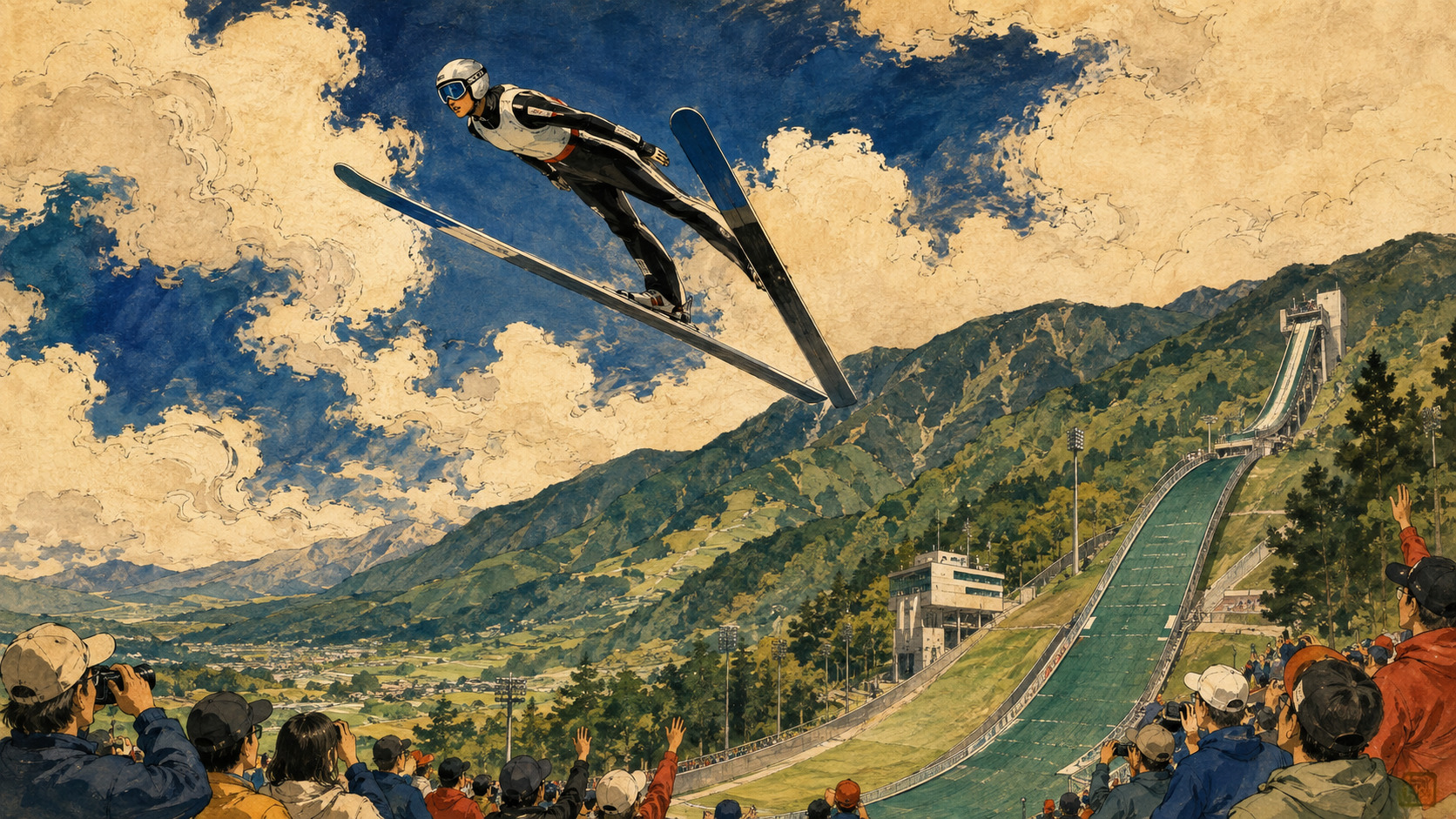
Taku Takeuchi was ten years old when he watched people fly. In February 1998, at the Nagano Winter Olympics, Masahiko Harada, Takanobu Okabe, Hiroya Saito and Kazuyoshi Funaki won men’s team ski-jumping gold for Japan at Hakuba. The venue was not Iiyama. But to a boy growing up in the same snowy prefecture, the world’s highest stage suddenly seemed connected to home.
Sixteen years later, Takeuchi stood on an Olympic podium himself. He, Noriaki Kasai, Daiki Ito and Reruhi Shimizu won team bronze at Sochi 2014, making Takeuchi the first athlete from Iiyama to earn an Olympic medal. In 2026 he occupies the other side of the sightline. His teamtakuCUP TAKE AIR festival is designed so children can encounter elite jumpers not as small figures on a screen but through the hiss of skis in the inrun, the violent precision of takeoff and the hush before a landing.
What is actually confirmed for October 12
The organizer’s August 18 announcement sets the festival at Iiyama Schanze, 8892 Iiyama, in Nagano Prefecture. Seven jumping divisions are planned from elementary-school to general competitors, alongside athlete talks, music and participatory activities. Advance admission is ¥1,500 for the general public and ¥1,000 for Iiyama residents. Children of junior-high-school age and younger enter free. Take Sun and a local revitalization team are organizing the event with Iiyama City as co-host.
| Item | Published detail | Unresolved as of August 19 |
|---|---|---|
| Date and place | October 12, 8:00 AM–7:00 PM, Iiyama Schanze | Weather and schedule-change procedures await later notices |
| Competition | Seven divisions, elementary school through general | Eligibility, application procedure and entry fees are not in the announcement |
| Admission | ¥1,500 general; ¥1,000 Iiyama residents; junior high and younger free | The free offer is spectator admission, not a confirmed waiver of competition fees |
| Planned guests | Taku Takeuchi, Noriaki Kasai, Sara Takanashi, Nozomi Maruyama, Ren Nikaido, Tsugiharu Ogiwara and others | Appearances can change with competition and health schedules |
| Prize | A winner is to be invited to watch a World Cup event in Slovenia | Division, venue, date, covered costs and minor-accompaniment rules are unpublished |
How skiing reached Iiyama in 1912
Iiyama’s flying story began with learning how to move across snow. In January 1912, Tatsujō Ichikawa—a Buddhist priest and teacher at Iiyama Middle School—went to Takada, in present-day Joetsu, and learned the single-pole skiing method taught by Austro-Hungarian officer Theodor von Lerch. Ichikawa brought it home. That episode is why Nagano Prefecture describes Iiyama as the birthplace of skiing in the prefecture, not the birthplace of Japanese skiing as a whole.
A local branch of the Japan Ski Club formed in 1913 and became the ancestor of today’s Iiyama Ski Club. Skiing entered school education, organized competition and eventually the regional visitor economy. Snow was no longer only a condition to endure. It became a medium for skill, identity and commerce.
1912 — Ichikawa brings von Lerch’s single-pole skiing method from Takada to Iiyama.
1913 — A Japan Ski Club branch forms in Iiyama, the root of local organized skiing.
1925 — Iiyama’s municipal ski jump opens.
1998 — Japan’s Nagano Olympic team gold inspires ten-year-old Takeuchi.
2014 — Takeuchi wins Sochi team bronze, Iiyama’s first Olympic medal.
2020 — The first teamtakuCUP connects competition with a community festival.
2025 — The jump marks 100 years as Iiyama considers renovation for the 2028 National Sports Festival.
2026 — TAKE AIR enters its seventh year with paid adult and free child admission.
A century-old jump is a working tool, not a monument
Schanze, the word commonly used in Japan for a ski jump, comes from German. Iiyama’s complex includes an established K60 medium hill and K30 small hill. Olympians Taku Takeuchi and Daiki Yamada developed there. Summer competitions keep athletes flying outside the snow season.
One hundred years, however, is both an achievement and a maintenance warning. Iiyama’s planning for the 2028 Shinshu Yamanami National Sports Festival identifies aging equipment, less reliable snow under a warming climate, winter sun on the east-facing slope and labor-intensive course preparation. Renovation is intended not only for the national event but for local athletes, Iiyama High School, training camps, regular competitions and tourism.
TAKE AIR matters because it turns a specialized structure into a civic stage. Charging adults a modest price while removing the admission barrier for children appears to balance access with continuity. But that is an interpretation, not a financial finding: organizers have not published a budget, attendance target or revenue model. A colorful festival cannot by itself prove that an expensive municipal facility is sustainable.
Seven years of turning a meet into a festival
The first teamtakuCUP was held in 2020. The fourth edition followed in 2023; a 2024 event invited medium-hill winners to Slovenia; and the 2025 program paired a music festival on one day with jumping on the next. In 2026, the seventh year, music, athlete conversation and competition are compressed into one long holiday.
A conventional local meet can remain largely inside a circle of athletes, relatives and officials. Takeuchi’s format gives a resident who knows nothing about scoring another reason to enter the grounds. Food, music and an athlete talk are not distractions when they make the first visit possible. Yet spectatorship and participation are different outcomes. The important question begins after the applause: did a child watch practice, contact a club, return next year and keep jumping?
Takeuchi himself embodies the proposed chain. He saw the Nagano Games, found an entry point, moved alone to Finland at 15 to study and train, and eventually returned with world and Olympic medals. Inspiration was the spark. Coaching, facilities, money, family decisions and years of repetition were the fuel.
Ski jumping is not simply “the farthest flight wins”
A jumper builds speed down the inrun. At takeoff, the athlete must move forward into flight in a tiny interval, open the skis into a V and use airflow for lift. The landing is not an afterthought: judges look for control and the characteristic telemark position, with one foot ahead of the other. The sport does not abolish fear. It asks athletes to preserve a rehearsed sequence while fully exposed to speed, height and changing air.
| Score element | What it measures | What a spectator can watch |
|---|---|---|
| Distance | Points are added or removed relative to a hill’s K-point | The length and efficiency of the flight path, not merely its height |
| Style | Five judges score flight, stability and landing; high and low scores are dropped | Symmetry in the air and a controlled telemark landing |
| Wind and gate | Compensation accounts for wind and different inrun gates | Why identical distances can produce different totals |
| Safety | Progressive training, equipment, coaching and managed facilities | A public festival does not mean untrained visitors can simply try the hill |
Television reduces much of this to a distance graphic. At the hill, the sport becomes audible: the inrun falls quiet, skis accelerate through the tracks, a body changes shape at the table, and a crowd waits for the landing. Watching elite athletes and elementary competitors on the same day reveals that mastery did not arrive whole. It is an accumulation of smaller flights.
Takeuchi, Kasai and Takanashi: generations in one sky
The announced guest list cuts across Takeuchi’s own career. He won mixed-team gold at the 2013 World Championships alongside Sara Takanashi and others. In Sochi a year later he shared men’s team bronze with Kasai. Nozomi Maruyama and Ren Nikaido represent the present: both won individual normal-hill bronze medals at Milano Cortina 2026.
| Planned guest | Place in the sport | The timescale children can see |
|---|---|---|
| Taku Takeuchi | Sochi 2014 team bronze; 2013 world mixed-team gold; Iiyama’s first Olympic medalist | A Nagano-inspired child returns home to build an entry point |
| Noriaki Kasai | Eight Winter Olympics; Lillehammer team silver; Sochi individual silver and team bronze | The extraordinary length of an elite career |
| Sara Takanashi | Women’s record 63 individual World Cup wins; PyeongChang 2018 bronze | The expansion of women’s jumping after Olympic inclusion |
| Nozomi Maruyama and Ren Nikaido | Milano Cortina 2026 individual normal-hill bronze medalists | The speed and technique of today’s medal-winning generation |
| Tsugiharu Ogiwara | Nordic combined Olympian and veteran communicator | A bridge between disciplines, athletes and a general audience |
Kasai was still pursuing international competition in his fifties in 2026. Takanashi owns the women’s World Cup victory record. Maruyama and Nikaido returned from the February Games with individual medals. This is not a nostalgia show built only around past champions, nor a publicity appearance limited to the latest winners. It places the beginning, peak and unusual longevity of a sporting life within one field of view.
The long wait for women to enter the Olympic sky
Men’s ski jumping appeared at the first Winter Olympics in 1924. Women did not receive an Olympic individual normal-hill event until Sochi in 2014. Takanashi finished fourth in that inaugural contest and earned bronze at PyeongChang four years later. The mixed team entered the Games only at Beijing 2022.
That history gives girls’ divisions and visible women champions particular force. A role model does more than prove that participation is permitted. Children can see how an elite woman prepares equipment, discusses an error, waits for wind and returns after disappointment. The ordinary labor surrounding a flight makes excellence imaginable.
One appearance cannot erase practical barriers. Equipment, travel, parental time, changing facilities, women coaches and age-appropriate safety all affect whether a girl stays in the sport. Organizers should publish participation and retention by gender over time. Inclusion becomes infrastructure when the child who enters this autumn can still find a place to train next year.
Why Slovenia is more than a prize destination
The 2026 announcement promises a winner a trip to watch a World Cup event in Slovenia. It does not name the venue. Slovenia has major competitions at Ljubno, associated with the women’s tour, and at Planica, the Alpine valley synonymous with ski flying. It would therefore be premature to describe the prize as a Planica trip.
The country nevertheless carries exceptional meaning. Planica produced a world-record 92-meter jump in 1934, the first recognized flight beyond 100 meters in 1936, and the breaking of the 200-meter barrier in 1994. In 2026 it hosted the first women’s World Cup ski-flying competition. There, jumping is both elite sport and enormous public gathering.
Iiyama has a precedent. In 2024, the male and female medium-hill winners of teamtakuCUP were invited to Planica. Seeing the world circuit from the stands can recalibrate ambition: the winner observes athlete preparation, coaching, spectators and a town organized around a hill. But a viewing trip is not a development system. The value returns to Iiyama only if the traveler comes home to train, report, mentor and share what the world stage looked like.
Ninety-two athletes—and seven local schoolchildren
Iiyama’s 34th Summer Jump competition in June 2026 drew 92 athletes from inside and outside Nagano Prefecture. The city reported that four elementary pupils and three junior-high students were from Iiyama. A single event cannot establish a trend or identify causes. It does, however, provide a sharp snapshot: in a city famous for producing Olympians, the local school-age pipeline is small.
The explanation cannot be reduced to children losing courage. Iiyama’s population was an estimated 17,187 on July 1, so the pool of children itself is limited. Jumping requires a dedicated hill, qualified coaching, equipment, transport, insurance and gradual safety instruction. Even in snow country, its first step is harder to arrange than kicking a football in a park. Climate uncertainty and an aging facility add pressure for operators.
Attendance is therefore an incomplete measure of success. Better indicators include first-time and female competitors, the retention of local children, conversions from practice visits into club participation, safe jumping hours, volunteer workload and what a Slovenia invitee does after returning. The test is whether celebrity light can be converted into an ordinary weekly structure.
Why a small city keeps a specialized sports facility
Iiyama has roughly 140 lodging businesses and a long history of receiving ski classes and training camps. Skiing is both a visitor product and part of how the snow country understands itself. Yet winter dependence brings seasonal and climate risk. An autumn festival combining sport, music and food opens the hill to green-season exchange and spending.
The public case for maintenance also changes. “This hill once produced Olympians” is not enough on its own. Local school training, regional competitions, camps, children’s education, spectator events and the 2028 National Sports Festival together form a broader public use. Conversely, a festive crowd should not be allowed to obscure hard questions about safe renovation and annual operating costs.
Nor should the hill’s value be reduced to how many Olympians it creates. A young jumper acknowledges fear, follows a sequence, waits when the wind is wrong and climbs back up after failure. Those habits remain even without a medal. The facility matters through both its narrow road to the world and its wider road back into ordinary civic life.
A practical guide for spectators and families
| Event | teamtakuCUP TAKE AIR 2026 |
|---|---|
| Date | Monday, October 12, 2026, a national holiday; gates 8:00 AM, scheduled close 7:00 PM |
| Venue | Iiyama Schanze, 8892 Iiyama, Iiyama City, Nagano Prefecture |
| Advance admission | ¥1,500 general; ¥1,000 Iiyama residents; free for junior-high-age children and younger. Check official terms and same-day ticket information |
| Program | Seven jumping divisions, athlete talks, music and activities. Detailed timetable is to follow |
| Planned guests | Taku Takeuchi, Noriaki Kasai, Sara Takanashi, Nozomi Maruyama, Ren Nikaido, Tsugiharu Ogiwara and others; subject to change |
| Child competitors | Separate from free admission. Confirm eligibility, application, fees, equipment and safety rules in the formal competition notice |
| Slovenia invitation | Announced for a winner to watch a World Cup event. The division, venue, dates, expenses and minor-accompaniment terms are not yet public |
The next person may already be in the crowd
In 1998 Takeuchi did not know he would win an Olympic medal. He did not know he would move to Finland, fight through illness to stand on the Sochi podium, or build an event at home. He saw people fly and wanted to fly too. An athletic life began not with a result but with a line of sight.
Not every child at Iiyama in October needs to become a jumper. One will cheer. Another may arrive for music and look up at the structure for the first time. One may enter a supervised practice; another may eventually prepare equipment, coach or organize a competition. A sporting culture is larger than the athletes it sends to the Games.
TAKE AIR’s deepest promise is not an airline ticket to Slovenia. It is the proof that a runway toward the world can begin on a hundred-year-old hill in a city of fewer than 20,000 people. Whether that promise lasts will be decided less by the festival day than by the adults waiting at a safe small hill the morning after.
- teamtakuCUP TAKE AIR 2026 event announcement, August 18, 2026
- Iiyama City news archive, teamtakuCUP reports for 2024 and 2025
- Pen & Sports, “teamtaku CUP,” 2023
- Nagano Prefecture, Iiyama’s 1912 skiing history
- Iiyama Ski Club history
- Iiyama City, municipal ski-jump renovation
- Iiyama City, 34th Iiyama Summer Jump results, 2026
- Iiyama City monthly population statistics
- Japanese Olympic Committee, Taku Takeuchi profile
- Olympics.com, how Nagano 1998 inspired a generation of Japanese jumpers
- Olympics.com, Noriaki Kasai athlete profile
- International Ski and Snowboard Federation, women’s World Cup career-win record
- International Ski and Snowboard Federation, Milano Cortina 2026 medal account
- Olympics.com, how ski jumping is scored
- Slovenian Tourist Board, Planica’s 100- and 200-meter milestones
Editor’s note: This article uses information published through August 19, 2026. Because the event is still forthcoming, guests, times and competition or admission conditions may change. “Free for junior high and younger” refers to spectator admission, not a confirmed competition-fee waiver. The announcement did not yet identify the Slovenia prize division, venue, date, covered expenses or guardian terms. The 2024 Planica trip is precedent, not proof of the 2026 destination. The 92 total athletes and seven local school-age competitors come from a separate June 2026 event and do not establish a long-term trend or cause. The exchange-rate display is supplied by the editorial desk.