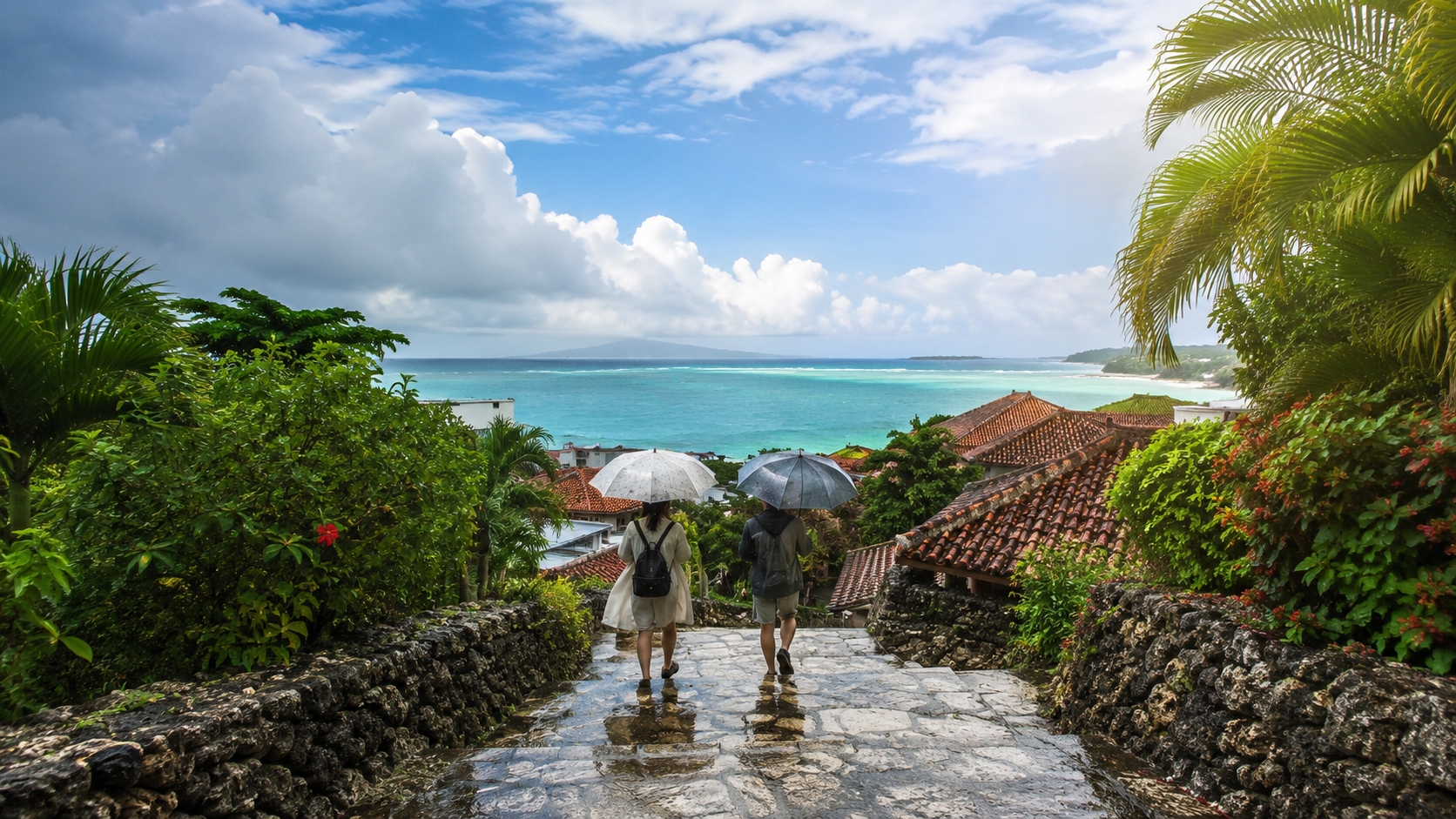
Okinawa remembers summer first
In late June, Japan becomes one country with several skies. In Okinawa, rain clouds begin to pull back and the sea starts showing off again. Stone lanes may still be wet, umbrellas may still be open, and laundry may still be negotiating with humidity, but the light has changed. Farther north, Tokyo, Osaka, Kyoto and Fukuoka are still living inside the damp committee meeting known as tsuyu.
June 21 is the summer solstice. It is also, in an average year, roughly when Okinawa’s rainy season reaches its end. The Japan Meteorological Agency’s climatological dates put Okinawa’s rainy-season onset around May 10 and withdrawal around June 21. Amami follows around June 29. Southern Kyushu usually waits until around July 15. Kanto-Koshin, Kinki, Tokai, Chugoku and northern Kyushu often wait until around July 19. The rainy season begins in the south, ends in the south, and then slowly releases the rest of the country.
That makes Okinawa Japan’s first carriage into summer. The doors are not fully closed behind the rain, but they are sliding. Beach businesses watch the sky. Travelers check forecasts and ferry notices. Residents debate whether laundry can finally go outside. The rainy-season declaration itself can be revised later by the weather agency, so this is not a magic switch. It is a seasonal turn: the moment when Okinawa starts moving from wet early summer toward high summer.
What tsuyu really is: not just rain, but a front
Calling tsuyu “the rainy season” is accurate but incomplete. The main actor is the Baiu front, a boundary between warm, humid air to the south and cooler air to the north. When that front stalls, clouds and rain gather along it. When it shifts, the wet zone moves. This is why one region may be soaked while another is merely cloudy, and why the season creeps north rather than arriving everywhere at once.
Okinawa sits far to the southwest, closer to Taiwan than to Tokyo, between the East China Sea and the Pacific. Its rainy season arrives earlier and ends earlier than the mainland’s. May in Okinawa is not only postcard blue. It can be humid, unsettled and full of sudden showers. But it rarely behaves like a single gray curtain all day, every day. The sky changes quickly: shower, sun, cloud, sun again. It is less a weather pattern than a playlist with no shuffle warning.
On the mainland, tsuyu normally stretches through June into July. In Tokyo and Osaka, it appears as umbrellas in railway stations, convenience-store plastic raincoats, wet escalator floors, hair that has surrendered to humidity, and commuters who have become experts at holding a bag, a phone and an umbrella while looking only mildly betrayed by the universe.
Why is it called “plum rain”?
The word tsuyu is written with the characters for plum and rain. The season coincides with the ripening of plums, and the older Sino-Japanese reading baiu remains the term often used in meteorology. It is a graceful name for a season that also produces mold, damp shoes and laundry that refuses to become dry. Japanese seasonal vocabulary has a talent for dressing inconvenience in poetry.
But the poetry is not fake. Early-summer rain has shaped rice agriculture, reservoirs, forests, rivers and the look of the countryside. For a rice-growing society, rain was not merely a nuisance; it was part of the agricultural clock. Today, heavy rain can bring dangerous downpours and flooding, and the tone of the season has become more serious. Still, without the rain, Japan’s summer green would not be so deep.
For Okinawa, the end of rain is also the start of typhoon watchfulness
When Okinawa nears the end of tsuyu, travelers understandably think of the sea: snorkeling, ferries, island beaches, sunset drinks, white sand and the electric blue that makes cameras feel underqualified. But Okinawa’s summer has a second chapter: typhoons. Official Okinawa tourism guidance notes that typhoons mainly affect the islands from June to September and advises travelers to monitor weather before and during trips.
This is the basic rule of Okinawa travel: the prettier the sea, the more seriously you must respect the weather. Check ferry operations before going to outer islands. Check waves and wind before entering the water. Check road conditions in heavy rain. Check hotel and flight policies before assuming the sky will obey your itinerary. A tropical schedule can collapse into “laundry and convenience-store dinner” faster than anyone wishes to admit.
Even so, late June can be a glorious time in Okinawa. It is before the deepest crush of peak summer, the vegetation is rich from weeks of rain, the light grows sharper, and the sea begins to look less like scenery and more like an invitation. Okinawan summer does not simply begin. The rain curtain rises, and the stage lights turn blue.


Mainland Japan is still waiting
While Okinawa starts looking toward beach season, much of mainland Japan remains inside tsuyu. According to JMA normals, Kinki, Tokai, Kanto-Koshin, Chugoku and northern Kyushu typically do not see rainy-season withdrawal until around July 19. Southern Kyushu is around July 15, Shikoku around July 17, and Hokuriku and Tohoku even later. Okinawa may be thinking about the sea; Tokyo may be thinking about dehumidifier maintenance.
But mainland tsuyu is not only misery. It gives Japan some of its most atmospheric scenes: hydrangeas in Kamakura, wet temple stones in Kyoto, moss gardens darkened by rain, hot ramen on a damp night, ryokan windows blurred by water, and the soft click of umbrellas entering a train station. A clear-sky itinerary is not the only kind of good travel.
The practical issue is footwear. Not umbrellas—footwear. Wet shoes can ruin a sightseeing day with bureaucratic efficiency. A light rain jacket, spare socks, waterproof pouch, foldable umbrella and one fewer activity on the schedule can transform tsuyu from disaster into mood. The secret of rainy-season travel is not defeating rain. It is giving the rain fewer opportunities to defeat you.
The new problem: rain plus heat
Modern early summer in Japan is no longer only about rain. It is about rain and heat together. Humidity lingers, temperatures rise between showers, and once tsuyu withdraws the heatstroke risk can climb quickly. For residents, that matters at home, at school, on construction sites, in elder care, in agriculture and across cities built largely of concrete and asphalt.
This is why tsuyu has become more than a seasonal inconvenience. It sits at the junction of heavy rain preparedness, heatstroke prevention and typhoon readiness. Check official weather alerts. Do not move through dangerous rain simply because a hotel booking says you should. Do not pack every daylight hour with outdoor sightseeing when the heat index is high. Japan’s early summer is beautiful, but it has a habit of becoming very serious without asking permission.
Late-June travel memo
| Region | Seasonal read | What to carry / watch |
|---|---|---|
| Okinawa | Near the average end of tsuyu. More sun, stronger beach mood, still unsettled at times. | Sunscreen, hat, sunglasses, marine shoes. Check typhoons, waves and ferry status. |
| Amami | Usually a little behind Okinawa; average withdrawal around June 29. | Prepare for both sudden rain and strong sun. |
| Kyushu, Shikoku, Kinki, Kanto | Still in the heart of rainy season, often until mid- or late July. | Water-resistant shoes, spare socks, compact umbrella. Do not overpack the schedule. |
| Hokuriku and Tohoku | Later onset and later withdrawal than much of southern mainland Japan. | Watch long rain spells and road conditions in mountainous areas. |
| Hokkaido | Less affected by tsuyu. | A strong escape option for people fleeing mainland humidity, though local weather still matters. |
Do not only hate the rain
Tsuyu rarely gets the glamour of cherry blossoms, autumn leaves or snow. Rain clouds are poor publicists. But the rainy season deepens Japan’s scenery. Trees grow darker. Moss wakes up. Hydrangeas become the main characters. Umbrellas add color to stations. Streets shine at night. A wet Japan is sometimes quieter, sometimes inconvenient, and often more real.
On June 21, Okinawa is close to leaving tsuyu while the mainland waits. That waiting is also part of the national calendar. When the rain finally lifts, full summer arrives—hot, humid, bright, occasionally brutal, and sometimes so beautiful that people forgive the wet socks.
- 梅雨 / tsuyu: Japan’s early-summer rainy season.
- 梅雨 / baiu: The meteorological reading of the same characters.
- 梅雨入り / tsuyu-iri: The apparent start of the rainy season.
- 梅雨明け / tsuyu-ake: The apparent end or withdrawal of the rainy season; declarations may be revised later.
- 梅雨前線 / baiu zensen: The stationary rainy-season front.
- 蒸し暑い / mushi-atsui: Hot and humid, the air-conditioner’s favorite business model.
- にわか雨 / niwaka-ame: A sudden shower.
- 台風 / taifū: Typhoon; especially important for Okinawa from summer into autumn.