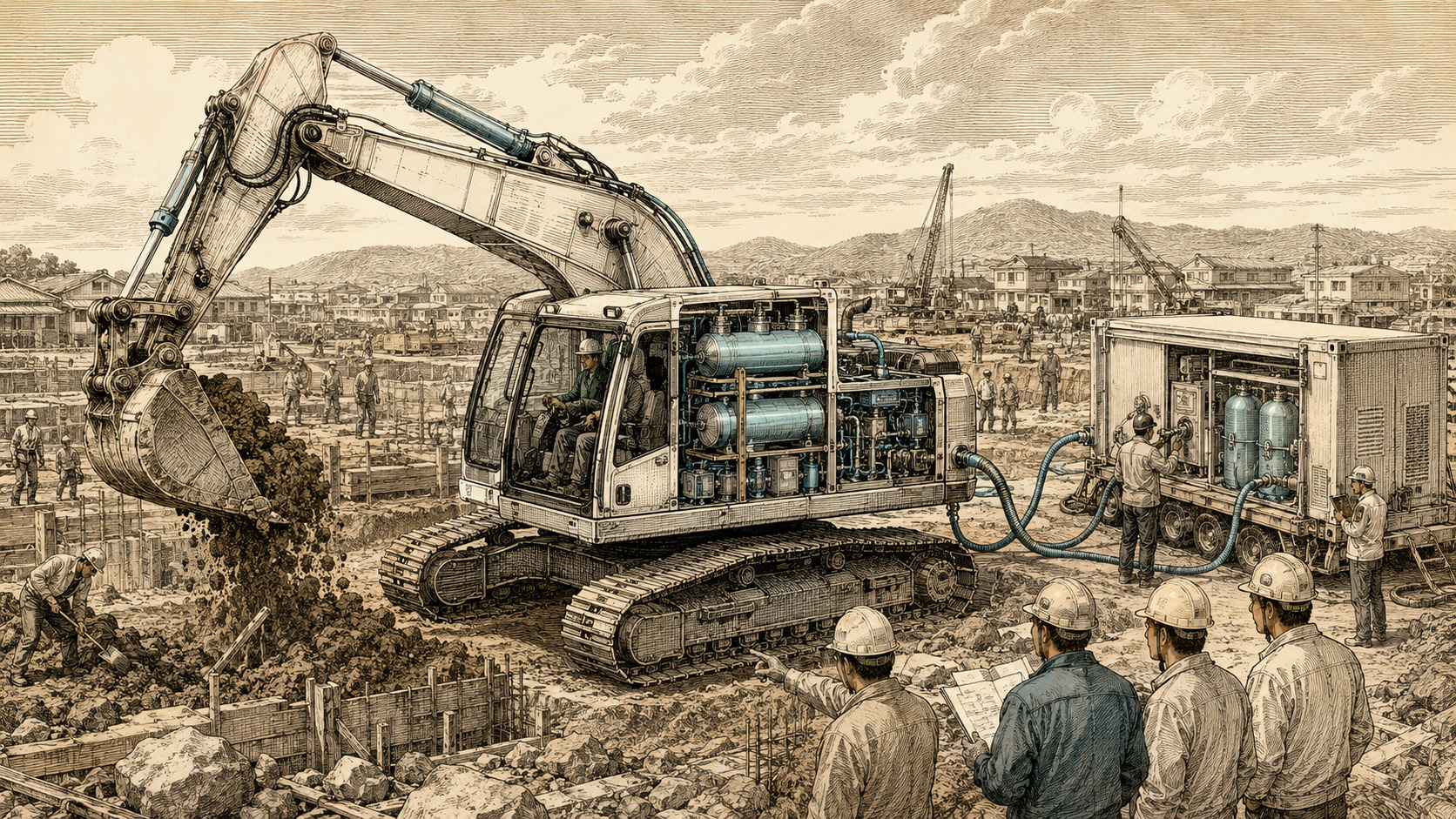
The excavator was not given a theatrical assignment. It did not cut a ceremonial first scoop beneath exhibition lights. It moved surplus excavated soil inside a temporary storage yard at the Kitanomaki rockfall-countermeasure project in Annaka, Gunma Prefecture. When it needed fuel, it received hydrogen at the site. That ordinary work is precisely what makes the trial interesting. A new powertrain enters the construction industry not when it dazzles a trade show, but when it becomes a line in somebody else's schedule.
Obayashi, Komatsu and Iwatani reported that the machine delivered work performance equivalent to a conventional diesel excavator in the test. They said the absence of engine-induced vibration eased operator fatigue, while lower noise improved awareness of nearby activity and reduced the site's environmental disturbance. Those are the three companies' findings from a limited proof-of-concept, not yet proof of multiyear durability, fleet economics, uptime across every climate, or performance in every soil condition.
That distinction matters because a construction machine is not commercial merely because it moves. It must wake up at the start of a shift, endure dust and rain, repeat thousands of dig-and-swing cycles, avoid delaying other crews and keep finding fuel even as haul roads and material yards migrate around it. The Gunma test moved the question away from fuel-cell chemistry and toward something more difficult: whether an entire working system can be made dependable.
The most important word is “site”
The machine did not operate on a manufacturer's level proving ground. The host was the E18 Joshin-Etsu Expressway Kitanomaki No. 2 rockfall-countermeasure project, commissioned by NEXCO East's Kanto Regional Head Office. The site lies between the Matsuida-Myogi and Usui-Karuizawa interchanges, above the 190-meter Kitanomaki Tunnel in Annaka's Matsuida district.
NEXCO East says the project must remove roughly 95,000 cubic meters of rock from a formation around 70 meters high with an average slope of about 70 degrees—all while keeping the expressway in service. The solution is a small theater of engineering in its own right: a protective deck over the highway, temporary bridges, rock bolts and an incline system capable of carrying two dump trucks at once. Work began in 2017, full excavation started in May 2023, and completion is planned for 2029.
The hydrogen machine did not perform every task on that vast project. Its assignment was controlled: relocating soil in the temporary storage area. But limited does not mean trivial. The trial tested whether high-pressure refueling, safety zones and unfamiliar equipment could fit the existing choreography of truck movements, stockpiles, personnel routes and changing ground conditions. It was a cautious first step grounded in operational reality.
Remove the engine; preserve the excavator
Komatsu first announced proof-of-concept work on the medium-size machine in May 2023. The concept combines Toyota's fuel-cell system and hydrogen tanks with Komatsu-developed components, hydraulic-excavator know-how and overall vehicle control. In the fuel cell, hydrogen reacts electrochemically with oxygen from the air to produce electricity and water. An electric motor uses that power to turn hydraulic pumps. Those pumps still operate the boom, arm, bucket, tracks and upper-structure swing through the familiar language of hydraulic pressure.
The machine therefore does not move its arm “with hydrogen” directly. It carries a compact power plant that supplies electricity in place of a diesel engine. It emits no carbon dioxide from a tailpipe at the point of use and removes combustion pulses that generate much of an engine machine's vibration and noise. It is not silent: pumps, cooling fans, tracks, hydraulic flow, alarms and the work tool itself still make sound.
Komatsu sees hydrogen's high energy per unit of fuel mass and short refueling time as potentially valuable for medium and large equipment, where battery mass and charging downtime become more difficult. Yet the public test reports do not disclose fuel-cell output, tank capacity, hydrogen consumption, time between fills or actual refueling duration. “Equivalent” referred to work performance in the trial; it did not mean equal purchase price, fuel cost or hours between refueling.
| Power route | Where it may fit best | Main commercialization barrier |
|---|---|---|
| Battery electric | Compact machines, indoor and urban work, short shifts near charging | Charging time, battery mass, sustained high-load duty |
| Hydrogen fuel cell | Medium and large machines where longer duty and fast refueling matter | Tank capacity, fuel supply, hydrogen cost and regulation |
| Hydrogen combustion | Applications that can reuse engine manufacturing and service knowledge | NOx control, efficiency, fuel logistics and lifecycle emissions |
| Cable electric | Long operation inside a fixed work envelope with reliable grid access | Cable handling, mobility limits and safe power planning |
A three-company relay
The division of labor shows why a hydrogen excavator cannot become a commercial system through one manufacturer alone. Obayashi selected the site, planned the trial and supervised its execution within the construction operation. Komatsu provided the concept excavator, helped design the test and supplied technical support. Iwatani delivered hydrogen and supported onsite refueling by differential pressure.
Differential-pressure filling uses a pressure difference to move hydrogen from higher-pressure storage into the lower-pressure tank on the machine. The phrase sounds simple. The practice is not. Temperature, flow, connectors, leak detection, shutoff logic, grounding and equipment placement all have to be managed around a gas stored under high pressure. Unlike a fixed factory, a construction site changes shape: excavation advances, roads move, stockpiles grow and tomorrow's safe zone may not be available next month.
Iwatani brings an unusually long fuel-side history. Founded in 1930, it began selling hydrogen in 1941 after recognizing value in by-product gas that was often discarded. Its Advanced Hydrogen Technology Center handles liquid hydrogen at minus 253 degrees Celsius and ultra-high-pressure hydrogen up to 135 MPa. The company describes itself as Japan's only supplier of liquid hydrogen. Experience from industrial supply and vehicle stations is relevant, but serving a moving construction site presents a different geometric and logistical problem.
- Obayashi: site selection, test design, execution and supervision. It plans to define which sites can safely accommodate refueling and what hydrogen competencies workers and partners need.
- Komatsu: concept machine, test planning and technical support. It aims to bring medium and large fuel-cell construction equipment into commercial production.
- Iwatani: hydrogen supply and differential-pressure refueling support. It is exploring a high-capacity, fast mobile station that would carry liquid hydrogen.
The real prototype may be the fuel station
Diesel's advantage is bigger than its engine. Fuel is widely available, trucks and portable equipment can deliver it to remote sites, and contractors know how long replenishment takes. For hydrogen to displace diesel, it must acquire an equally boring and reliable logistics system.
The three companies identified four connected challenges: increasing hydrogen carried onboard, speeding up fuel delivery, complying with regulation, and defining safe, efficient site-selection criteria as field conditions evolve. The production, storage, transport and use of high-pressure hydrogen fall within Japan's High Pressure Gas Safety Act framework. Mobile hydrogen stations are governed under the General High Pressure Gas Safety Regulations. Separation distances, protected-property clearances, inspections and work procedures turn refueling into a spatial-design problem on a crowded site.
The rules are evolving rather than frozen. In April 2025, Japan's Ministry of Economy, Trade and Industry revised provisions affecting pressure limits and separation distances at compressed-hydrogen stations. The policy task is to remove unnecessary obstacles without relaxing physical safety. Obayashi's plan to establish site and personnel criteria, and Iwatani's Tokyo-supported work on a mobile station carrying liquid hydrogen, acknowledge that the product is not just an excavator. It is the entire system that lets the excavator work a shift.
Where hydrogen sits in a century of Komatsu history
Komatsu traces its origin to 1917, when Takeuchi Mining established Komatsu Iron Works to make mining equipment domestically. Komatsu Ltd. separated from the mining company in 1921. It built Japan's first crawler-type farm tractor in 1931 and, in 1943, the Model 1 Ground Leveling Machine that became a prototype for Japanese bulldozers. A 1963 technology tie-up with Bucyrus-Erie led toward hydraulic excavator production in 1968.
That history is partly a century of improving engines, but it is also a history of using engines less. In 2008, Komatsu launched what it called the world's first hybrid hydraulic excavator. The system recovered electrical energy while braking the upper structure's swing, stored it in a capacitor, then reused it to assist the next swing and the engine. In 2020 came the PC30E-5 electric mini excavator; in 2022, the tiny PC01E with swappable Honda batteries.
The 2023 fuel-cell concept was not a clean break. Regeneration, power electronics, electric motors and integrated machine control—knowledge accumulated through hybrid and battery machines—could be connected to a new source of onboard electricity. Even when the power source changes, the hard-won skill of reading digging forces, distributing hydraulic power smoothly and answering an operator's control input without hesitation remains.
1921 Komatsu is established, emerging from a mining-equipment works.
1941 Iwatani begins selling by-product hydrogen.
1968 Komatsu begins production of hydraulic excavators.
2008 The company launches the world's first hybrid hydraulic excavator.
2020 The PC30E-5 electric mini excavator enters the Japanese market.
May 2023 Proof-of-concept begins on the medium excavator using Toyota fuel-cell technology.
2024 Obayashi and Komatsu power an electric mini excavator from a hydrogen co-firing generator at an Oita Expressway project.
December 2025 The fuel-cell excavator works and refuels at Kitanomaki.
February 2026 The three companies publish results and identify the remaining barriers.
Two years earlier, the hydrogen stood beside the machine
In 2024, Obayashi and Komatsu tested a different architecture during slope-repair work on the Oita Expressway. A portable generator burning a mixture of hydrogen and another fuel supplied electricity to a battery mini excavator. The hydrogen was not carried aboard the excavator; it stood beside the machine in the temporary power system.
At Kitanomaki, the hydrogen tanks and fuel cell moved onboard a medium-size excavator. This is not necessarily a single ladder on which one technology replaces the previous rung. Swappable batteries or charging may be rational for compact machines. Cable power can dominate within a fixed work envelope. Fuel cells may make sense where sustained loads, larger equipment and short refueling windows converge. Construction decarbonization is likely to branch into several powertrains matched to duty cycles.
Fuel cells and hydrogen engines are not the same machine
Other manufacturers are testing hydrogen, but the architectures differ. Volvo Construction Equipment began testing the HX04 fuel-cell articulated hauler prototype in 2022. Liebherr's R 9XX H2 crawler excavator and JCB's hydrogen construction machines instead burn hydrogen inside internal-combustion engines. That route can reuse more engine manufacturing and service knowledge, but it differs from fuel cells in efficiency and emissions behavior, and it still requires control of nitrogen oxides.
Komatsu's concept makes electricity electrochemically and belongs to the electric-hydraulic family. Treating every “hydrogen machine” as the same technology obscures the real competition. Purchase price is only one measure. Duty time, refueling speed, maintenance, noise, fuel carbon intensity and whether infrastructure can be shared will determine which route survives.
Between zero tailpipe carbon and zero carbon
The fuel-cell excavator emits no carbon dioxide from an exhaust pipe while working. That does not make its lifecycle automatically carbon-free. If the hydrogen is made from natural gas without effective carbon management, upstream emissions remain. Hydrogen made by electrolyzing water with renewable electricity can cut emissions substantially, but electricity is consumed at electrolysis, compression or liquefaction, transport and conversion back to electricity in the fuel cell.
The field test is therefore the beginning of an environmental calculation, not its final answer. How many kilograms of hydrogen produced an hour of useful work? What was the carbon intensity of that fuel? How many machines can share the mobile station? When the machine, maintenance, fuel and refueling infrastructure are counted together, does it outperform diesel, batteries, cables or low-carbon liquid fuels? The unpublished operating data will matter more to commercialization than the headline.
- Useful work per kilogram of hydrogen and operating hours per fill
- Actual refueling time, station occupancy and space required onsite
- Output in heat, cold and sustained high-load work, plus long-term durability
- Lifecycle greenhouse-gas emissions, including hydrogen production and delivery
- Total cost of ownership, including machine, maintenance, fuel and infrastructure
Policy opened the gate for batteries first
Japan's Ministry of Land, Infrastructure, Transport and Tourism launched its GX Construction Machinery certification program in October 2023. The initial scope covered battery and cable-electric hydraulic excavators and wheel loaders. That December, it certified the first 15 electric-excavator models from four companies. Electric machines have therefore reached the policy and product gate first; fuel cells are still building the standards, supply system and manufacturing case needed to follow.
Komatsu has set a target to cut CO₂ emissions from product use and production 50% by 2030 from 2010 levels and is challenging itself to achieve carbon neutrality by 2050. Yet the construction fleet will not decarbonize through the sale of a machine alone. Rental companies, general contractors, specialty subcontractors, fuel suppliers and public clients will need new ways to share utilization data, infrastructure cost and risk.
The next barrier is becoming unremarkable
The excavator at Kitanomaki moved soil in a temporary yard. That sounds modest. But revolutions in construction machinery occur when a machine can repeat the same job tomorrow, next month and at a different site—not when it performs one spectacular demonstration.
Obayashi plans to define sites and people prepared to use hydrogen safely. Iwatani is considering a liquid-hydrogen mobile station with greater capacity and faster refueling. Komatsu wants to mass-produce medium and large fuel-cell machines. Their next task is to turn the “Japan first” into something too routine to deserve a headline.
If the fuel arrives before the shift, the operator boards without ceremony, the schedule holds, the carbon and cost arithmetic works, and the machine and station can move together to the next project, hydrogen construction equipment will have crossed from invention into industry. The deepest question unearthed at Kitanomaki was never whether an excavator can run on hydrogen. It was whether society can operate a construction site that does.
Reporting notes and primary sources
This article uses public information checked through August 10, 2026, 9:00 a.m. JST. The performance findings and scope of the Japan-first claim are attributed to the three-company announcement. Undisclosed output, tank capacity, fuel use and cost have not been estimated. Point-of-use CO₂ emissions and lifecycle carbon neutrality are treated as distinct claims.
- Obayashi: Japan's first on-site proof-of-concept using a hydrogen fuel-cell hydraulic excavator (Feb. 16, 2026)
- Komatsu: Field-test results, division of roles and next challenges (Feb. 16, 2026)
- Komatsu: Hydrogen fuel-cell medium-size hydraulic excavator concept (May 12, 2023)
- NEXCO East: Kitanomaki project scale, methods and schedule
- Komatsu corporate history
- Komatsu: 15 years after the world's first hybrid hydraulic excavator
- Komatsu: PC30E-5 electric mini excavator launch
- Obayashi and Komatsu: hydrogen co-firing generator and electric mini excavator test (2024, Japanese)
- Iwatani corporate history
- Iwatani Advanced Hydrogen Technology Center
- High Pressure Gas Safety Institute of Japan: compressed-hydrogen station rules and standards
- METI: 2025 revisions to compressed-hydrogen station provisions
- MLIT: Launch of GX Construction Machinery certification (Oct. 2023)
- Volvo CE: HX04 fuel-cell articulated hauler prototype
- Liebherr: R 9XX H2 hydrogen-combustion excavator