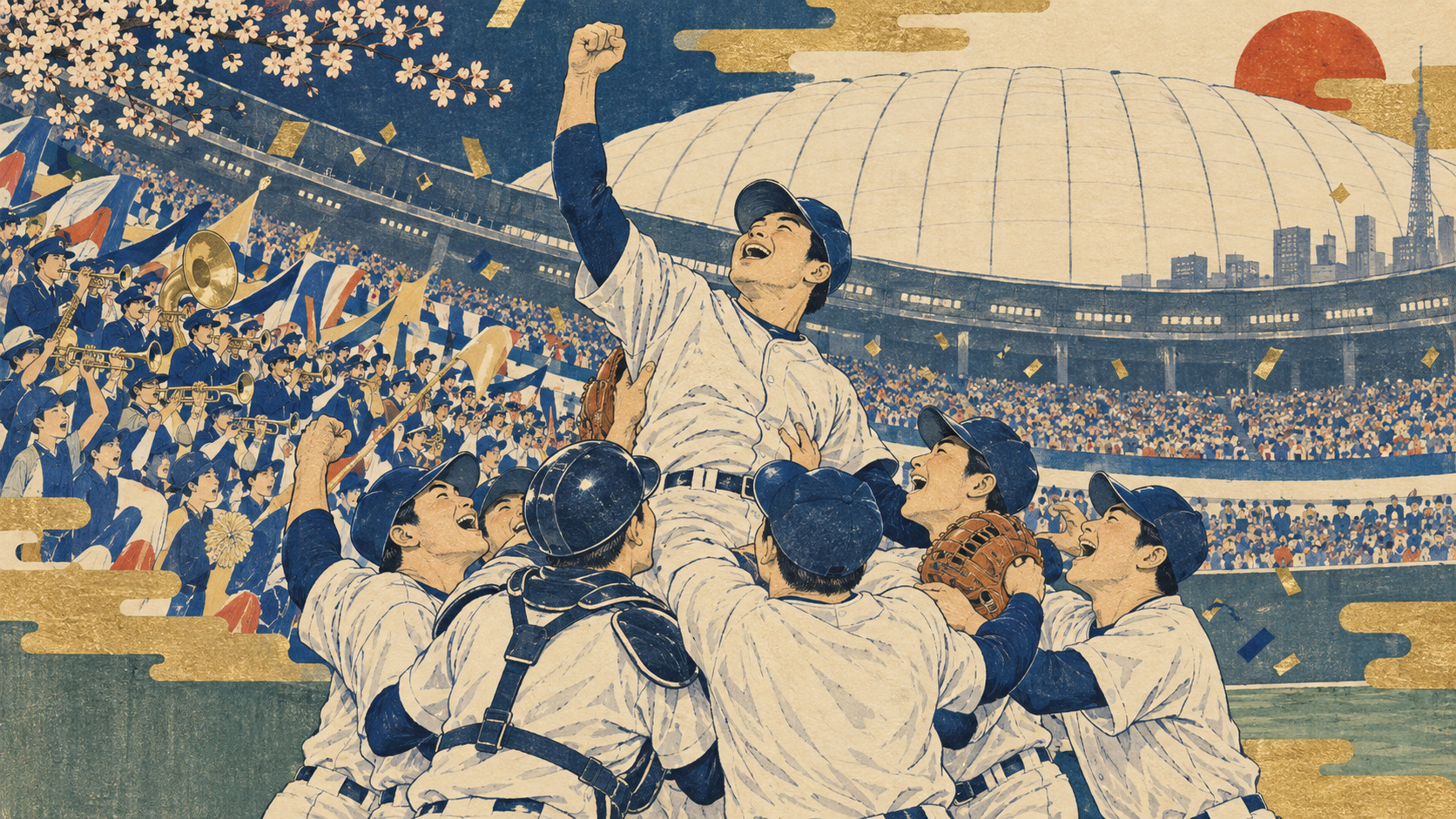
The English name “Intercity Baseball Tournament” hides an institution with no clean overseas equivalent. Company employees play for corporate clubs. Those clubs enter under city banners. Colleagues fill vast cheering sections with brass bands, coordinated chants and company colors. Teams that survive regional qualifying may borrow as many as three players from eliminated local rivals.
That entire structure was visible in NTT West’s 5–2 semifinal victory over Mitsubishi Heavy Industries East at Tokyo Dome on September 5. The Osaka representative scored its first two runs through a reinforcement player, recovered from a fielding error, and relied on a 36-year-old employee-pitcher to complete all nine innings.
The result put NTT West in the final for the first time in 61 years—but that phrase needs precision. The present company was established in 1999. The historical line runs through Denden Kinki, the telecommunications public corporation’s Kinki team that won the tournament in 1965, then NTT Kansai, and finally NTT West.
An error did not become an ending
NTT West attacked immediately. Two consecutive hit batters and an infield single by cleanup hitter Koyo Mizushima loaded the bases with one out. Hidemasa Tanaka swung at the first pitch and singled to left, bringing home two runs.
Tanaka is a Mikihouse player, not an NTT West employee. He joined Osaka’s roster through the tournament’s reinforcement system. In 2026, 30 of the 32 teams selected 86 such players in total. The arrangement preserves the founding proposition of the tournament: the strongest possible city representative can be more important than the boundary of one company club.
The lead disappeared in the bottom of the first. MHI East tied the score with two runs as second baseman Ikuma Yoshikawa’s error compounded the danger. Yoshikawa then struck out looking in his first plate appearance. In a knockout tournament, the sequence could have defined his night.
Instead, with two outs and a runner on first in the fourth, the No. 9 hitter drove a two-run home run into the left-center seats. The error remained in the scorebook, but it no longer controlled the story. Yusei Kushihata added an RBI double in the seventh for the fifth run.
The 36-year-old who finished what he started
Kodai Hamasaki, a right-hander wearing No. 20, allowed four hits and two runs, one earned. He struck out five, walked none and hit one batter. His 125 pitches covered all nine innings; after the first, MHI East did not score again.
The line matters beyond endurance. With the final scheduled for the following afternoon, every unused reliever retained value. Hamasaki faced 30 batters, only three above the minimum for nine innings. Two double plays and a repaired infield defense turned control into efficiency.
NTT West’s official roster places Hamasaki in the company’s General Affairs and Human Resources Department. He came through Hokkaido Sakae High School and Higashi Nippon International University and is in his 15th company year. The description “company baseball” is literal: although work arrangements differ by club and player, this competition was built around athletes carrying both a job and a team identity.
That makes the complete game something different from a professional veteran’s performance. Longevity is sustained inside an employment system, a corporate sports program and a national amateur federation. The pitcher’s age is not merely a statistic; it is a measure of how long that structure has made elite competition possible.
Four victories, four different tests
NTT West’s run began on August 31 against Nippon Express, the Saitama representative. The teams were tied 1–1 after nine innings. Under the tournament tiebreak, the tenth began with runners on first and second and nobody out. Osaka scored twice and won 3–1.
The second round produced a match rich in corporate history. NTT West beat NTT East 7–3 in what NTT East’s official account identified as the first East–West NTT meeting in Intercity tournament history since the 1999 reorganisation. The bracket had turned a national telecommunications lineage into a Tokyo–Osaka contest.
A 7–0 quarterfinal win over JFE West followed on September 4. One night later came the 5–2 semifinal over MHI East. Extra-inning pressure, a group-company counterpart, a shutout and a comeback from an untidy first inning demanded four different forms of composure.
| Date and round | Opponent (city) | Result |
|---|---|---|
| Aug. 31 · First round | Nippon Express (Saitama) | 3–1, 10 innings |
| Sept. 3 · Second round | NTT East (Tokyo) | 7–3 |
| Sept. 4 · Quarterfinal | JFE West (Fukuyama and Kurashiki) | 7–0 |
| Sept. 5 · Semifinal | MHI East (Yokohama) | 5–2 |
A national tournament built around cities and companies
The first Intercity tournament brought 12 teams to Meiji Jingu Stadium in August 1927. The 97th edition, organised by the Japan Amateur Baseball Association and The Mainichi Newspapers, placed 32 regional qualifiers at Tokyo Dome from August 26 through September 6. The champion receives the Black Lion Flag, the tournament’s central symbol.
“Industrial league” or “corporate baseball” are common English descriptions of shakaijin yakyu, literally “adult members of society baseball.” Neither phrase fully captures it. These are not minor-league affiliates. The clubs belong to companies or communities, players remain amateurs under the governing structure, and the two principal national tournaments—the Intercity and the Japan Championship—have identities separate from Nippon Professional Baseball.
At the Intercity, the city is not decorative. The scoreboard and bracket pair every club with a municipality: NTT West with Osaka, MHI East with Yokohama, Seino Transportation with Ogaki. Corporate cheering sections convert an individual employer into a temporary civic delegation.
The reinforcement system, introduced in 1950, sharpens that local character. Up to three players from teams eliminated in the same region can join a qualifier. The player temporarily changes uniforms, while the regional baseball network remains visible. Tanaka’s two-run single was therefore both NTT West’s opening blow and a contribution carried in from Mikihouse.
Why “61 years” needs a family tree
The company now styled NTT WEST, Inc. was established on July 1, 1999. It cannot literally have played a final in 1965. The baseball club’s recognised lineage, however, began in 1952 as Denden Kinki, was renamed NTT Kansai in 1985 and became NTT West in 1999.
The company’s own historical summaries explicitly count results from the Denden Kinki and NTT Kansai eras. OmyuTech’s JABA team record uses the same sequence. The accurate claim is therefore that NTT West has reached the final for the first time since its predecessor Denden Kinki did so 61 years earlier.
In the 1965 final, Denden Kinki defeated Sumitomo Metal Industries 4–0. The first four runs were scored in the opening two innings. The Nippon Life reinforcement pitcher listed in the historical record as 小弓場保 won the Hashido Award as the tournament’s most valuable player. Reinforcement was not incidental to that championship; it stood at its center.
The parallel with 2026 is striking but should not be romanticised into sameness. Japan’s telecommunications system passed from a public corporation through NTT privatisation and the 1999 regional-company reorganisation. Employment patterns and corporate sport have changed. What endured was an institutional decision to recognise one team’s results through its successive names.
1952 — Club founded as Denden Kinki.
1959 — First Intercity appearance; finished third.
1965 — Beat Sumitomo Metal 4–0 for its first title.
1985 — Renamed NTT Kansai.
1999 — Reorganised as NTT West; the present company was established July 1.
2026 — Beat MHI East to reach the lineage’s first final in 61 years.
The final was another contest between cities
Seino Transportation, representing Ogaki in Gifu Prefecture, defeated Agekke of Oyama 3–2 in the other semifinal. It advanced seeking its first Black Lion Flag since 2014. NTT West was pursuing the first since 1965. The final was scheduled for 2 p.m. on September 6 at Tokyo Dome.
The one-day turnaround makes recovery part of the tactics. Hamasaki had just thrown 125 pitches. Manager Yasuhiro Kawamoto had to evaluate what, if anything, remained available from his veteran while building nine innings from the rest of the staff. Seino entered its fifth game under the same compressed tournament logic.
Whatever happened next lies beyond this article’s stated cutoff. The achievement reported here is narrower and already secure: a club carrying Osaka’s name, a telecommunications lineage and a modern company identity crossed a 61-year interval to reach the last game.
Yoshikawa required only three innings to travel from error to home run. Hamasaki required 125 pitches to travel from a difficult first inning to the final out. Historical continuity is made from those shorter acts of recovery. A name survives not because the past repeats itself, but because another team earns the right to place a new game beside it.
- Japan Amateur Baseball Association, 97th Intercity Baseball Tournament — official field, schedule and results.
- OmyuTech / official JABA semifinal box score — innings, batting and pitching records.
- OmyuTech / official JABA NTT West–Nippon Express record — 3–1 result in ten innings.
- NTT East baseball, official September 3 game report — 7–3 score and first post-reorganisation Intercity East–West meeting.
- NTT West baseball, official roster — Japanese name readings, employment sections and player backgrounds.
- NTT West corporate profile — formal company name and July 1, 1999 establishment.
- NTT West baseball-club summary — results counted across the Denden Kinki and NTT Kansai eras.
- Baseball Hall of Fame and Museum, the Black Lion Flag — tournament-trophy history.
- Mainichi publication, tournament history and restoration of traditions — 1927 founding and reinforcement-system history.
- Iga Town Information YOU, 2026 reinforcement selections — Tanaka’s selection and the tournament-wide totals.
- Mainichi tournament page, MHI East–NTT West semifinal — match progression and visual record.