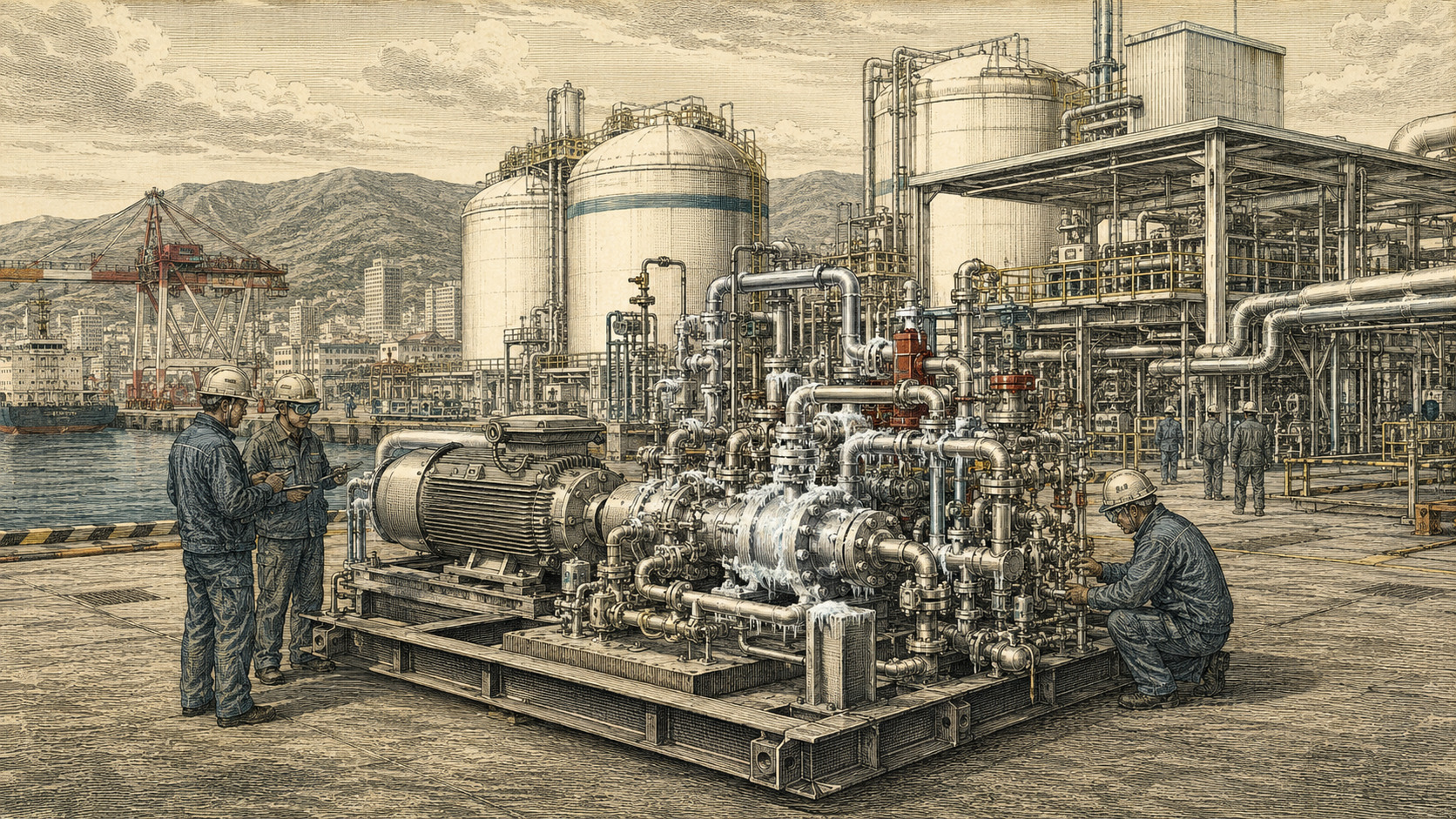
On one side of the piping is a liquid only about 20 degrees above absolute zero. On the other is the pressure and flow demanded by a combustor. Three pistons reciprocate between them. Seen from outside, the equipment Nikkiso delivered to the Kobe Hydrogen Energy Center is simply a steel frame holding a pump, motor, valves, instruments and pipework: one skid among the larger machines on site.
For hydrogen, however, this is a gate between phases. Whether engineers pressurize it as a liquid or first allow it to become a gas changes the auxiliary power, pipe sizes, vaporizer behavior and operating cost of the generating plant. When Kawasaki and Kobe Steel called their 2026 result a world first, they meant the operation of this combination as a power-generation fuel train: a liquid-hydrogen pump raising pressure beyond the critical point, an IFV and a hydrogen turbine.
The names at the top of the announcement were Kawasaki and Kobe Steel. The heart moving the liquid was made by Nikkiso, founded in 1953, and its U.S.-based Clean Energy & Industrial Gases group. Hydrogen infrastructure is not made by prominent system integrators alone. The less visible companies that accept responsibility for cryogenic seals, pistons, inlet valves, vacuum insulation, regulatory compliance and service determine whether the system can leave the demonstration stage.
Problem one: hydrogen becomes harder to push after it becomes a gas
At ordinary temperature and pressure, hydrogen carries exceptional energy by mass and very little by volume. The U.S. Department of Energy gives its normal boiling point as −252.8°C. Liquefaction reduces the volume of a given mass to roughly one eight-hundredth of the room-temperature gas, making bulk transport by truck or ship much more practical. The safety reference H2Tools gives a liquid-to-gas volume ratio of about 1:848.
That advantage reverses at the destination. Vaporize liquid hydrogen and its volume expands dramatically. Compressing it afterward means handling that great gaseous volume and supplying substantial work. A liquid is dense and nearly incompressible, so a pump can raise pressure while the same mass occupies little space. “Press first, heat second” is the physical core of the Kobe system.
Kawasaki and Kobe Steel say this route avoids the large compression power of a system that pressurizes gaseous hydrogen and can therefore improve the energy performance of the generating system. They have not said how many kilowatts were saved. Without the reference compressor's inlet state, pump efficiency, IFV heat source and turbine fuel pressure, no credible percentage can be calculated from the release.
What it means to cross 13 bar
Hydrogen has a point above which the distinction between liquid and gas disappears. NIST lists a critical temperature of 33.18 K—−239.97°C—and a critical pressure of 13.00 bar, about 1.3 MPa. If the fluid is brought above that pressure and then warmed, it does not cross the conventional boiling boundary where separate liquid and vapor phases coexist. It changes continuously from a dense cryogenic fluid toward a gaslike one.
The companies explicitly say that the pump raises the liquid above critical pressure, but they have not published the actual discharge pressure. Their release does not spell out every reason for choosing the supercritical route. From the phase physics, it can avoid the ordinary two-phase region of liquid and bubbles in the vaporizer and piping, favoring a more controllable fuel stream. That is a technical interpretation of the NIST data, not a reported measurement of pulsation reduction or stability at Kobe.
The vocabulary requires care, too. The equipment is called a liquid-hydrogen vaporizer. Above critical pressure there is, strictly speaking, no liquid-vapor boundary to cross. Functionally it is a heat exchanger that warms a high-pressure cryogenic fluid to the state the turbine can accept. The industrial name accurately describes its place in the system, if not every molecular step through it.
Problem two: at −253°C, an ordinary pump ceases to be ordinary
Hydrogen boils about 91 degrees colder than LNG. Metals assembled at room temperature contract when cooled, and different alloys contract by different amounts. A clearance that becomes too tight can seize a piston or valve; one that becomes too wide leaks and loses efficiency. Nikkiso says cryogenic-pump design can require dimensional precision on the order of one-hundredth of a millimeter.
Materials change character as well. Carbon steels and many elastomers can become brittle at low temperature. Air that enters the system can freeze—at liquid-hydrogen temperature, every atmospheric gas except helium is solid—and particles of water, nitrogen or oxygen can obstruct a valve or instrument. Heat entering warm pipework boils the liquid and can form bubbles at the suction. A positive-displacement pump that inhales vapor instead of liquid can lose delivery, cavitate or damage components.
Trapped liquid hydrogen is also a pressure source when it warms. H2Tools places the expansion to room-temperature gas at roughly 848 times the liquid volume. Boil-off occurs even in normal operation, which makes relief valves, vents, leak detection, purging and insulation part of the pumping system rather than accessories. A skid is not just a convenient floor under a bare pump. It is a way to place the cold end, warm drive, valves, instruments and safeguards inside one testable boundary of responsibility.
| Cryogenic problem | Why it happens | What design and operation require |
|---|---|---|
| Thermal contraction | Different metals shrink at different rates | Cold clearances, compatible materials and precision machining |
| Vapor formation and poor suction | Heat ingress and pressure drop generate bubbles | Adequate suction pressure, vacuum insulation and cooldown procedures |
| Leakage | Hydrogen is a small molecule and seal materials change in the cold | Qualified materials, detection, ventilation and inspection |
| Ice and solid blockage | Air and moisture freeze in the cryogenic section | Drying, inert-gas purge and prevention of air ingress |
| Overpressure in an isolated section | Trapped liquid warms and expands toward 848 times its volume | Pressure relief for every trapped volume and safe venting |
Three pistons—and the skid as a product
Nikkiso identifies the unit as a “3-cylinder SGV.” CE&IG's product material describes SGV as a compact, modular displacement pump offered with one, two or three cylinders and a vacuum-jacketed cold end for liquid-hydrogen service. In a reciprocating cryogenic pump, a motor and drive mechanism on the warm side move piston rods; suction and discharge valves in each cold cylinder alternately admit and expel a measured volume of liquid.
Three cylinders divide the work among several smaller discharges instead of one very large piston. In reciprocating-pump practice, overlapping those strokes can provide the required flow with smoother delivery. Kobe's phase angles, speed, piston diameter, stroke, flow and pulsation have not been disclosed. This explains the published product family, not a confidential Kobe specification.
The phrase “pump-skid delivery” carries industrial significance. The drive, lubrication, piping, valves, instruments, control and safety devices are placed on a common steel base, integrated and tested as far as possible before shipment. That reduces one-off assembly in the field and makes responsibility for performance clearer. Scaling hydrogen infrastructure begins not with making one unusual machine, but with defining a repeatable unit that can be built, tested, installed and serviced again.
Why Nikkiso was standing at this particular gate
Nikkiso began in 1953 as Special Pump Co. It moved from importing American metering and canned-motor pumps into domestic manufacturing, then into artificial hearts, dialysis machines and carbon-fiber aircraft parts. Those businesses appear unrelated until viewed through their common requirement: precise machinery and fluids whose interruption can affect a patient, aircraft or industrial plant.
In liquefied gases, Nikkiso formed a technical relationship with the U.S. company J.C. Carter in 1982 and records delivery of its first domestically produced cryogenic pump in 1985. It modified the technology for the demanding requirements of Japanese LNG terminals and formed a U.S. testing company in 1996. It bought Atlas Copco's cryogenic-pump business in 2015 and U.S.-based Cryogenic Industries Group in 2017, reorganizing the latter as CE&IG in 2021.
The SGV in Kobe is therefore not a simply “Japanese-made pump.” It is an international product: U.S.-based liquid-hydrogen displacement-pump experience combined with a Nikkiso engineering team that optimized the package for Japan's High-Pressure Gas Safety Act and the customer's specifications. The technology crossed borders in much the same way the planned hydrogen supply chain would.
There is a small disclosure discrepancy in the delivery record. Nikkiso's Japanese release of April 7, 2026, says the group has delivered more than 450 liquid-hydrogen pumps worldwide. The English version says more than 400. Both establish substantial experience, but they do not match. This article uses the conservative 400-plus figure; the company does not explain whether the difference reflects rounding or an update lag.
Since 2018, Kobe has been learning about everything around the flame
Port Island's story did not begin with the new pump. Kawasaki completed a 1 MW-class hydrogen gas-turbine cogeneration demonstration in December 2017. On April 19 and 20, 2018, the project used 100% hydrogen to deliver electricity and heat simultaneously to four urban facilities. It sent a total 2,800 kW of heat to Kobe City Medical Center General Hospital and Port Island Sports Center, and 1,100 kW of electricity to those two plus Kobe International Exhibition Hall and the sewage-treatment plant.
The heat made cogeneration tangible. At the sports center it served the swimming pool, hot water and space heating. At the hospital, steam supported water heating, rooms and sterilization of medical equipment. Cogeneration turns fuel into both electricity and useful exhaust heat, raising total use where customers are close. It also makes the schedules of a hospital and pool part of the energy system.
The original wet combustor injected water to cool hot zones and suppress nitrogen oxides. Kawasaki demonstrated dry low-NOx combustion of pure hydrogen in 2020 by dividing the flame into many small flames without water injection, then tested mixed fuel in 2022. The new 2026 train first succeeded in feeding the known wet combustor. Connecting it next to the dry combustor matters because pump development and the evolution of the burner are not independent.
1953 Special Pump Co., now Nikkiso, is founded.
1982–1985 After a relationship with J.C. Carter, Nikkiso delivers its first domestically produced cryogenic pump.
2015 Nikkiso acquires Atlas Copco's cryogenic-pump business.
2017 It acquires Cryogenic Industries Group; Kobe's 1 MW-class hydrogen CGS is completed.
April 2018 Port Island supplies 1,100 kW of electricity and 2,800 kW of heat from 100% hydrogen to four urban facilities.
2020 Kawasaki demonstrates dry low-NOx combustion of pure hydrogen in a gas turbine.
2022 Kobe Steel's liquid-hydrogen IFV development is selected for NEDO support.
2023 Sub-1 MPa IFV testing finishes; the above-critical-pressure regional CGS project with Kawasaki is selected.
January 2026 Operation of the next-generation Port Island fuel train begins.
March 2026 The partners announce successful supply to the wet-combustion hydrogen turbine.
April 2026 Nikkiso identifies its three-cylinder SGV pump-skid contribution.
The IFV turns “waste cold” back into a product
Hydrogen arriving as a liquid must absorb heat before entering a turbine. Kobe Steel's IFV does not exchange heat directly between industrial water and hydrogen; it inserts an intermediate fluid such as propane. Evaporation and condensation of that fluid move heat while helping prevent the water side from freezing and making recovery of the cryogenic cold more practical. The design transfers experience from LNG vaporizers into hydrogen.
The joint release lists turbine-inlet cooling, refrigeration, data-center cooling and commercial or industrial air conditioning as potential applications for the recovered cold. Hot weather reduces the density of gas-turbine intake air and tends to reduce output. If liquid hydrogen cools that inlet, part of the refrigeration energy paid for at the liquefaction plant can become useful at the destination.
Potential is not performance. The March announcement does not say how many kilowatts of cold were supplied to any of those uses, for how many hours, or give IFV effectiveness, industrial-water temperature or freezing behavior. Hot-weather confirmation remained on the test list precisely because the integrated system changes with the season.
Energy saved by the pump—and energy already spent on liquefaction
The advantage of liquid pumping must not be mistaken for high efficiency across the whole hydrogen economy. The U.S. Department of Energy says today's liquefaction technology can consume more than 30% of hydrogen's energy content. After that come boil-off from insulated tanks, marine and road transport, loading, pumping, heating and conversion losses.
Nikkiso's pump makes one row in that loss ledger smaller. Kobe Steel's IFV recovers value that would otherwise remain “waste cold.” Cogeneration sells turbine exhaust heat to local customers. The logic of putting all three together is to waste as little as possible of the large energy investment already made to liquefy and deliver the hydrogen.
There is a carbon boundary as well. If the test hydrogen was made from fossil fuel and the resulting CO₂ was not captured, the turbine's lack of direct CO₂ does not make its electricity low carbon by itself. The 2026 Kobe disclosures do not identify the production pathway, transport distance or carbon intensity of the hydrogen used in this trial. That does not diminish the equipment test; it leaves its environmental value unquantified.
Between one successful run and a bankable plant
The March milestone is real: actual liquid hydrogen was raised above critical pressure, passed through an IFV and delivered to an operating wet-combustion hydrogen turbine. This was more than a process diagram. The public evidence for power-plant durability and economics, however, remains sparse.
- Public: The pump is a three-cylinder SGV made by Nikkiso CE&IG and adapted to Japanese rules and customer requirements.
- Public: Testing began in January 2026; above-critical pressurization and supply to the wet turbine succeeded.
- Public: The project is intended to systematize design and operating knowledge across pump, IFV and turbine.
- Still to come: Dry-combustor supply, hot-weather operation and long-term pump-reliability testing.
- Not public: Exact flow, suction and discharge pressures, speed, pump power, efficiency, vibration and pulsation.
- Not public: Cumulative hours, start-stop count, availability and service history for seals, valves and piston rings.
- Not public: IFV cold recovery, turbine output and NOx, and electrical, thermal and total system efficiencies.
- Not public: Capital and maintenance cost, hydrogen and power cost, or the fuel's life-cycle emissions.
For a pump, the more revealing question is what remains after the hundredth or thousandth cooldown, start and stop. How quickly do the cold valves wear? At how many hours are piston rings replaced? How long do cooldown and warmup take, and how much hydrogen is lost? What happens to efficiency and pulsation at part load? Can maintenance be performed without a standby unit? Long-term reliability testing is the stage that begins to produce numbers a lender can use.
Cogeneration imposes another condition: a customer for the heat. A hospital can use steam throughout the year, while pool and air-conditioning demand changes by hour and season. Maximizing electricity can leave surplus heat; following heat demand can put the turbine and pump at part load. Efficient components do not guarantee sound project economics if local demand does not match them.
Not a small company, but an invisible one
Nikkiso is a listed multinational active in medicine, aerospace and industrial equipment. It is not a small supplier. Yet in public hydrogen discussion it disappears behind the names of vehicles, ships and utilities. Industrial policy needs to see this middle layer. Pumps, valves, seals, heat exchangers, instruments, controls, certification and service networks determine the speed of deployment and how much value remains in the domestic economy.
Nikkiso's hydrogen-pump work extends beyond Kobe. In 2025 it received a Kawasaki order for a hydrogen-fueled ship's pump unit and tested a second high-speed liquid-hydrogen-pump prototype for aircraft. In July 2026, CE&IG launched a new submerged-motor-pump platform whose operating range includes liquid hydrogen. Power stations, ships, aircraft and filling stations look different, but all share the problem of moving a cryogenic liquid without leakage at the required pressure and flow.
That gives a Japanese supplier a practical hedge. Even if hydrogen demand grows more slowly than forecasts, cryogenic-pump knowledge serves LNG, oxygen, nitrogen, ammonia, spaceflight and medical gas. Technology and a service network can migrate from established industrial-gas businesses while the hydrogen market develops. The Kobe skid is also a picture of that strategy: manufacturing experience accumulated in the United States, adapted to law and customer needs in Japan.
The real machinery of a hydrogen economy keeps the flow unbroken
A hydrogen supply-chain diagram is written with verbs: make, carry, store and use. Between them lie other verbs—send, pressurize, warm, measure, vent, stop and repair. Without the equipment that performs those verbs, the chain is not a line but a row of isolated boxes.
Kobe's result is not an announcement that commercial hydrogen power has arrived. Long-duration reliability, summer performance, dry combustion, cost and carbon intensity still await answers. What succeeded was an integrated flow: pressurize hydrogen while it remains small and dense, warm it above the critical line and deliver it to an existing hydrogen turbine.
At its center was not the carrier or the gleaming spherical tank. It was a pump skid with three pistons. When an energy transition moves from experiment to industry, the protagonist often shifts from the machine that photographs best to the one that produces the same pressure every morning. Whether a hydrogen economy truly begins may depend on whether that uncelebrated machine is still running ten years from now.
Reporting notes and principal sources
This article uses public information checked through August 10, 2026, 9:00 a.m. JST. The critical pressure of about 13 bar is from NIST; the roughly 848:1 gas-to-liquid expansion is from H2Tools. Avoiding the ordinary two-phase boundary above critical pressure is a technical explanation from phase data, not a private Kobe performance figure. The 1,100 kW electrical and 2,800 kW thermal figures are from the 2018 demonstration, not presented as 2026 output. Nikkiso's Japanese release says more than 450 liquid-hydrogen pumps delivered; its English release says more than 400, so the article conservatively uses 400-plus.
- Nikkiso Japan: Liquid-hydrogen pump delivered for hydrogen cogeneration, April 7, 2026
- Nikkiso English: Liquefied Hydrogen Pump for the Hydrogen CGS
- Kawasaki and Kobe Steel: Operation begins for the next-generation hydrogen fuel-supply system
- NEDO: 100% hydrogen supplies urban electricity and heat in 2018
- Kawasaki: History of the Kobe CGS and international liquid-hydrogen chain
- Kobe Steel: Regional hydrogen-CGS project above critical pressure
- Kobe Steel: IFV development for liquid-hydrogen cold recovery
- NEDO: Selection of 2023 regional hydrogen-utilization projects
- Nikkiso: Corporate and pump history since 1953
- Nikkiso: Domestic cryogenic-pump development and low-temperature design
- Nikkiso CE&IG: SGV series and cryogenic reciprocating pumps
- NIST Chemistry WebBook: Hydrogen critical temperature and pressure
- U.S. Department of Energy: Liquid-hydrogen delivery, liquefaction energy and boil-off
- H2Tools: Liquid-hydrogen properties, expansion and freezing hazards
- H2Tools: Materials for cryogenic hydrogen equipment
- Nikkiso: Second liquid-hydrogen pump prototype for aircraft
- Nikkiso: Pump-unit order for a hydrogen-fueled ship