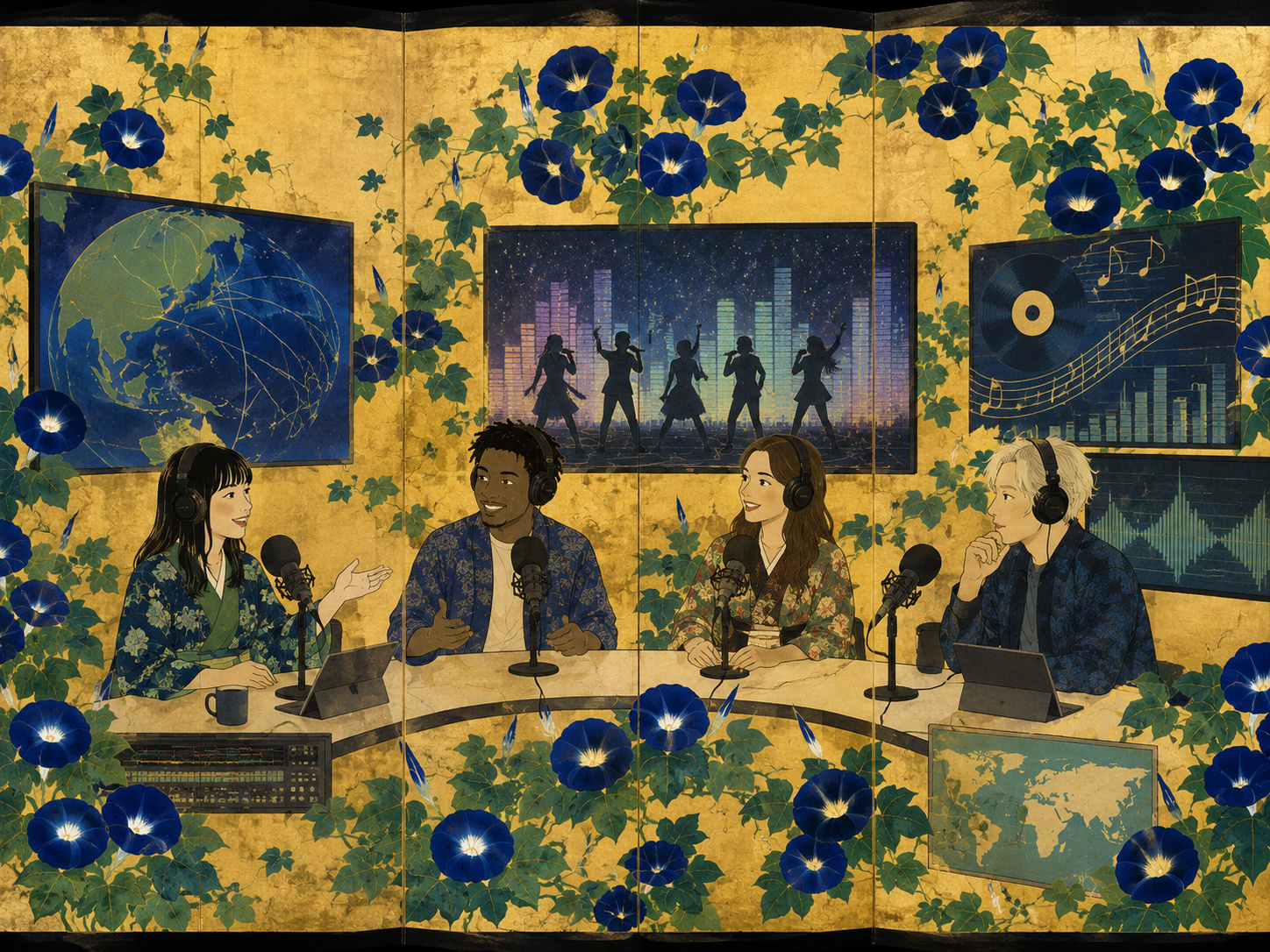
The title sounds like a class Japan will teach to the world.
The first episode is more interesting than that.
NHK WORLD-JAPAN’s new program SCHOOL OF J-POP is scheduled to begin on August 21 with four international broadcasts across a 24-hour cycle—11:30 a.m., 4:30 p.m. and 10:30 p.m. on Friday, then 4:30 a.m. on Saturday, Japan time. Video on demand is scheduled from noon after the first broadcast. A later Japanese-language edition is planned for domestic terrestrial television.
Naomi Watanabe is positioned as the representative student. Voice actors Yuko Natsuyoshi and Saori Hayami join the class. Reol appears as a “SENSEI,” explaining the “utattemita” culture of people posting their own sung versions online and the importance of Nico Nico Douga to her own beginnings. Trash Taste—the Japan-based trio The Anime Man, Gigguk and CDawgVA—also appears as teachers, but from the opposite direction: overseas-born creators explaining how international anime fandom hears and understands the work.
The subject of the lesson is Super Kaguyahime!, a 2026 animated film that itself folds centuries of Japanese culture together.
Its premise reaches back toward The Tale of the Bamboo Cutter, often described as Japan’s oldest surviving prose narrative. Its music reaches into one of the most radically networked creative movements of the 21st century: Vocaloid producers, Hatsune Miku, Nico Nico, remixing, fan singing, illustration, video and creator communities that often grew before conventional media companies knew exactly what to call them.
That makes the first lesson unusually appropriate.
A program about explaining J-pop internationally begins with music whose history was already built by people explaining, remaking and redistributing Japanese culture to one another across networks.
The phrase “J-POP” was itself a translation device
Before asking how J-pop became global, it is worth asking where the label came from.
The best-known origin story begins with J-WAVE, the Tokyo FM station that launched on October 1, 1988.
J-WAVE’s early identity was intentionally cosmopolitan and heavily oriented toward Western music. That created a programming problem. If the station was going to play selected Japanese songs beside foreign pop, what should it call them?
“Kayokyoku” carried older domestic associations. “Japanese pops” sounded cumbersome. J-WAVE staff and record-company representatives began using the shorter “J-POP.” The station itself has long claimed the term as part of its history, and later accounts place the first textual appearance in a J-WAVE program listing in late 1988.
The name did more than identify geography.
It repositioned Japanese popular music inside an international listening frame.
Instead of saying, in effect, “here is domestic music,” J-POP said: here is pop, with a J attached.
That subtle difference matched the atmosphere of late-1980s Japan—a country confident enough economically and culturally to imagine its music beside the international mainstream rather than beneath it.
By the mid-1990s, the term had spread far beyond one FM station. It became an enormous umbrella covering rock, dance-pop, singer-songwriters, idol music, electronic music and forms that previously would have been divided among kayokyoku, “new music” and other labels.
“J-POP” was born as a way to make Japanese music legible beside foreign pop. SCHOOL OF J-POP arrives when foreign listeners no longer need Japan to tell them where the door is.
Japan built one of the world’s biggest music markets without needing the world
For much of J-pop’s modern history, international success was desirable but not economically necessary.
Japan developed an unusually large domestic recorded-music market. IFPI ranked Japan as the world’s second-largest recorded-music market in 2025, behind the United States. The Recording Industry Association of Japan estimated the 2025 domestic market for music software plus digital distribution at ¥398.8 billion.
The structure of that market has also been unusual.
Streaming is now enormous: RIAJ estimated ¥137.7 billion in subscription streaming revenue in 2025 plus ¥20.2 billion from advertising-supported streaming. Yet CDs and physical music products remain far more economically important in Japan than in many Western markets. The same RIAJ estimate put CD sales alone at roughly ¥168.6 billion, before vinyl and music video are added.
A huge home market can be a strength.
It can also reduce pressure to design for export.
Japanese artists historically did not need English-language radio, foreign label systems or global touring to reach commercially meaningful scale. A million-selling domestic album could be a major success without becoming a household name in California or France.
This is one reason the overseas path for Japanese music developed differently from the later K-pop model, in which global markets were built systematically into training, promotion, multilingual releases and platform strategy.
J-pop often traveled indirectly.
Anime was one of its vehicles.
Anime taught listeners to love a song before they knew the singer
For many overseas fans, Japanese music first arrived attached to an image.
An opening sequence.
An ending theme.
A character.
A convention screening.
A fansubbed video.
An AMV cut together by another fan.
Academic work on the overseas expansion of Japanese music was already observing this mechanism in 2009: anime and manga fandom had created networks through which Japanese rock and popular music could reach Western audiences, including conventions and specialist labels.
The history inside Japan is equally important.
Anime songs were once widely understood as “TV manga theme songs”—music for children, closely tied to a particular program. Research tracing debates in anime magazines from 1978 to 2000 shows how that category changed. As anime audiences aged and record companies entered more aggressively, songs increasingly became viable pop records and “image songs” in their own right. By the 1990s, the idea that anime music could circulate beyond children’s television was no longer remarkable.
That shift eventually created an international advantage.
An anime song travels with narrative context.
A listener who does not understand every Japanese lyric may already know the emotional stakes because the song opens an episode they have watched for twelve weeks. The character, visual sequence and fan community create a bridge before translation is complete.
Today the numbers are visible in global charts. Billboard Japan’s 2025 year-end “Global Japan Songs Excl. Japan” list included songs tied strongly to anime alongside older viral and catalog tracks: Creepy Nuts, YOASOBI, Kenshi Yonezu, LiSA and others. In August 2026, the weekly chart was still mixing current releases with enduring global tracks such as “TOKYO DRIFT,” imase’s “NIGHT DANCER” and Miki Matsubara’s revived “Mayonaka no Door.”
Global J-pop is not one genre.
It is several discovery systems overlapping.
Then the singer stopped needing a human throat
Yamaha introduced the first VOCALOID singing-synthesis engine in 2003, with commercial products following in 2004.
The technical idea was powerful but initially niche: type lyrics and melody into a computer and generate a singing voice from recorded voice-bank data.
The cultural explosion came with VOCALOID2 and Hatsune Miku in 2007.
Crypton Future Media released Hatsune Miku on August 31, 2007. The turquoise-haired character on the software package gave the voice an identity without turning it into a conventional celebrity. Yamaha’s own history credits the combination of Miku, Nico Nico Douga and social media with rapidly expanding recognition of the technology.
The crucial innovation was not merely synthetic singing.
It was distributed authorship.
A composer could write a song without finding a singer. An illustrator could draw the character. Another creator could make a video. Somebody else could cover the song. Somebody else could remix it. Fans could comment directly across the video screen on Nico Nico. Works accumulated around one another.
Crypton later described Hatsune Miku not simply as software but as the center of a “creative circle.”
This system changed the route into the music industry.
A person could become known as a “Vocaloid producer”—a Vocalo-P—before becoming a conventional recording artist.
Several of Japan’s internationally important musicians came through this networked environment or adjacent internet creator cultures.
SCHOOL OF J-POP’s first episode explicitly names Kenshi Yonezu and Ado as examples in the broader story of Japanese internet culture feeding contemporary J-pop.
Reol is useful in that lesson because she does not have to explain the culture as a historian.
She can explain it as biography.
1988 — J-WAVE launches in Tokyo and the label “J-POP” emerges as a way of identifying selected Japanese popular music within an international-minded FM format.
1990s — “J-POP” becomes a broad mainstream category during Japan’s CD boom; anime songs increasingly coexist with the commercial pop market.
2003–04 — Yamaha introduces VOCALOID technology and the first commercial engine generation.
2006 — Nico Nico Douga emerges as a Japanese video-sharing platform built around highly visible user participation and on-screen comments.
August 31, 2007 — Crypton releases Hatsune Miku for VOCALOID2.
December 2007 — ryo posts “Melt,” one of the defining early Hatsune Miku songs.
May 2008 — ryo posts “World Is Mine” to Nico Nico.
February 2, 2009 — NHK WORLD TV relaunches as a 24-hour English-language international service.
2009 — supercell makes its major-label debut, showing how an internet-born Vocaloid creator unit could cross into the conventional record industry.
2023 — Billboard Japan launches “Global Japan Songs Excl. Japan,” explicitly charting Japanese music consumption outside Japan.
January 22, 2026 — Netflix begins worldwide exclusive streaming of Super Kaguyahime!, built around songs from major Vocaloid producers.
August 21, 2026 — NHK WORLD-JAPAN schedules the first episode of SCHOOL OF J-POP.
“World Is Mine” is almost the perfect first lesson
The song at the center of one part of the first episode is not new.
That is why it works.
ryo of supercell posted “World Is Mine,” featuring Hatsune Miku, to Nico Nico in May 2008. It belonged to the burst of early Vocaloid culture that also included ryo’s “Melt,” “Love Is War” and “Black Rock Shooter.” The songs circulated first in a creator network where music, illustration and video were unusually entangled.
supercell’s official history records “World Is Mine” as a May 2008 Nico Nico upload. The group later moved from self-produced releases at Comic Market into a major-label debut in 2009.
Eighteen years later, Super Kaguyahime! brought the song back as “World Is Mine CPK! Remix,” with ryo himself handling the remix. The film’s cast characters Kaguya and Yachiyo sing the new version, voiced by Yuko Natsuyoshi and Saori Hayami.
The film does not treat Vocaloid as retro decoration.
Its music roster includes ryo, kz (livetune), 40mP, HoneyWorks, Aqu3ra and yuigot—creators representing different stages of the internet-born music ecosystem. Its story takes the ancient Kaguya-hime motif into a virtual world called Tsukuyomi and builds major narrative sequences around performance and music.
The first SCHOOL OF J-POP episode therefore contains an elegant loop.
An internet song made with a virtual singer becomes a song performed by anime characters in a global Netflix film, then becomes material for a public broadcaster to teach the history of Japanese internet music to an international audience.
The network did not replace the institution.
It changed what the institution now has to explain.
Reol represents the route from participation to profession
“Utattemita” translates literally as “I tried singing it.”
The modest wording is important.
On Nico Nico, “I tried singing” became a category in which users uploaded their own performances of existing songs. The performer did not need permission from a television producer to audition for an audience. The audience was already there, commenting across the screen.
Reol’s official announcement for SCHOOL OF J-POP says she will discuss this culture and Nico Nico from her own experience, describing them as part of the background through which Japan’s internet culture fed into current J-pop.
That is a different kind of music-industry genealogy.
The conventional model moves from talent discovery to agency, training, recording, promotion and audience.
The internet model can begin with audience.
A creator uploads. Other creators respond. Identity may be partial or pseudonymous. Visuals and music may come from different people who never shared a studio. The work accumulates social proof before the conventional industry arrives.
This did not abolish record labels, management or professional production.
It changed the point at which those institutions could enter.
Trash Taste represents the fan who became infrastructure
Trash Taste is equally revealing for the opposite reason.
The Anime Man, Gigguk and CDawgVA did not become important to Japanese popular culture by being commissioned to translate it officially.
They built audiences by talking about what they loved, disliked, misunderstood, argued over and found strange in anime, manga, games, food and life in Japan.
GeeXPlus said in August that the group’s YouTube channel had 1.62 million subscribers and its podcast had surpassed 500 million plays.
This makes them more than “foreign guests.”
They are part of a new layer of cultural distribution.
For much of the 20th century, international broadcasters, newspapers, distributors, festival programmers and record labels decided which parts of a country’s culture reached foreign audiences. Today, a creator with a microphone and a large audience can become an interpreter, recommender, critic and gateway.
Sometimes that layer explains Japanese culture badly.
Sometimes it explains it with a fluency and specificity that institutional promotion cannot reproduce.
The first SCHOOL OF J-POP episode turns that informal authority into part of the format.
The broadcaster is not simply saying, “Here is what Japan wants foreigners to know.”
It is asking people who already have foreign audiences: “What did they notice?”
The old export model sent culture outward. The platform era also sends interpretation inward.
Naomi Watanabe makes the classroom stranger—in a useful way
The program could have chosen a music critic as host.
Instead, its “student representative” is Naomi Watanabe.
The role fits the concept because Watanabe’s own career has become transnational. She built enormous celebrity in Japan through television, comedy, fashion and social media, then established a major professional base in New York.
That means she can plausibly occupy both sides of the cultural explanation.
She knows the assumptions of a Japanese audience but also knows what happens when Japanese references leave their original context. She can ask questions that sound naïve without the naivety being entirely artificial.
The promotional concept describes the show as “the world’s most pop music school,” with Watanabe asking why Japanese music can feel so unusual and compelling.
The phrasing risks exoticizing J-pop—turning complexity into “crazy Japan.”
But handled well, the beginner’s question can be useful.
Every culture has systems its insiders stop noticing.
The “teacher” from outside can make the system visible again.
NHK WORLD-JAPAN has changed along with the thing it broadcasts
There is another history behind the program: Japan’s international broadcasting strategy.
NHK had international television before 2009, but the major shift came on February 2 of that year, when NHK WORLD TV relaunched as a 24-hour English-language channel focused on presenting Japan and Asia to overseas audiences.
At launch, the service aimed to reach about 110 million households. By August 2025, Japan International Broadcasting said NHK WORLD-JAPAN/jibtv was available to roughly 406 million households in around 160 countries and regions.
The old international-broadcast model assumed scarcity.
A foreign viewer might have few reliable ways to encounter Japanese news or cultural programming, so the broadcaster’s job was to send information outward.
The streaming era produces abundance instead.
Anime is already on Netflix. Japanese music is already on Spotify and YouTube. Fan translators, TikTok clips, reaction videos, podcasts, playlists and algorithmic recommendations can reach a listener before NHK does.
The public broadcaster’s job therefore changes.
It no longer has to prove that Japanese pop exists.
It has to add context to a conversation already underway.
The global audience is not one audience
“Overseas fans” sounds singular.
They are not.
A Brazilian listener who discovered Japanese songs through anime openings has a different history from a Taiwanese fan of Japanese idols, an American city-pop collector, a French Visual Kei fan, an Indonesian Hatsune Miku producer or a British teenager who found Ado through an algorithm.
Even the same song can travel through different meanings.
Miki Matsubara’s 1979 “Mayonaka no Door—Stay With Me” became a global streaming-era city-pop phenomenon decades after its original release. TERIYAKI BOYZ’ “Tokyo Drift” remains globally durable through a Hollywood film and internet meme culture. YOASOBI’s “Idol” moved through anime and streaming. Creepy Nuts songs have crossed through anime, dance trends and social platforms.
Billboard Japan’s “Global Japan Songs Excl. Japan” chart is useful precisely because it shows these histories coexisting rather than one clean export strategy winning.
SCHOOL OF J-POP will be most interesting if it resists saying “the world loves J-pop because X.”
There is no single X.
- Anime: narrative and visual context introduce songs to audiences already invested in a story.
- Games: rhythm games, character franchises and soundtracks create repeated contact with artists and composers.
- Creator platforms: Nico Nico, YouTube and social media allow songs, covers, remixes and fan works to circulate together.
- Streaming: playlists and recommendation systems reduce the friction of finding music in another language.
- Short-form video: a hook can become globally recognizable before listeners know the artist’s biography.
- Catalog rediscovery: old songs can return decades later through algorithms, covers and online subcultures.
- Influencers and podcasts: foreign fans themselves become curators and interpreters for other foreign fans.
- Global screen distribution: Netflix and other platforms can release Japanese animation and its music simultaneously across many territories.
The Japanese language stopped being the barrier everyone assumed it was
For decades, one of the standard explanations for Japanese music’s limited overseas reach was language.
The assumption was reasonable. Pop songs are built around words. Radio programmers want familiar material. Marketing requires interviews. Singers whose English is limited may struggle with conventional Western promotion.
But music listening changed before language did.
Subtitles became normal. Lyrics sites became searchable. Fan translations arrived instantly. Platforms let a listener save a song whose title they cannot type. Romanization is less important when an algorithm remembers the track for you. Visual and narrative context can precede literal comprehension.
Most importantly, listeners became comfortable with not understanding everything.
K-pop demonstrated this at enormous scale, but Japanese music’s global growth has its own route. Anime fans had already spent decades listening to Japanese lyrics they partially or completely did not understand. Vocaloid fandom treated voice itself as software and character. City-pop revival showed that even a 40-year-old Japanese song could acquire a second international life without having been designed for that audience.
The barrier did not vanish.
The listener’s tolerance for the barrier changed.
Japan’s music industry is now measuring the outside
Charts reveal what an industry considers worth seeing.
In 2023, Billboard Japan launched “Global Japan Songs Excl. Japan,” a chart designed specifically to measure Japanese songs being consumed outside the domestic market.
The existence of the chart is itself evidence of strategic change.
For decades, the primary commercial questions were domestic: Oricon rank, CD shipment, karaoke popularity, television exposure, arena demand.
Now the industry increasingly asks which Japanese tracks are being streamed abroad, in which markets, through which context and for how long.
That data can produce good decisions.
It can also tempt the industry into copying the surface of whatever happened to work globally.
If anime tie-ins travel, make everything an anime tie-in.
If city pop trends, reproduce city pop.
If short-form choreography moves streams, write for the clip.
The history of Vocaloid suggests the opposite lesson.
Some of Japan’s most exportable music became distinctive because it was optimized first for a local creative ecology—not for an overseas marketing plan.
Why the first episode uses Kaguya-hime
Super Kaguyahime! creates almost too perfect a symbol for the program.
The source story is ancient.
The Tale of the Bamboo Cutter has been retold for centuries: a shining child discovered in bamboo, impossible marriage tasks, celestial origin, departure from Earth.
The 2026 film relocates that cultural memory into a virtual space and makes song central to the relationship between its characters. Its creators call it a “music animation project.” The soundtrack draws heavily on producers who emerged through Vocaloid and internet culture.
Old story.
Virtual world.
Synthetic-singing genealogy.
Global streaming distribution.
Voice actors performing remixed internet classics.
Foreign YouTubers explaining why international fans respond.
NHK broadcasting the discussion in English.
The layers are not a detour from J-pop.
They are contemporary J-pop.
There is still a risk in teaching culture like a school subject
A television format needs clean explanations.
Culture rarely provides them.
“Why does J-pop sound different?” can lead to music theory, production style, language rhythm, melody, harmony, idol systems, television, karaoke, anime, game music, internet communities, subcultures and economics.
Compress that into 29 minutes and some complexity will disappear.
The teacher-student framing also creates authority. Whoever is called “SENSEI” gets to explain what a culture means.
That is why the mixture of teachers matters.
Reol can speak from inside a Japanese creator culture.
Trash Taste can speak from the reception side.
Natsuyoshi and Hayami can discuss performance from inside the anime production.
Watanabe can ask from a mobile position between Japanese and overseas entertainment.
No single one of them is “the explanation.”
The format is strongest if their explanations collide.
| Claim | What the evidence supports | What it does not prove |
|---|---|---|
| “SCHOOL OF J-POP launches August 21.” | Participant and distributor announcements list international broadcasts beginning August 21, with VOD scheduled after the first airing. | What actually occurred in the finished episode before it has aired. |
| “Trash Taste represents overseas fans.” | The program explicitly uses the trio to discuss the film and music from an overseas-fan perspective; they have a large international audience. | That three creators represent all non-Japanese listeners or all anime fandom. |
| “Anime made J-pop global.” | Research and contemporary charts show anime has been an important discovery route for Japanese music overseas. | That anime is the only or even dominant route for every globally successful Japanese song. |
| “Vocaloid created modern J-pop.” | Vocaloid/Nico Nico culture produced influential creators and new routes from amateur publication into professional music. | That contemporary Japanese popular music can be reduced to Vocaloid culture. |
| “Japan is the world’s No. 2 music market.” | IFPI’s 2026 Global Music Report ranks Japan second by recorded-music market size for 2025. | That being a large domestic market automatically translates into equal global influence. |
Broadcasting “to the world” means something different now
When NHK WORLD TV relaunched its 24-hour English service in 2009, the phrase “international broadcasting” still carried the geometry of transmission.
Japan here.
The world there.
A satellite beam crossing the distance.
In 2026, the geometry is messier.
A British creator living in Japan can explain Japanese anime to American viewers on YouTube. A Japanese musician can build an audience from covers on Nico Nico before entering the mainstream record business. A 1979 song can go viral globally decades later. A synthetic singer developed in Sapporo can perform through thousands of unrelated creators. A Netflix film can release worldwide before a domestic public broadcaster builds a lesson around it.
The “international” audience is already inside the culture.
Sometimes it changes what Japan makes next.
This is the deeper shift SCHOOL OF J-POP can document if it succeeds.
Cultural globalization is no longer a one-way export process.
It is feedback.
The best teacher may be the listener who heard it differently
There is an old anxiety in cultural export: foreigners may misunderstand.
They will miss the lyric.
They will flatten the history.
They will turn a complicated practice into an aesthetic.
All of those things happen.
But misunderstanding can also reveal assumptions invisible to insiders.
An overseas fan may hear a chord progression as unusual because the conventions around it differ from the music they grew up with. They may attach enormous significance to an anime opening Japanese listeners treat as one promotional tie-in among many. They may rediscover a city-pop track its original industry had largely archived. They may pronounce an artist’s name incorrectly while giving that artist their first audience on another continent.
The relationship is not clean.
It is productive precisely because neither side fully controls it.
A culture becomes global not when everyone understands it the same way, but when enough people care to keep interpreting it.
The school opens after class has already begun
At 11:30 a.m. Japan time on August 21, if the schedule holds, NHK WORLD-JAPAN will broadcast the first lesson.
But the students have been studying for years.
They studied in anime openings downloaded before official overseas streams existed.
They studied in convention halls.
They studied through Nico Nico comments they could barely read.
They studied from Hatsune Miku videos, fan translations, karaoke, AMVs, rhythm games, reaction channels, Spotify playlists and YouTube recommendations.
Some of them became creators.
Some became translators.
Some became critics.
Some moved to Japan.
Now three of them are being placed at the front of an NHK classroom and called teachers.
That may be the real story of SCHOOL OF J-POP.
Not that Japan has finally decided to explain its music to the world.
The world has been explaining Japanese music to itself for a long time.
NHK has built a program that finally makes that fact part of the lesson.
- GeeXPlus / Dwango — August 13, 2026 SCHOOL OF J-POP premiere and Trash Taste announcement
- Reol official site — SCHOOL OF J-POP appearance; Nico Nico and utattemita focus
- Tower Records — first-episode format, Reol, Trash Taste and Vocaloid-history framing
- Super Kaguyahime! official site — January 2026 Netflix release, cast and Vocaloid-producer music roster
- Netflix — Super Kaguyahime! global release and music-animation project
- supercell official history — 2007–09 Nico Nico posts, “Melt,” “World Is Mine” and major-label transition
- Yamaha — VOCALOID history, VOCALOID2 and the Hatsune Miku breakthrough
- Yamaha R&D — August 31, 2007 Hatsune Miku launch and Nico Nico creator culture
- Crypton Future Media — Hatsune Miku and the “creative circle” of music, illustration and online derivative works
- J-WAVE — history of the term “J-POP” from the station’s 1988 launch era
- Chiba University / J-STAGE — history of anime songs moving beyond the “children’s TV theme” category, 1978–2000
- University of Tokyo / J-STAGE — 2009 study of Japanese music’s overseas expansion through anime, manga and fan networks
- Billboard Japan — 2025 Global Japan Songs Excl. Japan year-end chart
- Recording Industry Association of Japan — 2025 domestic music-market estimate
- IFPI Global Music Report 2026 — Japan ranked No. 2 recorded-music market in 2025
- Japan International Broadcasting — NHK WORLD-JAPAN distribution in about 160 countries/regions and approximately 406 million households as of August 2025
- The Japan Times — February 2009 launch of NHK’s 24-hour English international service
Editorial note: This feature was prepared before the first scheduled SCHOOL OF J-POP broadcast on August 21. Program content is therefore described from broadcaster/participant promotional material rather than as a review of the aired episode. A GeeXPlus/Dwango release repeatedly labels August 21, 2026 as “Wednesday”; August 21, 2026 is Friday, and Reol’s official schedule and other program listings correctly state Friday. Trash Taste audience figures are company-reported. “J-POP” is treated as a historically contingent umbrella label, not a single musical genre, and anime/Vocaloid are presented as important global pathways rather than complete explanations for Japanese popular music.