At the beginning, there was almost nothing between the start and the finish.
That emptiness was the assignment.
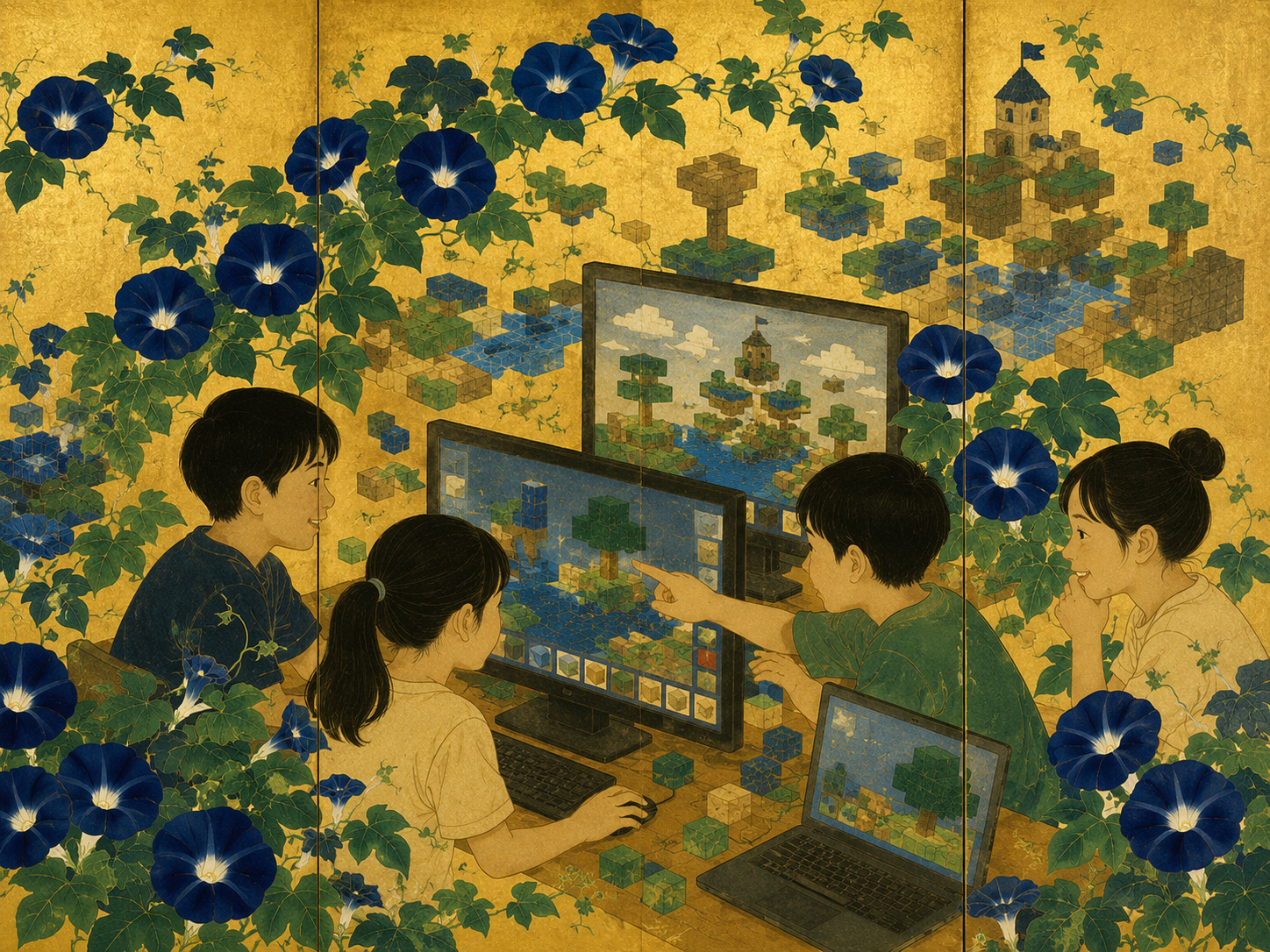
On August 4, 2026, 26 children who use Nakama City’s Higashi after-school childcare program sat down with Teravit, a Japanese sandbox game built around making and sharing playable worlds. The basic challenge was local and concrete: create a game in which a player travels from a starting point, passes through Enju Bridge in Habu Park, and reaches a goal.
Then came the harder instruction. The player had to be able to finish the course—and enjoy it.
That second requirement changed the activity from digital construction into design. A path can be correct and boring. A trap can be surprising and unfair. A moving floor can create suspense or simply make the route impossible. A non-player character can clarify the next step or become noise. Once another person is expected to play, every object becomes a decision about somebody else’s experience.
The children were given tools rather than a single answer. Teravit offered slippery ice blocks, rings that launch a player at speed, spike traps that cause damage, light blocks, programmable dialogue for NPCs, opening doors, moving platforms and buildings. Teams discussed where to put them, tried their routes, discovered what did not work, and changed the worlds.
When construction ended, the event did not. The children played games made by other teams. They presented what they had built, what they had tried to make interesting and what had been difficult. They were asked to reflect on what was fun, what they changed, what failed, and what they would do differently next time.
A game whose real material is consequence
A child building with blocks learns something immediate: if the tower is badly balanced, gravity settles the argument.
A digital game has its own form of consequence. The bridge may look beautiful but fail to connect. The jump may be possible for its creator, who already knows the trick, but impossible for a first-time player. A trap placed for comedy may make the game unfinishable. A route can function technically and still fail socially because nobody understands where to go.
That is why making a game can be intellectually different from playing one.
Playing asks the learner to infer somebody else’s rules. Making asks the learner to invent rules, express them through a system, watch another person encounter them, and then confront the mismatch between intention and result.
CyberStep described “logical thinking” to the children in deliberately plain language: thinking, in order, about what has to happen to make the thing they want actually occur. In the Nakama exercise, the sequence could be physical rather than textual code: first the player reaches this platform; then a launch ring sends the player across a gap; then a door opens; then the route bends toward the bridge; then the goal becomes visible.
The machine does not care that the designer meant well. It executes the world that exists.
The educational power of a game editor is not that every child becomes a programmer. It is that an idea has to survive contact with rules, sequence, failure—and another player.
From a turtle on a screen to a bridge in Nakama
The philosophy behind this kind of activity is older than the personal computer.
In the late 1960s, mathematician and learning theorist Seymour Papert and colleagues developed Logo, a programming language intended for children. Its famous “turtle” could move across a screen—or, in early forms, across a floor—when a child gave it instructions. To draw a square, the learner had to convert the concept of “square” into a sequence: move, turn 90 degrees, repeat.
Papert’s larger argument was more radical than teaching children syntax. Computers, he believed, should not merely deliver information to students. They could become materials for children to think with. His constructionist theory held that people often build knowledge especially effectively when they are actively constructing something meaningful in the world: a drawing, robot, program, story or game that can be examined, shared and changed.
In Mindstorms, first published in 1980, Papert contrasted a computer “programming the child” with a child programming the computer. Years later, reflecting on educational games, he made the distinction sharper: instead of only wishing for games that teach children, a constructionist would want children to make the games.
The technology changed. Logo commands gave way to graphical blocks, robotics kits, Scratch projects, game engines and sandbox worlds. But the intellectual move stayed recognizable: change the learner’s role from consumer to author.
1967 — Logo is created by a team including Seymour Papert and Cynthia Solomon as a programming environment accessible to children.
1980 — Papert publishes Mindstorms, arguing for computers as tools children can control, explore and think with.
2000 — The business that became CyberStep Holdings begins operations in Japan.
2015 — Nakama’s Onga River Pumping Station becomes part of the UNESCO-listed Sites of Japan’s Meiji Industrial Revolution.
2020 — Programming education becomes part of the fully implemented Japanese elementary-school curriculum framework.
2023 — Teravit expands across mobile and Nintendo Switch alongside its PC presence, emphasizing “play, create, show.”
February 17, 2026 — Nakama City and CyberStep Holdings sign a regional agreement covering children, creativity and resource circulation.
August 4, 2026 — Twenty-six children in Nakama build and test games around a digital Enju Bridge challenge.
Japan deliberately avoided making “programming education” synonymous with coding
There is a reason CyberStep’s phrase “think in order about how to make something happen” sounds familiar in Japan.
When the Ministry of Education prepared elementary schools for programming education, it defined the target more broadly than learning a professional programming language. “Programming thinking” was described as the ability to consider what combinations of actions are necessary to realize an intended activity, how corresponding symbols should be combined, and how the sequence can be improved to get closer to the intended result.
The national guidance also emphasized that programming experiences should be embedded in meaningful learning rather than treated as a disconnected technology exercise. It explicitly included examples of schools working with companies and outside organizations, while warning that listing a company or teaching material in official examples should not be interpreted as endorsing that particular company or product.
That distinction is useful in Nakama.
The August event was not part of a claim that every child needs to master Teravit, nor was it a lesson in a formal programming language. It used a game editor as a constrained environment in which sequence and revision become visible. The educational question is therefore not “Did they learn to code?” but “What kinds of thinking did the design process require?”
- Decomposition: break “get to the goal” into smaller sections and encounters.
- Sequencing: decide what must happen first, next and later.
- Constraint awareness: work with the behavior of available blocks, traps, doors and moving assets.
- Testing: play the route rather than assuming it works.
- Debugging without code: change a design when the player gets stuck, misses a jump or misunderstands the route.
- User perspective: design not only for the creator, but for someone who does not know the answer.
- Communication: negotiate with teammates and explain the finished game publicly.
- Reflection: identify what failed and imagine a next version.
Why Enju Bridge was a better assignment than “build anything”
Infinite freedom sounds creative. In practice, a useful constraint can make creativity easier to see.
The Nakama teams shared the same basic destination and local landmark. That meant their choices became comparable. One team could build a direct path. Another could place risk before the bridge. Another could hide the route. Another could turn a crossing into a sequence of jokes.
Enju Bridge also carries something a generic fantasy castle does not: place.
Habu Park is Nakama’s largest urban park, known for its cherry blossoms. The red bridge crosses the pond toward Hanyu Shrine. On the park’s western hill are the Habu Rakan Hyakuana, a group of horizontal tombs dating to the late Kofun period and designated as a Fukuoka Prefectural cultural property. A child building “the bridge” is therefore not only placing red blocks. A piece of the physical city is being translated into a rule-bound digital space.
Nakama has already signaled interest in taking that idea further. Its February agreement with CyberStep Holdings mentions possible creative activities around the Onga River Pumping Station, the city’s component of the UNESCO World Heritage property “Sites of Japan’s Meiji Industrial Revolution.” The pumping station began operating in 1910 to supply water to the Yawata Steel Works and remains part of a story about coal, steel, imported technology and Japan’s industrial transformation.
No such heritage project was announced as completed in the August event—the children’s task used Enju Bridge, not the pumping station. But the possibility points toward a richer form of local digital education: children could become interpreters of their own city rather than merely visitors to somebody else’s virtual world.
Teravit is a game that contains a game-making tool
Teravit describes itself with three verbs: create, play, show.
It is a free-to-play multiplayer sandbox developed and operated by CyberStep. Players combine voxel blocks and other parts to build worlds, add game mechanics, publish what they make and play worlds made by other users. It now runs across Windows PCs, smartphones, Nintendo Switch and PlayStation 4/5.
That places it in a broad family of platforms in which the boundary between player and creator becomes deliberately porous. A user can arrive because a world looks fun, then discover the editor behind it. Templates and reusable assets lower the threshold for a person who cannot yet build an entire game system from scratch.
The commercial version also contains incentives that do not belong automatically in an educational setting: it is free-to-play with item sales, and CyberStep has promoted systems that reward creators when published worlds are played or associated items are purchased. Those features may make creation feel connected to a real audience, but educators should distinguish the design tool from the commercial ecosystem around it.
CyberStep’s corporate history also needs one small clarification. CyberStep Holdings lists its origin as April 2000. In December 2025 the group shifted to a holding-company structure; the current operating company named CyberStep Inc., which develops and runs Teravit, lists December 1, 2025 as its establishment date. The 2026 education program therefore comes from a business lineage more than 25 years old, even though the current operating subsidiary is new on paper.
The municipality did not meet the game company by accident
The August workshop grew from an agreement signed six months earlier.
On February 17, Nakama City and CyberStep Holdings concluded a regional partnership agreement on children and resource circulation. The city’s own description lists five areas: provision and effective use of toys and related goods; activities that nurture imagination and creativity; environmentally conscious and circular-resource initiatives; cooperation with local organizations and institutions; and other actions necessary to advance those goals.
CyberStep’s version of the announcement added that the parties were discussing digital educational measures using Teravit, including opportunities for children to experience digital creation, cultivation of programming-oriented thinking and creativity, and possible projects based on the Onga River Pumping Station.
The partnership sits inside CyberStep Holdings’ “Smile Step Project,” launched around the group’s 25th anniversary. The company has also run game-making workshops in Okinawa, including at the community learning space Sansu Cafe, and has donated computers and game hardware there.
This history matters because one-off corporate events are easy to stage and easy to overinterpret. A durable local program requires much more boring infrastructure: equipment, staff time, child safeguarding, access, scheduling, continuity, and a reason to return after the publicity photograph.
Nakama’s August event included city staff, two university students from a group identified as UNITY, the mayor, and the head of the Nakama City Council of Social Welfare alongside CyberStep personnel. That breadth may be more important than the software itself if the activity is expected to become part of a local learning ecosystem rather than a single afternoon.
The quiet child who spoke loudly
After the event, after-school staff reported one observation that deserves attention precisely because it is not a test score.
A child who was usually quiet and did not speak much was said to have spoken loudly during the activity. Staff also described unusual levels of concentration among some children, and reported that the children broadly said the event was fun.
It is tempting to convert that into a grand claim about games unlocking hidden talent. The evidence does not support that.
But classroom and after-school environments are social systems. A child who says little during a worksheet may become the person who understands how the launch ring works. A child who struggles to explain an abstract idea may point to a platform and say, “Put it here.” A design object can give a group something external to argue about, rather than making the argument about who is “good at school.”
This is one reason constructionist educators have long valued shared artifacts. The thing under construction gives thinking a public surface. It can be touched, tested, criticized and repaired without equating the failure of the object with the failure of the child.
In game design, failure is especially cheap. A spike trap in the wrong place does not ruin a bridge in the real world. The child can move it. The player tries again. The designer sees the consequence.
“Hard fun” needs the hard part
Educational technology often fails when adults remove the very difficulty that creates learning.
If every placement works, there is nothing to debug. If the template supplies the entire game, there is little to design. If the facilitator fixes every mistake, the child never discovers why the mistake happened. If “fun” means simply keeping attention, an entertaining product can be mistaken for an educational one.
Papert used the phrase “hard fun” for learning experiences that are demanding precisely because the learner cares about what is being made. The Nakama exercise had a modest version of that structure. Children described the building as difficult, but also described the satisfaction of finishing and the humor of experimenting together—including one team where a friend placed magma in unexpected places while they were building Enju Bridge.
The laughter is not outside the learning. It is part of the feedback loop: action, surprise, revision, shared memory.
But a one-day workshop cannot show whether those habits transfer to mathematics, writing, scientific reasoning or later programming. Transfer is one of the hardest claims in education. The organizers told the children that the same way of thinking can be useful in study and sports. That is a reasonable pedagogical invitation, not a measured outcome.
| Claim | What the public record supports | What it does not establish |
|---|---|---|
| “The children learned programming.” | The activity required planning, sequencing, testing and revision; the organizer explicitly links these processes to programming-oriented thinking. | That participants learned a programming language or wrote code. |
| “Teravit improved logical thinking.” | The workshop was designed to exercise ordered problem-solving, and staff observed engagement and concentration. | A measured improvement in logical or computational thinking; no controlled assessment was published. |
| “The children recreated Nakama.” | The core assignment used Enju Bridge in Habu Park as a required local landmark. | That the workshop reconstructed the whole city or the UNESCO pumping station. |
| “Games are educational.” | Game creation can require design, iteration, explanation and systems thinking, depending on the task. | That ordinary game play—or any game-making activity—automatically produces educational benefits. |
The next question is access
There is a democratic promise in “anyone can create.” There is also an equipment list.
Digital creation requires devices, network access, time, adults who can troubleshoot, and environments where children feel safe experimenting. A child with a gaming PC at home enters a workshop differently from a child whose only reliable device is a school tablet. A child who already understands three-dimensional controls has more time to think about level design than a child still learning how to move the camera.
That is why the setting matters. This event occurred in an after-school childcare program rather than requiring families to buy a course. The city co-hosted it. Staff and outside supporters were present. In CyberStep’s Okinawa work, the company went as far as donating PCs and a Nintendo Switch 2 after a workshop, explicitly connecting equipment access with continued creation.
Public-private projects should still ask difficult questions. What data are children asked to provide? Are personal accounts necessary? How are published worlds moderated? How are commercial prompts separated from educational activities? Can children with disabilities participate fully? What happens after the visiting specialists leave?
The August Nakama release does not provide enough detail to answer all of those questions, so this article does not assume the answers. If the project grows, those operational details will become part of its educational quality.
The bridge changes when somebody else must cross it
At Habu Park, Enju Bridge has a simple real-world job. The red bridge crosses the pond and leads toward Hanyu Shrine. People know what bridges are for.
Inside the children’s games, a bridge could become something else.
It could be a checkpoint. A joke. A danger zone. A reward. A landmark glimpsed in the distance. A place where the player thinks the game is nearly over and discovers one last trap. The physical bridge carried bodies across water; the digital bridge carried intentions between designer and player.
That may be the most useful way to understand what happened in Nakama.
The children did not simply consume a simulation of their city. They were asked to decide what another person would do inside a representation of it. The moment a teammate or another group tried the game, the design stopped being private. If the player became lost, the world was giving the designer information.
That is a compact lesson in engineering, storytelling and citizenship at once: the thing you make is ultimately experienced by somebody who is not you.
A child playing a game asks, “How do I beat this?” A child making one must eventually ask a more difficult question: “What will another person think I meant?”
There is no need to turn 26 children into 26 future software engineers for the afternoon to matter.
One may remember the moving platform. One may remember the magma joke. One may discover that presenting a game is harder than building it. One may return to the editor. Another may never open Teravit again but retain a smaller habit: when something does not work, break it into steps, test the steps, and change the part that failed.
In the 1960s, Papert gave children a turtle and asked them to tell it where to go.
In Nakama, the children built the road themselves—and then watched to see whether someone else could cross the bridge.
- CyberStep Holdings — August 20, 2026 report on the Nakama Teravit game-making event
- Nakama City — February 17, 2026 regional partnership agreement with CyberStep Holdings
- CyberStep Holdings — partnership agreement, educational discussion and Onga River Pumping Station concept
- Teravit official site — “create, play, show” platform description
- CyberStep — November 30, 2023 Nintendo Switch release and creator-platform description
- CyberStep Holdings — company overview and 2000 origin
- CyberStep Inc. — current operating company and Teravit listing
- Ministry of Education — Elementary School Programming Education Guide
- Ministry of Education — definition and policy discussion of “programming thinking”
- Ministry of Education — programming-education examples involving companies and external organizations
- MIT — Seymour Papert, Logo and constructionist learning
- MIT Press — Papert, “hard fun,” and the idea of children making games rather than only playing them
- Nakama City — Habu Park, its red bridge, Hanyu Shrine and Habu Rakan Hyakuana
- UNESCO/ICOMOS — Onga River Pumping Station within the Sites of Japan’s Meiji Industrial Revolution
Editorial note: The core event account comes from CyberStep Holdings’ August 20 release and is therefore an organizer’s description. Teacher and child comments cited in that release are treated as observations, not independent outcome measurement. The company explicitly states that this was not a code-writing class. No standardized pre/post assessment, control group, longitudinal follow-up, or academic evaluation of the Nakama workshop was published with the announcement. The article therefore distinguishes the cognitive processes built into the task from demonstrated learning gains.