Light arrived first. On July 16, 2024, a daytime fireball passed south of the Statue of Liberty and drove a sonic boom across New York City. Sixty observers in five eastern states reported seeing it. Sixteen people reported feeling the shockwave. At an altitude of about 35 kilometers, the luminous object disappeared.
The story did not end in the sky. Weather radar at Newark Airport briefly detected a ribbon of small falling objects from Staten Island into New Jersey. Near the far end of that trail, in Hillsborough, one of the largest pieces punched through the roof of a house and the ceiling of its main bedroom.
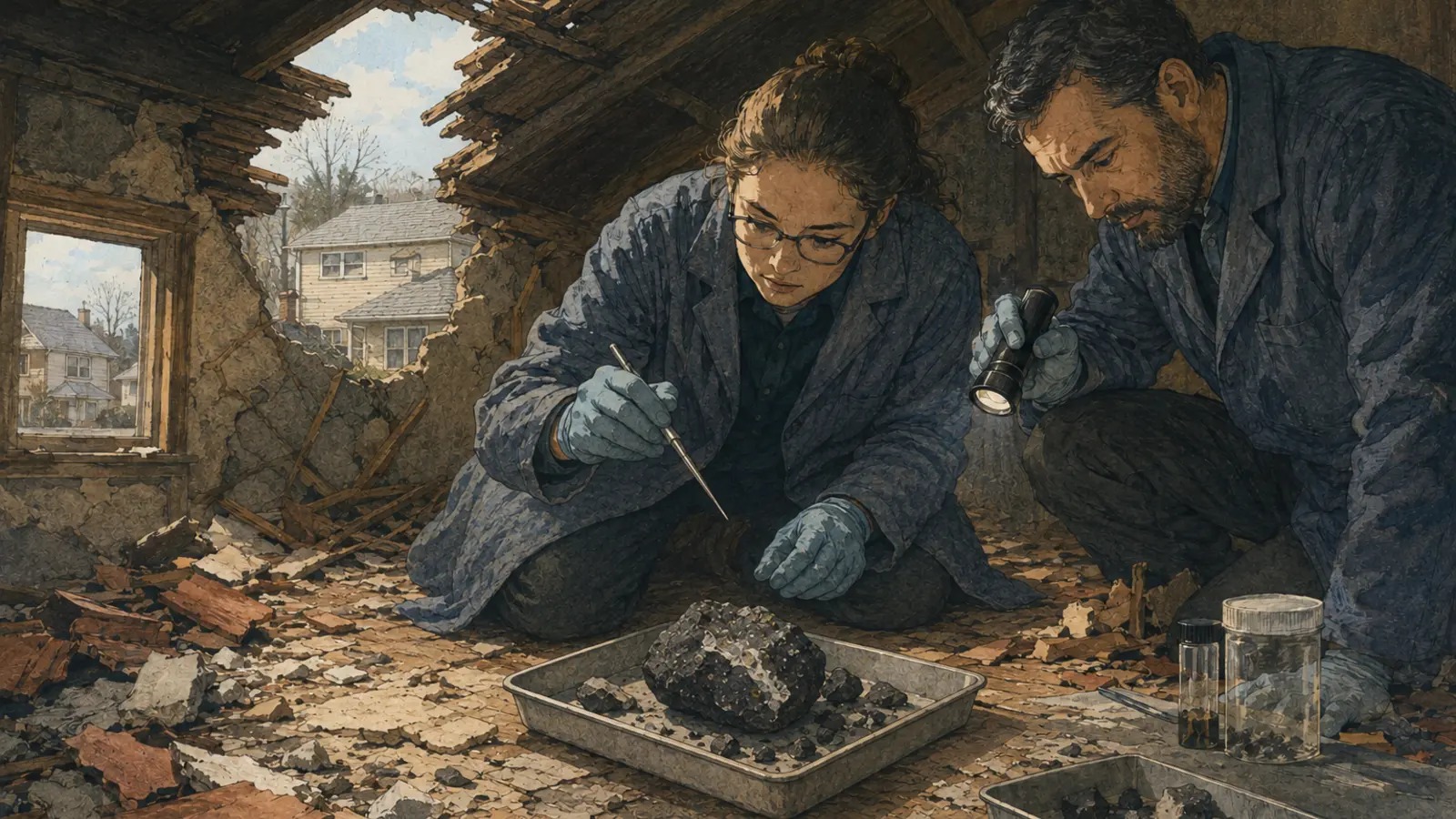
The homeowner found black dust and fragments across the bed and carpet, accompanied by a sulfur-like odor. What happened next turned property damage into an exceptional scientific recovery. He put on disposable gloves, handled the pieces with aluminum foil, sealed them in glass jars and documented the room. Rain, soil, bare hands and household cleaners never had the chance to rewrite the chemistry.
Named Hillsborough for the township where it landed, the stone was analyzed by an international collaboration led by the SETI Institute and NASA. Its authors include researchers from the Institute of Science Tokyo, the Japan Agency for Marine-Earth Science and Technology, Yokohama National University and institutions across the United States and Europe. The results appeared in Science Advances on July 15, 2026.
A sample-return mission by accident
A space rock changes names as its location changes. In space it is a meteoroid. Its luminous passage through the atmosphere is a meteor; an exceptionally bright one is often called a fireball. A solid piece that survives to the ground becomes a meteorite. At Hillsborough, cameras, witnesses, a shockwave, radar and recovered material linked every part of that sequence.
All-sky cameras in Connecticut and Pennsylvania and a doorbell camera in New Jersey recorded the flight. The reconstruction describes a fragile rock about the size of a heavy airline bag entering at 14.4 kilometers per second with an estimated mass near 53 kilograms. It traveled east to west, shedding material as it broke apart. Radar followed the wind-blown fragments after the light went out.
That combination is rare. Many meteorites are found in deserts or Antarctica years, centuries or millennia after falling. Scientists can identify their class, but the incoming orbit is gone and Earth's water and microbes have begun altering the sample. Spacecraft-returned samples are clean and geologically located, but collecting them takes years, exacting engineering and vast expense.
Hillsborough sits between those cases. Nature delivered the sample. Citizen cameras and weather radar supplied the route. The homeowner limited contamination. It was not a controlled space mission, but origin region, flight, arrival and specimen were preserved together—something close to a sample-return mission performed by chance.
The rare boundary called CM1/2
Under a microscope, the stone was not one continuous rock. It was a regolith breccia: fragments broken by ancient collisions and later assembled again near the surface of its parent body. Researchers classified it as a CM carbonaceous chondrite. The “M” honors Mighei, a meteorite that fell in what is now Ukraine in 1889.
Carbonaceous chondrites preserve primitive material from before the planets finished forming. The Institute of Science Tokyo says CM meteorites account for only about 1% of known meteorites and are notable for water-bearing minerals and organic matter. The Murchison meteorite, which fell in Australia in 1969, became the benchmark for the study of extraterrestrial amino acids.
The numbers 1 and 2 do not indicate age; they record the intensity of aqueous alteration. CM2 material has been moderately transformed by water. CM1 has been more thoroughly altered, leaving fewer of the original minerals intact. About 95% to 98% of Hillsborough is CM2-like material, but it encloses millimeter-scale C1/CM1 clasts. Some of those tiny pieces are sodium-rich and record a stronger episode of fluid alteration. The mosaic therefore stands at the boundary: CM1/2.
Hillsborough is only the 22nd observed fall of any CM meteorite and the second witnessed CM1/2 fall, after Kolang landed in North Sumatra in 2020. No pure CM1 fall has been witnessed. Because of the homeowner's response, the team describes Hillsborough as the most pristine CM1/2 meteorite material known.
1889 · Mighei falls, giving the CM meteorite group its name.
1969 · Murchison falls in Australia and becomes a benchmark for organic cosmochemistry.
2020 · Hayabusa2 returns samples from Ryugu; Kolang becomes the first witnessed CM1/2 fall.
2023 · NASA's OSIRIS-REx returns samples from Bennu.
July 16, 2024 · Hillsborough enters a New Jersey home.
July 15, 2026 · The international analysis is published in Science Advances.
Salt is the fingerprint of vanished water
How can a dry stone preserve a watery past? Fluids rearrange minerals. Water dissolves salts and transports their ions through pores and fractures. When water evaporates or freezes, the remaining solution becomes more concentrated until minerals precipitate. The physics resembles the rings left by a drying salt lake on Earth. The setting, however, was an asteroid.
Small clasts in Hillsborough carried much more sodium than the surrounding meteorite. Electron microscopy and X-ray elemental maps showed sodium-rich material in old microscopic fractures. The investigators could also detect fragile sodium-carbonate salts, minerals that readily react with moisture in Earth's atmosphere and often disappear before a conventional meteorite find reaches a laboratory.
The most coherent reconstruction is that liquid water reacted with rock near the parent body's surface and became saltier as it evaporated. An ice-rich primitive asteroid had warmed early in solar-system history, allowing water to alter its minerals. Later collisions shattered and mixed material from different environments into the breccia that eventually fell.
“Brine” should not be mistaken for modern terrestrial seawater or simply table salt dissolved in water. It means a solution concentrated in dissolved ions. The team is still identifying the exact salt minerals. The sequence in which they formed, and how much evaporation, freezing or impact processing contributed, remain subjects for further work.
Reading one stone in dozens of ways
The study's strength is not a single dramatic microscope image. Independent lines of evidence converge on the same history. Astronomers studied the orbit. Mineralogists mapped the fabric of the rock. Organic chemists separated molecules. Isotope specialists tested elemental sources and alteration.
| Clue | Method | What it revealed |
|---|---|---|
| Fireball and falling debris | All-sky and security cameras, witness reports, sonic boom, Doppler radar | Speed, direction, fall zone and an orbit tracing toward the lower asteroid belt |
| Tiny clasts and fractures | Scanning and transmission electron microscopy, X-ray elemental mapping | Highly altered C1/CM1 pieces and sodium enrichment within CM2 material |
| Carbon and nitrogen | Bulk abundance and stable isotope measurements | 1.8% carbon and 0.07% nitrogen by mass, with isotope signatures typical of CM meteorites |
| Organic molecules | Multiple mass-spectrometry techniques | A diverse inventory of amino acids, carboxylic acids and soluble organics |
| History in space | Orbital dynamics and cosmogenic nuclides | The inner belt and possibly the Erigone family; the exact parent remains uncertain |
Yoko Kebukawa of Science Tokyo and Nanako Ogawa, Yoshinori Takano and Naohiko Ohkouchi of JAMSTEC were among the Japanese researchers working with NASA, SETI and laboratories in the United States and Europe. Their collaboration joined mineral, organic and stable-isotope evidence. Meteorite science cannot be completed by one instrument or one institution. Some measurements consume material, making decisions about which grain is distributed, when it is tested and how much is saved part of the science itself.
Amino acids are not life
Hillsborough contains 1.8% carbon and 0.07% nitrogen by mass, and its carbon and nitrogen isotopes are characteristic of CM meteorites. Researchers found a diverse inventory of soluble organic compounds, including amino acids and carboxylic acids. NASA says the complexity of its amino acids is comparable to that of Murchison.
That cannot be shortened to “life was inside.” Amino acids are used to build proteins, but nonliving chemistry can make them. In planetary science, “organic” means carbon-containing; it does not automatically mean biological. The finding shows that chemistry capable of producing prebiotic molecules can proceed inside small asteroids, not only in oceans on mature planets.
Brines are chemically interesting reaction spaces. They can help keep phosphate in solution and promote reactions between organics and precipitating minerals. Hillsborough also contains many magnesium-organic compounds apparently shaped by interactions with minerals. But the authors have not determined whether those compounds were products of brine chemistry or remnants of earlier impact shock.
The conclusion should therefore remain in two layers. Strong evidence shows that water and salts altered rock inside the parent body while a diverse organic inventory was preserved. A broader and well-supported hypothesis holds that CM bodies delivered amino acids and other molecules to the young Earth, enlarging the chemical inventory available before life emerged. It does not identify where or how terrestrial life began.
- Shows: Concentrated brine chemistry operated near the surface of a CM-type asteroid.
- Shows: Intensely water-altered clasts and diverse organics were preserved in the same breccia.
- Does not show: Liquid water, an ocean, organisms or fossils inside the meteorite today.
- Does not show: A unique, named asteroid as the confirmed parent.
- Does not show: That meteorites alone caused life to begin on Earth.
Ryugu, Bennu and the stone in a bedroom
Hillsborough enters a comparison made possible by Japan's Hayabusa2 and NASA's OSIRIS-REx. Hayabusa2 delivered sealed material from Ryugu in 2020. OSIRIS-REx returned material from Bennu in 2023. Both brought primitive samples to Earth with minimal terrestrial exposure, revealing organic matter and minerals recording the evaporation or concentration of brines.
Ryugu and Bennu material is closest to the CI family; Hillsborough is CM. NASA's Mike Zolensky says Hillsborough's saltiest pieces compare closely with the returned samples but are not identical. That difference is the point. Scientists can test how water altered distinct small worlds built from related early solar-system material.
Hillsborough is the first CM meteorite in which these delicate sodium salts have been identified. The finding suggests brine alteration was not limited to the parent bodies represented by returned CI-like samples. As the number of water-processed bodies grows, the early solar system looks less like a warehouse of dry rock and more like a collection of local fluid-chemistry laboratories.
Which asteroid sent it?
The camera-derived orbit points toward the lower inner asteroid belt. One candidate is the Erigone family, a population of carbon-rich objects that includes Donaldjohanson, the asteroid visited by NASA's Lucy spacecraft in 2025.
Reversing an orbit does not yield a single street address. Gravitational resonances, collisions and slow thermal forces move small bodies over time. The research identifies Erigone as a plausible family, not a proven parent. Connections with other carbonaceous populations, including the Beagle cluster in the Themis family, remain part of the discussion.
Cosmic-ray exposure measurements and dynamical models also suggest that the meteoroid may have entered the chain of near-Earth orbits roughly 200,000 years ago. That is not the same as the age of its 4.5-billion-year-old material. A meteorite carries several clocks: formation of the solar system, aqueous alteration of the parent, later collisions, independent travel through space and atmospheric fall.
The next fireball can become science
The team will continue identifying Hillsborough's sodium-rich salts and measuring how they differ from Ryugu and Bennu particles. Some of the meteorite will be curated by the American Museum of Natural History in New York, preserving material for analytical methods that do not yet exist.
Another part of the future remains on Earth. Networks of inexpensive all-sky cameras, home-security video, weather radar and public observations can narrow a fall zone quickly enough to recover stones before rain arrives. In this case, only one large piece was found because it struck a house. The roof, ironically, stopped a fragile visitor, and the homeowner became its first curator.
“If you follow the water through the solar system, you're actually following life,” Zolensky said. It is not a declaration that life was found. It is a research program: trace when and where the elements and molecules life requires encountered liquid water.
The Hillsborough stone was dry when it reached the bedroom. Its interior was nevertheless crowded with water's consequences. From black dust on a bed, researchers reconstructed brine on a world without an ocean—and showed that when people respond quickly, a random impact can become a window into the solar system's past.
- Jenniskens et al., “Meteor over New York City: Brines in a primitive CM asteroid,” Science Advances (2026) — peer-reviewed paper, DOI 10.1126/sciadv.aea2105.
- Institute of Science Tokyo research release — Japanese participation, mineral, isotope and organic analyses, and limits of interpretation.
- NASA, “Study of Pristine Meteorite Adds to Story of Ancient Asteroids” — preservation, salt minerals, Ryugu/Bennu comparison and candidate origin.
- SETI Institute, “Alien World Chemistry Found Inside Meteorite” — fireball observation, fall reconstruction, CM classification and organics.
- NASA Technical Reports Server paper record — authors, institutions, funding and research abstract.
- JAXA on soluble organic molecules in Ryugu; JAXA on Ryugu's formation and evolution.
- NASA Earth Observatory on Bennu's evaporite minerals.
Editor's note: This report prioritizes the peer-reviewed paper and primary institutional releases. The parent-family assignment, pre-entry mass and time since orbital separation are model-based estimates, not direct measurements. “Ingredients for life” refers to organic molecules, not evidence of life.