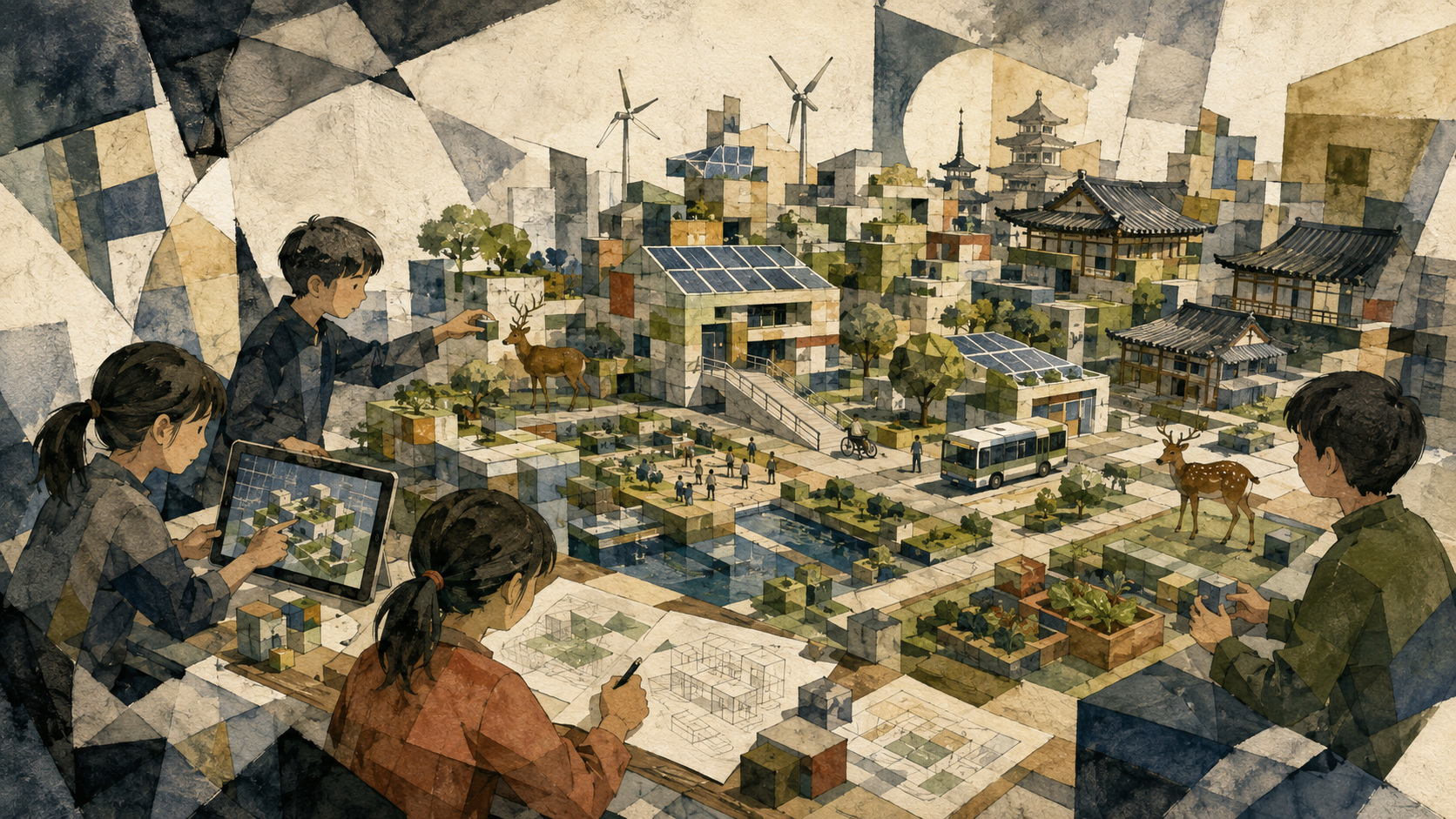
A child lays a road across a field of cubes. Beside it comes a low-floor bus stop, then a clinic, an irrigation pond, solar panels and a shaded square. Another child wants a deer crossing. A third asks where the old people live. The questions begin to collide: if the bus detours to every house, can it still run often? If panels cover the hillside, what happens to the view and the forest? If the square welcomes tourists, where do residents buy groceries?
That collision is the useful part. Minecraft makes construction almost frictionless. Community does not. A digital block can be placed in a second; a real site has owners, neighbors, budgets, buried archaeology, maintenance bills, flood paths and memories. The educational value lies not in confusing the two worlds, but in making a proposal visible enough for someone else to challenge.
Nara Prefecture announced on August 4 that it would participate as a local-government partner in the eighth Minecraft Cup. It has supported the contest in that role since the seventh edition, but 2026 brings a significant change: Nara is one of the prefectures with its own regional block. Children in the prefecture no longer enter a broader combined district before the later stages. Nara’s regional presentation is scheduled for November 14 at AEON Mall Kashihara, and eligible district finalists can be considered for a prefectural special prize, the “Future of Nara Award.”
The setting carries an accidental historical elegance. Kashihara is the city of Fujiwara-kyo, the first full-scale Japanese capital laid out on a formal grid. More than thirteen centuries after that city was completed, young people will gather in the same municipality to present new settlements built on a different grid—one made of programmable cubes rather than roads, drainage channels and palace walls.
The contest behind the blocks
The Minecraft Cup began in 2019. Its organizer says 21,577 people have registered and 3,603 works have been submitted since the program began. In 2026, entries are being accepted across 24 regional blocks—23 in Japan and one overseas. The eighth competition has removed the earlier division system and allows one-person entries. Teams may contain up to 40 members.
The elementary grouping is determined by a team’s oldest member being no older than 12 on April 1, 2027. The middle- and high-school grouping allows an oldest member up to 19, with the rule requiring a 19-year-old to be enrolled in an eligible secondary course. Submissions opened June 1 and close at 5 PM on September 7. Preliminary judging follows on September 12 and 13; regional finalists are due to be announced September 18. Regional events run from October 17 through November 29, followed by area judging in December and the national final at the University of Tokyo on February 14, 2027.
The official theme is expansive: “A Future City Where Everyone Shines: The Beta Generation’s Future Community—How Will We Live in a Society Where the Population and Age Balance Are Changing?” The organizers ask participants to imagine 10 or 20 years ahead and consider technology, environment, region, work, daily life and human connection. The phrase “Beta Generation” provides a dramatic horizon. The harder and more useful part is the question after it: what changes when there are fewer people, a different balance between young and old, and unequal change from one place to another?
Nara’s press release emphasizes programming and digital making, but the competition rules make clear that technical fluency alone is not enough. Judges score six dimensions. A beautiful skyline can lose to a less polished world if it cannot explain what was researched, why the design exists or how the mechanism addresses the stated problem.
| Judging dimension | What the official rules ask | What that means in practice |
|---|---|---|
| Theme | Turn the theme into a question and embody the answer in the world. | “A green city” is a label. “How can a mountain village keep mobility with fewer drivers?” is an inquiry. |
| Research | Use books, websites, video, interviews, visits and direct experience; understand and communicate what was found. | Talk to a bus user, forester, shopkeeper or caregiver; visit a pond; compare a map with the model. |
| Conception | Develop an original idea through writing, drawing or plans and explain the personal reason for making it. | The entry should reveal a value and a point of view, not only reproduce familiar “smart city” objects. |
| Execution | Plan the work, respond to trouble and finish; collaborate well or seek advice effectively as an individual. | The process—including disagreement and revision—matters alongside the final world. |
| Technique | Use tools such as MakeCode, redstone and command blocks, and connect the mechanism to the theme. | A sensor, routing system or energy display should solve or demonstrate something, not exist as decoration. |
| Expression | Use images, video and presentation to communicate the most important feature and the maker’s commitment. | Regional finalists must make the idea intelligible in a one-minute video, a two-minute speech and questions from judges. |
That sequence—research, question, design, system, explanation—separates digital civic learning from a building contest. Minecraft is the common language, not the subject of the whole conversation.
Nara has been designing cities for 1,300 years
The Minecraft grid has a deep predecessor in Nara. Fujiwara-kyo, completed under Empress Jito in 694, arranged roads into a formal jobo grid around an approximately one-kilometer-square palace complex. Kashihara City describes it as Japan’s first capital based on a full gridded urban system. Roads, drains, residential parcels, temples, administrative buildings and the movement of resources had to be planned at a scale the archipelago had not attempted before.
It was not merely an architectural project. The city expressed a new centralized state. The palace occupied the center; hierarchy was visible in space. The Taiho Code of 701 organized government and law while the capital organized bodies, offices and ceremony. The grid was a political technology.
Fujiwara-kyo lasted only 16 years as the capital. Kashihara’s archaeological account notes that it faced urban problems including sanitation and unpleasant odors. In 710, the court moved to Heijo-kyo, in present-day Nara City. That larger capital also used a broad rectilinear plan. The Agency for Cultural Affairs describes a city roughly 4.3 kilometers east to west and 4.8 kilometers north to south, plus an eastern extension, with an estimated population of about 100,000. Nara remained the capital until 784; UNESCO calls the surviving monuments evidence of a period when the framework of Japanese government was consolidated and Nara became a source of national culture.
The comparison with Minecraft should not become sentimental. Ancient residents did not co-design the capital in an open workshop, and the grid represented centralized authority rather than participatory democracy. But the history supplies an essential lesson: a plan is never neutral. The placement of a palace, road, market, drain, school or bus stop distributes time, safety, access and prestige. Every map contains an answer to “who matters,” even when the mapmaker never writes the words.
694 Fujiwara-kyo becomes the capital, with a formal grid, palace, roads and drainage.
701 The Taiho Code helps establish the institutions of the centralized state.
710 The capital moves to Heijo-kyo, another vast planned city in present-day Nara.
710–784 Nara serves as Japan’s capital and a major center of political and cultural formation.
2019 The first Minecraft Cup is held.
2025–26 Nara participates as a local-government partner from the seventh competition.
November 14, 2026 Nara’s first independent regional block presents future-city entries in Kashihara.
There is a second historical lesson in the vanished capital. Even a monumental plan can become a field again. After the court departed, much of Fujiwara-kyo returned to agricultural use. Buildings were dismantled or moved; archaeology now recovers roads and drains from the earth. The enduring community is not the rendering. It is the capacity to adapt after the rendering has failed, aged or outlived its purpose.
Water: 4,300 lessons in collective maintenance
Nara’s future cannot be designed only through famous temples and deer. The physical prefecture is an uneven system of basin and mountain, dense settlement and thin settlement, water scarcity in one place and abundant headwaters in another.
The Nara Basin receives relatively little rain. Across generations, residents made reservoirs part of the landscape; the prefecture counts about 4,300 irrigation ponds of different sizes today. These are not scenic blue tiles. They store water, support farming, require embankment inspection, affect flood risk and connect downstream users to choices made elsewhere. Nara’s agricultural history also includes rotations between paddy and dry-field crops and later transfers of water from the Yoshino River system.
A child can reproduce a pond in Minecraft in minutes. Research begins when the pond acquires relationships. Where does the water come from? Who maintains the embankment as farmers age? What happens in a drought? What happens during extreme rain? Is a walking path compatible with agricultural use? Can sensors report water level without creating a maintenance system that no one can afford?
This is why the competition’s research criterion matters. A model that places water beside every farm may look generous while ignoring elevation and supply. A stronger project could document a real pond, interview users, represent the watershed, program changing water levels and show who receives an alert. It should also admit what it cannot simulate. Minecraft water does not establish hydraulic capacity, seismic safety or legal water rights.
A forest grows faster on screen than in Yoshino
Forests cover 77 percent of Nara Prefecture. The Yoshino region has a documented planting tradition reaching back to around 1500 and a forestry system famous for dense planting, repeated thinning and careful management over generations. Some trees still standing were planted two or three centuries ago. The work linked mountain owners, local “mountain keepers,” labor, river transport, sawmills, builders and distant markets.
That history is almost the opposite of digital construction. In creative mode, timber is unlimited and a tree is an object. In Yoshino, a forest is a promise made by one generation to another. The prefecture’s own account describes falling timber prices, reduced demand for high-end wood, expensive extraction and shortages of younger workers. The question is not simply how to conserve trees; it is how to keep a living management system viable.
A future-community entry might connect local timber to housing, school renovation, biomass heat or disaster prevention. But each link introduces a test. How much wood is harvested, and how much grows back? Does a biomass facility have a reliable fuel stream? Who thins steep slopes? How far must material travel? Is carbon stored in long-lived construction or quickly returned to the air? The prefecture’s decarbonization strategy itself notes that Nara faces terrain and grid constraints on large wind and hydropower development, placing more emphasis on solar power, woody biomass and localized small hydro. A generic field of turbines would therefore be less persuasive than a design grounded in Nara’s actual limits.
Minecraft can make time visible if the team chooses to build it: a young stand, a thinned stand, a mature forest, a mill, a house and the workers between them. It can show cause and effect. It cannot prove slope stability, biodiversity protection, commercial viability or life-cycle emissions. Those require field knowledge and specialized analysis beyond the game.
One prefecture, radically different distances
Nara’s population is concentrated in the northwestern Yamato Basin. The mountainous south and east contain much of the land but far fewer people; the prefecture describes its habitable land area as the smallest among Japan’s prefectures. Its southern and eastern policy region comprises 19 municipalities, many dealing with depopulation, aging and the difficulty of sustaining services over long distances.
This is where the 2026 theme becomes concrete. “Population decline” is an abstraction until the last shop closes, a driver retires, a nurse covers a wider route, a school has too few pupils, or an older resident stops going out because the return bus leaves too early. A shrinking community is not merely a smaller version of a large one. Fixed infrastructure remains long after the users and tax base change.
In 2025, Nara’s governor argued that land-use controls created to prevent disorderly growth under a rising population may no longer fit communities where population growth ended long ago. That does not mean every restriction should disappear. It means the original problem—containing expansion—has changed. Reuse, consolidation, mobility and care can become more urgent than opening new subdivisions.
Digital blocks are well suited to comparing arrangements. A team can place homes around a shared mobility hub, convert a closed school into a clinic and workshop, test a demand-responsive route, or show a traveling service. It can walk through the design at a child’s eye level, then at the slower pace of a person using a wheelchair. The multiplayer world allows one child’s ideal shortcut to run into another child’s need for a safe crossing.
But the model must include people, not only facilities. Who books the vehicle without a smartphone? Who drives when automation fails? Who pays for an elevator’s inspection? Does relocating services save money while stripping identity from a village? What happens to a resident who refuses to move? The unanswered questions do not weaken a project. Naming them makes it more honest.
| Real Nara question | Evidence a team could gather | What a Minecraft prototype could show | What it cannot establish |
|---|---|---|---|
| Water and farming | Pond visit, watershed map, farmer and maintenance interviews, drought and rainfall records | Flows, alerts, shared uses, upstream and downstream consequences | Engineering safety, water rights, construction cost |
| Forest livelihoods | Forester or mill interview, harvest cycle, slope and access, demand for local wood | A multi-decade management cycle and links from forest to building or energy | Ecological impact, profitability, real carbon accounting |
| Aging and mobility | Timetables, resident travel diaries, barrier audit, talks with drivers and care workers | Routes, transfer points, accessible paths and service scenarios | Operating budget, labor supply, legal compliance |
| Heritage and daily life | Site visit, archaeology constraints, resident and visitor movements, accessibility needs | Alternative paths and uses that protect significant spaces while widening access | Conservation approval or impact on buried remains |
| Deer and people | Park observation, protection plans, waste and traffic patterns, farmer perspectives | Crossings, feeding rules, habitat edges and visitor circulation | Animal behavior, population ecology or enforceability |
These are examples of inquiry, not reports of what entrants have submitted. As of publication, the submission window remains open. Their purpose is to show the distance between decorating a “future city” and investigating a future community.
Why Minecraft can work as a civic sketchbook
Minecraft’s first educational advantage is legibility. A conventional zoning plan is difficult for many adults, let alone children. A block world can be entered, walked, changed and discussed. A participant can point: the crossing is too far; the roof blocks the view; the square has no shade. The object of disagreement is shared.
The education version became generally available in Japan and other Asia-Pacific markets in 2016. It added classroom management and documentation tools to the open building environment. Camera and portfolio functions can record research and process. Non-player characters and boards can carry explanations or different resident viewpoints. Code Builder allows programming inside the world. The Cup specifically recognizes MakeCode, redstone circuits and command blocks when they are used to serve the theme.
That matters because a working system expresses more than a static building. A team can program streetlights, model an alert, count passengers, trigger an accessibility aid or show how energy demand changes. Coding forces a rule to become explicit. When should the bus depart? Which water level produces a warning? What happens if the sensor returns no data? A vague smart-city promise becomes a sequence that can fail.
Research gives cautious support to the approach. A 2023 mixed-methods study of 173 primary pupils in an Irish national project-based Minecraft initiative found that pupils reported learning opportunities particularly in creativity and collaboration, alongside enjoyment and perceived usefulness. Reviews of Minecraft in education find recurring evidence of motivation, social engagement and subject learning, but also uneven study quality, limited control groups and a need for stronger long-term evidence. A more rigorous 2024 cluster-randomized trial involving 885 pupils found no overall intervention-related improvement in spatial thinking; the control group had higher creativity scores at post-test, although one grade subgroup showed a spatial gain. Teacher interviews also identified implementation difficulties. Ordinary Minecraft play, then, cannot be assumed to produce broad cognitive gains.
The correct conclusion is conditional. Minecraft can support learning when the question, research, facilitation, reflection and assessment are strong. It does not turn screen time into civic understanding by itself.
Urban planners have reached a similar conclusion. Since 2012, UN-Habitat’s Block by Block methodology has used Minecraft as a participatory design tool, particularly to bring young people into public-space discussions. Projects combine site walks, training, group building and presentations to officials. A study with children in a Brazilian town found the game useful for engagement and for co-creating walkable, green and interactive places. These programs demonstrate that a block model can help people who do not speak architectural language make spatial ideas visible. They do not mean that every model becomes construction or that participation removes political conflict.
- Observe: walk the place, map it and notice who uses it at different times.
- Listen: interview people who experience the problem differently, including those who may dislike the first idea.
- Frame: turn a broad topic into a question specific enough to test.
- Build: create alternatives, not only one polished answer.
- Program: make at least one important relationship operate as a rule or system.
- Stress-test: add rain, a power failure, an absent worker, more visitors or fewer users.
- Revise and explain: show what changed because of evidence and what remains unknown.
The cube has edges
Every medium favors some ideas. Minecraft favors what can be seen, traversed and assembled. It makes a new building easier to display than a better staffing schedule, a trusted neighbor network, a change in procurement or a caregiver’s time. It rewards spatial abundance. Real shrinking communities may need fewer buildings, shared operations and careful maintenance—solutions that look modest on screen.
The grid also simplifies. Slopes become steps. Water follows game physics. Property lines can disappear. Materials arrive without extraction, wages or waste. A command block can make a service reliable in a way no public institution can guarantee. The model can test coherence—whether the pieces connect in the imagined system—not feasibility.
Competition changes behavior as well. A spectacular entry may be easier to remember than a quiet, evidence-based one. Experienced players can build faster than beginners. In a 40-person team, labor may be unequal: one child researches, another codes, a highly skilled builder controls the visible world. Adults can help so much that the child’s authorship becomes unclear. The Cup’s criteria and required disclosures, including identification of certain third-party and AI-generated material, attempt to make process visible, but judging can never observe every hour of creation.
Access is another real condition. Japan’s GIGA School program made one device per pupil and high-capacity networks a national standard, and elementary programming education has been compulsory since fiscal 2020. Yet a device in school does not equal equal time, an appropriate Minecraft Education license, a capable computer at home, reliable connectivity, a mentor or confidence in a game interface. The organizers offer a paid support package combining a license and three introductory online classes, acknowledging the entry barrier. Local libraries, schools, clubs and public workshops remain important if participation is to reflect more than the families already equipped to compete.
There is a final democratic limit. A child may build a beautiful village after interviewing adults and still miss the person who never entered the room. Participation is not representative simply because it is playful. Whose voices are absent—disabled residents, very old residents, migrant workers, non-players, people without time—should be part of the presentation.
The presentation is part of the city
Regional finalists will not be judged only by a downloadable world. They must use a one-minute video and a two-minute speech before answering questions. That compression can be harsh, but it introduces a civic truth: a proposal has to leave its maker’s screen. It must be explained to people who did not build it and may not share its assumptions.
The strongest question a judge can ask is not “How many hours did this take?” It is “What changed after you spoke to someone?” The answer reveals whether research decorated an existing idea or actually altered it. A bus stop moved. A staircase became a ramp and a resting place. A solar field became rooftop panels after a landscape interview. A tourist plaza gained a grocery delivery point. A forest acquired workers, years and a market.
Nara’s “Future of Nara Award” can recognize imagination. Its deeper opportunity is to recognize attention: a child’s capacity to see a familiar place as a system of relationships and to notice the person whom the current system makes wait. That is a form of civic education that predates any software.
The prefecture also runs other efforts to hear children and young adults, including an online “Children at the Center Club” and school visits. The Minecraft partnership will be most meaningful if it connects to that wider habit of listening. A competition produces winners; public life needs ways for useful observations from non-finalists to remain visible too.
From an old grid to an open question
On November 14, the regional presentations in Kashihara will bring two kinds of city-making into quiet alignment. Beneath and around the modern municipality lie traces of a capital drawn to embody the order of a new state. On screens in a shopping mall, children will show cities drawn to answer a different order: a society with fewer people, more older residents, new technologies and old obligations to land and memory.
The ancient grid and the digital grid share an attraction. Both make complexity appear governable. Straight lines imply that a place can be understood from above. But community is lived at ground level: the distance from a house to a stop, the slope of a path, the timing of a clinic, the shadow over a pond, the years before a tree is ready, the person who has to repair the system after the designers leave.
A successful entry should therefore be judged not by how completely it solves Nara. No child, planner or governor can do that in one model. Its achievement would be smaller and more durable: to define one real problem carefully, show the relationships inside it, make a proposal that another person can inspect, and remain willing to rebuild.
Minecraft makes deletion painless. That may be its most radical civic lesson. In public argument, people often defend a plan because it has become theirs. In the block world, a wall can move, a road can narrow, a forest can return. The point is not that reality is equally easy. The point is to practice changing one’s mind before concrete, money and authority make change harder.
Nara’s first capitals were built to last and then changed, disappeared or became something else. Their remains warn against mistaking a plan for permanence. The children’s cities will also be temporary. The valuable thing they may leave is not a skyline but a question carried back into the real prefecture: if we can build this together on screen, what would we have to learn—and whom would we have to hear—before trying any part of it outside?
Reporting Notes and Principal Sources
Competition dates, eligibility, judging and Nara’s role are based on official materials available through August 13 at 9:52 AM Japan Standard Time. Suggested project ideas in this article are illustrative; they are not descriptions of submitted entries. Educational research is presented as contextual and conditional evidence, not proof that the contest itself has produced a measured outcome.
- Nara Prefecture: participation in the eighth Minecraft Cup, Nara block, event and special award
- Nara Prefecture: child-centered participation programs and Minecraft Cup partnership since the seventh contest
- Minecraft Cup: theme, eligibility, judging criteria, schedule, rules and organizer
- Minecraft Cup: eighth competition launch and participation history
- Minecraft Cup: regional presentation format and venues
- Kashihara City: Fujiwara-kyo, its grid and state-building history
- Kashihara City: archaeology, urban problems and the end of Fujiwara-kyo
- Japan Cultural Expo and Agency for Cultural Affairs: Heijo-kyo’s scale and plan
- UNESCO: Historic Monuments of Ancient Nara and the capital from 710 to 784
- Nara Prefecture: agriculture in the basin and approximately 4,300 irrigation ponds
- Nara Prefecture: 77 percent forest cover and the history, methods and challenges of Yoshino forestry
- Nara Prefecture: sustainable development support for depopulated regions
- Nara Prefecture: population decline and reconsideration of land-use systems in the south and east
- Nara Prefecture: decarbonization strategy and local renewable-energy constraints
- Nara Prefecture: protection plan for coexistence between Nara’s deer and people
- Ministry of Education: GIGA School and the one-device-per-pupil environment
- Ministry of Education: programming education from fiscal 2020
- Microsoft: 2016 general availability of Minecraft Education in Japan and Asia-Pacific
- Minecraft Education: Code Builder documentation
- TechTrends: Slattery and colleagues on pupils’ experience in a national project-based Minecraft initiative
- Learning and Instruction: cluster-randomized trial of spatial thinking and creativity outcomes
- International Journal of Game-Based Learning: review of Minecraft in education, benefits and research limits
- UN-Habitat: Block by Block playbook for participatory urban design
- ISPRS International Journal of Geo-Information: Minecraft and children’s participation in urban planning