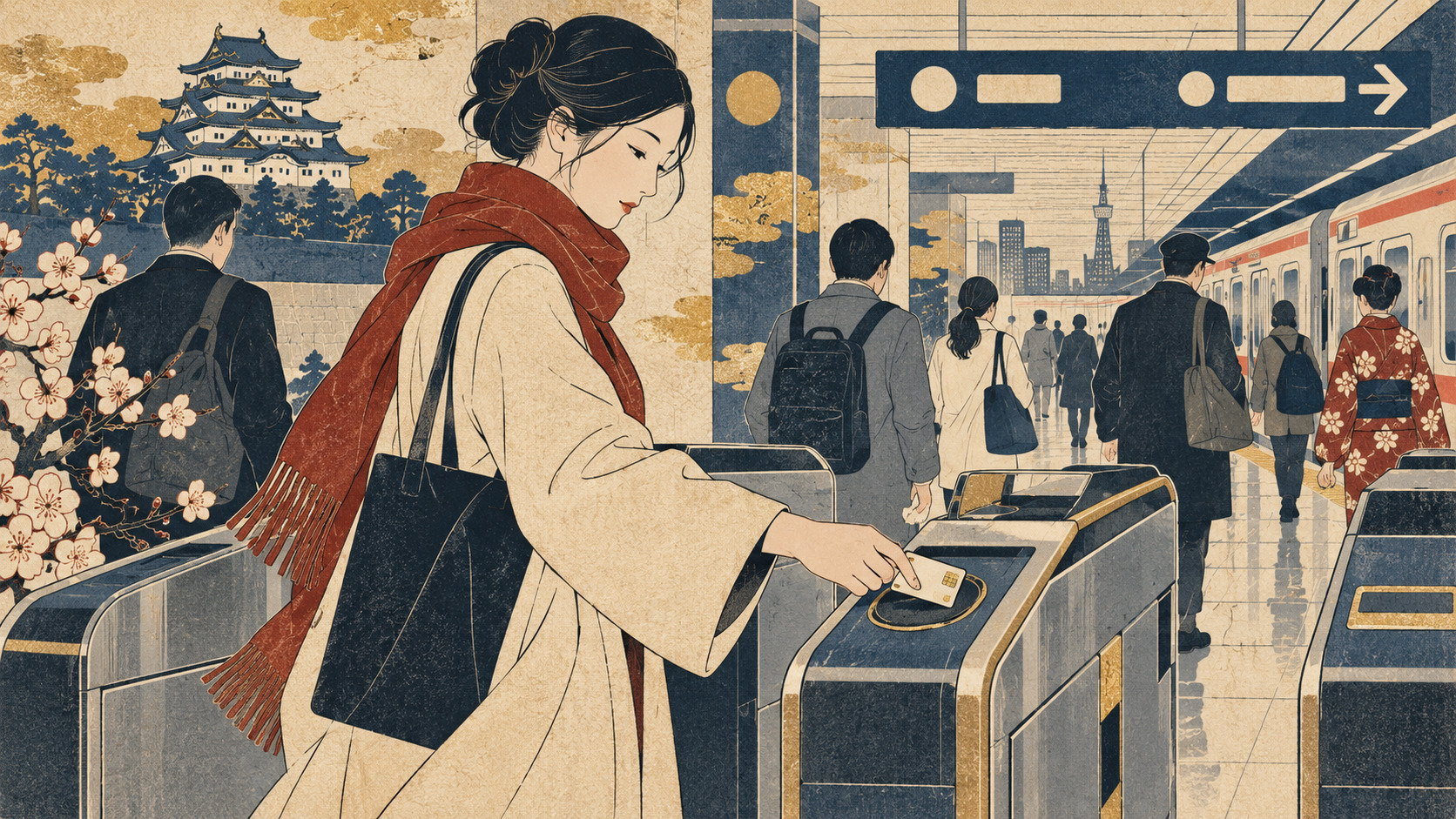
A visitor stepping off the shinkansen at Nagoya no longer has to understand a new stored-value card before taking the subway. A bank card bearing the contactless symbol—or a phone or watch provisioned with one—can be held to the dedicated reader. The passenger must present that exact same card or device on the way out. The system then calculates the trip and settles the day’s rides from the following day onward.
The Nagoya City Transportation Bureau calls the service kureka jōsha, literally “credit-card riding.” It began with the first trains on September 3 across all 87 stations. Visa, Mastercard, JCB, American Express, Diners Club, Discover and UnionPay are supported. Eligible credit cards, some debit and prepaid cards, and cards loaded onto smartphones and wearable devices can be used. No advance registration is required, and credit cards need no stored balance.
The apparent simplicity rests on one rule that can easily catch a hurried passenger: a plastic card and a phone linked to that card are different media, even if the visible account number appears identical. A person who enters with plastic cannot exit by tapping the phone. One card cannot carry a group through, and the cardholder—not a companion borrowing it—must use it.
Every station does not mean every gate
The difference matters in a network whose larger stations have several dispersed entrances. Nagoya is adapting existing automatic gates rather than replacing them all at once. A compatible gate has a dedicated reader and a sticker showing the payment brands. Riders are instructed to hold the card or device in place until the LEDs around the reader turn from blue to green.
As of this edition, three gate areas were scheduled for conversion during September: the south gate at Yabachō, the central gate at Atsuta Jingū Temma-chō and the central gate at Hibino. Twelve were scheduled for October or later: the east gates at Ōzone and Nagoya Dome-mae Yada; the central gates at Minato Kuyakusho and Myōondōri; the south gates at Tōkaidōri, Rokuban-chō, Higashi Betsuin and Heian-dōri; the west gate at Kurokawa; both west and east gates at Shiga-hondōri; and the central gate at Tsukijiguchi.
That list does not mean 15 stations are excluded. The station is in the service; a different gate may already have a reader, and at an unconverted gate the bureau tells passengers to ask the attendant. It is a modest operational distinction with a large editorial consequence: “all stations” is true, while “all gates” would not be.
The easiest tap may not be the cheapest choice
Every contactless bank-card ride is charged at the adult ordinary fare. Child fares, disability and other concessions, and the bureau’s transfer discount do not apply. A bank card cannot be combined with a commuter pass, 24-hour subway ticket, senior pass or another fare product. It cannot pay an on-board fare adjustment, and it is not accepted for substitute transportation when a disruption triggers reciprocal carriage arrangements.
That makes the new option especially well suited to an adult taking an occasional, straightforward trip. It is less attractive to a child, a qualifying concession holder, a commuter, or a visitor planning enough rides to make a day or 24-hour ticket worthwhile. Nagoya has added a lane to its fare system, not flattened the system into a single universal payment.
| Method | Best suited to | Main limitation |
|---|---|---|
| Contactless bank card | Adult single journeys; first-time visitors; riders avoiding a top-up | Adult ordinary fare only; same medium in and out; no pass or concession |
| manaca or interoperable transit IC | Routine travel; local transfer arrangements; riders used to stored value | Normally requires a balance; child and concession users need the appropriate card |
| Paper ticket or day product | Child and concession fares; intensive sightseeing; product-specific benefits | Conditions and geographic validity vary by ticket |
Debit and prepaid cards introduce another risk. The bureau says a balance greater than the fare is necessary and warns that insufficient funds may cause the card to be blocked from contactless travel on both Nagoya municipal transport and Meitetsu. Ticket machines do not display bank-card travel history. A rider who registers with QUADRAC’s Q-move website can view the previous year of journeys.
The operator aggregates rides by travel day and settles them from the next day onward; the date a charge reaches the account depends on the issuer. For an overseas card, the transit fare is denominated in yen, but the issuer’s exchange rate and foreign-transaction fee may affect the final home-currency amount. Nagoya does not control those card terms.
The tracks continue into Meitetsu territory; payment coverage does not
Nagoya’s subway is physically intertwined with the private railway network. Tsurumai Line trains run through at Kami Otai and Akaike onto Meitetsu tracks, while Kamiiida Line service continues onto the Meitetsu Komaki Line. A passenger may remain in the same train as it crosses the institutional boundary. The payment map is narrower.
The 13 Meitetsu destinations identified for through contactless payment are Central Japan International Airport, Meitetsu Nagoya, Kanayama, Higashi Okazaki, Jingū-mae, Kōnomiya, Meitetsu Ichinomiya, Shin Kisogawa, Kasamatsu, Meitetsu Gifu, Inuyama, Chita Handa and Nishio. Travel between those stations and the municipal subway is supported. For a Meitetsu origin or destination outside that group, the bureau tells riders to use a transit IC card or an ordinary ticket.
This is the present paradox of open-loop transit. A globally familiar bank card is valuable precisely because it can cross borders between cities and countries. Yet each railway must still install readers, connect fare logic and agree on settlement. “The train goes there” and “this card can pay there” remain two different maps.
From a 15-yen ticket to a third generation of gates
Nagoya’s first subway opened between Nagoya and Sakaemachi—today’s Sakae—on November 15, 1957. The 2.4-kilometer section was built beneath land reserved during postwar reconstruction along what became Nishiki-dōri. Engineers used a pneumatic caisson to carry the tunnel under the Horikawa. Public service began at 2 p.m.; two-car trains ran every three minutes, and the city recorded 130,000 riders that day. The adult flat fare was ¥15.
For decades the physical ticket was gradually supplemented by magnetic stored-value media. The local Yurika card stopped being sold on February 10, 2011, on the eve of the launch of manaca, Nagoya’s transport IC card. Yurika use ended in February 2012. manaca became interoperable with JR Central’s TOICA in April 2012 and joined the nationwide reciprocal-use network with Suica and other major transit cards on March 23, 2013.
manaca is a closed-loop transport instrument: a transit issuer controls the stored value, commuter-pass functions and local concessions. The new bank-card lane is open-loop. The same international payment credential used in shops becomes the identifier at the gate, while fare calculation and settlement happen behind it. The distinction explains why the systems coexist. Bank cards broaden access; manaca continues to carry functions that a generic retail payment card does not.
November 15, 1957 — The first 2.4 kilometers open between Nagoya and Sakaemachi.
February 11, 2011 — manaca launches.
April 21, 2012 — Reciprocal use with TOICA begins.
March 23, 2013 — Nationwide interoperability with major transit IC cards begins.
March 2024 — Meitetsu introduces contactless bank-card travel at 13 stations.
September 3, 2026 — Coverage reaches all 87 Nagoya municipal subway stations.
A global front door built for a very local deadline
The launch came sixteen days before the 20th Asian Games, scheduled for September 19 through October 4, and weeks before the fifth Asian Para Games, scheduled for October 18–24. A joint announcement by the bureau and its payment and equipment partners explicitly framed the rollout as preparation for domestic and international visitors unfamiliar with Japanese tickets or local IC cards.
The service uses Sumitomo Mitsui Card’s stera transit solution. The city operates the railway and prepares the equipment. Sumitomo Mitsui Card, Nagoya Card and JCB support the payment networks. Nippon Signal, OMRON Social Solutions and Toshiba develop or supply gate systems. Nippon Signal provides the IDONEO fare-determination platform, and QUADRAC supplies the Q-move authentication and payment platform. The effortless second at the gate is the visible edge of a multi-company cloud and settlement chain.
For the Games, the immediate measure of success will be whether unfamiliar visitors move through stations without queuing at ticket machines or help counters. As public infrastructure, however, the test is longer. How often do overseas cards fail? How many riders present a phone after entering with plastic? How well are people directed at unconverted gates? Do families discover the adult-only rule before they are charged? The launch materials reviewed for this report did not state the project cost, a usage target or transaction volume.
The reform deserves neither dismissal as a mere payment gadget nor praise as a universal solution. Its value is precise: it removes one piece of friction for people who already hold an eligible card. A child may still need a child IC card or ticket. A commuter will still prefer a pass. A visitor making many trips may save with an unlimited ticket. Nagoya’s new gate will have succeeded when the bank-card tap becomes unremarkable—and when the system makes the right alternative equally easy to find.
- Does the card carry the contactless “wave” symbol?
- Does the gate reader display supported payment-brand stickers?
- Will you use the exact same physical card or device to exit?
- Is an adult ordinary fare right for you? Use another medium for a child, concession, pass or day ticket.
- If traveling onto Meitetsu, is the origin or destination one of its 13 supported stations?
- Nagoya City Transportation Bureau: Credit-card travel (contactless payment) (Japanese) — launch, stations, brands, procedure, exclusions, settlement and gates awaiting conversion.
- Joint announcement by Nagoya and payment/equipment partners (Japanese, August 17, 2026) — participating companies, system architecture and Meitetsu interoperability.
- Nagoya City Transportation Bureau: Fiscal 2026 initiatives (Japanese) — conversion of existing gates and cashless program.
- Nagoya City Transportation Bureau: The growth of city buses and opening of the subway (Japanese) — the 1957 opening, engineering, ridership and fare.
- Nagoya City Transportation Bureau: Fiscal 2011 budget formulation (Japanese) — manaca launch date.
- manaca: Nationwide interoperability for transport IC cards (Japanese) — the March 23, 2013 start.
- Nagoya City Transportation Bureau: Handling of Yurika and special one-zone tickets (Japanese) — the transition from Yurika to manaca.
- Nagoya City Transportation Bureau: Asian Games and Asian Para Games commemorative tickets (Japanese) — official event dates.