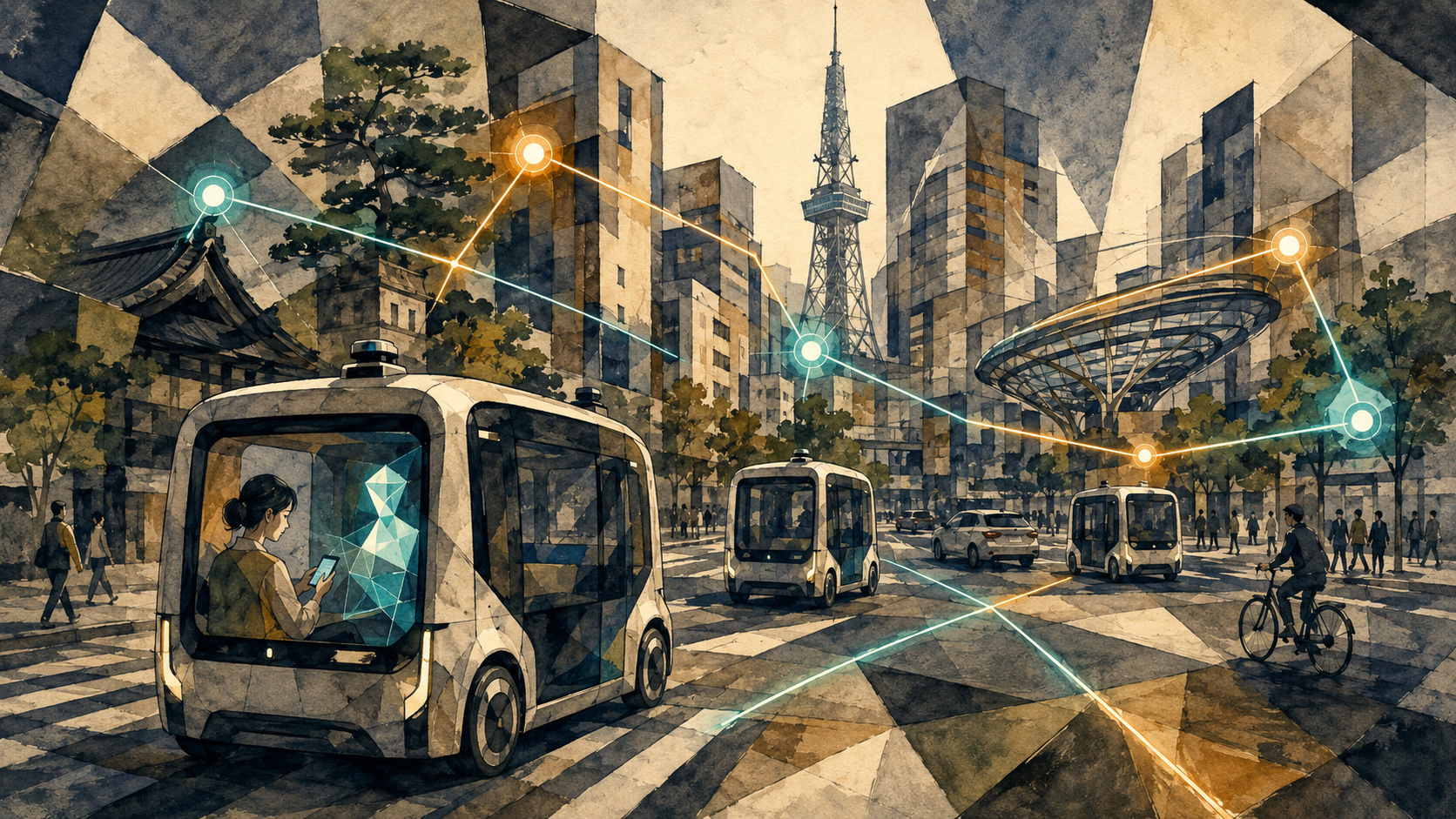
Press the reservation button, and one of three cars—not a timetable—begins to organize the trip.
Under a plan announced by Aichi Prefecture on August 12, three autonomous minivans are scheduled to operate in central Nagoya from September 11, 2026, through March 19, 2027. Service will run from 10 AM to 5 PM on weekdays, excluding public holidays and the year-end break. It will be free. Weather, inspections and other conditions may change or suspend operations.
The five boarding points are the Sogo Gakuen Spiral Towers near Nagoya Station; the Aichi Arts Center; STATION Ai; Nagoya Zokei University in front of IG Arena; and the FUJI Nagoya City Science Museum. A rider will choose an origin, destination and desired time in Meitetsu’s Nagoya MaaS app, Delide, which will handle both the booking and the check-in. Reservations are scheduled to open at noon on August 25, generally 31 days before travel.
The prefecture describes 20 routes, with a combined length of about 33 kilometers. Five stops, each connected to the other four with direction counted separately, produce 5×4, or 20, ordered journeys. The official announcement does not spell out that equation, but its route count is consistent with a complete set of directed trips among the five points. The 2025 loop becomes a small network in which the passenger chooses the destination.
Each vehicle is reserved by one party and carries up to five passengers, excluding the safety driver. Riders must be at least middle-school age, or elementary-age children accompanied by a guardian. Even with all three cars working, the fleet can carry at most three parties and 15 passengers at once. It is not mass transit. It is a tightly scaled experiment in dispatch, repositioning, check-in and passenger support.
From one car and two stops to three and five
Aichi has conducted autonomous-driving trials since fiscal 2016. The present downtown sequence took shape in fiscal 2024. One minivan linked Nagoya Station and the newly opened STATION Ai on a fixed route and schedule. The prefecture described it as an early attempt to sustain regular autonomous operation at prevailing traffic speeds on busy urban arterial roads. The service carried 1,419 passengers. A prefectural assembly report later put the autonomous-driving rate at 90.5 percent; parked vehicles and lane changes were leading reasons for manual intervention.
In fiscal 2025, two cars served a three-stop loop after the Aichi Arts Center was added. From October 14, 2025, to March 19, 2026, the operation planned 28 scheduled trips a day. Its final report counted 2,217 operated trips and 2,638 public riders, averaging two people per trip. The booking rate was 63 percent. Passenger-carrying trips numbered 1,289, or 58 percent of operated trips, while eight percent of bookings became no-shows. All 206 canceled trips were maintenance-related.
The technical scorecard contained progress and unfinished work. Manual intervention averaged 7.2 times per loop, meeting a target of eight or fewer. The longest continuous autonomous run was 2.6 kilometers, above a two-kilometer goal. But autonomous success at intersections and crosswalks was 92 percent, short of a 95 percent target, with right turns a particular problem. Comfort and satisfaction scored 82 out of 100, beating the target of 80. The passenger-inquiry rate was three percent—three times the goal—because booking and check-in generated questions.
| Fiscal year | Vehicles and stops | Service pattern | The next question |
|---|---|---|---|
| 2024 | 1 vehicle, 2 stops | Fixed route and schedule | Can it repeatedly match the pace and complexity of downtown traffic? |
| 2025 | 2 vehicles, 3 stops | Fixed scheduled loop | Can a small fleet handle turns, parked cars, bookings and check-in? |
| 2026 | 3 vehicles, 5 stops | 20 routes, on demand | Can dispatch, repositioning, waiting time and cabin help work together? |
Satisfaction alone can make that record look conclusive. Ninety-five percent of fiscal 2025 survey respondents gave a positive overall rating, and 97 percent were positive about both the cabin and the service process. Yet 82 percent said their main purpose was to experience autonomous driving itself. Most had come to try an unusual technology, not to complete an ordinary trip. The 2026 shift to on-demand service tests whether novelty can become useful mobility.
What the vehicle must see in a living city
The platform is Toyota’s Sienna minivan, a North American model, fitted with autonomous software from the U.S. company May Mobility. It is 5.3 meters long, 2.24 meters wide and 1.98 meters high. Its perception system combines five LiDAR units, eight cameras, five radar units, a global navigation satellite system, an inertial measurement unit and a high-definition autonomous-driving map.
Those instruments observe different uncertainties. LiDAR times returning laser pulses to measure three-dimensional shape and distance. Cameras provide rich evidence about lanes, signal colors, signs and object appearance. Radar is strong at range and relative speed. GNSS and the inertial unit tie the vehicle’s movement to its mapped position. The point of overlap is to compensate when glare, rain or occlusion weakens one kind of perception. A large sensor count is not itself proof of safety. The hard questions are what the system recognizes, how it predicts what happens next and how it slows or stops when confidence falls.
Nagoya is not a neat test track. Delivery vehicles occupy a lane edge. A bicycle emerges from a blind angle. A right turn requires reading both oncoming traffic and people crossing. Signal timing, merging etiquette and the speed of approach to a crosswalk all matter. Aichi says this year’s work will improve stability through better prediction of signal changes and strengthen safety control near crosswalks. Those aims respond directly to the previous year’s 92 percent result.
A parked car is an emblematic urban problem. The system must do more than classify a stationary obstacle. It has to decide whether and when it can enter the adjacent lane, whether another driver will yield, and whether construction, an oncoming vehicle or a cyclist changes the plan. A human negotiates partly through small changes in gaze and speed. A machine has to translate that informal conversation into observable rules and predictions.
The 18 seconds that exposed the handoff
At about 11:25 AM on October 28, 2025, a trial vehicle struck a construction fence. No passenger was aboard and nobody was injured. According to Aichi’s investigation, the contact occurred 18 seconds after the vehicle switched from autonomous to manual operation, just after the safety driver changed lanes. System logs revealed no autonomous-driving fault. The right mirror, a sensor cover and a camera were damaged.
This was not a case of an autonomous system autonomously crashing. It also showed why future safety cannot be reduced to the driving software. When does a person take over? How complete is their understanding of surrounding traffic? Can they instantly recover the feel of a wide vehicle? Manuals, training, suspension, repair and the decision to resume are parts of the safety system. Aichi added manual-driving hazards and near-miss examples to its procedures and restarted one vehicle on October 31.
A person will still occupy the driver’s seat in 2026. Riders, however, will be asked not to speak to the safety driver because the operation is meant to simulate a future empty cabin. It is an odd piece of theater: a person is visibly present but treated as absent. That constraint exposes how much work a driver normally performs beyond steering.
After the driver disappears, who says, “You’re all right”?
A bus or taxi driver does not merely manipulate controls. The driver confirms a name, explains the ride, notices illness, answers “Is this my stop?” and deals with lost property. Removing the person from the front seat does not remove that social work.
Nagoya’s interactive AI character explores part of the gap. It will appear on a cabin tablet and use a pre-ride questionnaire about the passenger’s purpose and information needs to offer guidance at what the project calls an appropriate time. It is planned for the second half of the trial, around mid-December—not the September launch. It is a passenger-facing concierge, separate from the driving software, not a virtual safety driver.
The previous tablet’s check-in and start functions were popular, but booking and check-in questions pushed the inquiry rate above target. Aichi does not explicitly describe the AI as a direct response to that metric. Still, conversational guidance is consistent with an attempt to close the support gap. The evaluation should measure more than whether the character is pleasant. What happens when it gives a wrong answer? Can it escalate to a person? What happens when connectivity fails? Does it accommodate different hearing, vision or cognitive needs? What trip and conversation data are retained? The August 12 announcement did not specify supported languages, accessibility functions or data-retention details.
The law and responsibility between Level 2 and Level 4
The automation levels are not scores for intelligence. They divide responsibility for watching the road and completing the driving task, including fallback when something goes wrong. At Level 2, the system may control steering and speed together, but a human driver continuously supervises. At Level 3, the system drives under specified conditions but may require a person to take over. At Level 4, the system performs the entire dynamic driving task and fallback inside a limited operational design domain—a defined combination of roads, speeds, hours, weather and other conditions—without a driver in the vehicle.
Level 4 therefore does not mean a car can drive driverlessly anywhere in Japan. It works only inside its approved domain. Japan’s 2019 legal amendments enabled Level 3 operation, and amendments passed in April 2022 and effective in April 2023 created a permit system for Level 4-equivalent “specified automated operation.” Approval of the vehicle under safety law is only one gate. The operator also needs permission from the relevant prefectural public safety commission and an operating structure covering responsibility, supervision and field response.
Japan’s first mobility service without a driver began in Eiheiji, Fukui Prefecture, on May 21, 2023. An electric cart followed electromagnetic guidance wire along roughly two kilometers of the Eiheiji Mairō path at 12 kilometers per hour. It was a historic Level 4 service with no driver aboard or at the remote site. Its operating conditions, however, were far removed from mixed downtown traffic.
From Eiheiji’s 12 km/h to Nagoya’s traffic-matching maximum of 48; from a constrained path to arterial roads filled with signals, right turns, parked vehicles and pedestrians. As speed and complexity grow, the task expands beyond perception. Legal responsibility, emergency arrival times, recovery of a disabled vehicle, passenger communication and cooperation with road authorities all become harder.
Fiscal 2016 Aichi begins its sustained autonomous-driving trial program.
2019–20 Japan passes and enacts legal changes for Level 3.
2022–23 The Level 4-equivalent specified automated operation permit is passed and enacted.
May 2023 Eiheiji opens Japan’s first Level 4 service with no driver.
Fiscal 2024 One vehicle links two Nagoya stops on a schedule.
Fiscal 2025 Two vehicles circle three stops.
September 2026, planned Three vehicles serve five stops and 20 routes on demand.
From a nation of trials to a nation of operations
The national government presents autonomous driving as one way to sustain transport in a shrinking country. The need is severe. An infrastructure ministry projection shows bus drivers falling from 116,000 in 2021 to 93,000 in 2030. If Japan tried to preserve the 2022 scale of service while accounting for overtime limits, the shortage would reach 36,000 drivers—28 percent of the workforce required. About 80 percent of bus companies cut or abolished services during 2023. From fiscal 2008 through 2023, approximately 23,193 kilometers of bus routes disappeared.
The number of pilots must not be confused with the number of driverless services. The government supported 67 autonomous-mobility initiatives in fiscal 2025, yet only 11 Level 4 mobility services had been implemented nationwide by May 2026. In January 2026 it set a new target of 10,000 autonomous-service vehicles by fiscal 2030. Moving from 11 bounded deployments to 10,000 vehicles will require much more than manufacturing. Every region will need permit review, map maintenance, remote monitoring, repair, incident investigation, insurance, cybersecurity and field responders.
Nagoya’s three vehicles are not about to solve the driver shortage. A free operation carrying one party per car during weekday daylight cannot replace a bus route. Its job is to decompose fleet service in a difficult city and reveal where it fails. In the center of Japan’s automotive industry, the consortium itself is part of the test: NTT companies handle project management, dispatch integration, vehicle deployment and the AI tablet; May supplies driving software; Meitetsu supplies MaaS and transport operations; taxi companies support operation; and local schools and universities contribute design and regional participation.
The Aichi-Nagoya Asian Games begin on September 19, eight days after the trial’s scheduled launch, and continue through October 4. IG Arena is among the five stops. Aichi’s announcement does not identify Games transport as the official purpose, so this limited three-car, weekday trial should not be presented as a core event shuttle. The overlap is nevertheless meaningful context: a mobility experiment will enter public service just as the city receives an unusual wave of visitors.
Seven questions that should define success
“No crash” and “passengers enjoyed it” are necessary but insufficient measures. The published design and the previous year’s results point to at least seven categories that a useful final report should answer.
- Safety: autonomous-driving rate by route; the frequency and cause of intervention; success at right turns, crosswalks and parked vehicles.
- Dispatch: waiting time, empty repositioning distance, imbalance among the three cars, cancellations and no-shows.
- Real demand: the share of riders using it for work, tourism or a destination rather than simply to try autonomous driving.
- Capacity: rejected requests at busy times and how many of five exclusive seats are actually used.
- Passenger support: inquiries, AI resolutions, escalation to people, connectivity failures and emergency procedures.
- Equity: usability for older and disabled people, families, visitors, and people uncomfortable with smartphone check-in.
- Economics: whether a fare riders will pay can approach the full cost of vehicles, monitoring, maintenance and field response.
In the 2025 survey, 56 percent named travel and tourism as a desired future use, 36 percent night travel, 35 percent hospital trips for an older family member and 27 percent weekend shopping. The new public operation is limited to weekdays between 10 AM and 5 PM. There are good reasons to expand safety and operations in stages, but the trial cannot test several of the periods people said they need most. That limitation belongs in the final accounting.
Price remains unsettled as well. In the previous fare demonstration, even a 20 percent discount from taxi-like prices was considered “expensive” by 30 to 37 percent of respondents, depending on the trip. Automation may eventually reduce driver labor, but early operations require costly sensors, remote oversight, maintenance and field support. Exclusive use can make a party feel secure while lowering seat utilization. A free service filling its reservation book is not proof of viable transport.
The future is behind the timetable, not inside the steering wheel
The three exteriors were designed, one each, by students at HAL Nagoya, the International Professional University of Technology in Nagoya and Nagoya Zokei University. Their concepts use a meteor, flowing blue lines and network hexagons. The third combines blue and magenta inspired by ukiyo-e, joining Asian tradition to advanced technology. The vehicles are industrial-policy exhibits, but they also let the city paint its own idea of the future.
The harder innovation is almost invisible. The app receives a request. A dispatch layer selects among the vehicles and routes. The driving software navigates the road. The tablet confirms the passenger. Transport operators handle delay, repair and exceptions. As automation rises, value moves away from the dramatic photograph of an empty steering wheel and into the quality of this coordination.
Nagoya’s three cars still require human supervision. Their hours and geography are narrow, and they charge no fare. Even so, they carry a larger question than the single car of 2024. Not whether a whole city can be automated at once, but whether one bounded piece can operate every day as a safe, comprehensible service that arrives when somebody wants it.
The road to Level 4 is not a story in which the driver’s seat suddenly becomes empty one morning. It is the record of one lane change, one confusing check-in, one unoccupied trip and one failed right turn, returned to the next design. If the person eventually leaves the front seat, the responsibility for transporting people does not leave with them.
Reporting Notes and Principal Sources
This article cross-checked government, operator, legal and transport-policy sources published by August 13 at 9:52 AM Japan Standard Time. The fiscal 2026 service had not yet begun. Dates, suspensions, reservations and the AI-guide schedule may change.
- Aichi Prefecture: Fiscal 2026 autonomous-vehicle operation in central Nagoya
- Aichi Prefecture: Fiscal 2025 regular-operation and demonstration results
- Aichi Prefecture and project consortium: Fiscal 2025 operating report
- Aichi Prefecture: The October 2025 manual-driving incident, findings and restart
- Aichi Prefecture: Fiscal 2024 Nagoya Station–STATION Ai operation
- Aichi Prefectural Assembly: Fiscal 2024 ridership, autonomous rate and intervention causes
- National Police Agency: Road Traffic Act provisions for Levels 3 and 4
- Ministry of Land, Infrastructure, Transport and Tourism: Japan’s first driverless Level 4 service in Eiheiji
- MLIT: 2026 autonomous policy, 11 Level 4 deployments and the fiscal 2030 target of 10,000 vehicles
- MLIT white paper: The 2030 bus-driver gap and route contraction
- MLIT policy material: Roles and responsibilities in specified automated transport
- May Mobility: Japanese deployments and the Nagoya platform
- Aichi-Nagoya 2026 Asian Games: Official schedule