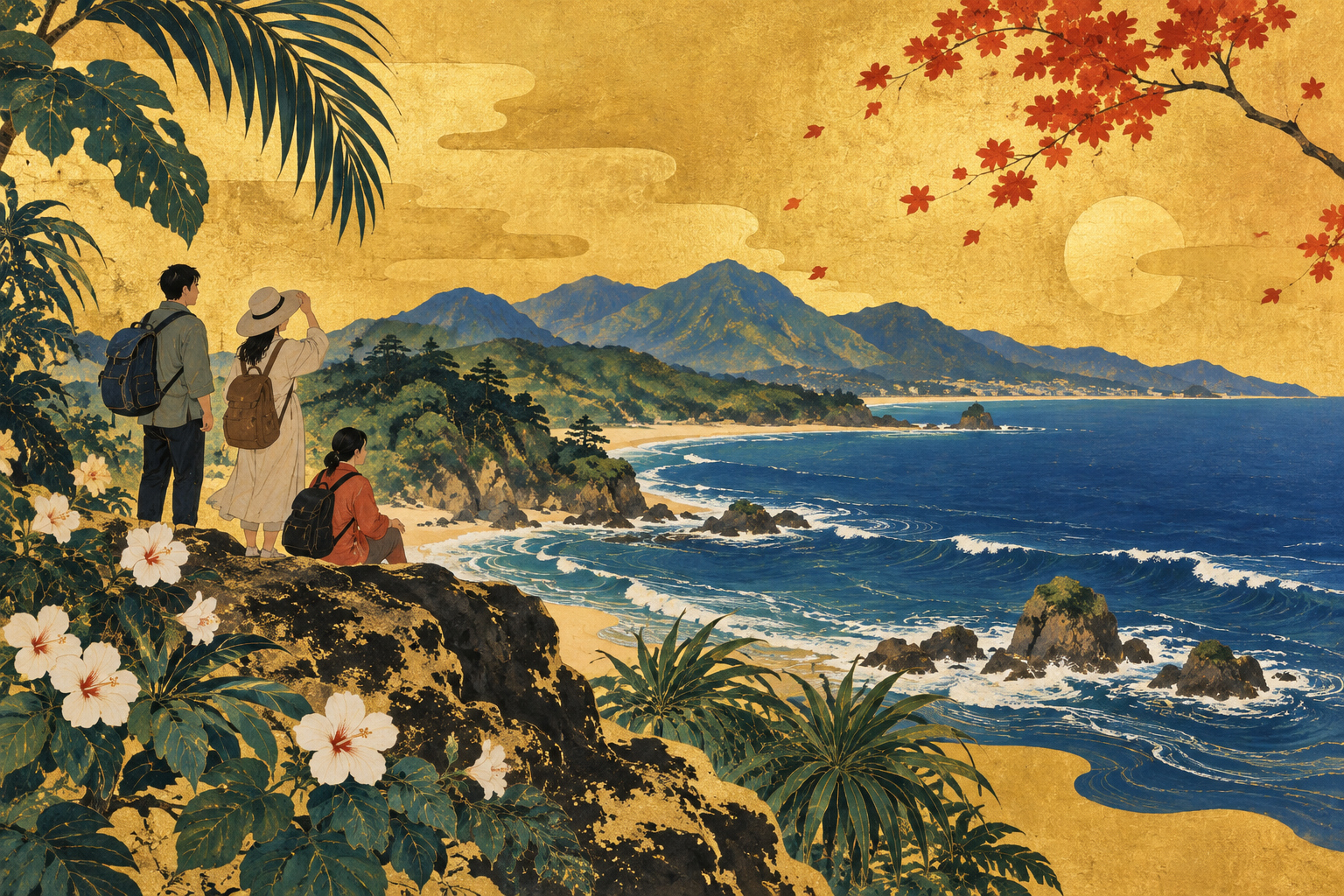
Miyazaki once sold Japan a dream of escape: a flight south, palms against the Pacific, and a honeymoon far from everyday life. Its latest tourism story begins in a less romantic place—a booking database—but asks a familiar question. What makes people choose this corner of Kyushu now?
Miyazaki placed first in Rakuten Travel’s Silver Week booking-growth ranking, released September 9. Toyama, Okayama, Shimane and Mie followed. The order measures year-on-year growth in booked accommodation nights, not the largest number of visitors or the busiest hotel market. [1]
For regional businesses, that distinction does not make the result unimportant. Reservations are where interest begins to become potential revenue. But the opportunity is more interesting than a league-table victory: Miyazaki is combining an established resort identity with travel support and new reasons to spend time in the prefecture.
The dates behind the ranking
Rakuten took its snapshot on August 20, comparing stays scheduled for September 19–27, 2026, with September 20–28, 2025. Its domestic-accommodation booking scope includes inbound reservations, dynamic travel packages and day use. This is therefore neither a Japanese-residents-only measure nor a report of completed holiday stays. [1]
Bookings can be added or canceled after the snapshot. Growth also depends on the starting point: a smaller base can produce a larger percentage increase without attracting more travelers in absolute terms. The ranking identifies relative momentum on one platform; it does not establish the size of Miyazaki’s entire visitor economy.
| Snapshot | August 20, 2026 |
|---|---|
| 2026 stay window | September 19–27 |
| 2025 comparison | September 20–28 |
| Ranking measure | Year-on-year growth in booked accommodation nights by prefecture |
A five-day break, with the option of nine
The calendar helps explain the commercial opportunity. The Cabinet Office lists September 21 as Respect for the Aged Day and September 23 as the Autumnal Equinox holiday. September 22 is also a holiday under the provision for a day between national holidays. For people with weekends off, September 19–23 becomes a five-day break; taking leave on September 24 and 25 extends it through September 27. Nine consecutive days off are an option, not a universal entitlement. [2]
Japan.co.jp’s analysis is that a longer break can make a destination involving more travel time easier to consider. It can also support a different pattern of spending: staying in one base and exploring, rather than fitting everything into a single hurried visit. Yet the calendar is also a comparison issue. Equal-length measurement windows do not necessarily contain equivalent holiday patterns.
That matters when interpreting claims about why bookings rose. A new attraction, a subsidy and a more convenient holiday arrangement can all influence the same decision. The ranking alone cannot separate their individual effects.
A discount designed to reach beyond the hotel
Rakuten points to strong use of local-government travel coupons in Miyazaki. [1] The prefecture’s Hinatabi campaign offers up to 30 percent off eligible travel or accommodation charges, capped at ¥3,000 per person per night, alongside a ¥3,000 electronic coupon for participating local businesses. Support is limited to three consecutive nights and is subject to budgets and sales allocations. [3]
The prefecture describes the program as a response to higher prices and a way to expand tourism spending and regional activity. The combination is significant: one component reduces the accommodation bill, while another creates an incentive to spend at businesses such as restaurants and souvenir shops. [3]
Travelers need to read the conditions of the actual booking channel. Rakuten’s listed allocation ends with September 30 checkout, whereas the prefecture’s broader first-phase announcement covers September 30 stays. The prefecture expressly allows channel-specific differences. Neither the campaign’s advertised dates nor this article establish that a particular coupon remains available. [3][4]
From a regional-economic perspective, Japan.co.jp would judge the support by additional activity, not simply redemptions. Did it attract someone who otherwise would not have visited? Did spending spread outside the hotel? Did the visit create a reason to return without a discount? Those questions require evidence after the booking stage.
How Miyazaki became an escape
The prefecture’s historical magazine Jaja describes a honeymoon boom stretching from the 1960s into the 1970s. Expanding air travel helped turn the journey itself into part of the attraction. Local investment in transport and visitor facilities helped make the southern landscape accessible and marketable. [5]
The enduring lesson is not that Miyazaki should recreate the honeymoon industry. In Japan.co.jp’s reading, the landscape became an economic asset through a combination of access, places to stay and a widely shared reason to travel. A beautiful coast was the foundation; an organized experience allowed people to choose it.
That distinction gives the historical comparison relevance today. Families, couples and visitors interested in food or architecture may arrive with different expectations, even when looking at the same sea. An established destination does not have to discard its identity to refresh its appeal. It has to make room for new uses of visitors’ time.
New experiences inside an established destination
In Miyakonojo, Kirishima Shuzo and Starbucks Coffee Japan developed KIRISHIMA GREENSHIP icoia for a January 27 opening. Their announcement describes a complex with a botanical garden, shops, a rooftop garden and lawn space, designed by Kengo Kuma. It brings together a regional manufacturer, a familiar coffee brand and a place to linger. [6]
Kirishima also says the facility uses heat from distillation and electricity produced from biogas derived from shochu-production residues. These are the operator’s statements about its systems, not an independent environmental assessment. For tourism, the wider point is the attempt to make local production something visitors can encounter through a place, rather than only through a product bought to take home. [6]
At Phoenix Seagaia Resort in Miyazaki city, renewal offers another route. The operator dates its indoor-pool refurbishment to April 25, including a new shallow-water area, and the opening of its outdoor Splash Area to July 18. These investments add activities to an existing resort setting. [7][8]
Such openings and refurbishments are tangible developments. Their precise contribution to prefecture-wide booking growth remains a separate question. A facility announcement establishes what changed; it does not measure how many additional travelers the change caused.
The coast offers more than a backdrop
Established sights remain part of the story. Around Aoshima, the formations popularly called Oni no Sentakuita—the “Devil’s Washboard”—come from uplifted layers of sandstone and mudstone shaped by erosion, according to the prefecture’s official tourism guide. The striking name belongs to the visitor vocabulary; the explanation is geological. [9]
Farther along the coast, Udo Jingu is known for its sanctuary inside a sea-facing cave. Its associations with childbirth, child-rearing and relationships belong to religious belief and tradition. They should be described as such, rather than presented as demonstrated effects of a visit. [10]
Horikiri Pass adds another familiar image: Phoenix palms overlooking the Pacific. [11] Connecting these places with newer attractions turns a list of sights into a trip. That requires transport planning. Miyazaki Airport’s official rail-access page directs visitors to timetables and JR Kyushu operating information; an accommodation booking does not, by itself, solve the onward journey. [12]
Japan.co.jp’s assessment is that the commercial opportunity lies partly in those connections. Time spent moving comfortably between a hotel, a coastal stop and an inland attraction can become time spent in more local businesses. A longer holiday helps only if visitors can use it well.
What should be measured after Silver Week
The useful follow-up is not another headline about popularity. It is whether reservations became stays, where spending occurred and whether businesses could serve the demand without undermining the experience. A crowded week and a stronger year-round visitor economy are related possibilities, not interchangeable results.
The Japan Tourism Agency’s Accommodation Survey measures matters such as guest nights, actual guests and room occupancy. [13] Those outcomes serve a different purpose from a platform’s advance reservations. Reading both together can connect the early signal with what happened, while avoiding the temptation to use one as a substitute for the other.
Miyazaki’s first place is an encouraging signal for an old resort destination finding additional ways to be useful to travelers. Its coast supplies continuity; new facilities and travel support supply fresh prompts. The lasting business result will depend on what visitors do after checking in—and whether the experience gives them a reason to come back.
- Rakuten Group, Silver Week booking-growth ranking, September 9, 2026
- Cabinet Office, national holidays and holidays for 2026
- Miyazaki Prefecture, Hinatabi accommodation campaign, May 7, 2026
- Rakuten Travel, booking-channel conditions for Hinatabi
- Miyazaki Prefecture, Jaja magazine, the Phoenix honeymoon era, 2010
- Kirishima Shuzo, KIRISHIMA GREENSHIP icoia opening announcement, January 22, 2026
- Phoenix Seagaia Resort, indoor-pool renewal
- Phoenix Seagaia Resort, Splash Area
- Official Miyazaki tourism guide, Oni no Sentakuita rock formations
- Official Miyazaki tourism guide, Udo Jingu
- Official Miyazaki tourism guide, Horikiri Pass
- Miyazaki Airport Building, rail access and JR Kyushu information
- e-Stat, Accommodation Survey overview