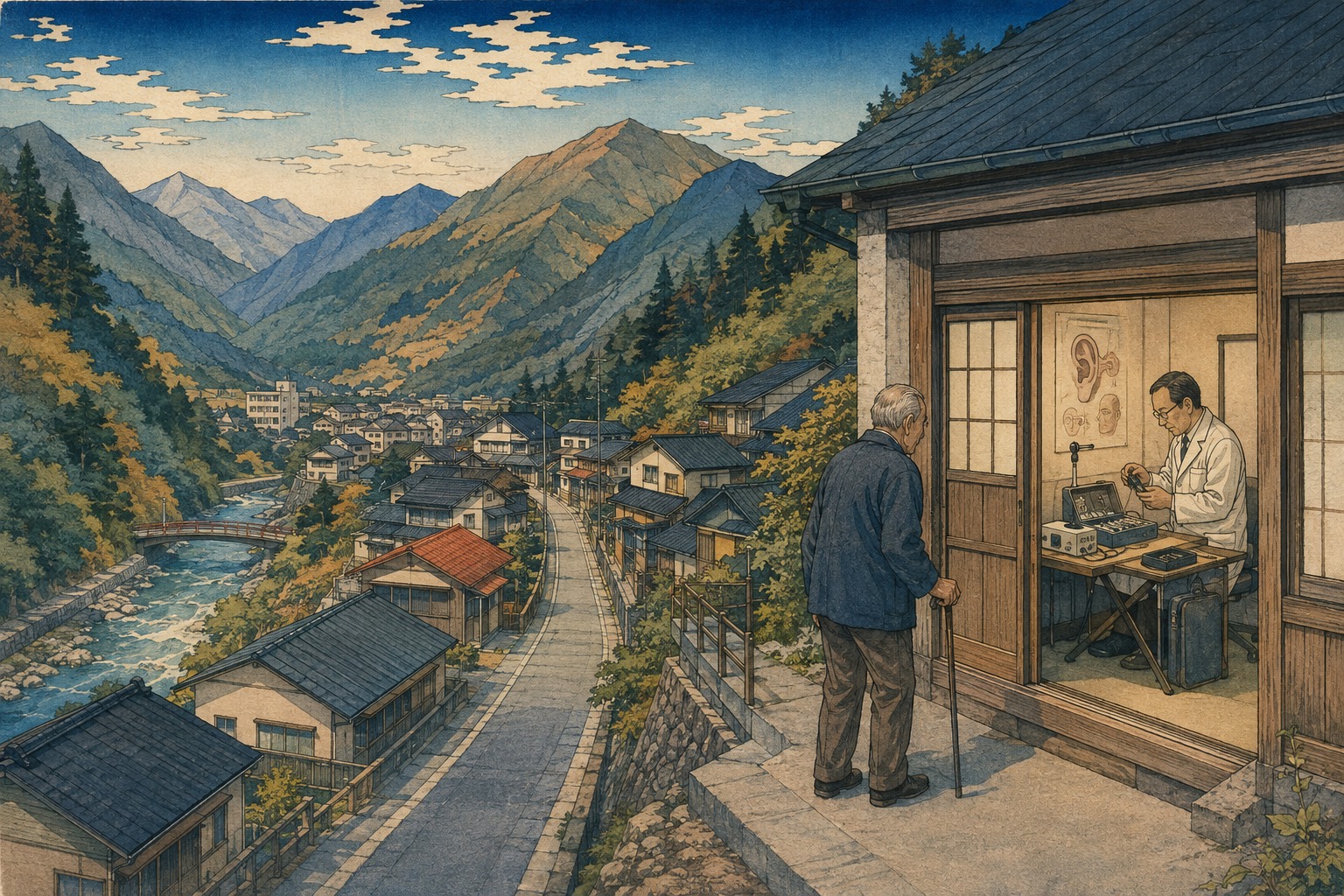
On July 31, roughly 70 residents and members of the press gathered at Misasa Onsen Hospital. What they were shown was not a new wing or a costly machine. It was a plan to carry a specialist and a small set of instruments into an existing hospital room once a month—and connect the medical visit to hearing-aid care before the patient went home.
Misasa lies in the mountains of central Tottori Prefecture. It has no ear, nose and throat medical practice and no hearing-aid retailer. A resident who needs an examination, advice about a device, a new fitting or a small adjustment must travel outside the town. For an older person who no longer drives, care is defined not only by whether it exists, but by whether it exists at a distance that can be crossed repeatedly.
Yuko Kataoka, a specially appointed associate professor at Okayama University Hospital’s Hearing Support Center, confronted that missing link after giving a public lecture in Misasa in 2025. Awareness and screening can identify hearing loss. But if no local ENT clinic can establish a diagnosis—and no skilled place can select and adjust a hearing aid—knowledge does not readily become treatment or sustained use. Misasa’s pilot is designed around the step that many health campaigns leave unfinished: what happens after a screening says there is a problem.
Reconnecting the chain in a single clinic day
The core of the plan is not a sign on a hospital door. It is a sequence. Functions that have been scattered outside town are to be arranged so the patient can move from one to the next in the same place.
| Stage | What Misasa plans to provide | Why it matters |
|---|---|---|
| 1. Examination | Kataoka will provide ENT care, using otoscopes and nasal specula owned by the town plus a portable headlight | Hearing difficulty cannot safely be assumed to be ordinary aging; wax, middle-ear disease and acute or asymmetric loss require medical judgment |
| 2. Hearing assessment | Portable audiometric equipment will measure the degree and pattern of loss | It converts “I cannot hear well” into frequency-specific information for treatment, referral or amplification |
| 3. Clinical decision | Treat what can be treated locally and refer people who need advanced tests, imaging or surgery | A retail device should not precede the identification of a medical problem |
| 4. Selection and trial | A certified hearing-aid technician from Audika will support device choice and trial listening | The device must fit the audiogram, the person’s hands, daily life and budget |
| 5. Adjustment and follow-up | Fitting, readjustment, continuing support and aftercare | “Too loud,” “speech is still unclear” and “I cannot operate it” must lead to another adjustment—not a device left in a drawer |
The low-capital design is deliberate. The partners are not building a dedicated sound suite and specialist department from the ground up. They will combine a room at Misasa Onsen Hospital, instruments already held by the town and portable testing equipment brought to each session. The physician-association hospital, municipal and prefectural governments, the regional medical association, Okayama University and a private hearing-aid professional each contribute one part of the pathway.
A hearing aid is not simply “glasses for the ears”
The comparison is useful, but incomplete. In age-related sensorineural hearing loss, sound does not only become quieter. The ability to distinguish speech—especially in noise—can deteriorate. Making everything uniformly louder is not the answer. Amplification must be shaped around hearing thresholds at different frequencies, speech discrimination, differences between the ears, uncomfortable loudness and the listening situations that matter to the individual.
The Japan Audiological Society’s hearing-aid fitting guidance describes ways to assess aided speech intelligibility and tolerance of environmental noise. The World Health Organization likewise treats hearing-aid service as a continuum: identification and hearing assessment; prescription, fitting and verification; then adjustment, education and counseling after the fitting. Handing over a box is not the same service as restoring usable hearing.
At first, amplified sound may not feel natural. Dishes, paper and one’s own voice may seem uncomfortably prominent. An earmold, feedback, batteries, charging and reduced hand dexterity can decide whether a device is used. Placing a certified technician in the clinic matters because it creates a route back from these small failures to another fitting. The long-term value lies as much in that return path as in the initial device selection.
- The ENT physician evaluates disease, treatability, candidacy for amplification and the need for referral.
- The certified technician supports device choice, trial listening, settings, handling, maintenance and readjustment.
- The patient is less likely to leave with a diagnosis but no idea where the next step is.
- The clinic must still preserve a clear line between clinical and commercial decisions, disclose prices and alternatives, and protect the patient’s freedom to buy elsewhere.
An 87-year relationship, beginning with a hot-spring sanatorium
This is not the first time Okayama has brought medicine to Misasa. In 1939, Okayama Medical University—Okayama University’s predecessor—opened the Misasa Hot Spring Sanatorium. Against the background of Misasa’s radon-bearing waters, it was renamed the Institute for Radioactive Spring Research in 1943. When Okayama University was founded in 1949, the clinical side became the Misasa branch of its medical school hospital.
For decades, the hot spring connected treatment, research and the town’s identity as a destination. The university’s medical base changed names and organization while providing rehabilitation, internal medicine and hot-spring research. But physician recruitment and hospital restructuring grew harder. Okayama University Hospital’s Misasa Medical Center was abolished in March 2016, after years of concern in Tottori about the loss of both a regional medical institution and a distinctive strand of thermal medicine.
The relationship did not end. A donated chair for regional medical support was established at Misasa Onsen Hospital under an initial three-year arrangement that sent two Okayama University physicians to the hospital. A university earth-science institute also remains in town. The 2026 ENT service is not an attempt to rebuild the old university hospital in miniature. It reworks an 87-year question—how to place university expertise in a small town—as a rotating, tightly focused specialist clinic.
1939 Okayama Medical University establishes the Misasa Hot Spring Sanatorium.
1943 It becomes the Institute for Radioactive Spring Research.
1949 Okayama University is founded; the clinical service becomes its hospital’s Misasa branch.
2002 The branch is reorganized as the Misasa Medical Center.
2016 The medical center is abolished; a regional medical-support chair is established at Misasa Onsen Hospital.
2025 Kataoka gives a community lecture and identifies the missing route from screening to local care.
October 8, 2026 The planned monthly ENT and hearing-aid clinic begins its six-month trial.
In a town of 5,494, distance becomes part of medicine
At the end of July 2026, Misasa had 5,494 residents. Its municipal health-data plan reports that 41.9% of the population was 65 or older in fiscal 2022, up 2.1 percentage points from 39.8% in fiscal 2019 and above both prefectural and national shares. Over the same period, the population fell from 6,328 to 5,949.
Geography matters as much as the percentages. The town’s long-range plan describes settlements distributed along narrow valleys—a landscape locally summarized as three valleys within the mountains—and says fixed-route buses increasingly struggle to meet diverse transport needs. Snow clearance is a condition of winter life. Even a person who can reach ENT care in nearby Kurayoshi must assemble the trip from the home to a stop, transfers, clinic waiting time and the last bus back.
Because a hearing aid is not a one-visit purchase, the travel burden compounds. A family member may be able to drive for one diagnostic visit. Trial fitting, delivery, early adjustments, readjustments and repair consultations are harder to sustain. Misasa’s model aims to reduce not only map distance but the time, family coordination and psychological cost of going “one more time.”
Japan’s hearing-care gap is larger than Misasa
JapanTrak 2025, an industry-backed survey based on a national sample of 14,368 people, estimated that 11.0% of the population self-identified as having hearing loss. Among that group, 15.6% owned a hearing aid—only a small increase from 15.2% in 2022. Self-reported hearing loss reached 33.6% among those 75 and older, while 11% of hearing-aid owners said they did not use their device at all.
These are survey estimates, not diagnosis-based national prevalence data, and the hearing-aid industry helped commission the research. They should not be treated as a government census. They are still revealing about attrition through the pathway: recognizing difficulty, speaking to a doctor, buying a device and continuing to use it. In the 2025 survey, 43% of people with self-reported loss had discussed it with an ENT physician and/or family doctor; 16% said they received positive medical advice or a recommendation for further action.
Since 2023, Misasa has offered a purchase subsidy to qualifying residents age 65 and older who do not hold a physical-disability certificate for hearing loss. It covers half the price of the hearing-aid body, up to ¥30,000, and can be used again after five years. But money toward a device does not create a place for diagnosis or fitting. The new clinic connects a medical and technical route to financial help the town already has.
Hearing and dementia: state the promise accurately
Hearing difficulty can make conversation exhausting and encourage withdrawal from family gatherings, work and community life. The WHO estimates that more than 430 million people worldwide have hearing loss severe enough to require rehabilitation and that the figure will exceed 700 million by 2050. The burden extends through communication, education, employment and social participation.
The relationship with cognitive health is important, but “a hearing aid prevents dementia” is too strong. The 2024 Lancet standing commission included hearing loss among the potentially modifiable risk factors for dementia. Observational studies repeatedly associate hearing loss with cognitive decline, but association alone does not establish that hearing loss is the sole cause—or that a device will create the same preventive effect in every person.
The U.S. ACHIEVE randomized trial enrolled 977 adults age 70 to 84 with untreated mild-to-moderate hearing loss. Over three years, hearing intervention did not significantly change cognitive decline in the full study population compared with health education. In a prespecified group drawn from the ARIC cardiovascular cohort—participants at higher baseline risk of cognitive decline—the hearing intervention slowed decline by 48%. It is a promising and clinically important result, but not proof of a universal effect.
Misasa’s clinic is not a dementia-prevention trial. Its first outcomes should be more direct: whether residents follow conversation more easily, experience less burden at home, actually use their devices, and receive prompt referral when a dangerous or treatable condition is found. A claim about long-term cognition would require follow-up far beyond six months and a suitable comparison.
What counts as success after six months?
The fewer the clinic days, the more each record must reveal. A high first-visit count means little if patients disappear before follow-up. Counting devices sold would be a poor clinical target and could compromise neutrality. The experiment should separate patient access, clinical quality, fitting outcomes, operations and cost.
| Dimension | What the six-month trial should measure | The question behind it |
|---|---|---|
| Access | Patients seen, waiting time, trips out of town avoided, family transport reduced | Did the clinic reach people who previously could not obtain care? |
| Clinical quality | Types of loss, treatable conditions, urgent and advanced-care referrals | Can a monthly clinic triage safely? |
| Amplification | Trial-to-adoption rate, readjustments, wearing time, speech and patient-reported benefit | Not “was it sold?” but “was it used, and did hearing improve?” |
| Continuity | Return visits, follow-up completion, response time for repairs and questions | Who supported the patient between clinic days? |
| Equity | Use by age, district, transport mode and ability to pay | Did service concentrate among people already closest to the hospital? |
| Operations | Patients per day, staff time, travel, equipment, billing and subsidy cost | Can the service survive after the pilot budget ends? |
| Trust | Disclosure of price and alternatives, satisfaction, complaints, clinical-commercial separation | Was reliance on one company managed transparently? |
The large limits of a small clinic
Once a month is far more than zero. It is not continuous coverage. Acute hearing loss, bleeding, severe vertigo and serious infection cannot wait. Patients who need detailed speech testing, imaging, surgery or admission will still travel outside town. Portable equipment creates an entry point; it does not compress a university hospital into a suitcase.
Capacity may become the next problem. In a town where more than four in ten residents are 65 or older, latent demand could fill one clinic day quickly. If someone is ill on the appointment day, must they wait a month? If a hearing aid fails the next morning, who responds? Schedules, winter roads, equipment calibration, reimbursement, data sharing and clinical responsibility all need an owner after the pilot. Sustainability may depend less on the machine than on the labor of coordination.
A private company’s technician offers a practical answer to the absence of any hearing-aid shop in town. It also places commerce close to medicine. Patients must be told—in a form they can hear and understand—that they need not buy on the day of diagnosis; what price ranges, trial conditions, repairs, returns and subsidies apply; and that they can choose another provider. The model becomes stronger, not weaker, when these boundaries are explicit.
- Sudden reduction of hearing in one or both ears
- Hearing loss with severe vertigo, facial weakness or an intense headache
- Blood or pus from the ear, severe pain or high fever
- Any rapid change suggesting acute illness rather than a routine device problem
This is general safety information, not individual medical advice. Acute symptoms require prompt contact with emergency advice services, a regular doctor or an available ENT service outside town.
From building more to combining better
Japan cannot place a full-time specialist and dedicated suite in every shrinking town. Sending every patient to a distant regional center, however, breaks follow-up for chronic conditions. Misasa’s design occupies the middle: a community hospital as the base; a specialist who travels on a schedule; portable diagnostics; and links to municipal health staff, transport, subsidy and technical fitting expertise.
If the model grows, the next design problem is the month between in-person sessions. Local nurses or public-health staff could check device use and ear symptoms, then organize issues for the next visit. Remote support may help with controls or family counseling, but it cannot replace examination inside the ear or accurate audiometry. Aligning municipal transport with appointment times could prevent the paradox of bringing the clinic closer while leaving the hospital door unreachable.
Replication also requires independence from one heroic physician. A standardized equipment kit, calibration, infection control, referral rules, patient records, sales ethics, local-staff roles and financing must become one operating procedure. Could one specialist alternate between two towns? Could several specialties share the same mobile infrastructure? The most valuable result of the pilot may not be a clinic day. It may be a design that another town can reproduce.
A monthly doorway into a quiet problem
Hearing does not display itself every morning like a blood-pressure reading. A family repeats the same sentence. The television grows louder. A person misses the moment when everyone else at the table laughs and eventually stops attending. These changes are easy to file under age.
Misasa’s plan is small: once a month, six months, portable equipment. Smallness is not only a limitation. Without first building an expensive facility, the partners can learn whether residents come, whether fitting continues, and whether a hospital, town, university and company can work as one care route. If it fails, the missing component can be identified at relatively low cost.
In 1939, medicine from Okayama came to Misasa as a hot-spring sanatorium. In 2026, the relationship returns carrying a headlight, an otoscope and portable audiometry. It will not recreate a major hospital. It will attempt to reconnect the few missing steps between noticing “I cannot hear,” receiving a diagnosis, trying a device, adjusting it and continuing to use it.
After six months, the meaningful question will not be how many hearing aids were sold. It will be whether people who had withdrawn from conversation found a way back—and whether one small clinic day can become a local system that returns the next month and the year after that.
Sources and reporting basis
- Okayama University, “ENT and hearing-aid care to begin in Misasa, Tottori” (August 7, 2026)
- Okayama University release with clinic schedule, equipment, technician and six-month trial details (August 13, 2026)
- Misasa Town, population and households (end of July 2026)
- Misasa National Health Insurance Data Health Plan, third term (population and aging)
- Misasa Town, subsidy for older residents purchasing hearing aids
- Misasa’s 11th Comprehensive Plan, latter basic plan (geography, transport and demographic change)
- Okayama University Medical School and Hospital history (1939 sanatorium and 2016 closure)
- Okayama University, closure of Misasa Medical Center and creation of the regional medical-support chair (February 10, 2016)
- Misasa Onsen Hospital, agreement establishing Okayama University’s donated chair (January 18, 2016)
- World Health Organization, “Deafness and hearing loss” (updated March 2026)
- WHO, “Service delivery approaches for hearing aids in resource-limited settings”
- Oto-Rhino-Laryngological Society of Japan, rules for hearing-aid consultation physicians
- Japan Audiological Society, hearing-aid fitting test guidelines (2010)
- Japan Hearing Instruments Manufacturers Association and Techno-Aids Association, JapanTrak 2025
- Lin et al., “Hearing intervention versus health education control to reduce cognitive decline in older adults with hearing loss,” The Lancet (ACHIEVE trial, 2023)
- Livingston et al., “Dementia prevention, intervention, and care: 2024 report of the Lancet standing Commission”
- Oto-Rhino-Laryngological Society of Japan, sudden sensorineural hearing loss
Editor’s note: The announced opening date, frequency, staff, equipment and six-month duration are plans, not results. Patient capacity, booking procedures, financing and post-trial continuation had not been publicly specified and may change. This article is based on material available by 3:14 a.m. Japan Standard Time on August 15, 2026.