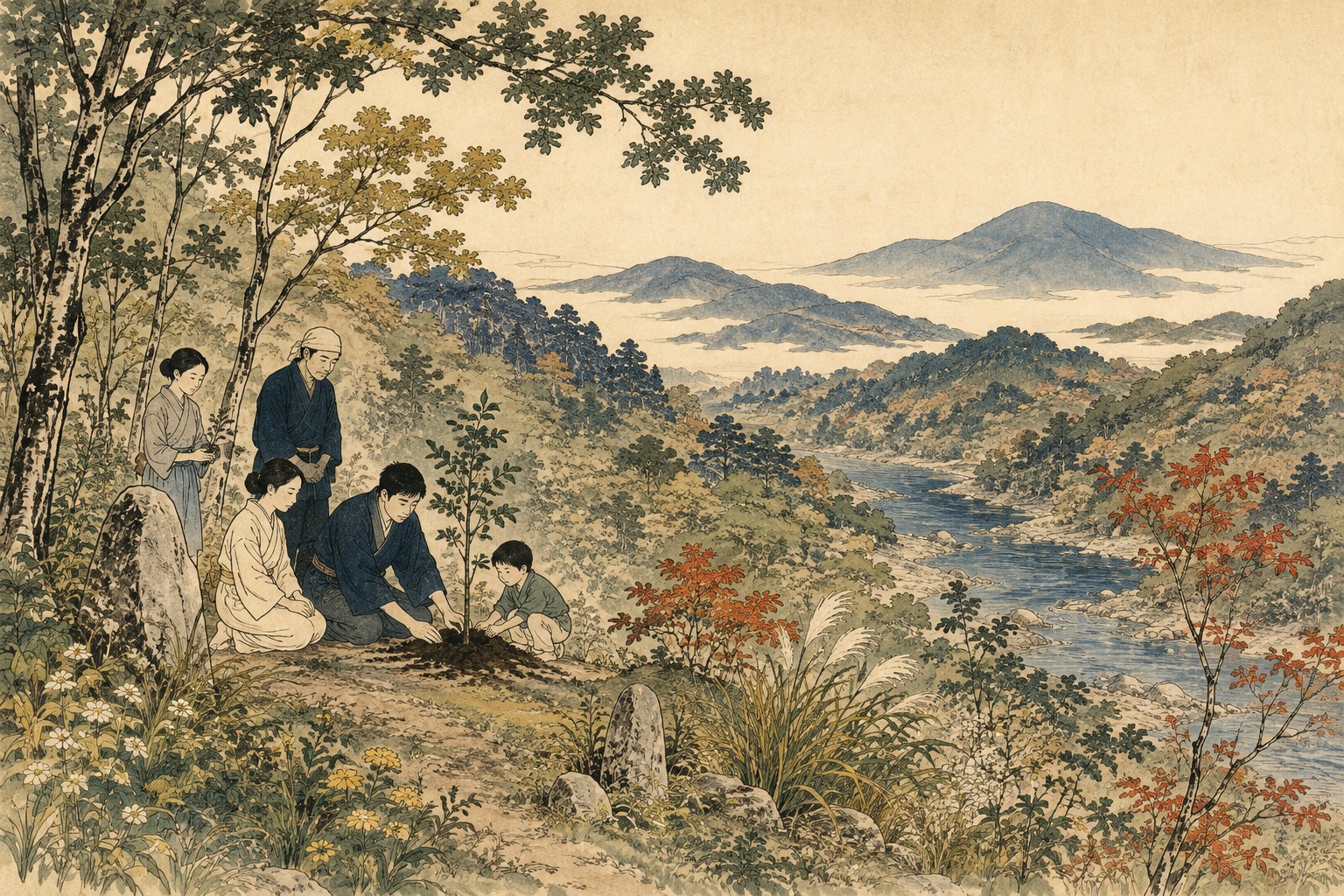
People walked around the hill and sowed flower seeds. At 9 a.m. on August 3, 41 participants from around the Atage community gathered at Eishoin in Mino, Gifu Prefecture. A priest ritually purified the site, the assembly recited the Heart Sutra, and participants offered incense. After the service, they circled the grounds and scattered cosmos and clover seeds in a gesture modeled on sange, the Buddhist offering of flower petals.
They were opening Mino Seiryu no Oka, a tree-burial cemetery of roughly 900 square meters on a hill above the Nagara River. An existing hackberry and a cherry tree were retained as visual anchors. Small plate-marked plots, flower beds, bamboo fencing, an offering stand and log benches now occupy ground that had become difficult to manage. Eishoin says the project took about four years; its first phase was completed in spring 2026 and opened for tours before the dedication.
The view is tranquil. The problem it addresses is not. Some older people have no children. Others have children who live hours away, use a different surname, are already caring for several family graves or cannot promise decades of mowing, cleaning, payments and visits. Who will call a temple after the contract holder dies? Who will maintain the stone? Who will decide when to close the grave? The common phrase “I do not want to burden my children” contains both affection and fear.
The 13th memorial as a design for time
Seiryu no Oka does not force a simple choice between an individual grave and an immediate communal grave. It offers plans for one or two people, three or four, and five or more. The cremated remains stay in a plate-marked individual plot until the 13th memorial observance for the last person in that plan. Eishoin then transfers them to its communal perpetual-care grave. For a two-person plan, the temple says both are moved when the later-deceased person reaches that observance.
The 13th memorial is generally held 12 elapsed years after death because Japanese Buddhist memorial counting includes the year of death. Until then, relatives have a specific place at which to address the deceased. Afterward, the cost and practical risk of preserving that individual plot indefinitely end, and the temple assumes communal care.
This is an emotional as well as an operational bridge. Some families resist moving someone immediately into a space where individual remains will no longer be distinguishable. A defined individual period gives grief a location without creating an obligation intended to survive every descendant. But communal interment is also a hard boundary. Once remains are mixed with those of others, individual recovery is ordinarily impossible. A family should know from the written contract when transfer occurs, who receives notice, what ceremony is held and whether removal remains possible before that date.
| Stage | What Seiryu no Oka publishes | What a family should verify |
|---|---|---|
| Before death | All sects accepted; no parishioner obligation; pre-need contracts allowed | Nature of the right, cancellation and refunds, optional rites, adding people |
| Interment | Choose plan and inscription, hold interment service, plant memorial tree later | Container, soil contact, interment fee, planting fee and tree choice |
| Individual term | Individual plot through the last person’s 13th memorial observance | Visiting rules, pruning and dead-tree replacement, updated contacts |
| After transfer | Temple care in communal grave; communal interment charge included | Advance notice, frequency of rites, name records and recoverability |
The “traditional family grave” has a history
To understand a new cemetery, it helps to recognize that the old one was also made by history. Japanese mortuary customs have never been uniform. Some communities used separate places for disposing of a body and visiting a stone memorial, a practice known as a dual-grave system. Individual graves, couple graves, village spaces and lineage monuments coexisted in different regions.
A synthesis of grave-marker research presented by Japan’s National Museum of Japanese History finds that stone markers for ordinary people spread in the 17th century, multigenerational monuments increased from the late 19th into the early 20th century, and grave building surged dramatically in the 1970s. After the prewar household-head system ended, younger sons formed independent households, moved to cities and increasingly built graves of their own. Rapid growth made stone affordable, suburban cemeteries expanded, and the surname-bearing family monument became a standardized image of respectability.
That boom matters now. One scholarly interpretation is that Japan’s current grave-closing wave reflects not only low fertility but also the very large stock of graves created during the high-growth era. Many nuclear households erected monuments as though each new branch would itself endure. The number of potential maintainers later narrowed while the number of stones did not.
Government data count kaisō—the authorized movement of a body or cremated remains to another grave or ossuary. A museum report citing health ministry figures says such relocations reached a record 151,076 in fiscal 2023. That statistic must not be mislabeled: kaisō is not an official count of grave closures and can include moves for other reasons. It nevertheless shows how extensively Japan is rearranging the geography of its dead.
17th century Stone markers become common among ordinary people; regional mortuary diversity continues
1670 Eishoin is founded beside the Atagezaka route
Late 19th–early 20th century Multigenerational family monuments increase
1948 The Graveyards and Burials Act establishes the postwar administrative framework
1970s Family-grave construction surges amid growth, migration and nuclear households
1999 Japan’s first tree-burial cemetery opens at Chishoin in Iwate
2019 A private consumer survey first records tree burial outselling conventional graves
August 3, 2026 Mino Seiryu no Oka formally opens
In 1999, tree burial began as forest restoration
Mino is not the birthplace of Japanese tree burial. In 1999, the model began in Ichinoseki, Iwate Prefecture, at the predecessor of Chishoin. Priest Genpo Chisaka developed a cemetery that used native regional trees in place of stone while directing human labor and cemetery income toward neglected satoyama. Chishoin says that after management returned, native plants reappeared in the forest floor and a more diverse habitat for insects and birds was sustained.
The term that spread from that experiment never acquired one statutory or design definition. Landscape researcher Hirofumi Ueda has classified cemeteries sold under the name into several broad forms: sites using existing woodland; plots where a sapling marks each burial; shared symbol-tree cemeteries; and garden-style facilities in which plates and flowers may matter more than trees.
In a 2022 study of 905 tree-burial sites identifiable online, Ueda found striking diversity. In 42.9% of the sites, remains were placed in a way described as returning to soil from the initial interment. In 50.9%, they were moved to a communal grave after an individual term. The visual and legal umbrella covers different relationships among remains, containers, markers, trees and time.
A tree therefore does not, by itself, tell a family whether the ashes touch soil. Seiryu no Oka combines plate-marked individual space, family planting, a limited individual term and later communal transfer. It is a hybrid linking satoyama imagery and management with a contemporary time-limited grave. That is not inherently better or worse than Chishoin’s original ecological model. It allocates individuality, accessibility, price, natural process and long-term capacity differently.
A cemetery is managed land, not untouched nature
Before it became a cemetery, the land beside Eishoin had grown difficult to manage and partly reverted to scrub woodland. The temple says it consulted local people as it acquired and reshaped the site. Workers retained the central hackberry and cherry, removed other growth and old materials, extracted large roots, cleared sasa bamboo and managed vegetation on the slope while considering water retention and disaster risk.
Bamboo cut from a nearby grove was heated to draw out oil and reused as boundary fencing. Former temple gateposts became a flower stand. Participants in the temple’s monthly morning zazen group split logs in June to make benches. Hedges and flower beds were added, and future maintenance is part of the plan.
This is not “leaving nature alone.” Satoyama is a secondary landscape historically shaped by the collection of fuel, leaves and bamboo and by small-scale farming. Japan’s Environment Ministry describes the decline of such human intervention as a second crisis for biodiversity. In shrinking communities, the person who cuts bamboo, clears a path and inspects a slope can disappear just as surely as the descendant who tends a grave.
Eishoin says it will direct as much memorial revenue as possible toward landscape maintenance, creating a circular model: burials fund care for the hill, and a cared-for hill gives the cemetery value. It is a compelling idea, but the ecological result cannot be certified by the idea alone. The public material provides no baseline vegetation survey, species targets, herbicide policy, long-term drainage data or earmarked accounts. A credible circle will ultimately need measurements as well as meaning.
Fewer people, smaller households
Japan had an estimated 36.19 million people age 65 or older in 2025, 29.4% of the population. The National Institute of Population and Social Security Research projects that single-person households will rise from 38.0% of all general households in 2020 to 44.3% in 2050. A projection is not destiny, but it describes the weakening fit between a multigenerational grave and the households expected to maintain it.
Mino’s official monthly statistics sharpen the local picture. At the end of June 2026, the city had 18,583 residents and 8,332 households. A year earlier it had 18,758 residents and 8,220 households. Population fell by 175 while the household count rose by 112. One annual comparison cannot prove that residents are living alone or that household change caused demand for this cemetery. It does illustrate a broader administrative reality: the number of living units need not shrink at the same rate as population.
A grave successor is not automatically secured because a person has children. Those children may themselves be old, live abroad or in a distant city, or already be responsible for graves on both sides of a marriage. Removing discriminatory anxiety about whether daughters can carry a family name does not remove distance, disability, expense or paperwork. The appeal of a non-inherited grave comes not only from people without children, but from people who do not want to appoint their children as permanent cemetery managers.
A temple founded in 1670 sells a promise about the next century
Eishoin is a Soto Zen temple founded in 1670 beside Atagezaka, a route linking Mino’s town center and its papermaking villages. The temple says Mino washi workers once paused there to pray and that during and after World War II it served as a place of learning for children evacuated from Nagoya. Today it welcomes people not only for funerals and memorials but for zazen, yoga, Buddhist hymns and a cherry-blossom illumination that incorporates Mino washi light art.
That history gives the cemetery two kinds of significance. The first is trust. A person buying continuing memorial care is not receiving a finished commodity. They are assigning work that will be performed after they can no longer inspect it. More than 350 years of institutional life gives the temple a story of endurance.
The second is responsibility. Past survival does not guarantee future survival. Population decline can reduce parishioners, clergy, donations and community labor at the same time. Japan’s health ministry guidance on cemetery operation therefore emphasizes eizokusei: stable, continuing management. The Japanese term eitai kuyō is commonly translated as “perpetual memorial care,” but “perpetual” is not magic. A consumer should read it as a concrete operating promise: who performs which rites, how often, with which funds, and under what succession arrangements.
Tree burial is not a required Soto Zen doctrine or a simple return to ancient Buddhist practice. It is a contemporary cemetery arrangement administered by a Zen institution. The sutras, memorial calendar and communal grave give the arrangement a Buddhist form. The plate plot, published package prices, pre-need contract and maintenance model answer modern consumer and demographic conditions.
Not a legal shortcut because it is under a tree
In Japan, tree burial ordinarily concerns cremated remains. It does not mean placing an uncremated body beneath a tree. The 1948 Graveyards and Burials Act distinguishes burial of a body from interment of cremated remains. Article 4 prohibits both burial and interment outside a cemetery. Article 10 requires administrative permission to operate a cemetery.
A tree cemetery is therefore not an exemption that permits someone to place ashes in any woodland. It operates within a legally recognized cemetery, under a manager who handles permits and records and under local administrative rules. Trees and flowers may change the marker and the experience of space. They do not remove the public obligation attached to holding human remains over decades.
This also separates tree burial from scattering pulverized ashes. Although Seiryu no Oka overlooks the Nagara River, it is not a plan to scatter remains into the river. The poetry of the view and the legal disposition of remains should not be confused.
The long contract beyond the price board
Eishoin’s official page lists a one- or two-person plan from ¥300,000, a three- or four-person plan from ¥550,000, and plans for five or more from ¥800,000. It says there is no maintenance or management fee and that the later communal interment charge is included in the initial amount. The published process also says an interment fee is paid after the interment service. A buyer should therefore ask for a total that identifies the plate, inscription, planting, service, interment, later lettering and any document fees.
Price is only one dimension. Can the family reach the place after it stops driving? What offerings are permitted? If the cemetery accepts every sect, what religious form does the temple use after communal transfer? Does one tree correspond to one plot? Who owns it, decides how it is pruned or replaces it after disease or a typhoon? Will a name remain findable after the individual plot ends?
Most importantly, every affected family member should understand communal interment. A person making a pre-need contract may love the idea of returning to nature while the relative who performs the final paperwork may later discover that individual remains cannot be retrieved. The strength of a pre-need contract is that the future occupant can choose. Its vulnerability is that someone else must carry out the choice years later.
- What is the all-in price, including interment, inscription, planting and ceremonies?
- Are remains placed in an urn, bag, capsule or directly in the ground, and when do they touch soil?
- How is the 13th memorial date calculated, and when is a family notified of transfer?
- Can remains be removed before or after communal interment?
- Who chooses, owns, prunes and replaces the memorial tree if it dies?
- How does acceptance of all sects relate to the religious form of later rites?
- What are the rules for flowers, incense, food, pets and opening hours?
- How does a contract holder update addresses and the designated contact person?
- Who inherits contracts and records after a change of priest, dissolution or disaster?
- What are the conditions for cancellation, refunds, relocation and adding another person?
Not eliminating the burden, but making it collective
It is too narrow to read Seiryu no Oka as a promise that no one needs to visit a grave. The temple is trying to create a space that does not close around a single bloodline: zazen participants build a bench; local bamboo becomes a fence; people gather beneath illuminated cherry trees; memorial fees return to the hill. An indefinite private duty is converted into a limited period of individual memorialization and then into institutional and communal care.
There is beauty in that model. There is also an unforgiving balance sheet. Grass grows each year. Trees fail. Slopes absorb storms. Registers must survive software and generations. Priests need successors. Revenue collected while plots are selling must support obligations decades after the first phase is full. The test will be whether a promise to use funds for the landscape becomes reserve planning, transparent accounts, ecological monitoring and a documented succession system.
The cosmos scattered on August 3 is an annual. Even if it flowers and drops seed, next year’s display depends on weather and care. Cemeteries are similar. Continuity does not come from the hardness of stone or the word “perpetual.” It comes from recording a promise, financing it and passing the work to another capable person.
Choosing not to pass down a grave is not the same as discarding memory. It is choosing what should be inherited. Not necessarily a single block of stone bearing a surname, but an individual place through the 13th memorial; sutras after the remains join a communal grave; a hackberry, a cherry, a bamboo fence and a path above the Nagara River. Mino’s temple is trying to pass down not an obligation to maintain a family monument, but the chance to remember someone in a landscape that is itself maintained.
- Eishoin, “Mino Seiryu no Oka Opens” (August 12, 2026: opening, site work, 41-person ceremony and operating vision)
- Eishoin’s official tree-burial page (prices, 13th-memorial transfer, fees, application, interment and planting)
- Eishoin official website (1670 founding, Atagezaka, temple activities and opening report)
- Gifu Shimbun, “Eishoin Tree-Burial Cemetery Opens” (August 5, 2026; approximately 900 square meters)
- Chishoin, “Japan’s First Tree-Burial Cemetery” (1999, native trees and satoyama restoration)
- Hirofumi Ueda, “Actual Use of Tree Burial Cemeteries and Their Economic Effects on Local Communities” (2021)
- Hirofumi Ueda, “Recent Trends and Morphological Changes in Tree Burial Cemeteries” (2022; analysis of 905 sites)
- National Museum of Japanese History, “Reconstructing Funeral and Burial Systems in a Super-Aged Society” (2024)
- Ministry of Health, Labour and Welfare, Graveyards and Burials Act (cemetery boundaries, permission and management)
- MHLW guidelines for cemetery operation and management (continuity, user protection and surrounding environment)
- Statistics Bureau, “Statistical Topics on the Elderly” (2025: 36.19 million people 65 or older; 29.4%)
- National Institute of Population and Social Security Research, Household Projections for Japan (2024 projection; 44.3% single-person households in 2050)
- Mino City monthly population statistics (June 2025 and June 2026 population and households)
- Environment Ministry, Satoyama Conservation and Use Action Plan (declining management and biodiversity)
Editor’s note: This article compares Eishoin’s releases and website with law, government statistics, academic research and the publicly visible portion of local reporting. Japan.co.jp did not independently interview the temple, contract holders or residents. Application numbers, total plot capacity, the complete contract, licensing documents, exact handling of remains and an independent ecological assessment were not public and were not guessed. Government relocation data are not presented as an exact count of grave closures.