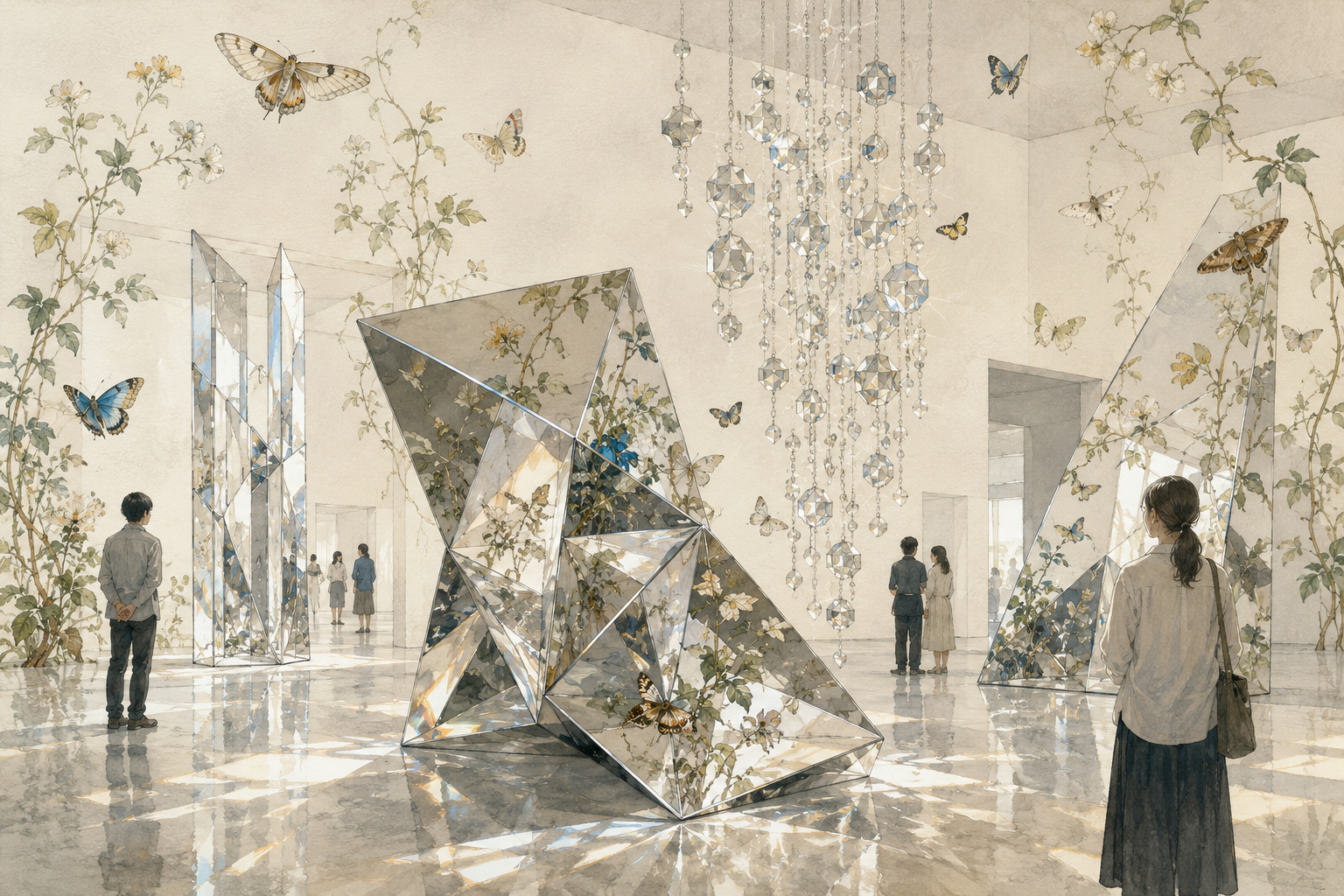
A RETROSPECTIVE normally begins with a simple act: bring the work back. Tada Minami’s career makes that act unusually difficult. A sculpture can travel; a wall of 7,600 glass blocks at the Imperial Hotel Tokyo cannot. A lighting installation commissioned for the Imperial Palace belongs to architecture as much as to an artist’s catalogue.
That difficulty gives “Tada Minami—Still, shimmering light” its purpose. Opened August 29 at the Museum of Contemporary Art Tokyo, the exhibition gathers about 70 paintings, sculptures and lighting works, along with architectural elements, photographs, sketches and other archival records. The museum describes it as the first major retrospective since Tada’s death in 2014.
The display spans roughly seven decades and 1,500 square metres, including a basement atrium and an adjoining outdoor area. It moves from early oil paintings through bronze and aluminium to acrylic mirrors, stainless steel, ceramic panels and the works Tada called “lighting sculpture.”
An Exhibition About Things Museums Cannot Easily Own
Tada’s public career developed inside postwar Japan’s new buildings. Her commissions included the 1957 Coal Mine relief for Tanrō Kaikan, lighting sculpture for the new Imperial Palace in 1968, the Dawn light wall at the Imperial Hotel Tokyo in 1970 and Auspicious Clouds at the Osaka Royal Hotel in 1973.
The museum says she produced roughly 200 sculptures and nearly 500 architecture-related works. The second number changes the meaning of the first. Her output was not merely installed in urban space; much of it was conceived through the dimensions, surfaces, lighting and circulation of a specific site.
Such work may remain publicly visible but is institutionally vulnerable. Renovation can alter it. A building can close. Components may survive after the intended experience disappears. A retrospective must therefore treat photographs, plans, samples and fabrication knowledge as evidence, not supplementary decoration.
The Viewer Enters the Sculpture
Frequency 37306505, made in 1965, consists of six projecting acrylic hemispheres with aluminium vapor-deposited surfaces and a steel structure. The museum’s collection commentary describes an approaching viewer discovering six distorted versions of the self.
The reflection is not a picture placed on the sculpture. It is an event produced by the surface, the room and movement. As the viewer changes position, architecture stretches and contracts across the hemispheres. Tada turned an apparently hard, controlled object into something optically unstable.
This is why “light” in her work should not be reduced to illumination. Reflection, transmission, refraction and shimmer determine what the form becomes from one moment to the next. Acrylic, aluminium, stainless steel and glass are physical materials; the image they generate is temporary.
Painting Was Not a Preliminary Footnote
Tada was born in Kaohsiung, Taiwan, in 1924 and raised in Korea. She graduated from the institution now known as Joshibi University of Art and Design in 1944 and exhibited oil paintings at the Nika Exhibition and Yomiuri Independent Exhibition during the 1950s.
The official checklist begins with Building from 1944 and includes Transformer Substation L and Transformer Substation from the 1950s. Around 1960, untitled paintings already combine oil with acrylic board, stone, nylon thread, sand and gravel. Material experiment happened inside the picture before it moved fully into space.
The winning Coal Mine relief proposal in 1957 connected that experiment to architecture. Tada founded Minami Tada Associates in 1962 and intensified her research into plastics and new fabrication methods. The shift from painter to sculptor was not an abrupt rejection of the flat surface; it was an expansion of what a surface could do.
| Period | Materials and settings | Question carried forward |
|---|---|---|
| 1940s–50s | Oil painting and architectural relief | How can line, structure and texture imply space? |
| 1960s | Bronze, aluminium, acrylic and lighting | Can industrial fabrication remove the artist’s visible hand? |
| 1970s | Mirrored sculpture and architectural commissions | Where does the work end and the site begin? |
| 1980s–2010s | Stainless steel, glass, ceramic panels and public sculpture | How can colour and reflection respond to environment? |
| 2026 | Refabrication and reconstruction | What can be recovered after the original site is gone? |
A Reconstruction Is Not the Original
Chaindelier began as a 1963 lighting work at Matsuya Salon in Ginza. Tada transformed the ball chain familiar from sinks into a suspended structure. The museum identifies the commission as the work that led to her lighting assignment for the new Imperial Palace.
The original no longer exists. For this exhibition, Minami Tada Associates helped refabricate it at full scale. The checklist dates it “1963/2026” and explains that the year after the slash marks remaking or reconstruction. That notation matters: visitors are not being offered untouched matter from 1963.
Auspicious Clouds raises a related question. Part of the 1973 hotel installation has been reconstructed with about 3,000 crystal-glass components from the original production period. The components carry history, but the museum gallery cannot recreate the hotel ceiling, route, acoustics or social use around them.
Good reconstruction does not pretend the distance has vanished. It lets the object return while making the conditions of return visible.
Seventy Works Require More Than One Pace
The published checklist numbers 69 works; the museum describes the total as approximately 70, with archival materials presented separately. The distinction prevents documents, architectural fragments and remade works from becoming an inflated attendance number for objects.
The reflective sculpture rewards movement. A frontal view fixes only one temporary image, while a change of position pulls another artwork, a doorway or the viewer into the surface. In the atrium, daylight can change the reading again.
The risk is that optical pleasure overwhelms chronology. Early paintings, bronze, ceramic reliefs and documentary material explain how the famous mirrored surfaces became possible. Reading material labels and reconstruction dates is as important as photographing reflections.
Why the Posthumous Survey Matters
Tada worked across categories that museums often keep administratively separate: sculpture, product design, interiors and architecture. She also built a career through engineers, fabricators, companies and public clients. A history focused only on autonomous objects will capture part of that practice and lose the network that made it possible.
The exhibition also places a woman sculptor back into discussions of postwar public space. A two-day symposium on November 7 and 8, co-organized with AWARE: Archives of Women Artists, Research and Exhibitions, will examine women’s roles in abstract sculpture, architecture, commissioning and preservation from the 1950s through the 1990s.
The useful claim is not that Tada had disappeared. Major solo exhibitions were held in 1991 and 2009, and her work remains in museums and buildings. The sharper point is that no posthumous survey had yet joined the portable sculptures, architectural record and reconstructed lighting into one sustained account.
Planning a Visit
“Tada Minami—Still, shimmering light” runs through December 6 in the B2F special-exhibition galleries at the Museum of Contemporary Art Tokyo. Hours are 10 a.m. to 6 p.m., with last admission 30 minutes before closing. Every Friday in November extends to 8 p.m.
The museum is generally closed Mondays, but opens September 21, October 12 and November 23; it closes instead on September 24, October 13 and November 24. General admission is ¥1,600. University and vocational-school students and visitors 65 or older pay ¥1,100; junior-high and high-school students pay ¥640; younger children enter free.
Students in junior high, high school, vocational school and university may enter free from October 10 through 12 with valid student identification. Schedules and conditions can change, so the museum’s official page should be checked before travel. The 232-page bilingual catalogue includes four essays, illustrations and a chronology.
1924 Tada is born in Kaohsiung and later grows up in Korea.
1957 Coal Mine wins the competition for a Tanrō Kaikan relief.
1962 Minami Tada Associates is established.
1965 Frequency 37306505 wins an excellence award at the 8th International Art Exhibition of Japan.
1968–73 Major lighting and architectural commissions include the Imperial Palace, Dawn and Auspicious Clouds.
2014 Tada dies in Tokyo.
AUGUST 29, 2026 Her first major posthumous retrospective opens.
- Museum of Contemporary Art Tokyo — official “Tada Minami—Still, shimmering light” exhibition page
- Museum of Contemporary Art Tokyo — official exhibition press release, February 25, 2026
- Museum of Contemporary Art Tokyo — official floor map and bilingual checklist
- Museum of Contemporary Art Tokyo collection — Frequency 37306505 object record and commentary
- National Museum of Modern Art, Tokyo — curatorial discussion of Chiaroscuro
- AWARE Japan — Hikari Odaka and Mariko Tamura, “Tada Minami”
This English edition was written independently from official Japanese exhibition and collection records, the bilingual checklist and scholarly material available through August 29, 2026. Names, titles, dates, media, venue details and admission information were checked against Japanese-language sources. This is a documentary preview and analysis, not an account based on an on-site visit.