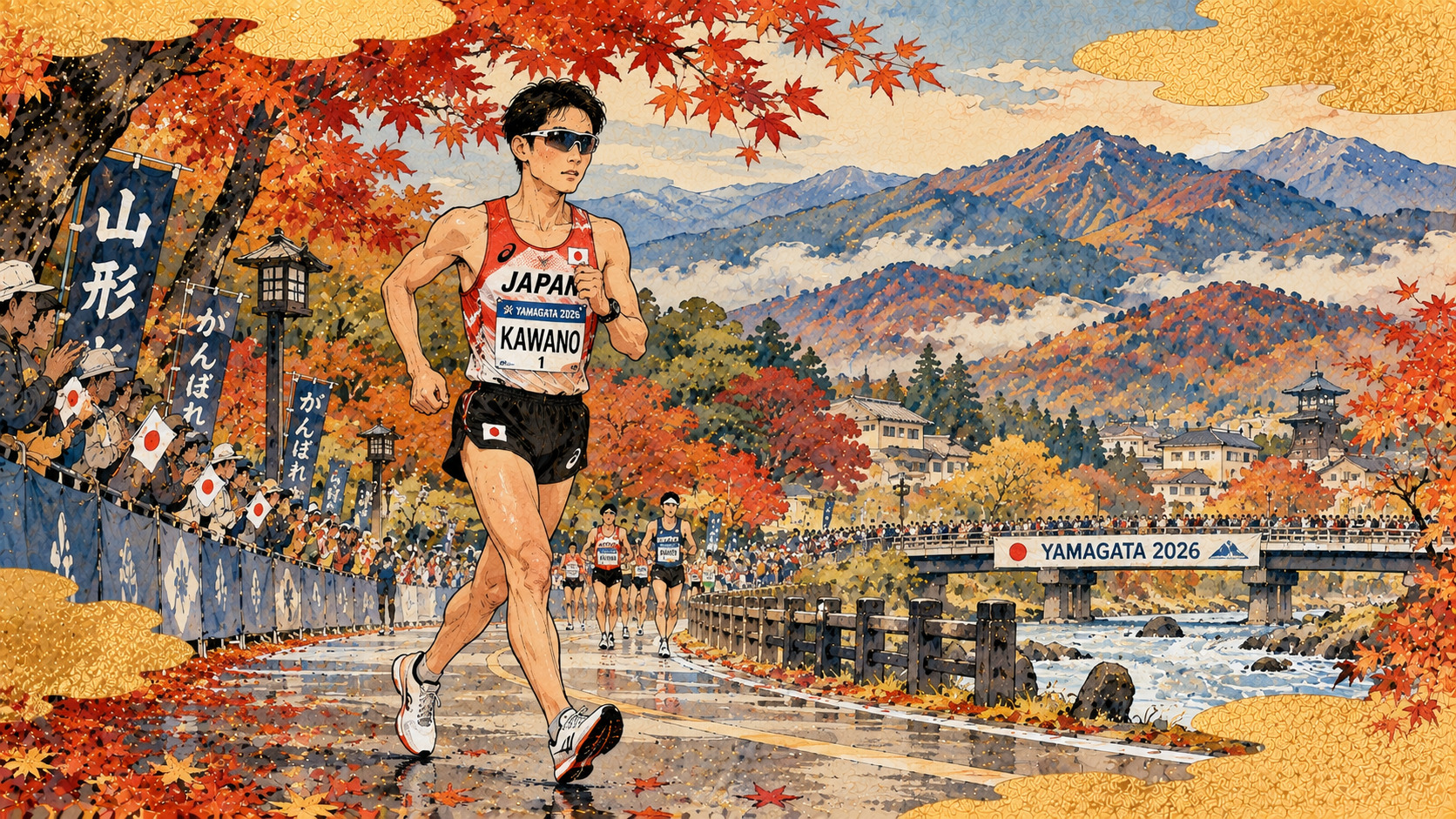
A new record written in the rain
On October 25, in rain-soaked Takahata, Yamagata Prefecture, Japanese race walker Masatora Kawano won the men’s marathon race walk in 2:55:14. World Athletics described his performance as the inaugural men’s world record at the newly recognized distance, subject to its usual ratification process. This was not a runner completing an ordinary marathon. Kawano had to cover all 42.195 kilometres while meeting the technical rules that make race walking one of track and field’s most unusual endurance disciplines.
The decisive six kilometres
According to World Athletics, Kawano accelerated away from a five-man group at 36 kilometres. The course rose and fell by approximately one metre per lap, and the weather was wet. He held his advantage to beat Kazuya Iwai by 41 seconds; Iwai finished in 2:55:55. It was a competition in which the decisive attack happened after most road runners would already have been searching for the finish, and in which increasing speed meant greater scrutiny of an athlete’s legal walking technique.
What does 2:55:14 actually mean?
Kawano’s average speed across 42.195 kilometres was approximately 14.45 kilometres an hour, equivalent to around four minutes and nine seconds per kilometre. That is an exceptionally demanding pace over nearly three hours. The difference from running is fundamental: race-walking rules prohibit visible loss of contact with the ground, and the leading leg must be straightened from first contact until it reaches the vertical position. Judges assess technique by eye. Speed and technical control are inseparable; faster is not necessarily better if it brings disqualification.
Why the record is called inaugural
The half-marathon and marathon race-walking distances became officially recognized from January 1, 2026. World Athletics established 2:56:30 as the performance standard for the first men’s marathon race-walk world record. Kawano became the first athlete to meet that threshold in the qualifying period, and World Athletics announced him as the inaugural record-holder, subject to ratification. His time was also 14 seconds faster than Hayato Katsuki’s 2:55:28, achieved on the same course in 2025. That earlier performance appears on the all-time results list; it should not be confused with a previously ratified men’s record under the new 2026 standard.
A discipline changing its measuring stick
Race walking has undergone major changes in its long-distance programme. The men’s 50 km walk featured at the Tokyo Olympics, while the 35 km became the longer individual event at World Championships in the years that followed. The introduction of half-marathon and marathon race walks in 2026 brings the sport into the vocabulary of familiar road-running distances, without changing its core movement rules. Running and race walking over 42.195 km are different competitive achievements; comparing their finishing times as though they measure the same movement is misleading.
The first landmark in Takahata came years earlier
Kawano’s relationship with Takahata predates this breakthrough. In 2019 he set a Japanese 50 km race-walk record of 3:36:45 there. He finished sixth in the 50 km at the Tokyo Olympics, won silver in the 35 km at the 2022 World Championships, and bronze at the 2023 edition. Back in Takahata in 2024, he broke the 35 km world record with 2:21:47. His 2025 World Championships result at 35 km was a less celebrated 18th place. The combination of world-class success and setbacks gives the new performance a richer history than a single extraordinary time.
From university athletics to the company team
Born on October 23, 1998, Kawano is listed by the Japan Association of Athletics Federations as an athlete from Miyazaki Prefecture who attended Toyo University and now competes for Asahi Kasei. His development illustrates Japan’s system connecting school competition, university sport, corporate teams and national championships. An internationally ranked race-walking event in a regional town can therefore serve as both a domestic test and an opportunity to establish a global benchmark.
The road toward Beijing in 2027
The 63rd All Japan Race Walking Takahata Meeting also served as a Japanese selection competition for the 2027 World Athletics Championships in Beijing. Hayato Katsuki placed fourth in 2:56:59, bettering the Japan federation’s stated dispatch standard of 2:58:00, according to Japanese reporting. But meeting a time standard and receiving formal team confirmation are not automatically identical for every athlete. Final selection statements should come from JAAF, not be inferred from results alone.
Two countries, two records on one day
Australia’s Rebecca Henderson recorded 3:14:52 at Takahata, improving the 3:15:11 women’s record set by Italy’s Sofia Fiorini in August. World Athletics presented both Henderson’s performance and Kawano’s with a note that ratification remained outstanding. Their achievements have a common location but different record histories: Henderson improved an existing women’s benchmark, while Kawano met the threshold that establishes the inaugural men’s record. The distinction is essential to an accurate story.
The rules that make a record meaningful
Race walking is sometimes dismissed by unfamiliar spectators because of its distinctive hip and leg motion. Its discipline comes from constraint. Athletes must travel fast without visible airborne phases, and they must keep the advancing knee straight over the designated portion of each step. The faster the closing kilometres become, the more demanding that combination can be. Records in this sport describe not only cardiovascular endurance but controlled movement under continuous observation.
The next mark to chase
Once confirmed, 2:55:14 will stand as the baseline against which the next generation of men’s marathon race walkers measures itself. It will not guarantee success at future championships or settle debates over programme changes. It does offer something every new event needs: a credible standard, achieved under competition pressure, and a human story to make the number memorable. In Takahata, a walk became a new point of reference for a global sport.
Sources and verification
Checked against World Athletics, JAAF, JOC and contemporary race reporting. The record remains subject to formal ratification. No independent interview with Kawano was conducted.
- JAAF: 63rd All Japan Race Walking Takahata Meeting
- World Athletics: Takahata race report
- World Athletics: preliminary record notice
- World Athletics: all-time marathon race walk results
- JAAF: official Masatora Kawano biography
- Japanese Olympic Committee: Kawano
- World Athletics: race-walking rules
- Rikujyokyogi: October 25 Takahata report
- World Athletics: Kawano athlete record