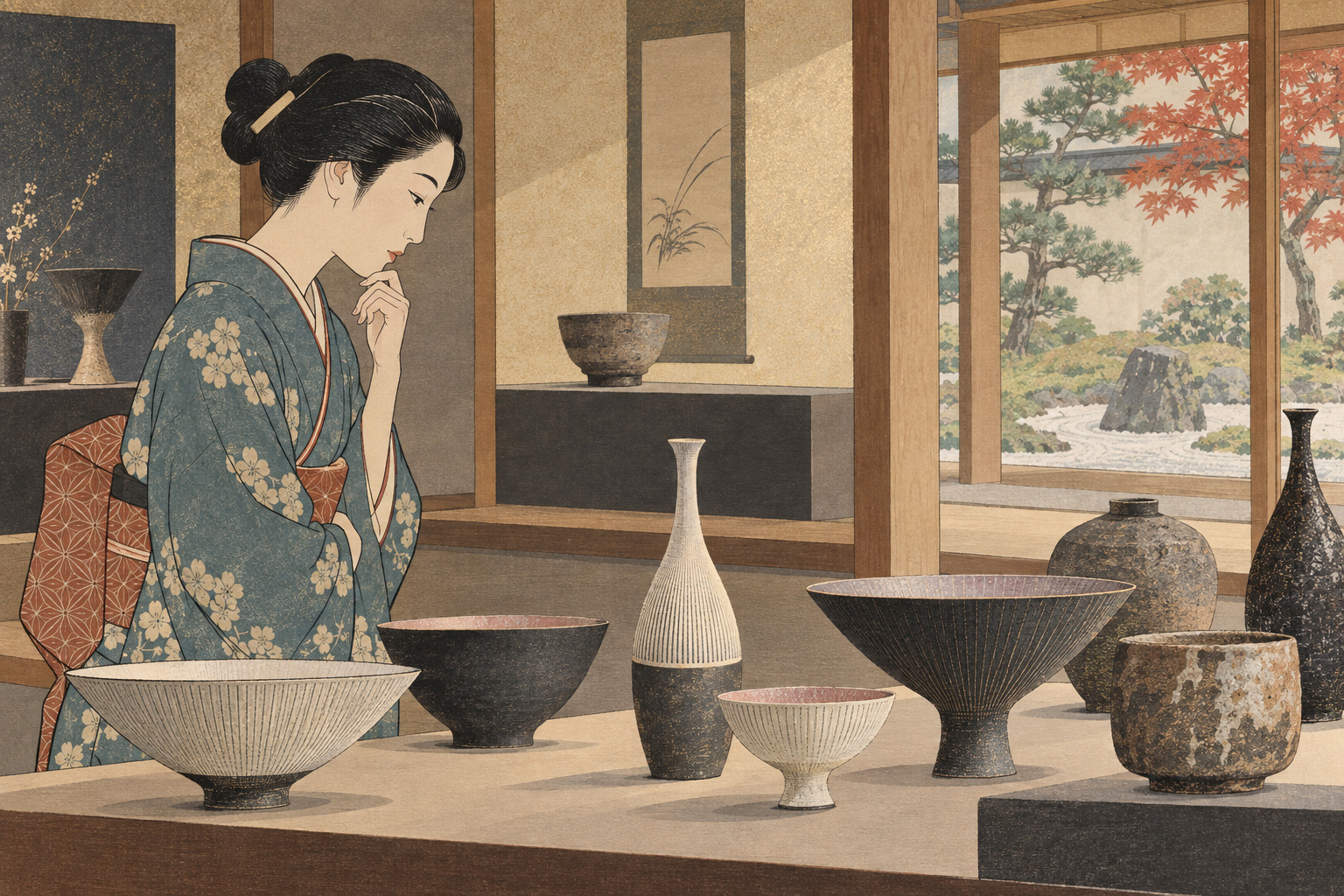
A line travels outward from the center of a bowl. It may be scratched through glaze or inlaid with pink. It draws the eye across the interior, over a rim pared almost to an edge, and down toward a tiny foot that seems improbably capable of carrying the whole form. Lucie Rie’s vessels look delicate. Their authority comes from how little material they need to establish it.
Tokyo has five calendar days left to see those decisions at close range. Lucie Rie: Elegant Vessels Fusing East and West closes at the Tokyo Metropolitan Teien Art Museum on Sunday, September 13. It is Japan’s first large-scale Rie retrospective in roughly a decade, staged across the 1933 Former Residence of Prince Asaka and the museum’s Annex.
The public checklist runs to No. 118, supplemented by reference objects. It places Rie beside Josef Hoffmann, Felice “Lizzi” Rix-Ueno, Bernard Leach, Hans Coper, Hamada Shōji and others. The point is larger than influence spotting. The exhibition asks how an artist who lost one country and rebuilt a workshop in another could remain fiercely individual while moving through a network that reached Japan.
Five days remain in Tokyo
The Tokyo presentation runs through 6 p.m. Sunday, with last admission at 5:30 p.m. Admission uses timed reservations: ¥1,400 for adults, ¥1,120 for university and vocational students, and ¥700 for high-school students and visitors 65 or older. Children of middle-school age and younger enter free. In a closing week, checking the official booking page is more prudent than assuming walk-up availability.
This is the end of one installation, not the tour. The exhibition is scheduled for the Mie Prefectural Art Museum from September 26 to December 13, then ABENO HARUKAS Art Museum in Osaka from December 26 through March 7, 2027. Tokyo is the last chance to see Rie’s vessels inside this particular building.
That distinction matters. The former royal residence was completed in 1933 as a total Art Deco interior: rooms, glass, metalwork, light and furniture were conceived together. A bowl placed in that domestic scale is never only sculpture. It remembers hands, a tabletop, flowers or coffee—even when its precision demands the attention normally given to autonomous art.
Vienna taught her that design was an environment
Rie was born Lucie Gomperz in 1902 into a Jewish family in Vienna. At the city’s Kunstgewerbeschule, or School of Arts and Crafts, she studied ceramics with Michael Powolny and encountered the potter’s wheel. Her early bowls belong to a city in which the Wiener Werkstätte pursued the ideal of a Gesamtkunstwerk: architecture, clothing, furnishings and useful objects brought into one designed environment.
The exhibition does not use Vienna merely as a biographical prologue. Its first chapter places a circa-1926 Rie bowl among Hoffmann designs, a liqueur glass decorated by Rix-Ueno, contemporary ceramics and Bauhaus publications. The comparison shows that her later clarity did not begin as an imitation of Japanese restraint. It grew from Central European modernism and its argument that utility and formal intelligence could occupy the same object.
Those early earthenware pieces are heavier and less assured than the vessels for which Rie became famous. That is useful evidence. A signature style is not an essence revealed fully formed; it is an accumulation of corrections made under changing conditions.
Exile turned a home into a workshop
In 1938, Nazi persecution forced Rie to leave Vienna for London. She arrived at 36 with an established Austrian career but no equivalent standing in Britain. At Albion Mews she made an urban home-studio with an electric kiln—far removed from the rural, wood- or gas-fired ideal favored by many British studio potters.
Exile should not be polished into an inspirational travel narrative. It severed Rie from language, clientele and security. Yet the shape of the London studio also continued something from Vienna: living, working and showing could share one address. Domestic space became infrastructure for artistic survival.
The exhibition’s second chapter lets practical objects carry that history. Tureens, coffee sets and cups sit near wartime buttons and work by the people who entered Rie’s orbit. “Useful” and “experimental” are not separate categories here. The same workshop had to solve both.
The buttons were not a footnote
Wartime restrictions pushed Rie toward fashion components. A family friend, Fritz Lampl, employed her to make buttons for his relocated Orplid business; she soon developed her own stoneware versions. The exhibition checklist includes glass buttons dated 1939–43 and ceramic examples from the 1940s and 1950s.
A button offers almost no room for indecision. Within a few centimeters, color, relief, incised marks and glaze must survive handling and repetition. Seen beside the pots, the buttons become a compressed laboratory for the surfaces that followed—not a romantic claim that hardship was creatively necessary, but evidence that commercial production and artistic research overlapped.
Hans Coper first came to the workshop as an assistant and fellow refugee. He became Rie’s collaborator, friend and one of the defining ceramic artists of postwar Britain. Decades later, Japanese designer Issey Miyake, who befriended Rie in the 1980s, incorporated some of her wartime buttons into his fashion collections, according to the Victoria and Albert Museum. A product of displacement acquired a second life in Japanese design.
Bernard Leach’s road was not hers
Bernard Leach dominated British studio pottery when Rie arrived. His synthesis of East Asian ceramics and English vernacular ware valued weight, visible process and the moral seriousness of useful pots. Rie briefly moved toward his idiom, but its robust forms were never fully hers.
Encouraged by Coper, she returned to thinly thrown Modernist vessels and smoothed away conspicuous throwing rings. The difference was not between handmade and industrial. It was between two ways of making the handmade visible. Leach let material and process speak loudly; Rie could make disciplined finish itself the evidence of a hand.
The gallery makes that divergence visible rather than prosecuting it. Leach’s large octopus dish and slipware sit near Rie’s quieter surfaces; Coper’s compressed and stacked profiles create a third position. Relationships are presented as conditions for difference, not machines that produce sameness.
“East and West” was a network, not two boxes
A central historical encounter came at the 1952 International Conference of Craftsmen in Dartington, England. Yanagi Sōetsu and Hamada Shōji attended from Japan, and Rie developed ties with them. The exhibition’s third chapter brings Hamada’s salt-glazed, iron-decorated pitcher and other objects into the conversation.
It is tempting to turn every incised line or modest profile into proof of “Japanese influence.” The evidence is less tidy. East Asian ceramics reached Rie through museum objects, Leach’s philosophy and working friendships, while her Viennese design formation and London practice remained active. Japanese, Chinese and Korean traditions were themselves distinct; treating “the East” as a single style would repeat the simplification the exhibition is equipped to challenge.
The checklist even includes, as a reference image, a jar-shaped vessel from the late Yayoi period. Juxtaposition is not proof of descent. It is an invitation to compare neck, shoulder, foot, surface and use—and to notice where resemblance ends.
One firing, no separation between skin and body
Rie worked in stoneware and porcelain, often applying glaze to an unfired, dry body and completing clay and surface in a single firing rather than using the customary biscuit-firing and glazing sequence. That compressed process increased risk. It also made body and glaze participants in the same thermal event.
Her vocabulary was exact. Sgraffito—identified in the Japanese exhibition as kaki-otoshi, or scraping away—cut lines through the surface. Inlay filled incisions with contrasting material. Marbling combined differently colored clays, allowing the wheel to draw spirals through the body itself. Manganese could create a dark field; volcanic glaze raised a rough crust that seemed almost thicker than the wall beneath it.
| Object in the Tokyo checklist | What it makes visible |
|---|---|
| Footed Bowl with Radiating Sgraffito with Manganese, c.1970 | Lines organize the eye around the center and clarify the bowl’s rotation. |
| Footed Bowl with Inlaid Pink Horizontal Circles with Bronze Running Rim, c.1975–79 | Color and inlay make a very small vessel optically expansive. |
| Bowl with Volcanic Glaze, c.1980 | A rough, heavily textured skin pulls against a thin body. |
| Marbled Vase, c.1980 | Pattern is generated through clay and rotation rather than painted on afterward. |
| White Glazed Bowl Decorated with Pink Line, c.1984 | Fine color calibrates proportion without becoming illustration. |
The term “decoration” can therefore mislead. A pink line does not narrate a flower or landscape; it makes the viewer feel diameter and speed. A pitted glaze is not wallpaper on a pot; it changes the apparent mass of the wall. Surface teaches the eye how to read form.
Japan did more than admire her
The museum identifies a 1989 exhibition at Sogetsu Hall as the moment Rie’s work was introduced to Japan on a substantial scale. Major retrospectives followed in 2010 and 2015. Her audience expanded beyond ceramics to designers and architects, while museums and private collectors assembled bodies of work large enough to sustain new scholarship.
The Iuchi Collection, deposited at the National Crafts Museum in Kanazawa, is crucial to the current show. Its blue-glazed, manganese, pink-lined, marbled and bronze-glazed works supply many of the exhibition’s defining images. Objects made in Britain now depend on Japanese stewardship for their continued public life.
That is a more supportable meaning of “influence” than a list of presumed imitators. Exhibitions, collecting, museum custody and design culture taught successive Japanese audiences how to look at Rie. Japan became not only a recipient of her reputation but one of the places where that reputation is preserved and revised.
A vessel stands on its own small foot
The exhibition’s fourth chapter concentrates on work from 1970 onward, when the small foot, taut profile, manganese surfaces and scratched or inlaid line had become a mature language. These pots can appear inevitable. The preceding rooms prevent that illusion: the apparent ease rests on Vienna training, forced migration, wartime economics, collaboration and refusal.
The former Asaka residence then returns the objects to bodily scale. A vase can be autonomous sculpture and still imply flowers; a coffee set can be rigorous design and still anticipate pouring. Rie never needed to resolve the hierarchy between fine art and use. She made the distinction feel less interesting than the object itself.
What remains in the final room is not a harmonious merger of East and West. It is something stronger: a vessel capable of receiving many histories without becoming an illustration of any one of them. Rie’s bowls traveled remarkably far. On their tiny feet, they kept their balance.
- Lucie Rie: Elegant Vessels Fusing East and West
- Through Sunday, September 13, 2026
- Tokyo Metropolitan Teien Art Museum, Main Building and Annex
- 10 a.m.–6 p.m.; last admission 5:30 p.m.
- Timed-entry reservations apply. Adults ¥1,400; university/vocational students ¥1,120; high-school students and visitors 65+ ¥700; middle-school age and younger free.
- Personal photography is allowed for most works, subject to posted restrictions. No flash, tripods, selfie sticks or video.
Sources and editorial distinctions
Dates, admission, the four-part structure, object titles, collections and tour schedule come from the museum’s official materials. Interpretations of elegance, Japanese reception and the building’s effect on viewing are Japan.co.jp analysis. The article does not attribute direct influence on individual Japanese artists without documentary evidence.