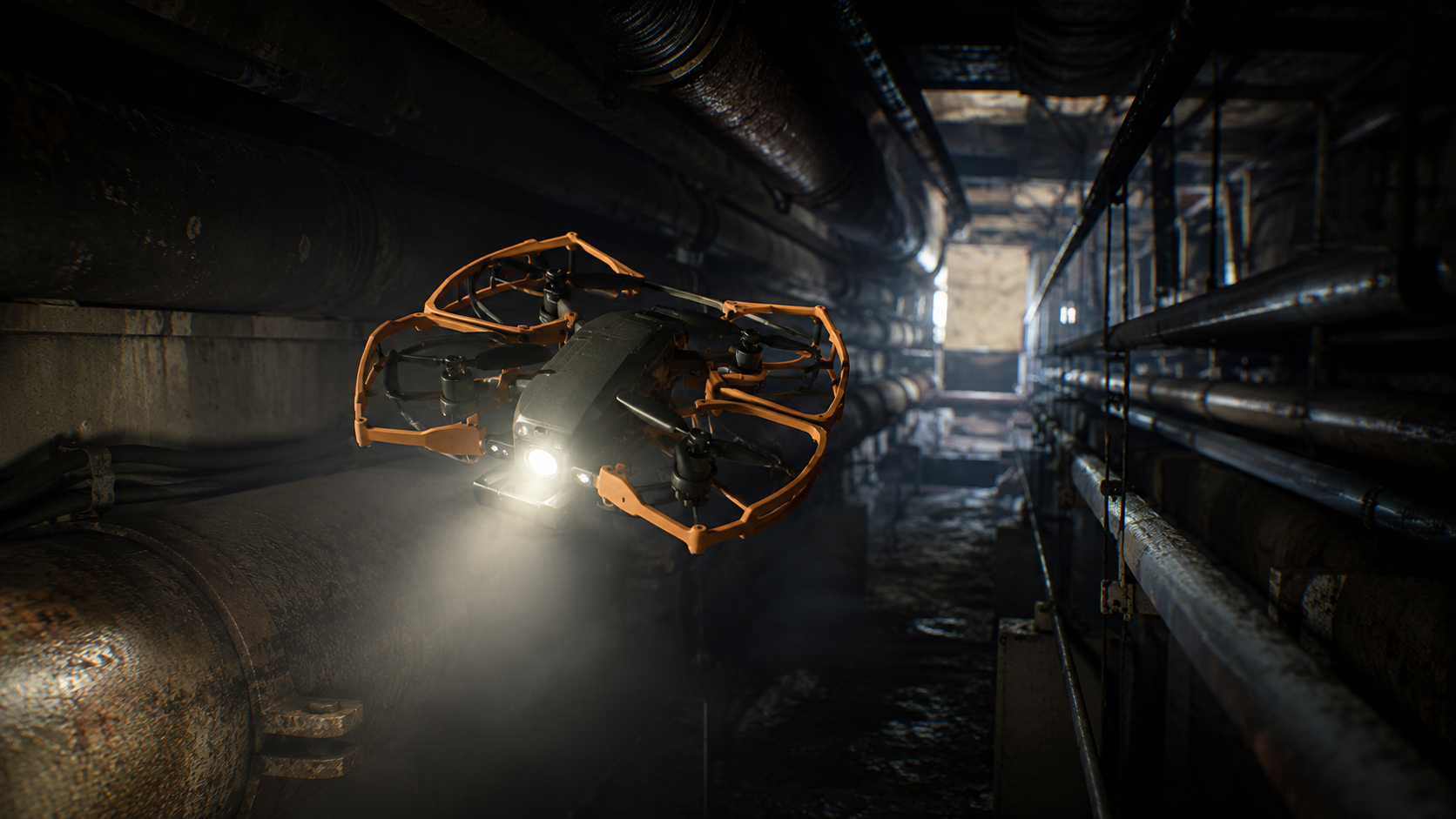
While big drones chase the sky, Liberaware sends a tiny one into Japan’s hidden machinery
When most people hear the word drone, they look up. They imagine delivery aircraft crossing mountains, crop-spraying machines over rice paddies, disaster drones above a fire line, or unmanned aircraft in defense headlines. Liberaware’s IBIS2 points in the opposite direction. Its world is ceiling cavities, ducts, chimneys, pipes, tunnels, plant interiors, boiler spaces, dam galleries, and underground utility corridors. In other words: the places that hold Japan together but almost nobody sees.
That is why Liberaware matters in Japan’s drone story. The company is not simply making a drone smaller for the sake of clever engineering. It is aiming the machine at a painful industrial problem. Humans cannot enter. Or they can enter, but only with risk. Scaffolding is expensive. Stopping equipment is expensive. Drawings are missing or outdated. The facility has changed over decades of repairs and add-ons. The work is dirty, dark, narrow, and sometimes dangerous.
Japan’s drone economy is often described through logistics, agriculture, disaster response, and defense. Liberaware adds another chapter: the drone as a maintenance worker’s extra eye. Small enough to enter, light enough to reduce damage risk, and useful enough to become part of the safety and inspection workflow.
A market made of places that are narrow, dark, and dangerous
Liberaware describes IBIS2 as an ultra-small inspection drone for indoor spaces that are narrow, dark, and dangerous. Public product information emphasizes a roughly 20-centimeter class body and a weight of 243 grams. That is the opposite of the heavy-lift drone philosophy. The point is not to carry more. The point is to get in.
Indoor inspection changes the rules of flight. GPS may not work. Walls matter more than wind. Long range matters less than stable flight in tight quarters. Clear imaging matters. Lighting matters. Communication matters. Avoiding damage to the facility matters. So does getting the aircraft back out.
This is a very Japanese problem because so much of modern Japan was built during an earlier demographic era. Factories, power facilities, water systems, rail assets, tunnels, commercial buildings, and underground corridors are now aging. The country that built them was younger. The country that must inspect them is older. The list of places to inspect grows while the number of experienced people available to inspect them shrinks.
Before scaffolding, shutdowns, and danger pay, send a small machine
Industrial inspection is never as simple as taking a look. To inspect a chimney, duct, plant room, or overhead cavity, a company may need scaffolding, a lift, protective equipment, lockout procedures, gas checks, confined-space protocols, and a schedule that avoids disrupting production. Every step costs money. Every step takes time. Every step adds a safety decision.
IBIS2 does not eliminate inspection. It changes the order of inspection. Before a person enters, a small machine can enter. Before a team builds access, a drone can provide first visual confirmation. Before a facility is shut down for a longer intervention, operators may get the evidence they need to decide whether that shutdown is necessary.
The important word is not flight. The important word is information. Liberaware’s business is not just selling a tiny aircraft. The company also describes services around inspection, surveying, data processing, analysis, digital twins, drawing creation, and BIM modeling. In that sense, IBIS2 is the sensor at the edge. The larger business is turning what it sees into usable facility knowledge.
From industrial inspection to rescue: the Chiba fire department signal
In March 2026, Liberaware announced that the Chiba City Fire Bureau had introduced IBIS2 through a rental arrangement. The stated purpose was use in rescue training and potential disaster sites, where the drone can be sent in before firefighters enter a hazardous enclosed space. The idea is simple and powerful: see first, enter second.
That turns an industrial inspection product into a public-safety tool. Collapsed structures, toxic gas risks, smoke-filled interiors, explosion hazards, dark voids, and unstable spaces all create the same operational question. What is inside, and is it safe for a human being to go in?
Japan needs both kinds of drone eyes. Large drones and helicopters can see the fire, flood, landslide, or damaged district from above. Small indoor drones can see the cavity, duct, room, void, or tunnel from inside. Disaster response becomes stronger when both views exist.
A TSE Growth listing makes a niche look less niche
Liberaware listed on the Tokyo Stock Exchange Growth Market on July 29, 2024, under securities code 218A. The point is not merely that the company went public. The point is that confined-space inspection became a story the capital market could understand.
There are more glamorous drone markets: air mobility, military systems, delivery, agriculture, and aerial imaging. But infrastructure inspection has a practical strength. Assets age. Safety rules do not disappear. Labor shortages deepen. Maintenance budgets remain. Customers are not buying a dream of the future; they are trying to reduce this month’s inspection cost, next month’s downtime, and next year’s accident risk.
Winning in this field requires more than a clever airframe. It requires field knowledge. What does the inside of a duct look like after years of use? What angle does the plant manager need? What kind of file will the maintenance team actually use? How do you train operators so the drone becomes part of a safe work procedure? Liberaware’s value sits in that gritty overlap between hardware, field work, and data.
Digital twins are where the tiny drone becomes a bigger business
Liberaware’s company profile lists drone operations, digital twins, and solution development. That combination matters. A drone inspection can be a one-time service. But if the data becomes a facility model, drawing, point-cloud record, BIM asset, or recurring maintenance reference, the drone becomes part of an operating system for infrastructure care.
Japan has many existing facilities whose drawings are missing, outdated, or inconsistent with reality. That is not rare in construction and maintenance. Buildings change. Pipes are added. Ceilings are opened and closed. Equipment is replaced. What exists on paper and what exists in the ceiling may no longer match. A small inspection drone can help turn the real condition back into usable information.
The rail and infrastructure angle is especially important. Liberaware’s history includes the 2021 establishment of CalTa with JR East Startup and JR East Consultants, tied to point-cloud data and infrastructure digitalization. Japan’s rail and public infrastructure culture is built on inspection discipline. Digitalizing that discipline is not merely about efficiency. It is about the next version of safety culture.
The small-drone discipline: no magic, lots of field reality
IBIS2 should not be treated as magic. Tiny aircraft face limits: flight time, communication, payload, lighting, environmental resistance, dust, moisture, recovery risk, and operator skill. Entering a narrow space is impressive; returning safely can matter just as much. A dark industrial interior is not a clean demo room.
That is why Liberaware’s real test is operational. Can the company package the drone, the training, the rental or sales model, the data service, and the safety procedure into something customers trust? Can it fit into the rules of plants, rail operators, local governments, and fire departments? Can it scale without becoming just another piece of fragile equipment in a difficult workplace?
Small drones can make small-looking mistakes that cause big industrial headaches. A device stuck inside equipment, a damaged component, a poor image, or a lost flight can make customers cautious. The discipline of implementation matters as much as the elegance of the machine.
What to watch
| Point | Why it matters |
|---|---|
| IBIS2’s size | The roughly 20 cm, 243 g profile shows a clear commitment to cramped, dark, indoor inspection. |
| Fire and rescue use | Chiba City Fire Bureau’s introduction points beyond industrial maintenance toward hazardous-space awareness and rescue support. |
| Digital twins | The long-term business is not only image capture. It is turning inspection data into usable facility information. |
| TSE Growth listing | The 2024 listing showed that confined-space inspection can be explained as a public-market industrial theme. |
| Aging infrastructure | Japan’s maintenance burden, labor shortage, and safety culture all support the case for small inspection robots. |
Japan’s drone industry also lives behind the wall
Liberaware belongs in Japan.co.jp’s June 23 drone issue because it prevents the story from becoming too sky-focused. Japan’s drone future is not only above towns, farms, harbors, and borders. It is also inside the walls, ducts, tunnels, and plant rooms of an aging industrial country.
The machine is small, but the market problem is not. Japan must inspect what it has already built. It must do so with fewer workers, higher safety expectations, and older assets. Sometimes the right answer is not a bigger aircraft. Sometimes the right answer is a palm-sized machine with a light, a camera, and a job nobody should ask a human to do first.
IBIS2 is not the drone of the postcard future. It is the drone of the maintenance future. That may be less glamorous. It may also be far more useful.
- Liberaware is a Chiba City drone and digital-twin company founded in 2016.
- IBIS2 is built for narrow, dark, dangerous indoor inspection and measurement work.
- The company listed on the Tokyo Stock Exchange Growth Market in July 2024 under code 218A.
- In March 2026, Liberaware announced that the Chiba City Fire Bureau had introduced IBIS2 for rescue training and disaster-site awareness.
- The strategic question is whether Liberaware can turn small-drone inspection into a recurring data and facility-management business.
Sources and references
This article draws on Liberaware’s official website, IBIS2 product information, the company’s Tokyo Stock Exchange Growth Market listing announcement, its announcement on the Chiba City Fire Bureau’s IBIS2 rental introduction, Highlighting Japan’s IBIS2 profile, and public company/product information. The market strip uses Japan.co.jp’s exchange-rate note of 1 U.S. dollar = 161.58 yen.