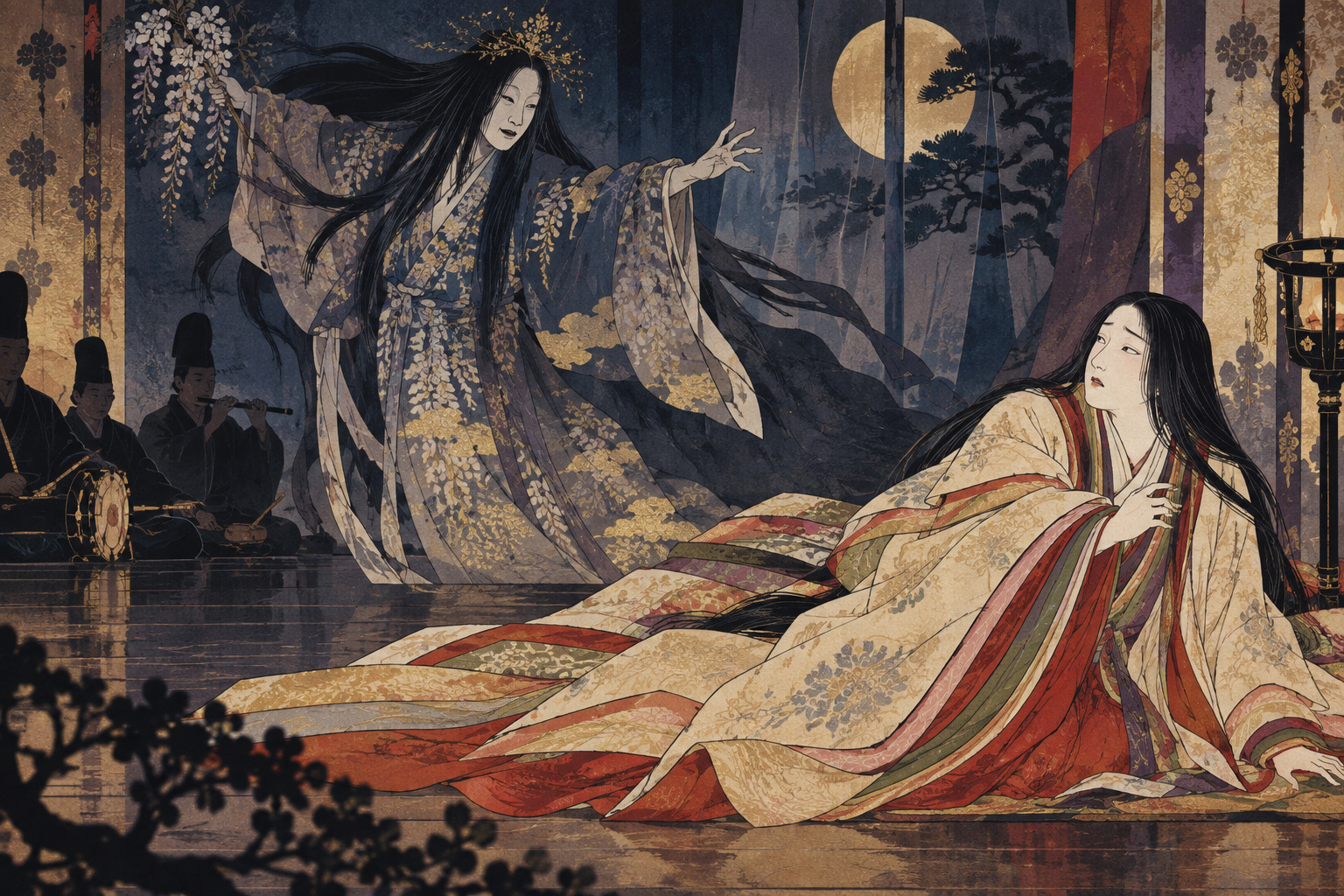
The title character is missing. At the beginning of the Noh play Aoi no Ue, an attendant places a small-sleeved robe at the front of the stage. That garment is Lady Aoi, confined to bed and tormented by an unseen force. The actors address it; the audience learns to see a person in an absence.
In January, a new work at Tokyo International Forum will reverse that extraordinary theatrical choice. Ukigumo wa Ten ni Nuretsutsu: Genji Monogatari yori Aoi no Ue is scheduled for January 4–11, 2027, in Hall D7. Its Lady Aoi will speak, move and resist a politically arranged marriage. The announcement arrived on September 7, 2026, so this is a documented preview—not a review of a production that has yet to open.
The organizers call the form shigaku-geki (詩楽劇), a coined label suggesting a stage work of poetry and music; no official English rendering was found. Kikunojo Onoe is composing and directing, with a script by Kazuhisa Tobe. Former Takarazuka star Yuzuru Kurenai plays Hikaru Genji, Murasaki Fujima plays Aoi, Mario Kuroba plays Tō no Chūjō, and Onoe also performs. Three musicians supply a sound world built from six Japanese instruments.
An announcement for January—not a September opening
The timing matters. The production was announced two days before this article’s publication, but the curtain is four months away. Casting, dates, prices and the stated concept are facts in an official release. Claims about chemistry, visual beauty or dramatic success would be prediction and do not belong in a report.
The official subtitle points to Lady Aoi, but the announced arc is much broader. The work is to range from “Kiritsubo,” the first of Genji’s 54 chapters, through “Fuji no Uraba,” chapter 33. That span takes Hikaru Genji from birth through his early loves to the summit of his worldly success. Condensing it into one evening means selection will be as important as spectacle.
Fujiwara no Teika, the medieval poet and scholar, provides the frame: as he considers the problem of establishing a text, the characters come alive. Murasaki Shikibu’s autograph manuscript does not survive, and Genji reached later readers through manuscript lineages. The new work turns that history of transmission into drama. Its Teika should therefore be understood as a theatrical device, not a complete lesson in textual scholarship.
The collision before the possession
In the “Aoi” chapter, the visible violence occurs before the supernatural one. Retainers attached to Lady Aoi, Genji’s pregnant principal wife, force aside the carriage of Lady Rokujō during the Kamo Festival. Rokujō had come discreetly; her public humiliation is all the sharper because she was once the consort of a crown prince and now feels Genji’s attention receding.
Aoi later becomes dangerously ill under what appears to be spirit possession. Rokujō, meanwhile, fears that her own soul may have escaped her body. The episode never resolves neatly into a courtroom account of culprit and victim. Shame, jealousy, dream and supernatural agency occupy the same unstable space.
That ambiguity matters. A synopsis in which a jealous woman attacks a blameless wife pushes Genji’s conduct and the court’s social machinery out of view. The chapter is also about status made public, women maneuvered into rivalry and a man whose freedom produces costs borne by others.
The woman represented by an empty robe
Noh makes a radical adaptation. In Aoi no Ue—a play shaped by Zeami from the “Aoi” chapter—the spirit of Rokujō is the shite, or principal role. A medium summons her with an azusa bow. She arrives in association with a broken carriage, strikes at Aoi, then returns in demon form to confront the ascetic of Yokawa.
Aoi never enters. Japan Arts Council’s Cultural Digital Library explains that the dashi-kosode, the robe placed onstage, establishes her sickroom and becomes the focus of the performers’ gaze. Removing one of the two women allows Noh to study Rokujō’s consciousness with relentless concentration.
The disappearance is not carelessness. It is form. A garment can be patient, rival, target and empty center at once. The play’s emotional violence gathers around someone who cannot answer it—a solution so powerful that later adapters have had to decide whether to retain the silence or break it.
When jealousy is given a body
Noh externalizes what prose can keep uncertain. Rokujō’s living spirit first appears as a noblewoman wounded by lost rank and love. In the second half, she wears a demon aspect and battles prayer. Voice, mask, costume, dance and hayashi ensemble make an invisible emotion physically legible.
Calling this merely “female jealousy” is too easy. The humiliation of the carriage dispute, the collapse of Rokujō’s social identity and Genji’s divided attachments all feed the figure. The Nohgaku Performers’ Association explicitly identifies the Kamo Festival incident as the direct source of her humiliation and links her entrance to the broken carriage.
The coming production faces a difficult balance. Its official synopsis presents Genji as lonely and unsure of love, and Aoi as seeking freedom. Those are the production’s interpretive choices, not quotations from Murasaki Shikibu. If the staging turns Rokujō into a convenient monster, it will flatten the very tradition it invokes. If it lets competing forms of confinement remain visible, the old triangle may acquire new force.
Mishima moves the haunting into a hospital
Yukio Mishima made a different wager. His Aoi no Ue, published in 1954 and first staged by Bungakuza in 1955, is one of the works collected as Modern Noh Plays. A hospitalized wife named Aoi is visited by her husband, Hikaru Wakabayashi. His former lover, Yasuko Rokujō, arrives in a gleaming automobile—while another version of her seems to be asleep elsewhere.
According to Japan Arts Council’s account, Mishima said he modernized the situation in order to preserve Noh’s freedom with time and space and its overtly metaphysical subjects. The car and telephone are not fashionable decorations. They produce a modern proof that immediately fails: a call confirms a sleeping body, but cannot explain the woman who has just occupied the room.
Mishima’s example is useful because it sets a high bar for adaptation. Contemporary clothing does not make a classic contemporary. The adapter must discover what the source’s structure can do inside the audience’s own reality—what its rooms, machines and social assumptions permit them to fear.
Aoi returns with a body and a claim
The new synopsis gives Aoi a sentence around which the production can turn: she wants to live her own life. It imagines her marriage to Genji as a political arrangement she resists inwardly. Genji asks her brother Tō no Chūjō to teach him about love; the two men become friends. Later, Genji tries to choose family life just as Aoi reaches for freedom and Rokujō’s spirit intervenes.
These are not neutral summaries of the “Aoi” chapter. They are an adaptation’s architecture. That distinction is editorially essential: the production is making an argument about agency rather than uncovering dialogue that has lain unnoticed in the classical text.
Murasaki Fujima, who assumed her dance name in 2021 and became head of the Murasaki-ha Fujima school, embodies Aoi. Kurenai brings the highly stylized stage training of a former Takarazuka Star Troupe top star; Kuroba has worked across musicals, film and television; Onoe is the fourth head of the Onoe school. Their different performance lineages could become part of the work’s meaning, though only the performance can show whether they cohere.
Six instruments, not an imitation Noh ensemble
Tomoya Nakai is billed on 25-string koto; Tomoka Nagasu on shakuhachi and biwa; Shogo Yoshii on taiko, shinobue and kokyū. This is not the standard instrumental lineup of Noh. It is a purpose-built palette extending from struck skins and plucked strings to breath and bowed sustain.
The official material does not assign instruments to characters or episodes, so it would be premature to claim that one instrument “represents” Aoi or another the spirit. What can be said is that the ensemble offers several ways to organize dramatic time: pulse, decay, breath, attack and an unusually wide koto range.
A concurrent lecture series in Hall D5, “The Tale of Genji, Popular Even in the Edo Period,” expands the frame. Genji did not travel from Heian court to a modern theater in one leap. Commentaries, pictures, abridgements and popular editions repeatedly moved it into new reading communities. Transmission has always involved transformation.
Staging a classic instead of embalming it
J-CULTURE FEST began in 2017 as a Tokyo International Forum 20th-anniversary project. Its declared concept is “tradition and innovation,” and the 2027 program coincides with the building’s 30th anniversary and a decade since the festival began. Those milestones explain the commission; they do not guarantee artistic value.
The Tale of Genji, the Noh Aoi no Ue, Mishima’s hospital drama and the new shigaku-geki are not four vessels holding identical content. Prose narration, Noh abstraction, modern psychological theater, dance and live music each impose a different ethics of attention. A responsible production should make those distances productive rather than melting them into generalized “Japanese tradition.”
Lady Aoi has long been a place where other people’s desires meet. Noh condenses her into one robe. The 2027 production proposes that she step out of it. The important question is not how much classical beauty surrounds her, but whether the work can let Aoi, Rokujō and Genji resist the labels waiting for them—and create a question that belongs to the present.
- Ukigumo wa Ten ni Nuretsutsu: Genji Monogatari yori Aoi no Ue
- January 4–11, 2027; 14 scheduled performances
- Tokyo International Forum, Hall D7
- Main performance: ¥11,000 general / ¥5,500 U25; performance-plus-lecture: ¥12,500 general / ¥6,000 U25; tax included
- Official advance: Oct. 8–14; ticket-agency advance: Oct. 19–25; general sales from 10 a.m. Nov. 7
- Schedules, casting and sales conditions may change; confirm with the official listing before purchase.
Sources and editorial distinctions
The official title, dates, cast, instruments, prices and synopsis come from the organizers’ release. Judgments about adaptation and artistic stakes are Japan.co.jp analysis, not claims by the production and not a review of the unperformed work. The article uses the title Aoi no Ue for its established literary and theatrical identity; it is not a personal given name in the modern sense.
- Tokyo International Forum-hosted news release (Sept. 7, 2026)
- Cultural Digital Library: the dashi-kosode in Aoi no Ue
- Cultural Digital Library: guide to the Noh Aoi no Ue
- Nohgaku Performers’ Association: program commentary
- Cultural Digital Library: Mishima’s modern Aoi no Ue
- National Institute of Japanese Literature: Edo-period illustrated Genji
- Onoe school: official Kikunojo Onoe profile
- Murasaki-ha Fujima school: official Murasaki Fujima profile
- Shochiku Entertainment: official Yuzuru Kurenai profile
- TRUSTAR: official Mario Kuroba profile