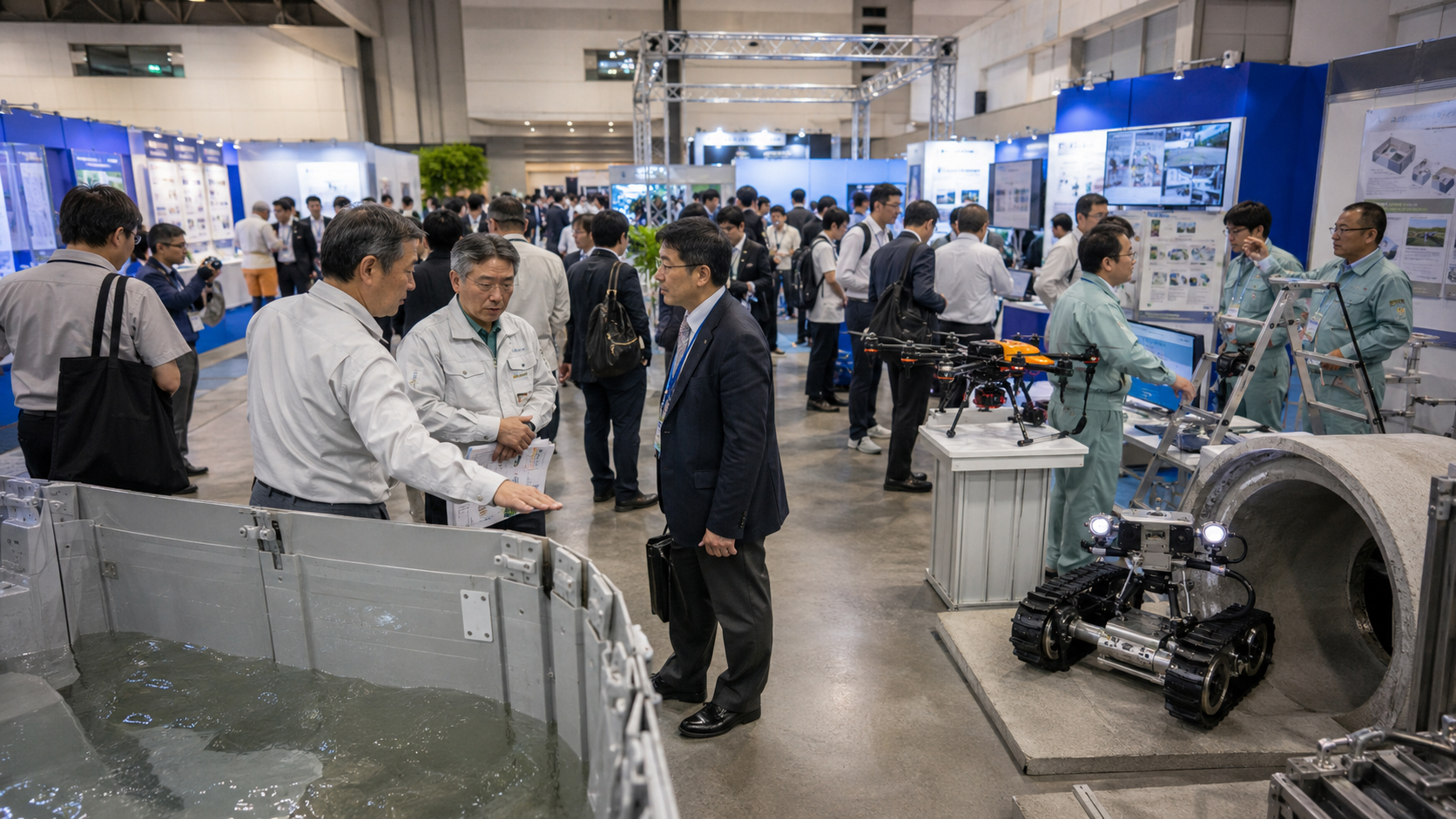
A Kyushu exhibition is not quite a Tokyo exhibition
Tokyo exhibitions often talk about the future in large language: giant booths, international companies, big screens, investors, media, and waves of suits. That future matters. But a disaster, infrastructure, and construction DX show in Fukuoka carries a different tension. The future here is not abstract. Will the next heavy rain arrive before the slope is monitored? Will the bridge survive the next quake? Are there enough inspectors? Can a small-town official stop carrying the whole emergency response on one tired desk?
The events at Marine Messe Fukuoka on June 24 and 25, 2026 have long names: Kyushu Construction and Development General Expo, Prepare for Disaster Risk Expo Kyushu, Social Infrastructure Maintenance and Conservation Show Kyushu, and the first Civil Engineering & Construction DX/Systems/Tools Expo Kyushu. Put together, however, they form one story. Build. Prepare. Maintain. Digitize. Survive. That is Kyushu’s reality.
Exhibitions can look like business-to-business rituals for large companies. But in this field, the real audience also includes small contractors, inspection firms, survey companies, local governments, construction consultants, equipment firms, technical schools, fire and disaster officials, and regional IT providers. Disasters happen locally first. Recovery begins locally first. Disaster tech cannot be completed in a Tokyo conference room.
Why Kyushu: a region with recent disaster memory
Kyushu has recent disaster memory. The 2016 Kumamoto earthquakes shook homes, roads, bridges, castles, slopes, tourism areas, and daily life. Kumamoto Castle’s stone walls collapsed. The Aso Bridge fell. Evacuation life stretched on. The earthquakes showed not only urban vulnerability, but also the fragility of mountain routes and tourism infrastructure.
The 2017 Northern Kyushu heavy rains struck areas including Asakura in Fukuoka and Hita in Oita, bringing landslides, driftwood, river flooding, road closures, and isolated communities. Rain does not merely add water. It moves mountains, trees, bridges, and roads.
The 2020 Kyushu floods hit the Kuma River basin in Kumamoto especially hard, including Hitoyoshi and Kuma Village. Damage to elderly-care facilities drew national attention. Disasters do not strike only geography. They strike demographics. In aging communities, evacuation itself becomes difficult. If roads fail, rescue and recovery slow down.
That is why a Kyushu disaster-tech show is not displaying tools that might be needed someday. It is displaying tools that are already needed. Heavy rain, earthquakes, typhoons, volcanoes, extreme heat, aging infrastructure, and labor shortages are not separate theoretical risks. Kyushu has nearly all of them.
Older bridges, fewer workers, more inspections
Japan built much of its infrastructure during the high-growth era: roads, bridges, tunnels, ports, river facilities, water systems, public buildings. At the time, construction symbolized growth. Today, the central task is maintenance. Bridges age. Concrete cracks. Steel corrodes. Slopes weather. Drainage clogs. Everything must be inspected, diagnosed, repaired, and eventually renewed.
The problem is that the people responsible for this work are fewer. The construction workforce is aging. Young workers are not entering fast enough. Local-government technical staff are limited. Smaller municipalities may need to manage roads, bridges, rivers, and public facilities with very few specialists. The assets remain. The watchers disappear.
This is where DX becomes real. The word is overused, but in infrastructure it can be concrete: inspect by drone, record with cameras, detect cracks with AI, map structures through point clouds, connect design and maintenance through BIM/CIM, link sites and experts through remote support, move asset ledgers from paper to data, and connect inspection results to repair planning.
DX is not a slogan here. It is a way to protect more infrastructure with fewer people.
The real stars are not only giant companies
Large companies naturally attract attention at disaster and infrastructure shows: sensors, robots, surveying devices, cloud platforms, communications, GIS, AI, and construction machinery. But the interesting work also comes from smaller firms and regional providers.
A small sensor watching a slope above a village. A camera that spots clogged drainage during heavy rain. A compact drone that checks the underside of a bridge. An app that automatically organizes site photos. A remote-support tool usable by older field workers. A battery system for evacuation shelters. A wearable that visualizes heatstroke risk. A small construction-management system that connects estimates, crews, and documentation.
These technologies may look modest compared with national strategy decks. In the regions, modest can be powerful. It is affordable. Easy to explain. Less likely to break. Suitable for municipal budgets. Usable by local contractors. Functional when power and communications are imperfect. Practical technology wins because it keeps being used.
Disaster, infrastructure, and DX should not be separated
The best part of the Fukuoka exhibition structure is that disaster risk, infrastructure maintenance, and construction DX sit together. In real emergencies, they are never separate.
Heavy rain comes. A slope collapses. A road closes. A bridge must be checked. Supplies need a route to an evacuation shelter. The town office gathers damage information. Contractors send machinery. Survey firms photograph the site. Communications must keep working. Maps must be updated. Residents need information. Recovery work must be ordered. The next disaster must be planned for.
That is one chain. Exhibitions should reflect it. A disaster-risk visitor should see inspection tools. A construction DX visitor should see heat countermeasures and labor safety. A town official should look at robots, asset ledgers, image management, cameras, and shared maps in one trip. Regional resilience improves when the silos touch.
| Exhibition area | Regional meaning |
|---|---|
| Disaster risk countermeasures | Products and services for heavy rain, earthquakes, snow, extreme heat, and increasingly diverse hazards. |
| Infrastructure maintenance | Inspection, diagnosis, repair, and renewal technologies for bridges, roads, rivers, slopes, and public assets. |
| Civil engineering and construction DX | BIM/CIM, robots, remote work support, image systems, cameras, and tools to reduce labor burden. |
| Construction and development | City building, productivity, sustainable local development, and construction-site improvement. |
| Regional companies | Small contractors, surveyors, equipment firms, disaster suppliers, and IT companies can meet local governments and larger partners. |
For local governments, exhibitions are places of translation
For municipal officials, adopting technology is difficult. Seeing a good product at a trade show is only the beginning. There are budgets, specifications, procurement rules, council explanations, existing systems, staff training, resident communication, and maintenance contracts.
That means an exhibition is not just a place to buy. It is a place to translate. What problem in our town does this solve? Which department owns the budget? Who uses it during a disaster? Who maintains it? Can local companies support it? Is there a subsidy? Can residents understand why we bought it?
Good exhibitors help with that translation. In local disaster tech, performance alone is not enough. Adoption matters. Can the tool survive staff rotation? Can it replace paper ledgers gradually? Can older workers understand it? Can it be used during an emergency without reading a long manual? Those questions often decide whether technology becomes infrastructure or a forgotten pilot project.
The field reality of Kyushu infrastructure DX
MLIT’s Kyushu Regional Development Bureau has been promoting infrastructure DX to address labor shortages, disasters, and aging infrastructure. The important point is that DX cannot remain a central-government slogan. It must land in the field.
Buying drones is not DX by itself. Creating 3D data is not enough either. Field workers must be able to use the tools. Owners must be able to read the data. Design, construction, and maintenance must connect. Data must help during disasters. Photos, PDFs, Excel files, and paper maps cannot remain scattered if they are needed for urgent decisions.
Kyushu’s diversity makes this harder. Fukuoka’s urban infrastructure, the Kuma River basin, island ports, volcanic roads, mountain villages, and coastal facilities do not need exactly the same technology. That is why a regional exhibition matters. It lets national-scale tools be tested against local conditions.
Disaster response begins with ordinary ledgers
In disasters, courage gets attention. Firefighters, police, self-defense forces, contractors, municipal staff, and volunteers matter enormously. But much of disaster response is decided by ordinary information prepared before the disaster.
Where are the bridges? When were they inspected? Which slopes are dangerous? Which shelters have generators? Which roads can carry heavy vehicles? Which contractors have machinery? Which elderly facilities are in flood zones? Which communication routes remain? If this information is not organized, response slows.
That is why disaster DX cannot begin after the rain starts. It begins with ordinary inspection, ledgers, drills, site photos, contact lists, shared maps, and maintenance plans. At a show like this, the less glamorous tools may be the most important: asset management, photo organization, inspection apps, shared mapping, remote meetings, procurement support, and documentation.
Labor-saving technology is also safety technology
Construction labor shortages are not only a productivity problem. They are a safety problem. When workers are few, tasks are delayed, inspections are stretched, older workers carry too much, younger workers learn too slowly, and extreme summer heat becomes more dangerous.
Robots, remote support, image analysis, wearables, and field apps are not only tools for reducing headcount. They can keep people out of dangerous places, reduce missed checks, help younger workers borrow expert eyes, and improve communication between field and office.
For small regional contractors, DX can sound too grand. “That is for large companies,” some may think. But simple field-photo organization, cloud inspection records, remote expert viewing, heat-risk monitoring, and shared checklists can matter even more for small firms because small firms have less room for error.
Resilience is not a fancy word. It is the ability to return
Resilience can sound fashionable. In practice, it is muddy and practical. Reduce damage. Keep systems from failing completely. Restore faster. Decide repair priorities. Help vulnerable people first. Record mistakes. Fix before the next event.
Kyushu needs exactly that. Heavy rain will return. Earthquakes will return. Typhoons will return. The population will not suddenly grow. Infrastructure will not suddenly become young. No single megaproject solves this. Resilience comes from daily inspection and many small improvements.
Each booth at the exhibition may look small. Regional resilience is built from small technologies: drainage checks, crack detection, road-clearing plans, shelter batteries, shared staff maps, resident notifications, and contractor networks. None is enough alone. All are needed together.
A business opportunity for regional companies
Disaster and infrastructure DX is also a business opportunity for regional companies. Large firms may build systems, but local firms often install, maintain, explain, train, and respond. Selling a sensor is one thing. Keeping it working through rain seasons is another. Flying a drone is one thing. Turning its data into useful repair planning is another.
Kyushu has room for cooperation among municipalities, contractors, universities, technical colleges, startups, equipment firms, survey companies, and IT providers. Because the region faces real hazards, it also has real field knowledge. Local companies know which valley floods first, which road always slips, which shelter is hard for older residents to reach, which bridge is politically sensitive, and which contractor can mobilize quickly.
That knowledge is not automatically inside any AI model. Regional disaster tech cannot be built only from maps. It needs local memory, administrative reality, resident behavior, road habits, rain patterns, and contractor networks. Exhibitions create a place where those forms of knowledge can meet technology.
A small map of Japan’s larger problem
Walk the floor at Marine Messe Fukuoka and you see a miniature version of Japan’s national challenge: disasters, aging, labor shortages, heat, worker safety, slow digitization, municipal finance, business succession, and construction productivity. Each one is heavy. In reality, they arrive together.
That is why this regional business story is bigger than it looks. AI in Tokyo towers matters. So does inspecting a rural bridge. Semiconductor factories matter. So do the roads, drainage systems, ports, electricity, and communications that support the regional economy around them.
Infrastructure is invisible when it works. Disaster preparation is boring when nothing happens. Then one night, rain falls, and every boring decision becomes visible. Was the bridge inspected? Was the data shared? Was the evacuation route known? Was the contractor network ready? Did the town office know who to call?
Meeting before the next disaster
The real value of a disaster-tech exhibition is that people meet before the next disaster. Business cards are exchanged. Products are touched. Officials hear explanations. Contractors understand municipal problems. Small firms meet larger partners. Students learn field pain. Researchers meet mud.
During a disaster, there is no time for first introductions. Knowing a face matters. Knowing which company has which tool matters. Knowing who answers the phone matters. Knowing which technology might actually survive field conditions matters. A trade show is also a quiet drill.
Kyushu’s disaster-tech fair is not a dream of a shiny future city. It is more practical, more urgent, and closer to the ground: protect bridges, open roads, watch rivers, measure slopes, reduce danger for workers, keep municipalities from isolation, and let small companies support the places they know.
It may look like a modest business story. But on the next heavy-rain night, modest technologies may be the ones people trust.
- Marine Messe Fukuoka hosts multiple construction, disaster-risk, infrastructure maintenance, and construction DX exhibitions on June 24–25, 2026.
- The shows address heavy rain, earthquakes, snow, extreme heat, aging infrastructure, and labor shortages — practical problems Kyushu already faces.
- The first Kyushu Civil Engineering & Construction DX/Systems/Tools Expo highlights BIM/CIM, robots, remote work support, image systems, and cameras.
- For local governments and small contractors, exhibitions are not only buying events. They are places to translate technology into budgets, workflows, and disaster plans.
- Regional resilience is built from ordinary tools: inspections, ledgers, photos, communications, power, shared maps, and relationships formed before disaster hits.
Sources and references
This article was based on public information from the Japan Management Association, the official Kyushu Construction and Development / Disaster Risk exhibitions, MLIT’s Kyushu infrastructure DX materials, MLIT infrastructure and labor-shortage materials, JICA research, and public information on the 2016 Kumamoto earthquakes, 2017 Northern Kyushu heavy rainfall, and 2020 Kyushu floods.
- Kyushu Construction and Development General Expo / Prepare for Disaster Risk Expo Kyushu Official Site
- PR TIMES: Kyushu Construction and Disaster Risk Exhibitions 2026
- Japan Management Association: Exhibition Calendar
- MLIT Kyushu Regional Development Bureau: Kyushu Infrastructure DX Promotion Office
- MLIT: White Paper on Land, Infrastructure, Transport and Tourism
- JICA Ogata Research Institute: Human Security and Disaster in Rural Japan
- Journal of Disaster Research: 2017 Northern Kyushu Torrential Rainfall
- International Trade Administration: Japan Infrastructure