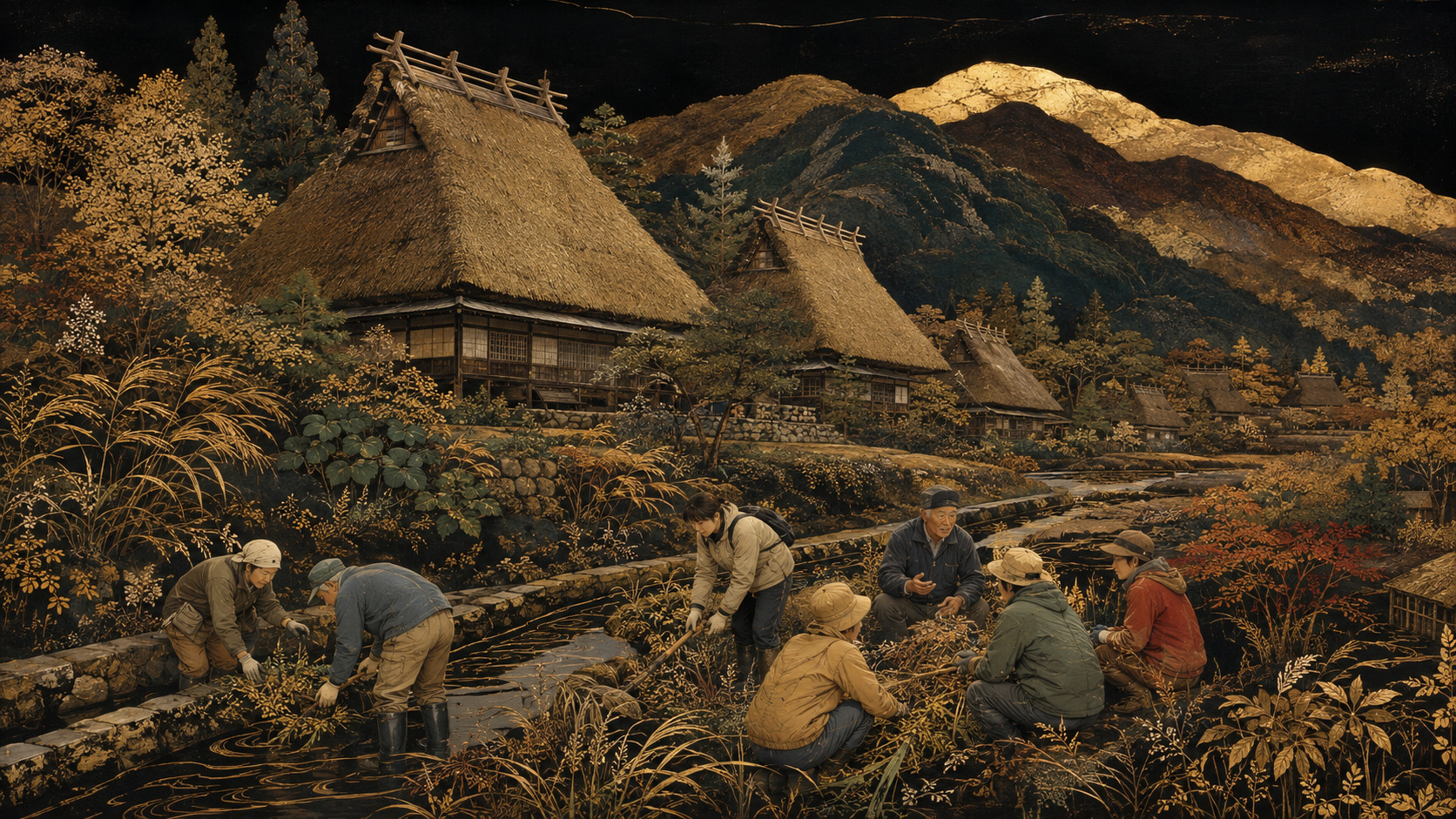
The famous image of Miyama is a roofline: deep thatch, steep gables, forested mountains behind. The plan that won a tourism Grand Prix on August 31 begins where that picture ends. It asks visitors to treat the village not as scenery but as the visible outcome of water management, agriculture, food production, handcraft and organized maintenance.
The official title makes the ambition explicit: “A Satoyama Discovery Journey: Becoming Part of a Satoyama Landscape,” followed by a Japanese subtitle describing an inquiry-based farm-stay program that would co-create a sustainable regional future. The Nantan City Miyama Tourism and Community Development Association—officially 一般社団法人南丹市美山観光まちづくり協会—submitted the itinerary and presented it at the ceremony in Tokyo.
Six departmental winners reached the final stage. Miyama, selected in the learning-plan category, received the overall Grand Prix. Yet the award needs a precise label. It was not a Cabinet ministry declaring Miyama “Japan’s best rural community.” JTB operated the Regional Stay Plan Contest 2026 as part of a demand-creation project funded through Japan’s Ministry of Agriculture, Forestry and Fisheries rural-community grant program. The prize recognizes an itinerary proposal, not a new government designation for the village.
The prize belongs to an itinerary, not to the village alone
The contest was designed to surface stays with a story: food and food culture, agricultural heritage, local history and scenery, primary industries and the lives built around them. Selected regions receive publicity, advisory support and help refining their programs with partner companies. The Grand Prix also carries an invitation to World Travel Market in London.
Miyama’s entry fits that brief by using time, not just place. The plan keeps guests for two nights and three days, with accommodation in Kayabuki no Sato—the thatched village—and at farm guesthouses. Public descriptions list farm work, meat processing, shimenawa sacred-rope making, traditional-food preparation and exchange with local residents.
Those parts are meant to illuminate a single chain: forest, water, agriculture and food. A wooded catchment feeds streams; water shapes farming; crops and animals become meals; seasonal labor and ritual turn materials into culture. The intellectual move is simple but consequential. Activities that might otherwise be sold as unrelated “authentic experiences” become evidence in an investigation of how a rural landscape functions.
| Plan element | What official material lists | Connection the stay is designed to reveal |
|---|---|---|
| Accommodation | Kayabuki no Sato and farm guesthouses | The village beyond daytime sightseeing hours |
| Livelihood | Farm work and meat processing | Land use, food, labor and the mountain environment |
| Food and craft | Traditional food and shimenawa making | Seasonal materials, inherited technique and ritual |
| Residents | Exchange and exposure to conservation activity | The people and institutions behind the landscape |
The table is a map of the published concept, not a final day-by-day schedule. Neither the organizer’s results announcement nor the association’s winning notice supplies a retail price, launch date, operating calendar, capacity or language arrangements. The contest material describes a program to be polished with post-award support. It does not establish that a consumer can book it now.
What the three-day journey promises—and what it does not
Japan’s agriculture ministry defines nouhaku, usually rendered as a rural or farm stay, more broadly than sleeping in a farmhouse. It is travel that includes a stay in a farming, mountain or fishing community and uses local resources for food and activities. The policy objective is economic as well as cultural: attract visitors, increase local income and build a “related population” of people who maintain an ongoing relationship with a place without necessarily living there.
Miyama’s design is strongest where it resists a frictionless pastoral fantasy. Meat processing places consumption next to production. Farm work places a meal next to land and labor. Shimenawa and traditional food connect material resources to seasons and ritual. Conversations with residents can show that preservation is governance and work, not merely affection for old houses.
But the official notices do not say which meat is used, how much processing guests perform, or which exact farm tasks are included. Nor do they say that visitors will rethatch roofs, thin forests or repair waterways. The organizer says participants will experience residents’ conservation activity. That supports an educational and participatory frame; it does not support claims of specified physical conservation labor.
The same restraint applies to environmental outcomes. Learning the system may lead to repeat visits, purchases, donations or longer relationships. No released document quantifies those effects, earmarks a share of revenue for conservation or sets a biodiversity target. A prize can validate the promise of the design. It cannot substitute for operating data.
Satoyama is an active system, not untouched nature
The word satoyama travels easily because it seems to name a universal longing: settlement, field and forest held in balance. Japan’s Environment Ministry gives it a more concrete meaning. Satochi-satoyama lies between primeval nature and cities and combines settlements with secondary woodland, farmland, ponds and grassland. Farming and forestry created and maintained it through repeated human intervention.
That definition changes what “conservation” means. Leaving the landscape alone is not necessarily preservation. Cutting grass, managing water, collecting forest material, cultivating land and passing on practical knowledge made the mosaic. Depopulation, aging and industrial change can break those cycles when fewer people use and manage local resources.
Miyama’s forest-water-farm-food sequence is therefore more than a marketing line. It is an accessible description of a social-ecological system. A field is connected to a watershed and a kitchen; a roof is connected to plant material and skilled labor; a beautiful vista is connected to collective rules.
Japan.co.jp’s analysis is that the plan should be judged on both sides of that hyphen. Environmental indicators alone would miss resident workload and income. Visitor numbers alone would miss habitat, water and maintenance. The useful measures are relational: local purchasing, compensation to hosts and instructors, support for preservation work, resident satisfaction, repeat engagement and pressure on daily life.
A living village is maintained, not frozen
Kayabuki no Sato sits in Miyamacho Kita in Nantan, central Kyoto Prefecture. Japan’s Agency for Cultural Affairs describes a settlement on a river terrace in the upper Yura River basin, where Kitayama-style thatched houses, stone walls and fields form a historic landscape with the surrounding mountains. The Kita district was selected as a nationally Important Preservation District for Groups of Traditional Buildings on December 8, 1993.
Current information published by Miyama’s tourism association counts 50 households and 39 thatched residences. The exact inventory has varied in official descriptions over time, but the central fact has not: this is a residential community, not an open-air museum. Roads and yards are part of daily life. Visitor access and photography are subordinate to privacy, fire safety and preservation.
The thatch survives because people keep replacing it. Materials must be obtained. Thatchers must be trained and paid. Fire-prevention systems must work. An Agency for Cultural Affairs case study records a seven-year fire-protection project after designation and a May 2000 fire that destroyed buildings of the Miyama Folk Museum. The structures were later rebuilt, while preservation organizations and a growing pool of thatching skills supported the district.
This is the historical fact that a picturesque photograph conceals: continuity requires change. New safety infrastructure, legal protection, tourism organizations and renewed craft training are not intrusions into an otherwise static past. They are the means by which a lived-in place continues.
Three layers behind the view
- Heritage: The 1993 district protects the relationship among buildings, fields, stonework and mountain setting.
- Home: Kita remains a residential community with privacy, access and safety rules.
- Maintenance: Thatch, specialist labor, resident organizations and fire systems keep the landscape standing.
Four decades of building institutions around tourism
Miyama did not discover tourism after social media discovered its roofs. The association’s own institutional history begins with depopulation and abandoned farmland in the 1970s. The former town of Miyama created a village-revitalization section in 1989 and worked across urban-rural exchange, agricultural scenery, farm-product sales and specialty goods.
The present tourism and community-development association was established in 2016. Three Miyama bodies began coordinated farm-stay work the following year. This matters because a multi-day program requires more than attractions: lodging, transport, food safety, guides, educational design, bookings and the consent of residents whose lives become part of the experience.
Recognition followed institution-building. Miyama and Niseko became Japan’s first villages selected for the UN World Tourism Organization’s Best Tourism Villages program in 2021. In 2024, Miyama was one of five areas chosen under a national sustainable farm-stay model program and received expert support to refine its offer.
A related contest produced an intermediate result in 2025. The Nantan City Miyama Ecotourism Promotion Council won a Booking.com corporate prize for a separate journey linking rice culture in Miyama and Fushimi. The 2026 winner is a different plan submitted by a different local body—the tourism and community-development association. Treating the two awards as one program would erase how several organizations contribute distinct pieces of Miyama’s tourism system.
1970s Depopulation and abandoned land become defining local problems.
1989 The former town creates a village-revitalization section.
1993 Miyamacho Kita becomes a national preservation district.
2016 The current tourism and community-development association is established.
2017 Three Miyama groups begin coordinated farm-stay development.
2021 Miyama enters the first class of UNWTO Best Tourism Villages.
2024 Miyama is selected as a sustainable farm-stay model region.
2025 A separate rice-culture itinerary wins a corporate award.
2026 The three-day satoyama inquiry plan wins the Grand Prix.
After the prize, proof must come from operations
The award gives Miyama attention, technical support and a path to an international travel trade show. Those are useful inputs. They are not yet outcomes. The next phase begins with prosaic questions that glossy rural tourism often leaves outside the frame.
How many overnight stays does the program generate rather than day visits? How much spending remains with guesthouses, farmers, cooks, guides, craftspeople and preservation work? How many hours do residents contribute, and are they compensated? Do guests return, buy from local producers or maintain a relationship? Does the program reduce or intensify pressure on a community of about 3,100 people?
The association itself offers an unusually candid warning. Its history says Miyama grew into a destination receiving roughly 900,000 visitors a year, yet tourism did not solve the region’s problems. The claim and visitor figure are the association’s, not an independent impact audit. Still, the warning is valuable: footfall is not the same as resilience.
Miyama’s Grand Prix plan has a compelling theory. It turns a protected view into a question about the work beneath it, then gives a visitor three days to follow the answer from forest to water, farm and table. The test now is whether the itinerary can make that relationship reciprocal—supporting the people and systems it asks travelers to understand.
Sources and documents
- Regional Stay Plan Contest 2026 office: results announcement, August 31, 2026 (Japanese; operator, ministry grant project, six departmental awards, Grand Prix, winning body and plan summary)
- Nantan City Miyama Tourism and Community Development Association: 2026 Regional Stay Plan Contest Grand Prix (Japanese; full plan title, two-night/three-day format, accommodation, listed activities and post-award support)
- Ministry of Agriculture, Forestry and Fisheries: Promotion of nouhaku (Japanese; official definition, local resources, regional income, related population and government support)
- Miyama association profile and history, sustainable farm-stay model announcement, and 2025 contest award (Japanese; tourism chronology, organization, coordinated farm-stay work and the separate 2025 plan)
- Agency for Cultural Affairs: Miyamacho Kita, preservation case study, Miyama media facts, and Japan Tourism Agency announcement of the 2021 Best Tourism Villages (Japanese; reading, preservation, landscape, fire history, current local facts and international selection)
- Ministry of the Environment: What are satochi-satoyama? (Japanese; landscape components, human intervention, resource cycles, biodiversity, depopulation and aging)
Reporting was checked against Japanese primary material available by 11:30 PM JST on September 1, 2026. Official Japanese forms and readings for Nantan (なんたんし), Miyamacho (みやまちょう) and Miyamacho Kita (みやまちょうきた), the winning organization and plan, government program names, and the specialist terms nouhaku and satochi-satoyama were verified in Japanese. English names without an established official rendering are descriptive translations. No direct comments from judges, residents, the organizer or the winning body were confirmed, so none were reconstructed or translated. Organizer and association claims are identified separately from Japan.co.jp analysis.
Image rights: © 2026 Japan.co.jp. This AI-assisted editorial illustration may not be republished or reused without prior written permission. For licensing, use the contact page.