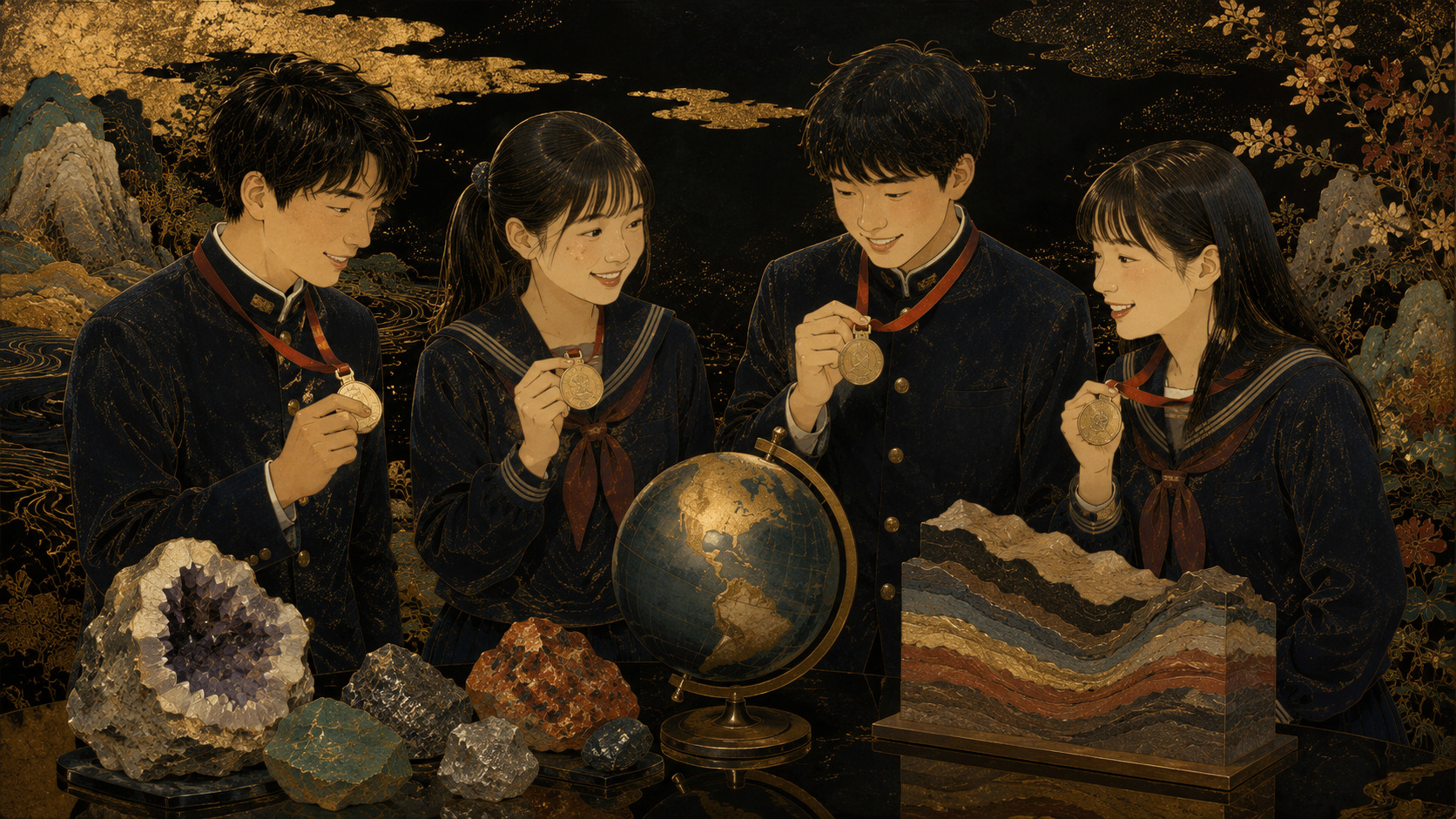
Two classmates from Nada High School left Turin with gold medals. A sixth-year student from a Tokyo metropolitan secondary school and a third-year student from Kobe College’s senior division returned with silver. For Japan, every name on the four-person roster appeared on the medal list.
The Ministry of Education, Culture, Sports, Science and Technology announced the results on August 31. Yoshihisa Kawakami and Taiki Okumura, both second-year students at Nada High School in Hyogo Prefecture, won gold. Yuzuka Nakayama, a sixth-year student at Tokyo Metropolitan Oshukan Secondary Education School, and Kurara Tsutsumi, a third-year student in Kobe College’s senior high school division, won silver.
The 19th International Earth Science Olympiad, or IESO, ran in Turin, Italy, from August 20 through 27. Japan’s ministry counted 151 students from 39 countries and regions. All four Japanese representatives will receive a commendation from the education minister.
The result is substantial, but its meaning is easy to distort. IESO medals are awarded in bands, not as a single gold-silver-bronze podium. The Japanese ministry says roughly the top 10% receive gold, the next 20% silver and the next 30% bronze. The releases reviewed by Japan.co.jp did not publish the four students’ scores, overall places or a national-team ranking.
The four names behind the perfect medal return
Kawakami and Okumura arrived with the strongest two results from Japan’s March national final. Okumura placed first overall, receiving the Ibaraki Governor’s Award, and also earned a special award for rock and fossil identification. Kawakami placed second overall and received the Tsukuba Mayor’s Award.
Tsutsumi was the highest-ranked female participant in the national final and received the Japan Geoscience Union Award. Nakayama joined the other three among the 10 domestic gold-award recipients eligible for the final team selection. The four were chosen after an additional English-language group discussion and interview.
| Student | School and year | Turin medal | Japanese national final |
|---|---|---|---|
| Yoshihisa Kawakami 川上 嘉久 | Nada High School, year 2 | Gold | Second overall; Tsukuba Mayor’s Award |
| Taiki Okumura 奥村 太紀 | Nada High School, year 2 | Gold | First overall; Ibaraki Governor’s Award; rock and fossil identification award |
| Yuzuka Nakayama 中山 柚佳 | Tokyo Metropolitan Oshukan Secondary Education School, year 6 | Silver | Gold award; advanced to team selection |
| Kurara Tsutsumi 堤 くらら | Kobe College senior high school division, year 3 | Silver | Top female participant; Japan Geoscience Union Award |
The school years in the table are those reported for the international competition. When the delegation was selected in March, the committee listed every student one year lower. Japan’s school year changed in April. Official Japanese sources supplied the kanji, readings and school names; no comments from the students were available in the material reviewed, so this article does not manufacture reactions or quotations.
Two exams determined the medals; two team projects served another purpose
The Japanese education ministry’s published delegation schedule placed the individual examinations in the middle of an eight-day program: a written theory test on August 24 and a practical examination on August 25. The release does not provide the Japanese students’ questions, answers or marks.
Earth science here is deliberately broad. It crosses solid-Earth geology, meteorology, oceanography, environmental systems and astronomy. A candidate may need to move between evidence at very different scales: a mineral specimen, a cross-section, an atmospheric record, an ocean process or a planetary observation. The organizing principle is not simply how many names a student can remember, but whether data can be turned into an explanation of a connected Earth system.
Turin also gave students work that could not be completed alone. In the Earth System Project, internationally mixed groups investigated an Earth-system question and presented a poster. The International Team Field Investigation paired field observation with a group presentation. Japan’s ministry explicitly marked both ESP and ITFI as outside the individual medal score for the 2026 event.
That separation matters. The individual tests create the medal bands. The mixed-country projects pursue a second IESO purpose: cooperation across different languages, curricula and scientific habits. Calling the team work “non-scoring” is accurate; calling it unimportant would miss why it is in the program.
The Japanese delegation schedule published by MEXT
- August 20–21: Arrival, exchange activities, opening ceremony and ESP preparation.
- August 22–23: ITFI field investigation and preparation for both international projects.
- August 24: Theory examination and ESP presentation.
- August 25: Practical examination.
- August 26–27: ITFI presentation and closing ceremony.
A national selection process designed for more than test speed
Japan’s 2026 team began forming in September 2025, when applications opened for the 18th Japan Earth Science Olympiad. The first preliminary round was a one-hour online multiple-choice test taken from home on December 21. Two hundred fourteen students qualified for the second round.
The January examination moved to designated sites around the country and used a 90-minute paper-based answer sheet. From it, 63 students in the main age group advanced to the March final in Tsukuba, joined by three younger “challenge” participants. The final replaced multiple choice with written answers and specimen identification.
The domestic gold award went to the top 10. Those 10 then faced the representative selection on March 17, including group discussion and interviews in English. Four emerged. From April through August, the committee’s standard program adds correspondence training, a May Earth Science Festival with Japan, Taiwan and South Korea, and a July session in Tsukuba.
The sequence is a curriculum in itself. Online screening tests reach and foundational knowledge. The later written and specimen work demands explanation and observation. English discussion tests whether a student can reason aloud with others. Training then shifts from selection to the practical reality of joining an international scientific community.
Why a geology contest reaches the atmosphere, oceans and sky
The English name “Earth Science Olympiad” is more revealing than the narrower image the word geology can summon. The planet does not respect school-subject borders. Heavy rain begins in the atmosphere but becomes a question of relief, river flow, sediment, slope stability and land use. A volcanic eruption originates underground, yet its effects can reach aviation, ocean chemistry and climate.
That connected view is central to the Earth System Project and to the committee’s description of the field. Students are expected to recognize rocks and structures, but also to work across meteorology, oceanography, environmental science and astronomy. Evidence must be observed at one scale and related to processes at another.
The four medals are evidence that four intensively selected and trained students performed in the upper score bands of an international competition. They are not a national audit of Earth-science teaching. They do not reveal how many Japanese schools offer advanced Earth science, whether fieldwork is equally accessible, or whether every region can recruit and train candidates. Those larger questions require enrollment, staffing and curriculum data that medal results cannot supply.
Japan’s path from a 2008 debut to Turin
IESO was established as a major activity of the International Geoscience Education Organization, with the first event held in South Korea in 2007. Japan joined at the second Olympiad in the Philippines in 2008 and won three silvers and one bronze. Turin was Japan’s 18th participation.
The event has had interruptions and reinventions. Japan hosted the 10th Olympiad in Mie Prefecture in 2016, welcoming 100 students from 26 countries and regions; the home team earned three golds and one silver. Japan won four golds at the 2019 South Korea event. The 2020 Olympiad was cancelled during the COVID-19 pandemic, and the competition operated online from 2021 through 2023 before returning to an in-person format in Beijing in 2024.
Recent Japanese results show both continuity and variation. The 2023 online event produced four silvers. Beijing in 2024 brought two golds and two silvers. The 2025 Jining event in China yielded four silvers. Turin restored the same two-gold, two-silver split recorded in Beijing.
2007 The first IESO is held in South Korea; Japan starts its national Olympiad.
2008 Japan makes its international debut, winning three silvers and one bronze.
2016 Mie Prefecture hosts the 10th IESO; Japan wins three golds and one silver.
2020 The international event is cancelled during the pandemic.
2024 In-person competition resumes in Beijing; Japan wins two golds and two silvers.
2026 Turin brings Japan two golds and two silvers in its 18th participation.
2027 Matsue, Shimane Prefecture, is scheduled to host the 20th IESO.
Matsue will inherit more than a medal target
The Olympiad now turns toward Japan. The 20th event is scheduled for August 23–28, 2027, in Matsue, Shimane Prefecture—the country’s first time hosting since Mie 11 years earlier. Applications for the national competition that will help select the home delegation opened on September 1.
A host must do work that a medal table cannot show: design defensible examinations, translate and moderate them, manage safe field activities, welcome students from many education systems and make international teamwork possible. Shimane offers rich geological, coastal and historical settings, but the official material reviewed for this report does not establish which sites or topics will appear in the competition. Geography is context, not a leaked syllabus.
The Turin medals will inevitably raise expectations for Matsue. A more durable test begins after the awards ceremony. Did the national contest reach students beyond a small set of schools? Did more young people gain access to specimens, observatories and field experience? Did the international teams remain scientific networks rather than week-long encounters?
Four medals are the visible outcome. The underlying achievement is the chain that made them possible: an open national entry point, progressively demanding selection, expert training and a competition that treats the atmosphere, oceans, rocks and space as one connected subject. Matsue has the opportunity to leave that chain stronger than it found it.
Sources and documents
- Ministry of Education, Culture, Sports, Science and Technology: Japanese students win medals at the International Earth Science Olympiad, August 31, 2026 (Japanese; medalists, verified readings, schools, scale, dates, examinations, international projects and ministerial commendations)
- 19th International Earth Science Olympiad, Turin—official event site (host city, edition and purpose)
- Japan Earth Science Olympiad Committee: Japan’s 2026 IESO representatives (Japanese; official name forms and readings, school years as of March and team selection)
- Japan Earth Science Olympiad Committee: 18th Japan Earth Science Olympiad (Japanese; preliminary rounds, national final, domestic awards, 214 qualifiers, 63 finalists, three challenge entrants and representative selection)
- Japan Earth Science Olympiad Committee: About IESO (Japanese; IGEO, event history and the standard Japanese selection and training pathway)
- Japan Earth Science Olympiad Committee: International competition data (Japanese; participation and Japanese medal records from 2008 through 2025, the 2016 Mie event and online competitions)
Reporting was checked against material available by 11:15 PM JST on September 1, 2026. Japanese name forms, readings, official school names, school years, awards and specialist terms were verified in primary Japanese releases from the education ministry and the Japan Earth Science Olympiad Committee. English school renderings are descriptive translations; the Japanese edition preserves the official Japanese names. No student comments were confirmed, so none were reconstructed or translated. Exact individual scores, overall places, a country ranking and detailed 2026 examination questions were not available in the reviewed releases and are not asserted. ESP and ITFI are identified separately from the medal score because the ministry explicitly called both non-scoring in 2026.
Image rights: © 2026 Japan.co.jp. This AI-assisted editorial illustration may not be republished or reused without prior written permission. For licensing, use the contact page.