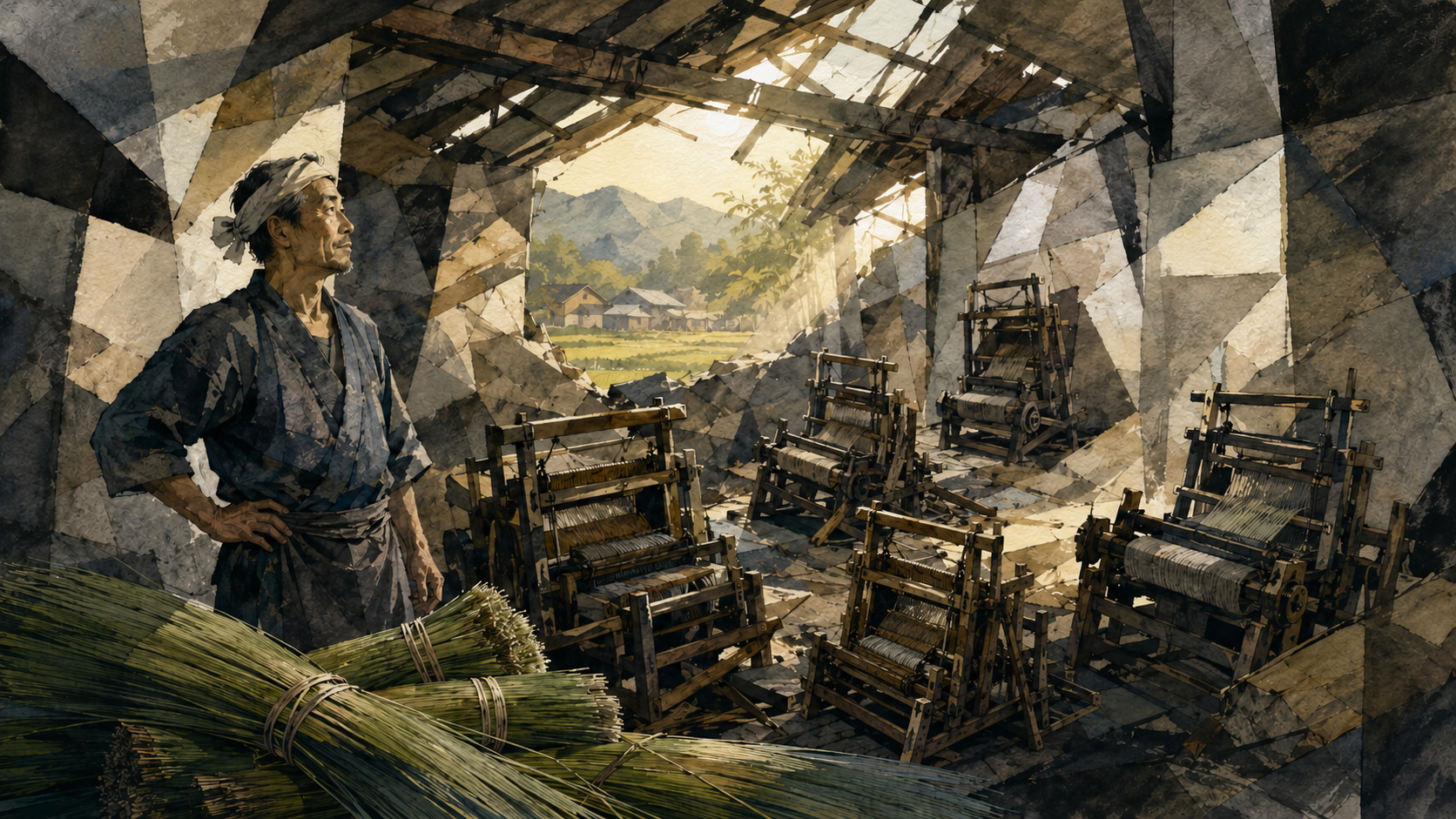
For a moment after the roof came down, the machines were no longer looms. They were columns.
Yusaku Miyashita was working inside his shed in Sencho, Yatsushiro, when the July 28 earthquake struck. The structure collapsed around him. In his account to local broadcaster KAB, the five tatami-weaving machines appeared to support part of the failing building long enough for him to get out. All five became unusable. The machines that may have preserved his life could no longer perform the work around which that life had been organized.
The harvest remained inside. Bundles of igusa—the slender wetland rush woven across warp threads to form the visible surface of tatami—lay beneath a roof pressing down on them. Miyashita wanted to retrieve what could be saved, but entering risked another collapse. A crop can be valuable and still be worth less than the person who grew it.
Outside, another break reached into the future. The irrigation channel had been damaged, preventing water from reaching the farm. Igusa is inseparable from controlled water: seedlings move into paddy beds in August, are prepared and planted in the main field around late November, then grow toward harvest the following June and July. A failed loom blocks this year’s income. A failed waterway can block next year’s crop.
Miyashita estimated that returning to production would take more than a year. He would need a workshop, weaving equipment, safe access to the stored rush and dependable water. Yet he told KAB that if demand for igusa tatami remained, the producing region had a responsibility to answer it. His determination was not the easy optimism of an undamaged person. It came after two disasters in twelve months.
Water Gave the Crop Life—Then Took It Away
In August 2025, a stationary rain band brought record rainfall to Kumamoto. Miyashita’s workshop area flooded. About 500 kilograms of his rush—enough for approximately 200 tatami facings—had to be discarded. Agricultural machinery, stored raw rush, finished mats and seedlings were inundated across the wider producing district.
Public support helped the region restore specialized equipment and resume production. Miyashita had recovered from the flood and his weaving work was returning to rhythm when the earthquake arrived. The sequence is especially cruel because the two disasters attacked opposite conditions of the same crop. In 2025 there was uncontrolled water everywhere. In 2026, a broken channel meant that needed water could not arrive.
The distinction between a field and a factory also dissolved. Igusa farming is vertically integrated in a way many consumers do not see. The farm raises the plant, harvests it, mud-dyes and dries it, sorts it by length, then weaves it into tatami-omote. Only then does the finished facing move through inspection and trade to a tatami shop, where it is stretched over a core and finished with edging.
This is why a harvest under a collapsed roof is not inventory in the ordinary sense. It is months of biological growth waiting for an industrial process that takes place on the same farm. And this is why five broken looms do not merely slow work: they break the bridge between crop and cash.
A Calendar With No Empty Month
The rhythm of igusa makes the earthquake’s date consequential. Harvest usually runs from late June to mid-July, often before dawn or in the cooler evening to preserve freshness. Newly cut rush is dipped in water mixed with fine natural clay, the traditional doro-zome or mud-dyeing process. The clay helps produce the familiar color, sheen and scent, coats the surface and encourages even drying.
Dried stems are sorted by length and condition. The root end and tip are excluded from the visible center of a mat, so longer, straight, unblemished rush makes higher grades possible. Agriculture Ministry guidance describes quality bands beginning around 97 centimeters and rising to 140 centimeters or more for the finest facing. Good weaving therefore begins in the field: the loom cannot manufacture length or repair a scar in the stem.
Weaving continues across the year. At the same time, the next cycle starts. Seedlings raised in an upland nursery are moved to a paddy nursery in August. In late November they are lifted, divided, root-trimmed and planted in the main paddy. Water, machinery, storage and labor are not separate systems; they overlap.
| Season | Work | Earthquake vulnerability |
|---|---|---|
| August | Move and establish seedlings for the next crop | Broken irrigation can interrupt the next production year immediately |
| Late November | Divide, trim and transplant into the main paddy | Field and water repairs must be ready before a narrow biological window |
| June–July | Raise support nets, harvest, mud-dye and dry | Power, dryers, labor and safe buildings are essential during a concentrated peak |
| Across the year | Sort, weave, inspect and finish tatami facing | Workshop or loom loss traps value between harvest and sale |
The earthquake struck just after harvest, when dried rush was entering workshops and the next seedling cycle was approaching. Recovery could not simply wait for a convenient off-season. Igusa does not have one.
From “Forbidden Rush” to Japan’s Largest Producer
Kumamoto’s official history dates the Yatsushiro igusa tradition to 1505. Iwasaki Shumanokami Tadahisa, lord of a small castle in what is now Sencho, is said to have ordered and protected cultivation in his territory. In the 1750s, the Hosokawa domain encouraged both growing and weaving.
Before the Meiji Restoration, cultivation was restricted to five villages—Tamuta, Niimuta, Age, Shinkai and Shimomura. The crop was called otome-gusa, “forbidden rush”: a controlled local resource whose cultivation knowledge and value were not to spread freely. The name carries a paradox. What was protected by restriction eventually survived through expansion.
Known at different times as Tamuta, Yatsushiro or Higo facing, the product developed into a regional industry around Yatsushiro and Uto. Mechanization, postwar housing construction and the spread of fully matted rooms enlarged demand. The Agriculture Ministry’s geographical-indication record says the region became Japan’s largest producer in 1970.
The wider history of tatami explains the market that Yatsushiro entered. Early Japanese texts describe layered or foldable mats. In the Heian era, tatami resembling the later form served as movable seats and beds on wooden floors; thickness and edging signaled rank. From the Kamakura through Muromachi periods, shoin architecture developed rooms fully covered with tatami. Use gradually spread into townspeople’s homes in the Edo period and became ordinary in mass housing through the modern era.
In February 2016, “Kumamoto Igusa” and “Kumamoto Igusa Tatami-omote” received separate national geographical-indication registrations. The first protects long-stemmed approved varieties and traditional mud dyeing; the second recognizes an integrated process from cultivation through weaving. The dual registration makes a subtle point in law: the plant and the woven surface are related, but each embodies distinct knowledge.
1505 Protected igusa cultivation is traditionally said to begin in today’s Sencho.
1750s The Hosokawa domain encourages cultivation and weaving.
Before 1868 “Forbidden rush” cultivation is limited to five villages.
1970 The region becomes Japan’s largest tatami-facing producer.
2016 Kumamoto igusa and Kumamoto igusa tatami facing receive GI protection.
August 2025 Record flooding damages machinery, raw rush, finished facing and seedlings.
July 28, 2026 The earthquake collapses workshops and damages looms and irrigation.
A National Craft Balanced on 223 Farms
The earthquake did not strike a large, expanding commodity sector. It struck a concentrated craft-agricultural system already shrinking at extraordinary speed.
Agriculture Ministry provisional data for the 2025 crop year put Kumamoto’s igusa area at 242 hectares, down 24% in one year; harvest at 3,630 tonnes, down 27%; tatami-facing output at 1.03 million mats, down 27%; and growers at 223, down 16%. Since 2022, the ministry’s domestic production table has listed only Kumamoto. In practical terms, the leading region is now nearly the whole recorded domestic crop.
The longer comparison is more severe. In 2006 Japan produced 6.88 million tatami facings and counted 1,030 igusa farms. By 2025, output was 1.03 million and the grower count 223—declines of roughly 85% and 78%, respectively. Compared with 1996, when domestic production was 26.94 million mats, the fall exceeds 96%.
| Indicator | 2024 | 2025 provisional | One-year change |
|---|---|---|---|
| Kumamoto planted area | 319 ha | 242 ha | −24% |
| Rush harvest | 4,980 t | 3,630 t | −27% |
| Domestic tatami-facing output | 1.41 million mats | 1.03 million mats | −27% |
| Igusa farms | 266 | 223 | −16% |
These are pre-earthquake figures, not an estimate of earthquake damage. They describe the small base on which the disaster landed. Losing one farm is not statistically equivalent to losing the industry, but each departure removes equipment, know-how, seedlings, production relationships and the possibility of succession from a rapidly narrowing system.
The Competition Underfoot
Changes in Japanese housing began reducing demand decades ago. New homes contained fewer traditional rooms; households replaced tatami less frequently; flooring became ordinary. Imported facing—predominantly from China—and surfaces made from paper or resin offered lower cost, consistent appearance or different maintenance characteristics.
In the year ending June 2025, Japan’s supply comprised about 1.03 million domestically produced facings and an estimated 4.58 million imported facings. Domestic material therefore accounted for 18%. The average domestic-facing price was ¥2,176, compared with ¥951 for imports, a gap of roughly 2.3 times. Those are average wholesale-side measures across grades, not retail prices for a completed tatami.
Price alone cannot explain quality. Kumamoto has responded with varieties such as Hinomidori, Yūnagi, Hinoharuka and Suzukaze, bred for length, color, fine texture, durability or weaving productivity. Approved varieties covered 97% of Kumamoto’s 2024 crop area. Producers identify themselves through labeling and QR-linked information, while the GI system ties the name to place and process.
But premium strategy creates its own recovery requirement. A high-quality market needs continuity. A tatami shop can promote domestic upper grades only if it expects the producing farm to deliver next year. The farm will rebuild only if it believes orders will survive the reconstruction year. Disaster support can replace an asset; demand gives that asset a reason to turn.
- Capital: a specialized machine whose replacement and repair network is limited.
- Farm income: the step that converts stored rush into a marketable facing.
- Quality control: matching stem length, density, warp and grade.
- Continuity: the ability to keep buyers while the next crop is already growing.
Industry reporting after the earthquake put a new loom at around ¥3 million in another Sencho farm’s case. That is a useful order-of-magnitude indicator, not a quotation for Miyashita’s five machines, whose model, condition and replacement needs were not disclosed.
The Second Disaster Tests the Support System
After the 2025 flood, Kumamoto created aid for igusa-specific machinery, alongside measures for agricultural equipment and the disposal of damaged rush and tatami facing. Yatsushiro later told the national government that the programs enabled early recovery and helped prevent farmers from abandoning production because of flood damage.
The earthquake tests whether recovery policy can handle the same farm twice. A newly repaired or replaced asset may have been damaged again. A building may require demolition before a loom can be assessed. A subsidy application from the flood may still be open while a second damage record begins. Rules designed around one event can become difficult when evidence, insurance, useful life and prior public support overlap.
By August 11, Kumamoto’s broader agriculture ledger counted roughly 2,000 cases of damaged machinery and facilities worth ¥10.38 billion. That category included tractors, rice equipment, greenhouses, barns and igusa-specific machines; it must not be presented as the rush industry’s total. The prefecture had established commodity teams, including one for igusa, to record problems and plan the resumption of farming. Emergency work on major water channels and temporary pumping was also underway.
A durable response needs several clocks. Debris removal and building safety are immediate. Loom repair, replacement and shared processing arrangements operate over months. Water and seedlings run on biological deadlines. Income support must bridge the period before sale. And demand-building must last beyond the brief public attention that follows a disaster.
Rebuilding a Workshop—or Preserving an Industry?
Miyashita’s recovery can be described as a construction project: clear the collapsed shed, recover what is safe, replace the building and machines, restore water, restart weaving. Yet that list misses the strategic choice inside it. Does a farmer replace five old functions exactly, or use the disaster to build a safer and more efficient layout? Can temporary or shared weaving preserve orders? Will buyers tolerate a year’s interruption? Can support pay for resilience rather than merely reproduction?
The same questions extend across the district. Equipment technicians are scarce. Farmers are aging. The domestic market is smaller. A single replacement program cannot reverse those forces. But recovery can strengthen the nodes that remain: seismic bracing for workshops and machines, higher storage, documented equipment anchoring, alternative water plans, mutual-aid weaving capacity, succession support and clearer producer-to-tatami-shop contracts.
Consumers also hold part of the answer. Choosing a Kumamoto producer-identified facing, asking where the rush was grown, and paying for a grade that returns value to the farm are not ceremonial gestures. They are market signals. One-time donations help clear the wreckage; recurring orders determine whether a replacement loom has work.
That does not place the burden of cultural preservation on one injured farmer. Miyashita is entitled to decide what is safe and viable for his family. His stated determination matters because it shows that the will to continue exists. Public policy and the market must decide whether that will is met with workable conditions.
The Room Begins in a Wet Field
A finished tatami room conceals its origins beautifully. The surface appears calm, repetitive and complete. It does not show the seedling moved in August, the winter transplanting, the predawn harvest, the clay water, the dryer, the sorting hands or the loom. It does not show a farmer standing outside a collapsed workshop, calculating whether the next room can still be made.
For five centuries, Yatsushiro has turned water and rush into an architecture of daily life. Once, tatami signaled rank. Later it covered ordinary homes. Today it competes for a smaller place in rooms and budgets, even as its scent and texture remain among Japan’s most immediate sensory memories.
The 2025 flood submerged Miyashita’s crop. The 2026 earthquake trapped the next crop beneath a roof and broke the machines that would weave it. His response was neither to romanticize the loss nor assign blame. It was to look toward the demand that might still be there and say he wanted to answer it.
Five silent looms are an intimate disaster. In a country whose domestic igusa supply now rests on only a few hundred farms, they are also a national question: when the room begins again, who will still be there to weave its floor?
Reporting Notes and Principal Sources
This article centers on KAB’s August 12 account of Yusaku Miyashita and distinguishes his documented losses from sector-wide figures. Production data are pre-earthquake, provisional 2025 crop-year figures published by the Agriculture Ministry in January 2026. Percent changes are calculated from the ministry’s 2024 and 2025 values. The prefecture’s machinery and facility totals cover agriculture broadly and are not an igusa damage estimate. No conclusion is drawn about future rush supply or prices.
- KAB: Yusaku Miyashita’s collapsed workshop, five unusable looms, trapped harvest, damaged irrigation and 2025 flood loss
- Kumamoto Prefecture: August 11 agricultural damage, igusa workshop example, commodity teams and emergency water response
- Ministry of Agriculture, Forestry and Fisheries: January 2026 igusa and tatami-facing production, supply, prices and farm numbers
- Agriculture Ministry: the annual farm cycle from seedlings through mud dyeing, weaving, inspection and sale
- Kumamoto Prefecture: Yatsushiro igusa history from 1505, “forbidden rush,” varieties and production methods
- Agriculture Ministry: GI registration No. 8, Kumamoto Igusa
- Agriculture Ministry: GI registration No. 9, Kumamoto Igusa Tatami-omote
- Yatsushiro City: national policy request describing 2025 flood damage and early recovery support for the igusa industry
- Kumamoto Prefecture: support measures for farmers affected by the August 2025 flood
- TV Asahi: a second Yatsushiro igusa farm illustrating the wider workshop and loom interruption
- Japan Tatami Industry Promotion Association: the history of tatami from movable status object to common flooring
- RMMS: summary of Japan Agricultural News reporting on loom damage, repair scarcity and order-based recovery