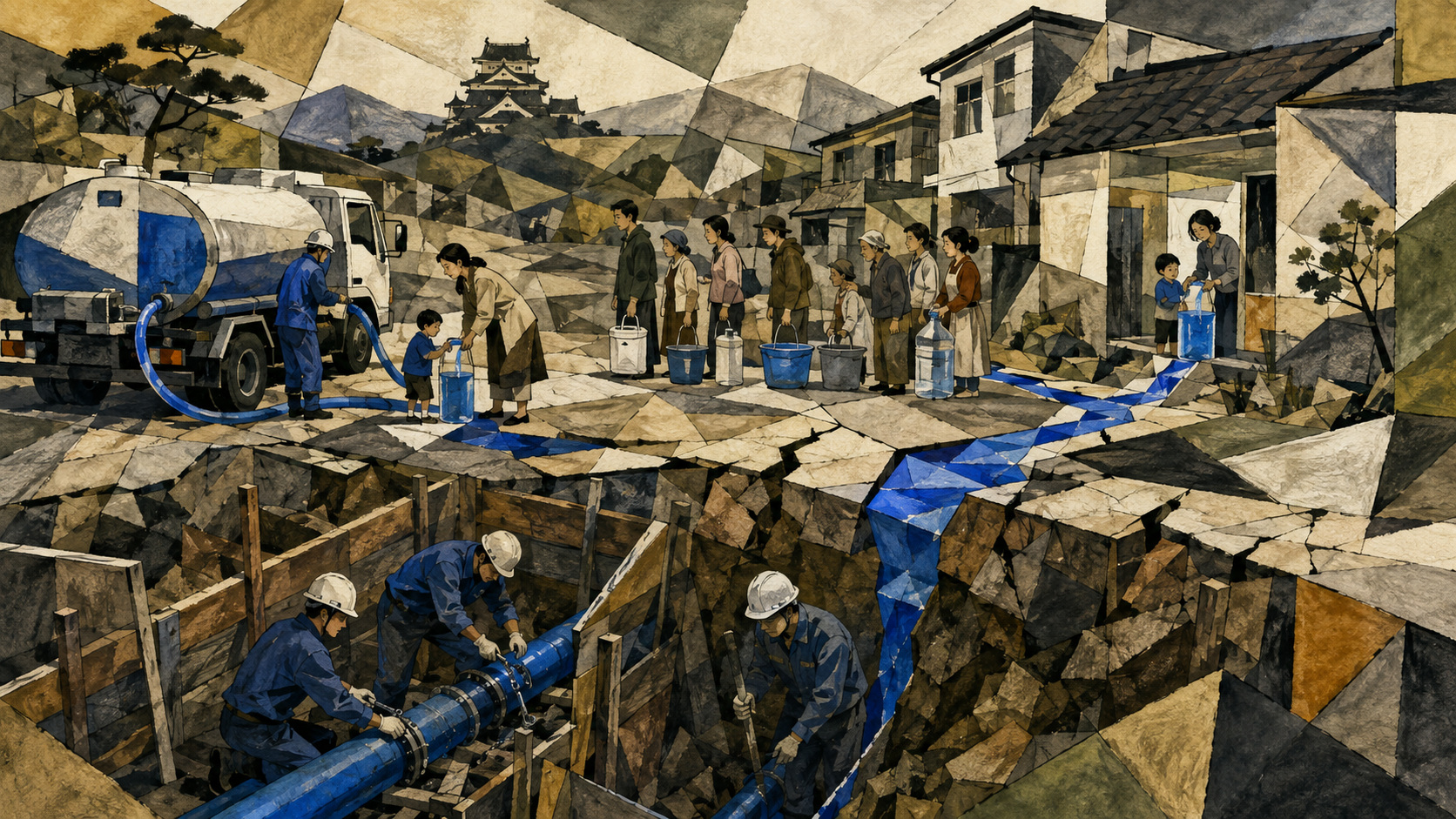
Restoring a water system is not the simple reversal of turning off a tap.
An earthquake can damage many layers of the network at once: wells and treatment plants, reservoirs, transmission mains, distribution pipes and the narrow service lines entering individual properties. A broken main spraying water across a road announces its location. More difficult are fractures that drain silently into gravel, joints pulled slightly apart below asphalt, and private pipes displaced with a house. This is not damage that can be represented by one red line on a map.
At 4:27 PM on July 28, a magnitude-7.1 earthquake struck at a depth of 16 kilometers beneath the Kumamoto region. Uki and Hikawa recorded the maximum Japanese seismic intensity of 7. Outages across 15 municipalities in four prefectures peaked at about 108,100 households or service connections. By 10:30 AM on August 12, the official count had fallen to about 29,200, all in Yatsushiro, Uki and Hikawa. More than seven in ten of the peak outages had been cleared, but in the remaining districts the arrival of water and permission to use it had become separate events.
The national breakdown was 22,979 in Yatsushiro, 4,098 in Uki and 2,132 in Hikawa. Within Yatsushiro, the city utility accounted for 16,932 and the Yatsushiro Life Environment Administrative Association for 6,047. But about 7,000 connections in the city system, about 100 in the association’s system and about 200 in Hikawa were already receiving some water. Why were they still outages?
Because a water system functions through pressure as well as volume. If a major break remains open between a reservoir and a neighborhood, incoming water escapes before the reservoir can recover. The system cannot build the hydraulic head needed to push water to distant ends or higher ground. Crews need to introduce water to reveal the leak; yet if thousands of customers use that test flow, there may not be enough volume or pressure left to expose it. Water needed for immediate household life and water needed to restore that life compete inside the same damaged pipe.
Waking an underground maze, one district at a time
Repair crews do not simply pressurize the entire damaged grid at once. They establish a route from the source, secure trunk lines, use valves to divide the network into manageable sectors and introduce water in stages. They watch for an abnormal rise in flow, a reservoir that will not hold its level, new water at the surface, changes in gauges and meters that keep moving after every tap has been closed. Each clue narrows the search. A crew excavates, replaces or clamps the damaged section, restores flow and then discovers whether the next weakness appears downstream.
This should not be confused with a uniform, formal hydrostatic pressure test at one prescribed pressure. In disaster recovery, controlled flow and the gradual return of pressure become tools for leak investigation. National emergency guidance follows the same logic: verify treated-water and transmission conditions, establish trunk routes first, protect shelters and other critical facilities, and then expand restored blocks toward smaller branches.
On August 3, Yatsushiro announced staged test flows in the Gunchiku, Showa and Hinagu school districts. Residents were told to make sure faucets had not been left open. If the small indicator on a household meter continued turning when every faucet was closed, a private-property leak was possible and the shutoff valve should be closed. Even if water appeared during the test, the city said not to use it.
Uki’s instructions were more granular. As of August 12, test water in parts of Ogawa and Toyono could be used for non-drinking domestic purposes but not consumed. Reduced-pressure service in Matsubase and other areas was considered potable, though residents were told to run visibly cloudy water until clear, conserve, and understand that some taps could remain dry. The visual fact—water emerging from a faucet—therefore had different operational meanings in neighboring jurisdictions. Yatsushiro test water, Uki domestic-use test water and potable reduced-pressure service were not interchangeable.
| System, August 12 | Official outage count | Operational condition |
|---|---|---|
| Yatsushiro city utility | About 16,932 | Leak investigation and repair; about 7,000 had flow but were asked not to use it so volume and pressure could be preserved |
| Yatsushiro Life Environment Administrative Association | 6,047 | Leak investigation and repair; about 100 had flow but remained under a no-use request |
| Uki | 4,098 | Test flow and reduced-pressure service in some districts; potability varied by zone |
| Hikawa | 2,132 | Leak investigation and repair; about 200 had flow but remained under a no-use request |
- Before a test flow, check faucets, washing-machine connections and water-heating fixtures, including at an unattended home.
- If the meter indicator continues moving after every faucet is closed, suspect a private-side leak, close the shutoff valve and contact an authorized contractor.
- Treat “water is flowing,” “reduced-pressure service” and “potable” as distinct conditions. Do not drink test water unless the municipality explicitly permits it.
- Report cloudiness, odor or sudden pressure changes as directed. Indiscriminate flushing can delay reservoir recovery when the utility is asking customers to conserve.
139 water trucks form a second network above ground
Until the buried grid works, an improvised grid moves along roads. On August 12, 139 water trucks were in the operation: 18 under the infrastructure ministry, 103 through the Japan Water Works Association and 18 from the Self-Defense Forces. Fifty-five were assigned to Yatsushiro, 32 to Uki and 25 to the Yatsushiro–Hikawa association. They did more than refill public distribution points. A coordination headquarters prioritized shelters, medical institutions and welfare facilities, as well as water for temporary toilets and showers.
This is a daily logistics problem: the condition of access roads, tanker capacity, the location of a refill source, heat, hospital consumption and changing reservoir levels all shape the route. Trucks are a flexible substitute for pipes, but they are not a replacement at urban scale.
Uki’s public distribution points operated from 8:30 AM to 5 PM, with a temporary limit of one visit and four liters per person each day. Residents had to bring containers. The city separately identified emergency wells whose water was not drinkable and temporary tanks whose water was. Four liters was not presented as the full daily quantity required for hygiene, toilets, washing and cooking. It was a ration from a constrained potable supply. A household might therefore need to obtain drinking water and non-potable domestic water from different places.
At the Ryusho Center in Hikawa, a portable treatment unit from the Japan Water Agency could process 50 cubic meters—50,000 liters—per day. It began producing domestic water on August 4 and drinking water on August 5; from August 9 its output also supported bathing facilities. That volume could not replace normal town demand. Its value was strategic: every liter produced locally reduced the distance a truck had to haul water and freed mobile capacity for another facility.
Wastewater sets another limit. Restoring supply before damaged sewers and pumps can carry the resulting flow creates a sanitation risk. National authorities said pipes serving shelters, hospitals and welfare sites would be prioritized as an integrated water-and-sewer task. That approach grew stronger after the 2024 Noto Peninsula earthquake. In Kumamoto, no loss of treatment function had been reported at the 30 treatment plants and 101 pump stations checked by August 12, but pipeline inspections in several municipalities were continuing.
1924: taps come to a city of groundwater
Kumamoto City’s water history captures two truths: an abundant source can coexist with a vulnerable delivery network. The modern utility began service on November 27, 1924, from the Hakemiya source and Tatsudayama reservoir. Today the city is unusual among major cities in supplying roughly 740,000 people entirely from groundwater, using 98 wells and pumping an average of about 220,000 cubic meters a day in the city’s cited fiscal-year data. The source of Kumamoto’s proud phrase—mineral water from the tap—is literal.
But groundwater beneath a city is not water inside every building. Between a well and a kitchen stand intake works, transmission lines, reservoirs, distribution mains, branch pipes and private service lines. The failure of any one can stop the tap. During the 2016 Kumamoto earthquakes, about 446,000 households lost water across the affected region. Kumamoto City was able to make distribution available citywide by April 30, but leak surveys and repairs continued afterward. Groundwater provided a resilient source and emergency wells helped some residents; it did not make the street grid earthquake-proof.
After 2016, the city expanded seismic upgrades to major routes, filling stations and service connections designed to retain stored water. In 2026, a citywide peak of about 20,970 outages was officially cleared by August 3, faster than in the hardest-hit surrounding districts. Experts cited stronger seismic investment as one reason. The comparison needs care: distance from the fault, soil, the location of breaks, network redundancy and the availability of workers all influence restoration. Still, there is a plausible through-line from the failure observed ten years earlier to the pipes and response relationships available now.
1924 Kumamoto City’s modern waterworks begin service from Hakemiya and Tatsudayama.
1995 The Great Hanshin-Awaji Earthquake cuts water to about 1.3 million households; maximum restoration takes about three months.
2011 The Great East Japan Earthquake cuts water to about 2.567 million; maximum restoration, excluding some tsunami areas, takes about five months.
2016 The Kumamoto earthquakes produce about 446,000 outages and a maximum duration of roughly three and a half months.
2024 The Noto Peninsula earthquake causes about 136,000 outages and exposes the danger of non-seismic “choke point” facilities.
2026 The new Kumamoto earthquake peaks near 108,100 outages; about 29,200 remain in the official count on August 12.
From Kobe to Noto: learning how one break can stop a region
The 1995 Great Hanshin-Awaji Earthquake showed how a modern urban water system fails at scale. About 1.3 million households lost service and full restoration in the last areas took roughly three months. The nationwide response coordinated by the Japan Water Works Association evolved into the mutual-aid system that now moves tankers, materials and repair crews across municipal boundaries. Kumamoto’s 68 support teams and approximately 250 people stood on three decades of standardized assistance.
Mutual aid cannot, however, fix what crews cannot locate, reach or supply with parts. In the 2024 Noto Peninsula earthquake, damage to non-upgraded intake, treatment and transmission facilities created broad, long outages. These were “choke points”: a single failure could disable the system downstream. Cut roads and severe weather made access worse. The national review called not only for stronger pipes, but also alternate routes, emergency sources, temporary piping, shared digital maps and integrated water-and-sewer restoration.
Japan’s seismic work remains incomplete. National figures for the end of fiscal 2024 show seismic upgrade rates of about 52 percent for critical intake facilities, 35 percent for raw-water conduits, 47 percent for treatment works, 49 percent for transmission lines and 68 percent for reservoirs. Among lines serving critical sites such as hospitals and shelters, about 47 percent of water pipes and 53 percent of sewer lines had been upgraded. Only about 9 percent of critical sites had both connections upgraded.
Aging advances at the same time. Government analysis found about 170,000 kilometers of water pipe—22 percent of the network—had passed the 40-year statutory service life by the end of fiscal 2021. The share was projected to reach about 41 percent a decade later. In fiscal 2022, Japan recorded about 20,000 water-pipeline incidents, including roughly 150 leaks that reduced or cut service to more than 100 households.
The labor base is shrinking as the physical burden grows. Water and sewer staffing has fallen about 40 percent from its peak. In fiscal 2022, utilities serving 50,000 people or fewer employed an average of about nine water staff. A declining population does not allow a town to shorten its buried network in proportion. Revenue falls while pipes still cross the same hills and fields, material costs rise and specialists retire. The earthquake brought a long-running financial and workforce problem to the surface in a single afternoon.
What lies beyond “the end of August”
The national schedule aimed to clear main-level outages by the end of August in old Yatsushiro, Kagami and Sencho, Uki’s Ogawa and Toyono districts, and the remaining areas of Hikawa. Hinagu, Toyo, Izumi, Matsubase and part of Shiranui were listed as cleared by August 12 under the government definition.
That definition matters. A public main can carry water while a branch or private service line remains broken. Some areas may stay under reduced pressure. Sediment disturbed when pressure was lost may require flushing; disinfection and water-quality confirmation may precede a potable notice. In Uki, repairs on the property side of the meter are the owner’s responsibility. Cost, contractor scarcity, insurance and temporary housing can therefore become the next bottlenecks after the public statistic reaches zero.
Progress should consequently be described in at least four stages. Can the public main be charged? Is pressure close to normal? Has water been declared potable? Can each building use its internal plumbing, toilets and drainage? The single figure 29,200 communicates scale, but a family deciding whether it can return home needs to know which step its street has reached.
| Stage | What has been established | What may still be wrong |
|---|---|---|
| Main flow | Water can move through the public trunk or main | Broken branches, low pressure, cloudy water, private leaks |
| Test or reduced-pressure flow | The municipality specifies diagnostic or limited use | Intermittent supply, non-potability, no water at system ends |
| Potable service | Water-quality checks and an official notice permit drinking | A building tank or internal plumbing may still be damaged |
| Household recovery | Private pipes, heater, toilet and drainage function safely | Owner-funded repairs and contractor queues may remain |
After immediate repairs, policy choices remain buried under the new asphalt. Which choke points should be upgraded first? Can the water and sewer routes to hospitals and shelters be strengthened in the same project? Can neighboring distribution zones feed one another? Where should wells and portable treatment units be staged? Can pressure, flow and pipe-map data be shared with incoming teams on the first day rather than reconstructed under emergency conditions? How much can local rates carry, and where must national funding take over?
Water pipes disappear from public view when the trench is filled. That makes them easy to forget between disasters. Yet what residents are waiting for in Kumamoto is not merely a liquid. It is the ability to cook, flush a toilet, wash off summer heat, continue treatment at a hospital and reopen a shop. All of those ordinary acts depend on pressure returning through an unseen maze.
When the first water emerges from a tap, recovery is not necessarily over. The network may only then be beginning to speak—showing crews where it still leaks. They must listen, isolate, excavate and reconnect. What 29,200 households were waiting for was not just water, but the final assurance that it was safe to use.
Reporting Notes and Principal Sources
This article cross-checked government, municipal, water-sector and news sources published by August 13 at 9:52 AM Japan Standard Time. Outage counts, distribution sites, test-flow rules, potability and restoration estimates can change. Residents should consult the latest municipal notice before using water.
- Ministry of Land, Infrastructure, Transport and Tourism: Kumamoto earthquake damage report No. 38, August 12
- MLIT: Water-system damage, emergency supply and restoration outlook, August 12
- Cabinet Office: Kumamoto earthquake situation report, August 12
- Yatsushiro City: Staged test flows and household meter precautions
- Uki City: District-level outage, reduced-pressure, test-flow and emergency-water information
- Yatsushiro Life Environment Administrative Association: Outage and emergency-water information
- MLIT: Emergency water-system restoration procedure after earthquakes
- MLIT: Waterworks seismic resilience and historic earthquake outage data
- MLIT: Water and sewer seismic-upgrade status at the end of fiscal 2024
- MLIT: Water and sewer earthquake policy after the Noto Peninsula earthquake
- MLIT: Aging pipes, pipeline incidents, staffing and utility finance
- Japan Water Works Association: Hanshin-Awaji and the history of nationwide mutual aid
- Cabinet Office: The 2016 Kumamoto earthquakes and lifeline damage
- Kumamoto City: The all-groundwater utility, wells, daily volume and 1924 founding
- Kumamoto City: Water restoration and resilience measures after 2016
- TV Asahi: Seismic upgrades and differing restoration speeds in the 2026 earthquake
- KAB: Test flows and leak investigation in Yatsushiro