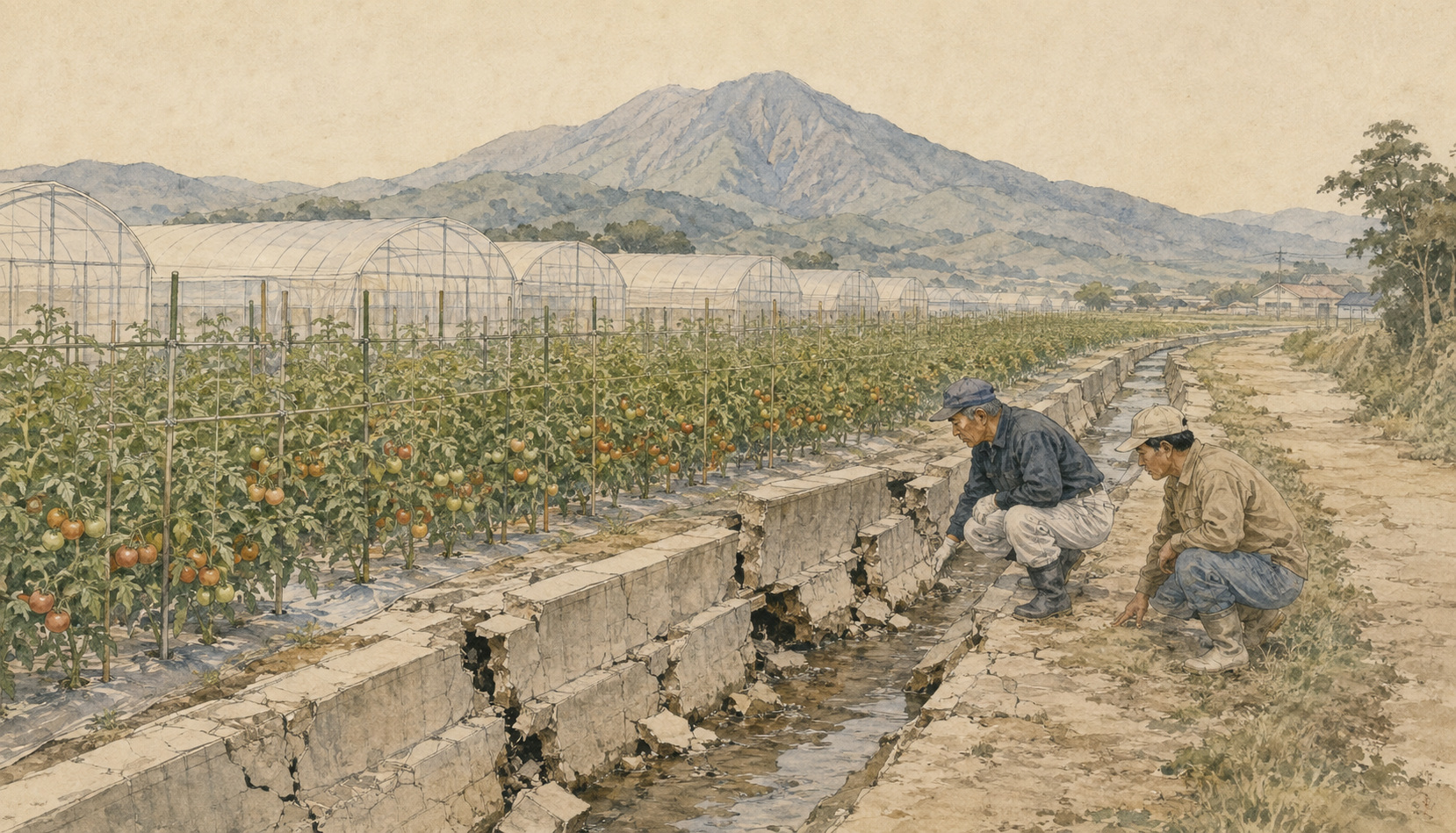
When an irrigation canal empties, the sound of water disappears from the plain. The silence does not mean the damage has stopped. Cracks widen in rice soil. Cucumbers are already in harvest. Strawberry plants must survive the summer nursery. And on farms that made Yatsushiro the core of Japan’s leading tomato prefecture, growers are preparing seedlings and greenhouses for autumn transplanting. A crop keeps agricultural time, not reconstruction time.
At 4:27 p.m. on July 28, a Japan Meteorological Agency magnitude 7.1 earthquake began 16 kilometers beneath Kumamoto Prefecture. Uki and Hikawa recorded the maximum Japanese seismic intensity of 7. In Yatsushiro, the nationally managed Shiranui Main Canal collapsed. It takes water from the Kuma River at the Youhai Headworks and carries it into the plain. Cracks and settlement also cut through the wider distribution network, stopping normal delivery.
The Kyushu Regional Agricultural Administration Office and local land-improvement district began emergency construction and pumping on July 30, two days after the earthquake. Temporary pumps were installed at Showa Nisshin-machi and Kagami Kitashinden in Yatsushiro. A tanker was stationed at JA Yatsushiro’s western tomato sorting center in Gunchiku Rokubancho. On August 6, the national government conducted a test release through the temporarily repaired main canal. Yet putting water into a trunk is not the same as delivering enough through every damaged branch to every field.
Praying for rain as a typhoon approaches
Farmers told reporters that they could do little but pray for rain. Then a typhoon approached from the south. The juxtaposition sounds absurd only if water is treated as a simple total. Farming needs water of usable quality, at the right place, in the right amount, at the moment a plant can use it.
A downpour may run from a broken channel to the sea in hours. It can flood low reclaimed land, scour an emergency repair and overwhelm damaged drainage stations. Some groundwater turned cloudy after the earthquake, raising concern that liquefaction had mixed sediment or salts into the supply. Kumamoto established a soil-analysis team. By August 7 it had found no abnormality, including salinity, at six agricultural groundwater sites—but six clear results do not automatically certify the entire plain.
An irrigation network converts rainfall into controlled time. Gates are opened, turns are scheduled and water is held or released in quantities roots can absorb. A tropical storm does the opposite. The same farm can suffer too much uncontrolled water and too little useful water in the same week.
Do tomatoes not prefer dry conditions?
The cultivated tomato descends from plants adapted to comparatively dry environments, and excess water can damage roots and dilute flavor. Growers sometimes restrict irrigation deliberately to raise sugar concentration. That does not make a water outage benign. Controlled deficit and loss of control are opposites.
A small seedling plug can wilt rapidly in summer heat. After transplanting, moisture must remain dependable until roots expand into surrounding soil. Heat combined with drought can contribute to poor establishment, blossom drop, failed fruit set, blossom-end rot and sunscald. If early development slips, the harvest curve and shipping calendar move with it. After intense rain delayed Kumamoto tomato planting in August 2025, the agriculture ministry expected the disruption to appear as lower autumn shipments months later.
JA Yatsushiro’s Hachibee tomato takes its name from the first characters in Yatsushiro and heiya, or plain. Its official shipping window runs from October through June. Summer is therefore deceptive: there may be fewer ripe local tomatoes in stores, while nurseries, soil preparation and transplant plans are determining the next nine months. The emergency begins before a consumer can see the missing fruit.
- Nursery: Small tomato and strawberry root balls dry quickly in heat, reducing plant quality.
- Transplant: Growers must delay field planting or use scarce substitute water to establish roots.
- Growth: Uneven moisture disrupts roots, flowers and fruit, widening variation in quality and yield.
- Shipping: A late first crop can shift sorting, trucking and retail supply weeks or months later.
Nearly one tomato in every five
The agriculture ministry’s 2026 prefectural profile records Kumamoto’s 2024 tomato harvest at 129,400 tonnes, first in Japan. That was about 19.5 percent of the national total of 663,600 tonnes—nearly one tomato in five. Warm Yatsushiro and Tamana send winter and spring tomatoes; cooler Aso and Kamimashiki send summer and autumn crops. Their seasonal relay lets the prefecture supply Japan all year.
Yatsushiro is a major lowland anchor. Agriculture ministry municipal data list 552 hectares planted in tomatoes and 550 farm entities growing them in Yatsushiro City. A 2025 report on the Hachibee cooperative alone counted 145 farms and projected about 20,000 tonnes for the season through mid-June. The figures come from different years and reporting boundaries, but together they show why a failure here is not merely a neighborhood farm problem.
Commercial tomato growing in Yatsushiro began around the early 1950s. From the late 1970s, more farms shifted as the region’s rush-grass industry contracted under import competition and changing lifestyles. A large central tomato sorting center opened in 1999, moving grading and packing from individual farms into a shared operation. Common standards, specialist advisers and cooperative marketing lengthened the season and gave Hachibee a recognizable name. Reclaimed soil, winter sunlight, greenhouses, a sorting line, trucking—and irrigation—became one production cluster.
Even Yatsushiro’s premium “salt tomatoes” illustrate control rather than neglect. In selected reclaimed soils, measured salinity makes it harder for a plant to absorb water, producing smaller fruit with concentrated sweetness. That managed stress is not a license to use untested cloudy water or accept an uncontrolled shift in soil chemistry after an earthquake. Yatsushiro’s skill has been to measure natural constraint and turn it into flavor.
The fields were once the sea
To understand the Yatsushiro Plain, roll the map backward. Some of the land now covered by tomato houses was once under the Yatsushiro Sea. During the Edo period, the Higo domain built stone embankments, tide walls and sluices, closing off shallows and extending farmland. The old Takashima Shinden dike of 1816 and the Ozaya sluices of 1819 survive as records of that engineering.
Meiji Japan enlarged the ambition. Work on the former Gunchiku Shinden Gate A began in 1900 and finished in 1901. Its 10 brick arches and cut-stone walls stretch 33.1 meters, with roughly a kilometer of stone sea wall still standing on the seaward side. It is one of the largest surviving masonry sluice gates in Japan and is designated an Important Cultural Property. The farms did not simply occupy naturally dry ground. Generations assembled them from walls, gates, drainage and patient soil-making.
Reclamation never ends when seawater is pushed out. Low, flat land must drain excess water while receiving fresh water for crops. Too little invites drought and salt damage; too much produces waterlogging. Yatsushiro agriculture grew inside this narrow managed space between river and sea.
Youhai Headworks: an old idea becomes a modern artery
A predecessor of the Youhai diversion weir appears in records from the late 14th century, and tradition says the feudal engineer Kato Kiyomasa later rebuilt it in stone. The present headworks and core canals were constructed under a national land-improvement project from fiscal 1964 through 1973. High-growth-era concrete turned the ancient idea—divide Kuma River water across the plain—into a large integrated network.
The national Yatsushiro Plain Irrigation Project now under way covers roughly 5,379 hectares in Yatsushiro City and Hikawa Town and includes renewal of 33.6 kilometers of trunk canals. It is scheduled from fiscal 2018 through 2030. Before construction began, the agriculture ministry had already identified lost concrete, corroding reinforcement and inadequate seismic performance at the headworks and conduits.
The 2026 earthquake did not discover aging for the first time. Renewal was in progress, but rebuilding a working regional system while continuing to use it takes more than a decade. Disaster arrived during that interval. Nor was this the canal’s first recent failure. Heavy rain on June 20, 2024, caused a road and the canal foundation at Higashikata-machi to subside for about 500 meters, making the channel unusable. Damaged by rain, repaired, then broken by earthquake: this is compound vulnerability, in which different hazards converge on the same lifeline.
| Layer | What Yatsushiro built | What 2026 exposed |
|---|---|---|
| Land Edo to Meiji | Sea walls, sluices and reclaimed fields converted tidal shallows into a productive plain. | Low ground is vulnerable to liquefaction, settlement, salinity and drainage failure. |
| Water Medieval weir to 1970s | Youhai Headworks and trunk and branch canals connected the Kuma River to farms. | Failure in one trunk can interrupt supply over a broad district. |
| Crop cluster 1950s to present | Greenhouses, shared sorting, branding and seasonal relay shipping. | A few lost weeks in nursery or transplanting can propagate into months of income and supply. |
| Renewal FY2018–2030 plan | A national project addressing aging and weak seismic performance. | A disaster can strike during the long process of renewing an operating system. |
Emergency pumps buy time
Mobile pumps, tankers and farm-carried tanks cannot replace a trunk canal. Their flow is smaller. They consume fuel and labor. The farther a field lies from an emergency intake, the harder it is to reach. Still, they can be decisive: keep seedlings alive, extend the transplant window by several days, or prevent a rice field from crossing an irreversible threshold. What emergency water chiefly purchases is time before choices disappear.
That makes allocation unavoidable. Rice needs water at sensitive reproductive stages; cucumbers are being harvested; strawberries are in nursery; tomatoes are approaching transplant. If upstream farms draw first, terminal reaches stay dry. Allocation based only on acreage, market value or political volume can break trust as surely as the earthquake broke concrete.
Japanese irrigation districts have long used bansui—rotational delivery by place and time—during scarcity. Its principle remains useful, but a modern emergency rotation should overlay each crop’s critical stage, the value and vulnerability of seedlings, access to wells or tanks, and the water lost in reaching the last branch. Publishing who receives how much protects legitimacy. Moving a small supply to the place where it preserves the most recoverable production is engineering and local governance at once.
The 2016 lesson: save this season, rebuild for the next generation
Kumamoto has seen irrigation repair under earthquake pressure before. The 2016 earthquakes cracked and settled fields, triggered liquefaction and damaged many farm-water facilities. To make rice planting possible, roughly 700 people joined debris removal and emergency canal work in mid-to-late May. The effort enabled planting on about 1,600 hectares.
That success did not prove that temporary repair was enough. Later reconstruction included larger fields and land consolidation—“creative reconstruction,” not simply returning every parcel to its previous shape. Emergency work saves a season. Permanent recovery designs the next several decades of farming and maintenance. They move at different speeds and answer different questions.
As of August 7, Kumamoto Prefecture put preliminary earthquake damage to agriculture, forestry and fisheries at about ¥23.3 billion, including roughly ¥18.96 billion to farmland and agricultural facilities. Crop, machinery and shared-facility losses were still being surveyed, so the total was expected to rise. A canal construction budget cannot by itself preserve a farm business. Rapid crop-insurance and income-insurance payments, bridge financing and replacement seedlings belong on the same recovery chart as concrete and steel.
Restoring the old single point of failure is not enough
Getting water through the Shiranui Main Canal as soon as possible is the immediate priority. But if permanent recovery aims only to reproduce the system as it stood on July 27, it will reproduce its dependence on one critical trunk. Preparing for the next earthquake, flood or drought means recording exactly how this one failed and adding options around the break.
- Alternate paths: Cross-connections and temporary hook-up points that can route water around an isolated break.
- Flexibility: Replaceable joints and shorter independent reaches at faults, settlement zones and fill boundaries.
- Isolation: Gates that can remotely separate a leak without shutting the entire healthy network.
- Observation: Continuous flow, level, turbidity and electrical-conductivity sensing, including at terminal reaches.
- Reserve water: Regularly tested farm wells, shared storage and preplanned placement of mobile pumps.
- Drainage: Seismic and flood resilience for drainage as well as supply, so typhoon water is not trapped on low land.
- Operations: Crop-priority rules, rotation tables, fuel, staff and contact chains rehearsed before an emergency.
Duplicating every channel would be unaffordable. The practical task is to map how many hectares lose service at each possible break, how long replacement takes, and which crop calendars overlap that outage. Investment can then target the interventions that prevent the largest cascade. Seismic design is not only thicker walls. It is also a system that fails in smaller pieces and can be repaired quickly.
The dinner table at the end of the canal
A Yatsushiro tomato is not made by a grower alone. It contains the upper Kuma watershed, an engineer maintaining Youhai Headworks, a land-improvement district operator turning gates, nursery workers, graders at the packing center and drivers moving produce to distant cities. Consumers who never see an irrigation canal still receive part of it in every fruit.
The August 6 test release was hopeful news, not an ending. Can water travel reliably to terminal farms? Will the temporary works survive typhoon rain? Can seedlings enter their planned fields? Will the first autumn shipments leave on time? Success will be decided day by day and reach by reach.
Yatsushiro made land from sea, diverted water from river and answered the decline of rush grass by building a tomato industry. It did not conquer nature. It learned to negotiate with nature through walls, gates, schedules and collective work. Repairing the Shiranui canal resumes that negotiation. The true measure of recovery is whether it can save this season’s plants while carrying a safer water system into the next hundred years.
Late 14th century A predecessor of the Youhai diversion weir appears in historical records; tradition later associates a stone rebuild with Kato Kiyomasa.
1816–1819 The old Takashima Shinden dike and Ozaya sluices are built during Edo-period reclamation.
1900–1901 Gunchiku Shinden and its 10-arch Gate A are constructed.
Early 1950s Commercial tomato growing begins in Yatsushiro.
FY1964–1973 A national project builds the present Youhai Headworks and core irrigation facilities.
Late 1970s onward More farms shift from rush grass to tomatoes.
1999 A large shared sorting center opens, expanding the region’s capacity and market reach.
FY2018–2030 plan National renewal project addresses age and inadequate seismic performance.
June 20, 2024 Heavy rain settles about 500 meters of road and canal foundation, stopping flow.
July 28, 2026 The M7.1 Kumamoto earthquake damages the trunk and branch network.
July 30 National emergency construction and pumping begin.
August 6 Test flow begins through the Shiranui Main Canal.
Reporting note and principal sources
This article uses public information available through August 8, 2026, 6:00 a.m. JST. Damage totals, delivery reach, groundwater quality and crop effects remain under investigation. It does not treat test flow as full restoration or forecast future yields and prices.
- The Mainichi: canal damage threatens Kumamoto’s tomato belt
- The Mainichi Japanese edition: Yatsushiro growers and the water crisis
- Kumamoto Nichinichi Shimbun: Shiranui canal damage and emergency supply
- Kumamoto Prefecture: August 7 disaster-response meeting materials
- Japan Meteorological Agency: 2026 Kumamoto Earthquake portal
- Kyushu Regional Agricultural Administration Office: Yatsushiro Plain Irrigation Project
- Kyushu Regional Agricultural Administration Office: project overview
- Kumamoto Nichinichi Shimbun: 2024 rain damage to the Shiranui canal
- Cultural Heritage Online: Yatsushiro Sea reclamation remains
- Cultural Heritage Online: former Gunchiku Shinden Gate A
- Ministry of Agriculture: 2026 profile of Kumamoto agriculture
- Ministry of Agriculture: Yatsushiro municipal farm data
- JA Yatsushiro: Hachibee tomatoes and regional produce
- Ie-no-Hikari: history of Hachibee tomato production
- Agriculture & Livestock Industries Corp.: formation of Yatsushiro’s tomato cluster
- JA Kumamoto Central Union: 2025 Hachibee shipping plan
- Ministry of Agriculture: technical guidance on tomato heat stress
- Ministry of Agriculture: tomato outlook after Kumamoto’s 2025 heavy rain
- Kyushu Regional Agricultural Administration Office: 2016 emergency irrigation repair
- Ministry of Agriculture: 2016 earthquake damage to farmland and facilities
- Kumamoto Prefecture: agricultural recovery after the 2016 earthquakes