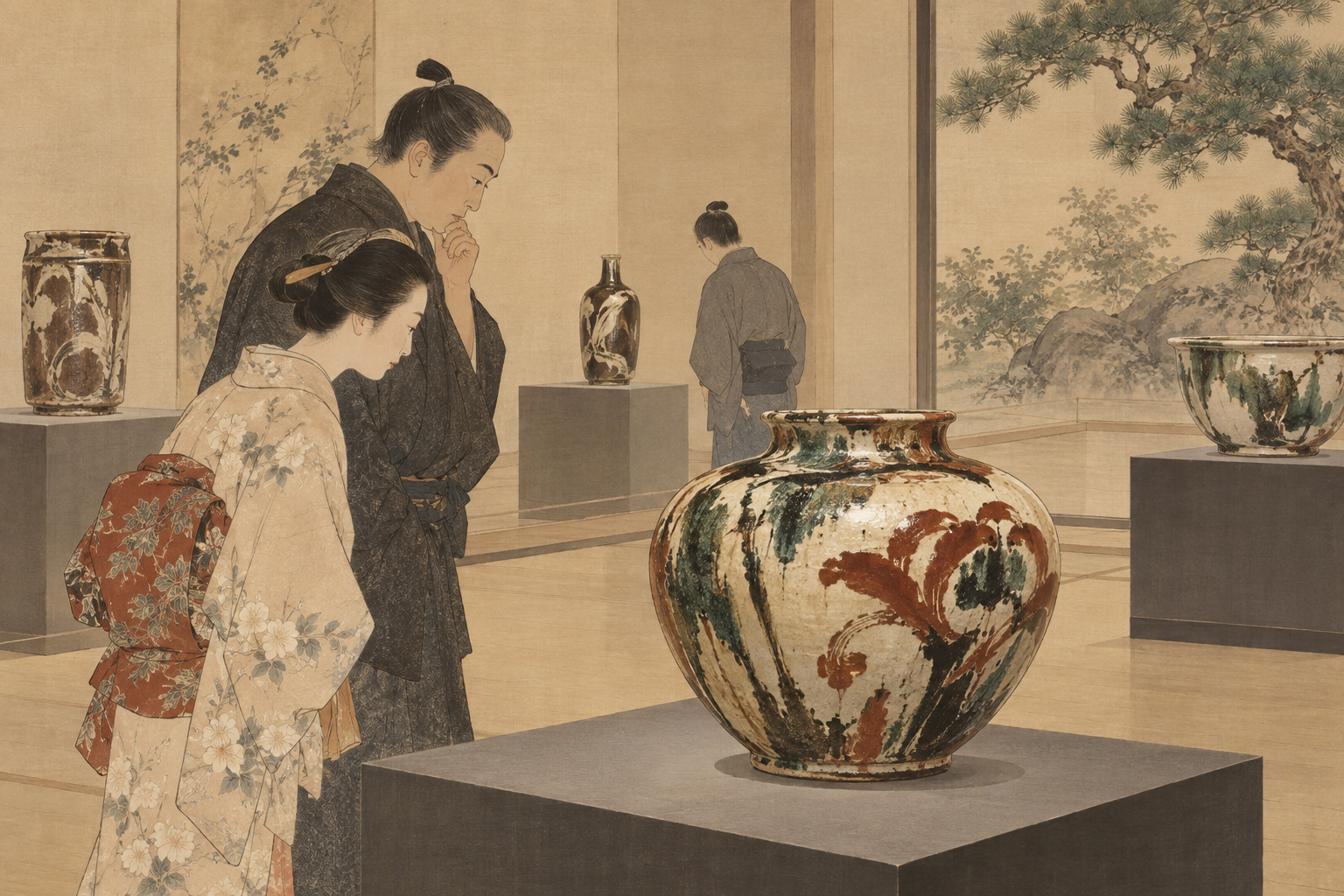
A museum exhibition devoted to a celebrated potter might seem an unlikely place to reconsider the beauty of anonymous work. Yet that is the productive question at the center of Seikado’s “Mingei SHOCK!!” in Tokyo: what happened when Kawai Kanjirō, already admired for his command of ceramics, began to rethink the values that made a pot worth making?
The exhibition, marking 60 years since his death, runs September 5–November 8 at Seikado Bunko Art Museum in Marunouchi. It invites visitors to consider Kawai through the objects and traditions around him, rather than treating every vessel as an isolated expression of genius.[1]
Seikado is presenting its entire 51-work Kawai collection for the first time. Dating from 1924 to around 1937, the holdings concentrate on his early Shōwa years. That makes this a particularly useful study of a transition, rather than a balanced survey of everything he made over his lifetime.[2]
A modern idea about ordinary things
Mingei is commonly rendered in English as folk craft. The Japan Folk Crafts Association’s explanation emphasizes useful, affordable objects made in quantity by unnamed craftspeople. The term concerns the relationship among making, everyday need and beauty; it is more demanding than a decorative preference for something rustic.[7]
A handmade appearance alone does not tell us whether an object meets that ideal. A deliberately rough surface can be as calculated as a polished one. Conversely, a repeated form may carry considerable skill without announcing the individuality of its maker. Mingei shifts attention toward the conditions of production and use, encouraging questions that a maker’s signature cannot answer.
Kawai complicates that proposition because we know his name. The museum is inviting us to recognize a distinctive artist while examining a movement that challenged the supremacy of exceptional authorship. The tension need not be explained away. It allows us to ask how an individual maker could learn from collective knowledge without pretending to become anonymous.
Skill came before the change in direction
Born in what is now Yasugi, Shimane Prefecture, in 1890, Kawai entered Tokyo Higher Technical School’s ceramics department in 1910. He subsequently worked in ceramic testing and research in Kyoto. His first solo exhibition, at Takashimaya in Tokyo and Osaka in 1921, presented work informed by older East Asian ceramics. A chronology preserved by the Tokyo National Research Institute for Cultural Properties records his closer friendship with Yanagi, through Hamada Shōji, in 1924.[4]
The sequence is important. This was a maker who had invested in technical knowledge before redirecting his ambitions toward everyday usefulness. The change can be understood as a reconsideration of purpose: a glaze, a form or a firing effect could serve more than the demonstration of virtuosity. Learning from ordinary pottery did not require forgetting how difficult pottery is to make.
The Japan Folk Crafts Museum describes Kawai becoming dissatisfied with his earlier work after its initial success. Its own holdings provide another perspective on his subsequent development: approximately 250 works, principally from the 1930s through the 1950s, all selected by Yanagi. A collection therefore records the judgments of a viewer and advocate as well as the decisions of a maker.[9]
The word, the proposal and the museum
The movement’s institutional chronology distinguishes several beginnings. In December 1925, Yanagi, Kawai and Hamada coined mingei during a journey to the Kishū region. In April 1926, those three and Tomimoto Kenkichi circulated a proposal for a folk-crafts museum. The latter initiative reaches its centenary this year; the word itself dates to the previous year.[8]
The Japan Folk Crafts Museum opened in Komaba in 1936 with support from Ōhara Magosaburō and other backers. An earlier manifestation, a model interior presented at a 1928 exhibition, had already connected the movement with the arrangement of living space. Collecting objects and proposing a way of living with them were intertwined.[5]
This history makes mingei a modern intervention in the way older things were valued. A bowl did not need to be newly made for someone to propose a new way of seeing it. Exhibitions, publications and institutions could draw attention to practices that had previously been taken for granted. The movement involved cultural interpretation as well as preservation.
Ceramics that cross borders
Seikado’s checklist includes English slipware from the eighteenth and nineteenth centuries, Joseon-period ceramics and Japanese regional wares. Kawai’s circa-1931 Nagashigaki bowl is identified in the bilingual list as bearing a design of two hands in white slip. Here slip—the liquid clay used in decoration—offers a way to follow the relationship between material and gesture.[3]
Rather than searching only for a matching motif, a visitor can compare how a line travels across different forms. Does a curve gather movement toward the center or carry it around the rim? Does repetition emphasize a vessel’s symmetry or unsettle it? Such questions connect technique with the object’s structure. They also leave room for difference: learning from another tradition need not result in a copy.
The Korean dimension requires historical care. The Japan Folk Crafts Museum explains that Yanagi’s interest in Korean ceramics helped direct his attention toward everyday objects. It also places his advocacy in colonial circumstances, recording his criticism of Japanese government policies toward Korea. Admiration for a ceramic tradition and the unequal political relationship around that admiration belong in the same history.[6]
It would consequently be misleading to treat mingei as an entirely self-contained Japanese aesthetic. It developed through encounters with other places and through decisions about how their work should be described. The older Korean, Chinese and English objects should retain their own cultural significance, even when an exhibition also uses them to illuminate a Japanese artist’s choices.
The caution inside a famous name
An especially instructive comparison concerns yōhen. Seikado presents Kawai’s Yōhen jar and covered box alongside the National Treasure Inaba Yōhen Tenmoku tea bowl. The museum cautions that Kawai’s understanding of the category may have differed from today’s. A shared designation does not establish that he reproduced the famous bowl’s effect or directly studied that object.[2]
That uncertainty enriches the comparison. Artistic knowledge travels through books, descriptions and reproductions as well as encounters with objects. Similarity can suggest a question without supplying its answer. The relevant distinction is between an interpretation of possible influence and a documented chain of transmission. A responsible account of Kawai’s experimentation preserves that distinction.
It also gives the exhibition a purpose beyond celebrating beautiful surfaces. Ceramic terminology has a history; categories can change as knowledge changes. Reading a work’s name alongside its material character can show how a maker understood an effect at a particular moment. The label becomes part of the evidence, rather than a timeless explanation of everything we see.
Collectors are part of the story
Seikado’s own history adds another layer. Its collections were built by Iwasaki Yanosuke and his son Koyata, leaders of Mitsubishi. The library was founded in 1892, and the institution began exhibiting in Marunouchi’s Meiji Seimei Building in October 2022. A show about everyday beauty is thus taking place within a collection shaped by substantial private patronage.[10]
The relationship is not peculiar to this museum. Objects often survive because someone with the resources to acquire, store and conserve them decided they mattered. Preservation can make comparisons possible across centuries. At the same time, removing a vessel from daily use changes our relationship with it. We can inspect a silhouette in a display case but cannot test how it sits in the hand at dinner.
The exhibition’s value lies partly in keeping both experiences imaginable. Museum attention can protect the object and sharpen perception. The idea of use can prevent that attention from becoming exclusively concerned with rarity or prestige. The challenge for viewers is to allow the two ways of understanding a pot to inform one another.
A life larger than a display case
Kawai’s former home and workplace in Kyoto offer a complementary setting. Kyoto’s official cultural-information site describes the house he designed in 1937, with its workshop and kiln surviving, and work in wood carving, metalwork and calligraphy alongside ceramics. His practice extended into the surroundings in which he lived.[11]
That wider setting changes the scale of the question. A bowl becomes one element in an arrangement of furniture, tools, rooms and repeated actions. For a contemporary reader, the connection is useful without requiring an imitation of Kawai’s household. It asks whether the objects we use daily deserve the same attention we readily grant an object behind glass.
Kawai died on November 18, 1966. Sixty years later, this focused exhibition offers a way to reconsider an artist willing to question the direction of an already successful practice. Its most lasting effect may be modest and close at hand: the next time a familiar vessel is lifted from a cupboard, its shape, surface and accumulated use may deserve a longer look.[4]
Visiting the exhibition
The venue is Seikado @ Marunouchi, on the first floor of the Meiji Seimei Building. Standard hours are 10 a.m.–5 p.m., with last admission 30 minutes before closing. Adult admission is ¥1,500. Mondays are generally closed; September 21 and October 12 are exceptions, with closures on September 24 and October 13. Consult the official page for evening openings and ticket arrangements.[1]
Some works rotate: the first period ends October 12, and the second runs October 14–November 8. The full collection is represented across the exhibition, not necessarily on one visit. Check the numbered list if a particular object is your priority.[3]
Sources and references
- Seikado Bunko Art Museum: Mingei SHOCK!! exhibition information
- Seikado: exhibition press release, August 2026, pp. 1–5
- Seikado: bilingual List of Works, September 2026
- Tokyo National Research Institute for Cultural Properties: Kawai Kanjirō, Year Book of Japanese Art, 1967, pp. 149–150
- The Japan Folk Crafts Museum: institutional history
- The Japan Folk Crafts Museum: Yanagi and the museum
- The Japan Folk Crafts Association: the principles of mingei
- The Japan Folk Crafts Association: chronology, 1925–1944
- The Japan Folk Crafts Museum: Kawai Kanjirō collection
- Seikado Bunko Art Museum: collection and institutional history
- Kyoto Art Box: Kawai Kanjirō’s House
Evidence reviewed September 14, 2026, Japan time. This feature draws on Seikado’s exhibition documents and Japanese institutional sources on the artist and mingei; it does not claim on-site attendance. Interpretations are Japan.co.jp analysis unless otherwise attributed.