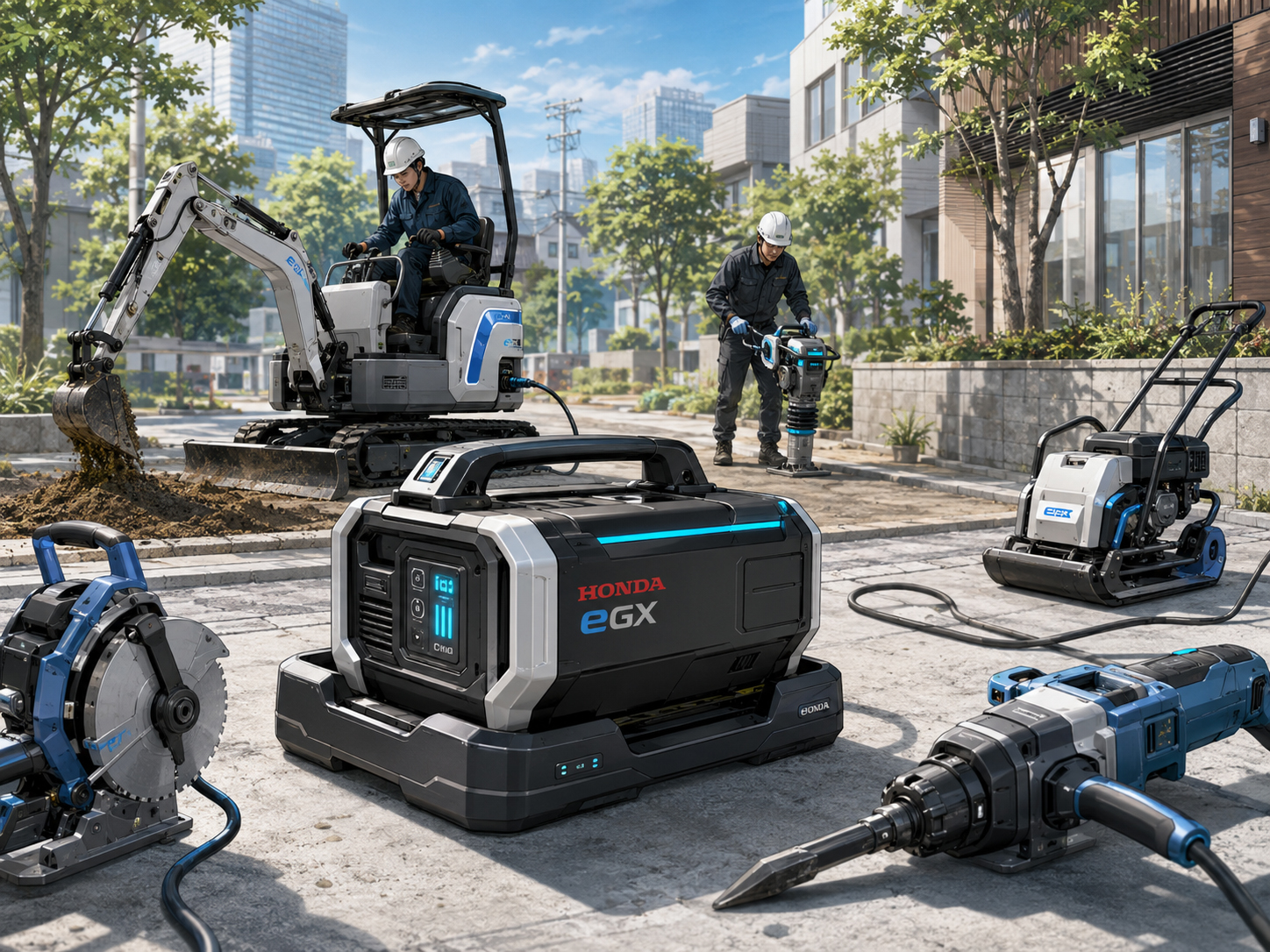
The future of the job site may be quieter than expected
Japanese cities are always repairing themselves. Roads are opened, pavement is removed, gas lines are replaced, sidewalks are rebuilt, station plazas are renovated, and apartment exteriors are repaired. The sound of small equipment in a residential morning, the vibration of night construction, the smell of exhaust — these are signs that a city is alive. They are also burdens on the people who live nearby.
Honda’s June 2026 announcement of high-output eGX electric power units may change that scene a little. The company will add three high-output models — GXE4.0D, GXE6.0D, and GXE9.0D — to its eGX series of electric power units for commercial-grade work equipment and begin supplying them to OEM customers this fall. Supply will begin in Japan and expand in stages to Europe, the United States, and other regions.
This is not a passenger EV story. It is not a glamorous sports car or a futuristic robot. But for practical decarbonization and urban life, it may be more important than it looks. Construction sites, indoor work, residential areas, night work, and underground spaces are where people encounter the hidden engine society every day.
Honda has powered that society for decades. Mowers, generators, pumps, rammers, plate compactors, concrete equipment, and agricultural machines often rely on compact power units that are far less visible than car engines but just as essential to work. The high-output eGX expansion suggests that this small but important heart of the worksite is beginning to move from gasoline to electricity.
What high-output eGX is aiming for
The three new models are the GXE4.0D, GXE6.0D, and GXE9.0D. Their names point to output classes above the original 1.8 kW eGX range. Since its 2021 introduction, eGX has mainly been adopted in smaller equipment such as rammers and plate compactors. The new higher-output models expand the target toward larger commercial-grade work machines.
Honda plans to unveil the models globally at the 8th International Construction & Survey Productivity Improvement EXPO, CSPI-EXPO 2026, held at Makuhari Messe in Chiba from June 17 to 20. The venue matters. This is not a consumer electronics show or an auto show. It is a construction, surveying, productivity, and worksite-improvement exhibition.
In other words, eGX is not being sold as a green image product. It is being sold as a jobsite product. Can it work on a construction site? Can rental companies handle it? Can OEMs integrate it into their machines? Will workers accept it every day? Charging, swapping, durability, dust, vibration, rain, maintenance, and price will decide its fate.
Electrification cannot enter the worksite on slogans alone. The worksite trusts what works.
Honda’s other engine history began in 1953
When people hear Honda, they may think of the Super Cub, Civic, Formula 1, NSX, or motorcycles. But Honda has another major history: general-purpose engines.
Honda’s first power product was the H-Type general-purpose engine, launched in 1953. Developed for agricultural machinery, it was compact and easy to handle, and it also marked the beginning of Honda’s OEM business. Honda was not only selling finished products; it was supplying power sources to other manufacturers’ machines.
General-purpose engines rarely become household names. But they enter machines around the world and support agriculture, construction, disaster response, cleaning, power generation, irrigation, and public works. A pump moves water. A generator makes electricity. A rammer compacts soil. A paving machine prepares a road. Somewhere inside, a small engine turns.
That unglamorous history makes eGX more than a new product line. It is the continuation of a role Honda has built for more than 70 years: supplying the power source inside other people’s machines.
The GX engine created a world standard
Within Honda’s power-products history, the GX series launched in 1983 is especially important. Honda built GX around durability, compactness, fuel efficiency, easy maintenance, and lower noise. At a time when side-valve engines were common, Honda adopted an OHV design to improve output, fuel economy, and quiet operation.
GX engines became standard power sources across construction, agriculture, rental, cleaning, generators, and pumps. For OEMs, reliability is only one part of the equation. Mounting compatibility, dimensions, output characteristics, parts supply, and service networks also matter. GX spread because of that total package.
This is essential to understanding eGX. An electric power unit does not win simply by having a strong motor. It must be easy to integrate into existing equipment, minimize redesign for OEMs, and survive work-machine duty.
From the beginning, Honda positioned eGX as inheriting the installation compatibility and reliability associated with the GX series. The company is trying to carry the mounting logic of gasoline engines into electrification.
Why electrify work equipment?
There are several reasons to electrify work equipment. The first is exhaust. Engine-powered small machines have long been normal outdoors. But indoors, underground, in tunnels, residential neighborhoods, and near schools or hospitals, exhaust and ventilation become serious concerns.
The second is noise. Construction noise is a major friction in urban life. Residential daytime work, night construction, commercial renovations, hotels, hospitals, and schools all create demand for quieter machines. Low-noise work equipment can expand when and where work can be done.
The third is vibration and maintenance. Electric units can be easier to start, eliminate fuel handling, and reduce routine maintenance such as oil changes. That can affect worker burden, rental-company service operations, and site safety management.
The fourth is regulation. In Europe, the United States, Japan, and urban markets worldwide, emissions reduction from construction machinery and small off-road equipment is becoming more important. California’s small off-road engine rules show how policy can push markets toward zero-emission equipment.


Small engines were a bigger emissions source than they looked
Passenger-car emissions have long received attention. But small off-road engines are also an important source of pollution. Lawn mowers, generators, pressure washers, brush cutters, and work machines are individually small, but they are numerous, and many use older engine designs.
The California Air Resources Board has used small off-road engine regulations to move such equipment toward zero-emission alternatives. The details vary by equipment and timing, but the direction is clear: even small engines are now under pressure from decarbonization and air-quality policy.
For Honda, that is both a threat and an opportunity. A company that built a global position in gasoline general-purpose engines must decide whether tightening regulation erodes its customer base or whether electric power units create the next standard. eGX is part of Honda’s answer.
The rental industry will be critical
In commercial work equipment, the rental industry matters enormously. Construction companies do not own every machine they use. They rent what they need when they need it: rammers, generators, compactors, lights, pumps, cutters, and mowers. The practical worksite is supported by rental fleets.
Whether electrification spreads will depend on whether rental companies can manage it. Can charging be organized? How is battery degradation tracked? Is run time enough? Is inspection after return simple? Can customers be taught quickly? What happens when something fails?
Honda’s decision to supply eGX to OEMs means it is thinking about the finished-equipment makers and the rental market at the same time. Electrification changes not only the user experience, but also distribution, maintenance, and fleet management.
Electric construction is not only about giant excavators
When people hear electric construction equipment, they often imagine large excavators or dumpers. Those machines matter. But smaller equipment may do more to change the feel of urban work.
Plate compactors, rammers, concrete finishing machines, cutters, pumps, generators, cleaning machines, and survey-support equipment are used in residential areas, indoor spaces, underground sites, and narrow jobsites. They are close to workers’ ears and close to residents’ daily life.
Electrifying large machines changes total site emissions. Electrifying smaller machines changes the daily experience of the site. Less noise. No exhaust. Easier start. No spilled fuel. These are practical changes that workers and neighbors can feel.
Battery challenges have not disappeared
Electric work equipment still faces challenges. Batteries are heavy. Costs are high. Charging takes time. For long continuous operation, engine equipment can still be more convenient when refueling is quick. Cold, heat, dust, rain, shock, and vibration all test durability.
A construction site is not a laboratory. There is mud, water, sand, drops, rough handling, and sudden schedule changes. Electric equipment must prove not only environmental performance, but also jobsite toughness.
That means eGX will not succeed on specification sheets alone. It must be integrated into real OEM machines, rented, used on jobsites, survive, fit charging workflows, and convince workers that it is good enough.
Electrification that fits Japanese cities
Japan is well suited to electric work equipment in several ways. Its cities are dense. Homes and construction sites sit close together. Night work is common. Work happens underground, near stations, inside commercial buildings, and close to hospitals and schools. Social sensitivity to noise and exhaust is high.
At the same time, Japan’s construction sector faces labor shortages. Aging workers, workforce limits, work-style reform, safety management, and productivity pressure are all real issues. Equipment that is easier to start, easier to handle, and easier to maintain is relevant not only to the environment, but also to labor.
Honda’s decision to show high-output eGX at CSPI-EXPO fits that context. Japan’s construction and surveying industries are being asked to decarbonize, save labor, improve safety, raise productivity, and reduce friction with neighbors all at once.
Honda is an engine company, and now an electric power company
Honda is an engine company. That is exactly why electrification matters. When the power source changes, product design, user behavior, maintenance, distribution, and customer relationships all change.
In passenger EVs, people talk about batteries, charging, range, and price. Work equipment has similar issues, but with harsher conditions: which machine needs which output, how much continuous operation is required, whether the battery is removable or integrated, how the unit survives dust and rain, and how OEMs adapt existing designs.
eGX shows Honda moving not only into vehicle electrification, but into the electrification of work. For Honda’s power-products business, this may become one of the biggest shifts since GX.
A quieter jobsite can change the value of the city
Construction sites are necessary. They are also inconvenient for neighbors. Noise, exhaust, vibration, traffic control, and dust come with urban maintenance. If the sound and exhaust of work equipment decline, the distance between construction and daily life may shrink a little.
Night road repair, indoor renovation, underground work, and construction near hospitals or schools are likely to be early places where electric work equipment proves value. It will not change every site at once. But it may enter places where engines are difficult, expand working-time options, and reduce worker burden.
Honda’s high-output eGX turns the big phrase of decarbonization into small changes at the worksite: a little less sound, no local exhaust, easier starting, no gasoline smell. Such small changes, repeated across cities, can alter the way urban work feels.
The future construction site will not be silent. Concrete will break, ground will be dug, and machines will move. But if more sites operate without engine noise and exhaust, cities may breathe a little easier.
- Honda is adding the GXE4.0D, GXE6.0D, and GXE9.0D high-output models to the eGX series.
- The target is OEMs for construction and commercial-grade work equipment, beginning with supply from Japan.
- eGX extends Honda’s power-source business from the 1953 H-Type engine and the 1983 GX engine into electrification.
- Low noise, zero exhaust during use, easy starting, and reduced maintenance can matter in urban jobsites.
- The challenges are price, charging, operating time, durability, and rental-fleet management.
Sources and references
This feature is based on public information from Honda, Honda Power Products, Honda Engines, the California Air Resources Board, and sources on construction-equipment electrification.
- Honda: Three high-output eGX models for commercial-grade work equipment, June 15, 2026
- Honda Engines: eGX Electric Power Unit
- Honda: General-purpose engine history and GX series
- Honda: Power Products archive, H-Type and GX history
- Honda: 2021 eGX electrified power unit announcement
- California Air Resources Board: Small Off-Road Engine regulations
- CALSTART: Zero-emission construction and agricultural equipment