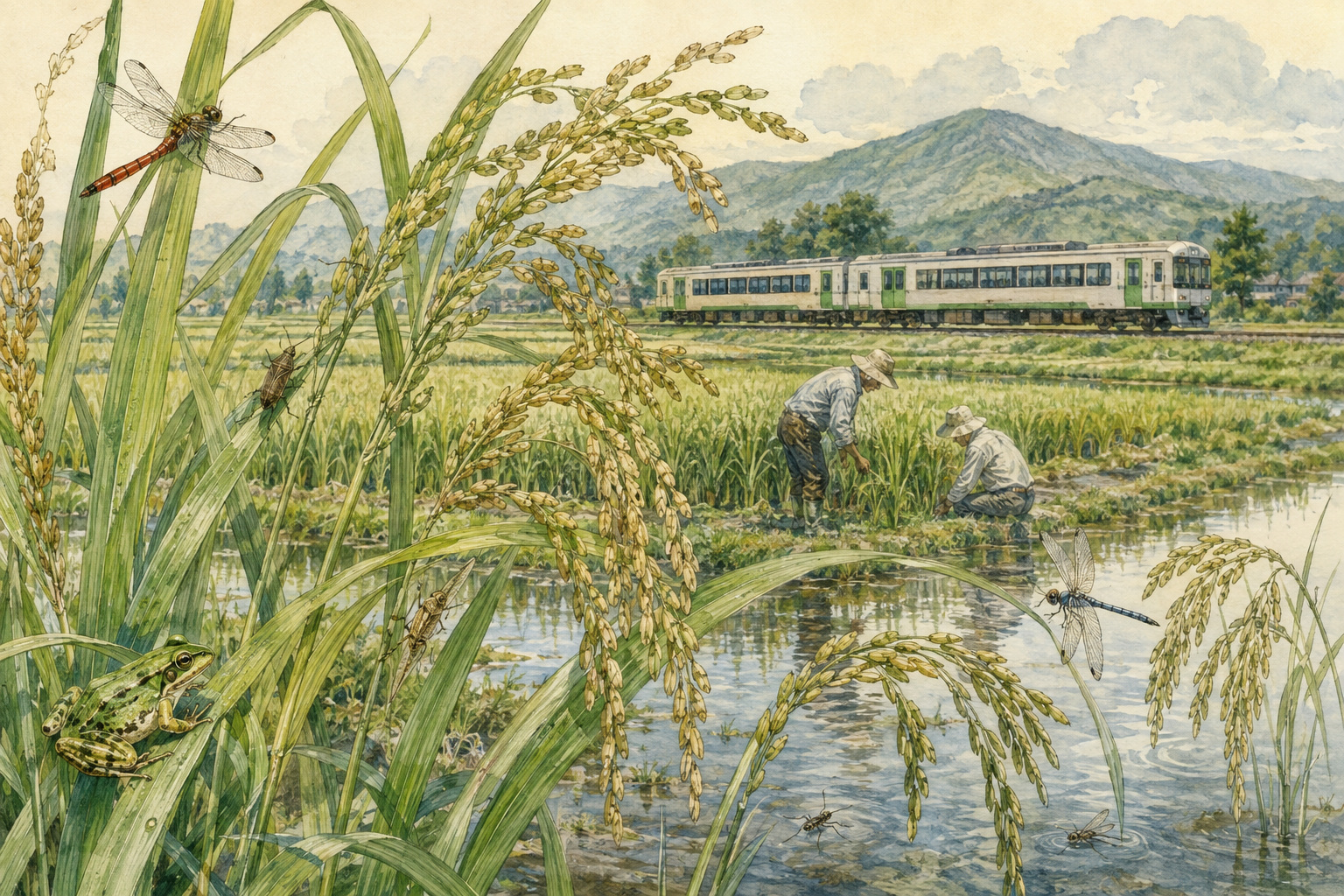
HANAMAKI, Iwate — A farm can change hands in a day. Its knowledge cannot. The machinery, leased fields, irrigation routines, planting windows and relationships with neighboring growers have to pass from one management team to another without waiting for the paperwork to settle.
That is the test now facing Hanamaki Nosan Co., an agricultural company founded in 2013 in Hanamaki. JR East Toyosato Revitalization Co., a subsidiary of East Japan Railway Co., acquired its shares on July 28 and announced the succession a month later.
The buyer says the farm will keep its Japanese corporate name, はなまき農産株式会社, and continue employing its workers. Operations remain in Hanamaki. Management changes: Takahashi, president of the acquiring company, becomes president of the farm as well, while the former president moves into an advisory role.
What exactly is being preserved?
Hanamaki Nosan grows paddy rice, wheat and soybeans and also carries out contracted farm work from its base in Hanamaki. The acquisition is therefore not a purchase of a packaged rice brand alone. It takes in an operating platform: fields under management, machinery, workers and commitments to perform jobs for other farms.
Keeping the name matters because agricultural companies transact through local memory. A landowner who leases a field, a contractor who repairs a combine, a water-users group and a neighboring farmer all know the operating company through repeated seasons. A new national brand on the gate could suggest rupture. Retaining Hanamaki Nosan signals continuity.
Continued employment matters more. The release makes an explicit commitment to retain employees, but gives no headcount, job categories or duration. Over time, the meaningful measure will be whether experienced workers stay, whether younger operators are hired and trained, and whether pay and schedules support year-round employment around highly seasonal work.
The first deal for a four-month-old company
JR East Toyosato Revitalization was established on April 28, 2026 with capital and related funding of ¥400 million. Its shareholders include JR East, rice wholesaler Yamatane Co., agricultural workforce company YUIME Inc., and three JR East employees who proposed the business. Its work is defined as investment in agricultural corporations, management support and consulting.
The Hanamaki acquisition is its first farm succession. The model begins with a viable agricultural company whose continuation has become difficult. The new owner invests and provides management. That company can then become a local base capable of leasing surrounding fields or accepting production contracts from farmers who retire.
It is consolidation by continuity rather than closure. But it also places a large corporate network behind the process of concentrating farmland into fewer operating entities. Good governance will require clarity about which decisions remain local, how landowners are treated and how the gains from scale reach employees and the community.
Four resources the railway group wants to add
| Area | Resource or partner | Announced direction | Evidence still needed |
|---|---|---|---|
| Recruitment | YUIME, regional hiring and academic links | Attract and train future agricultural workers. | Positions, employment terms, intake and retention. |
| Peak-season labor | JR East’s agricultural side-work program | Connect employees with labor-intensive planting and harvest periods. | Hanamaki assignments, training, supervision and workdays. |
| Production | Agritech companies linked through LiSH | Test technology, materials and methods such as direct seeding into flooded paddies. | Trial area, controls, yield, quality and cost. |
| Management | Komepro and an affiliated large-scale farm operator | Strengthen farm operations, finance and accounting. | Local autonomy, reporting structure and operating results. |
Railway workers in the rice calendar
JR East says it has about 40,000 employees across eastern Japan and began an agricultural side-work system in 2023. The company reports an annual cumulative total of approximately 900 employee participants. Rice is an obvious match for flexible labor because planting and harvesting create short periods of intense demand.
The number needs careful reading. It is a groupwide annual total, not 900 different people and not a promise that 900 people will work in Hanamaki. The acquisition announcement does not say how many workers the farm needs, which jobs employees may perform or how they will be trained to work safely around agricultural machinery.
Short-term help can relieve a bottleneck. It cannot replace year-round responsibility for crop planning, machinery maintenance, water management, chemical records, contracting and sales. The side-work program is most valuable when it supports—not substitutes for—a stable local team.
A production method named, but not yet proven here
Among the methods under consideration is tansui choku-han, direct seeding into a flooded paddy. Instead of raising seedlings and transplanting them, a grower sows rice seed directly into a prepared, water-filled field. Japan’s agriculture ministry says the method can eliminate seedling raising and transplanting work.
The release describes trial introductions, not adoption across Hanamaki Nosan’s fields. It gives no test area, rice variety, seeding method or performance target. Direct seeding may reduce spring labor, but emergence, weeds, birds, water control and lodging all affect the result. The proper comparison includes labor, yield, grade, inputs, machinery and cost per tenth of a hectare.
Technology can make a larger farm manageable. It can also move the demand for skill from one task to another. Removing transplanting does not remove management; it changes what the operator must know.
The regional numbers behind the deal
A Tohoku Regional Agricultural Administration Office evaluation covering Hanamaki, Kitakami and Kanegasaki shows the direction of change. Between 2005 and 2020, the number of individual agricultural management entities fell 51%, from 12,427 to 6,067. Core agricultural workers fell 33%.
At the same time, corporate farm entities roughly doubled from 93 to 188, while managed land per entity rose 89%, from 2.11 to 3.99 hectares. Only 27.5% of respondents in the evaluation’s survey said a successor had been secured. These are regional figures, not Hanamaki Nosan’s own results, but they explain why succession and consolidation now arrive together.
The pattern creates capacity and risk. Larger entities can spread machinery, accounting and technical expertise over more hectares. They also carry more land and community obligations when weather, prices or labor fail. A strong balance sheet and management system matter as much as a larger map.
JANUARY 2013 Hanamaki Nosan is established.
2023 JR East starts its agricultural side-work program.
APRIL 28, 2026 JR East Toyosato Revitalization is established.
JULY 28, 2026 The subsidiary acquires Hanamaki Nosan’s shares.
AUGUST 28, 2026 The companies publicly announce the succession.
The 1,500-hectare target is not a Hanamaki forecast
JR East Toyosato Revitalization says its future model aims for planted area on the scale of 1,500 hectares and eventual expansion into other parts of eastern Japan. That is a broad company ambition. The release does not say that Hanamaki Nosan itself will grow from roughly 50 hectares to 1,500.
The distinction is important. A groupwide portfolio of several local base farms is different from one centrally managed 1,500-hectare operation. Distance between fields, irrigation systems, soils and local agreements can erase some economies of scale. The useful measure is not acreage accumulated but productive land maintained at a sustainable return.
- Employee headcount, retention, new hiring and training
- Planted area by crop, yield, grade and sales channels
- Changes in contract work and leased farmland accepted from the community
- Assignments, workdays and duties supplied through JR East’s side-work program
- Methods and comparative results for each technology trial
- How operating authority is divided between Hanamaki and the Tokyo parent
JR East brings something many succession projects lack: access to people, partners and management systems. Hanamaki Nosan brings something the railway group cannot create quickly: a working local farm with more than a decade of relationships and field experience.
Keeping the name and staff is the right opening promise. The harder proof will come season by season—whether the same fields remain cultivated, whether people choose to stay, and whether the new owner can make a 50-hectare operation resilient enough to accept more responsibility without losing its local footing.
- JR East Toyosato Revitalization and East Japan Railway — announcement of the company’s first business succession and acquisition of Hanamaki Nosan shares (Japanese, August 28, 2026)
- East Japan Railway — announcement of the planned agricultural company (Japanese, March 10, 2026)
- East Japan Railway — establishment of JR East Toyosato Revitalization (Japanese, April 28, 2026)
- JR East Toyosato Revitalization — official website and company profile (Japanese)
- Tohoku Regional Agricultural Administration Office — post-project evaluation for the Waga Chubu agricultural region (Japanese)
- Ministry of Agriculture, Forestry and Fisheries — terminology for direct-seeded rice cultivation (Japanese)
Japan.co.jp reviewed Japanese primary materials available through August 29, 2026. Official company names, readings, titles, address, planted area, business activities, transaction date and technical terminology were checked against those sources. The acquisition price and percentage, employee count, employment terms and financial information were not estimated. Evaluative questions in this report are Japan.co.jp’s editorial analysis.