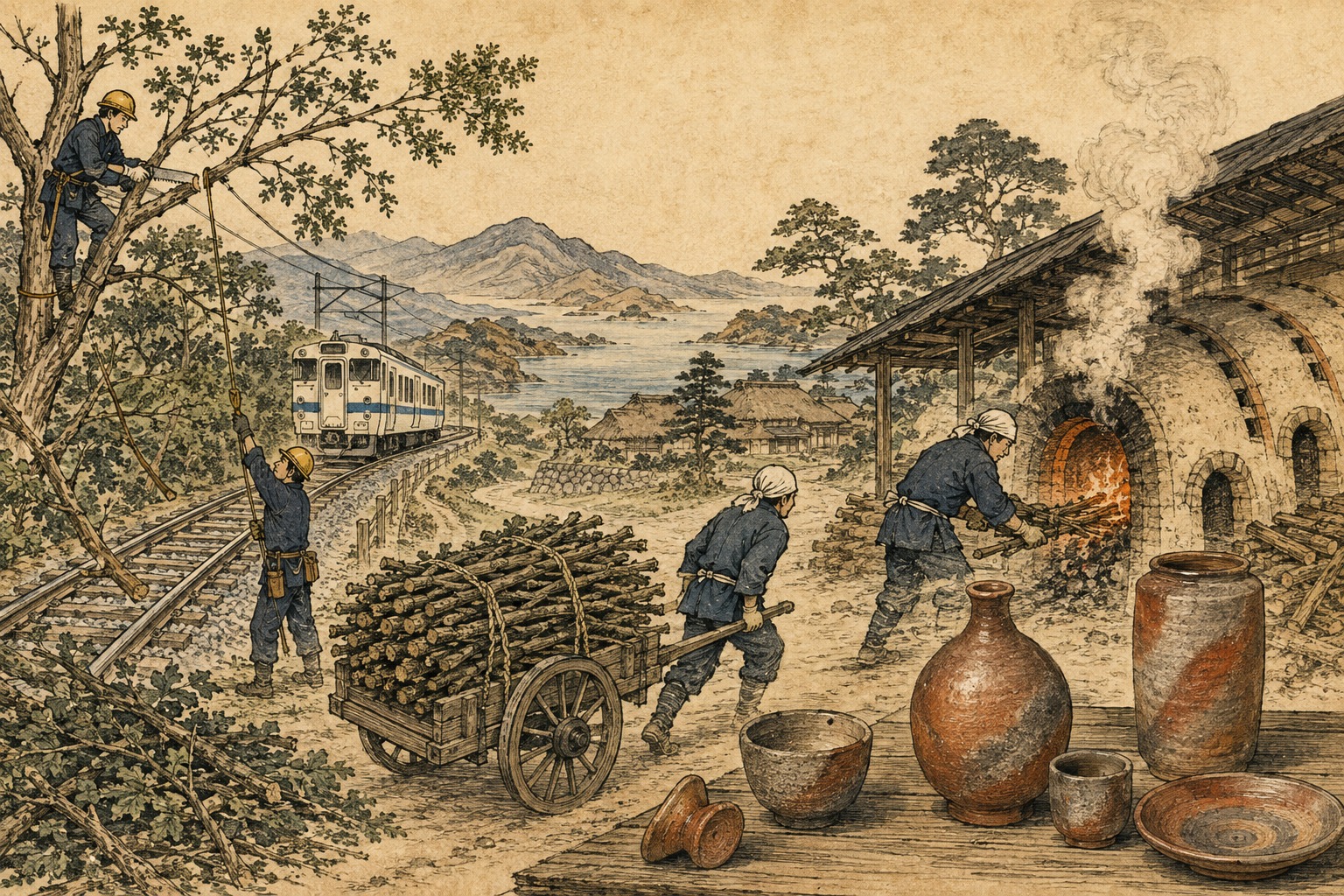
A train leaving Tamagashi Station on the Tsuyama Line follows a great bend of the Asahi River into the hills. JR West itself describes the stretch toward Makiyama as a place to savor the view, where bright fields replace the noise of Okayama city. For a railway, however, a tree leaning toward the track is more than scenery. Wind, snow, age or disease can bring it down onto a train or the line. Diagnosing and cutting dangerous vegetation is unglamorous, permanent safety work.
In fiscal 2026, three metric tons cut from that section were sent toward an unusual destination. Instead of becoming anonymous heat in the usual biomass-fuel stream, the wood traveled to the kiln site of Bizen potter Hiroyuki Matsui. It burned there, became ash and rode the flame onto clay. At high temperature, minerals in the ash reacted with the body of each pot, forming yellow, brown and sometimes greenish specks or flows. A “landscape” removed to protect the railway appeared again as a different landscape on a vessel.
The student art-project team STartLE at Okayama University, JR West’s Okayama Branch and Matsui named the new brand BIZENYAKI NEO KESHIKI. In Japanese ceramics, keshiki means not only scenery but the pattern or surface effects born in a kiln. The students connected three: the view along the tracks, the landscape emerging on Bizen ware and the scene of Bizen in everyday life. One word joined a material journey to an emotional one.
The Students Were Not Merely the Logo Department
The project grew from a comprehensive agreement signed by Okayama University and JR West’s Okayama Branch in March 2025. The partners promised to use their people and physical resources for regional development, education, local problems and sustainability. Such agreements can remain ceremonial and abstract. NEO KESHIKI descends all the way from those words to timber, kiln, packaging and price tag.
STartLE, led within Okayama University’s Faculty of Education by Professor Tetsuo Kiyota, explores new relationships between the body and the world through art. Its students did more than name the product. The university says they formed the concept, negotiated with the potter, developed the brand name and logo, planned the package, moved materials, assisted firing and worked on sales. They did not decorate a craft from the outside; they designed relationships across the process by which fuel reaches a kiln and a buyer reaches a vessel.
The package is a revealing detail. Bizen works are often sold in paulownia boxes, yet the closed box hides the surface—the very thing that distinguishes one piece. Professor Kazufumi Yamamoto contributed woodworking expertise to a package that could withstand transport while revealing the fired landscape. The university supplies it.
The division of labor is unusually legible. JR supplies and transports fuel; Matsui controls clay and fire; students and teachers design the relationship and its presentation. No participant alone could make the product. The industrial-academic innovation is not a new patented material. It is a new flow among resources the partners already possessed.
| Participant | Published role | Value created |
|---|---|---|
| JR West Okayama | Supply and transport of three metric tons from trackside management | A railway-safety byproduct becomes local cultural fuel |
| Hiroyuki Matsui | Wood firing with material unlike Bizen’s customary red pine; making the vessels | Unfamiliar ash and flame become a ceramic landscape |
| STartLE students | Concept, name, logo, negotiation, moving fuel, firing assistance and sales planning | Redesigning the distance between tradition and daily use |
| Okayama faculty | Project guidance and transport packaging that exposes the surface | University knowledge enters both price and buying experience |
How Can a Pot Be “Unglazed” Yet Grow a Glaze?
Accounts of Bizen ware often place two apparently contradictory statements beside each other: no glaze is applied, yet a natural ash glaze appears. The difference is agency and timing. The potter does not coat the vessel beforehand with a deliberately mixed liquid glaze. Ash created by fire lands during the firing and may fuse where it falls.
A tree contains inorganic minerals drawn from soil, including calcium, potassium, magnesium, silicon and iron. Combustion sends most of the organic matter away as gases and leaves those minerals in ash. When ash settles on a vessel in the high heat of a kiln, some components act as fluxes, lowering the temperature at which silica and alumina in the clay can fuse. The result is a thin glassy skin. A granular yellow-brown effect is called goma, for sesame seeds; a thicker molten run can become tamadare.
Ash is not a standardized industrial ingredient. Its chemistry changes with species, soil, the mixture of bark and branches, drying and combustion. Kiln position, flame path, atmosphere and the amount of ash alter the result again. The project has not disclosed the species mix, but its release says Matsui sought a natural-glaze effect unlike what red pine normally provides. Variability is therefore both the quality-control problem and the aesthetic point.
A Thousand-Year Tradition Was Never Preserved by Freezing Its Recipe
Bizen is one of Japan’s Six Ancient Kilns, beside Seto, Tokoname, Shigaraki, Tamba and Echizen. Descended from Sue stoneware, it has been made for roughly a millennium around Imbe in present-day Bizen City. Iron-bearing clay dug beneath rice paddies, red-pine fuel, a mild climate, the Sanyō road and Seto Inland Sea shipping routes gave the place the conditions for a durable craft.
In the medieval period, kilns produced tough jars, mortars and storage vessels. From the Muromachi into the Momoyama era, the plain earthen surfaces entered the aesthetics of tea. Tea masters and political elites valued the accidental marks of fire; flower vases, water jars and tea vessels brought Bizen into art. Under the Ikeda lords of Okayama in the Edo era, potters received protection while practical bottles, water jars and seed containers circulated broadly.
Modernization and changes in domestic life brought decline. In the early twentieth century, Kaneshige Tōyō studied the clay, kiln structures and forms of Momoyama Bizen. He did not merely copy them; he selected and reconstructed tradition through a modern artistic standard. In 1956 he became Bizen’s first holder of Important Intangible Cultural Property status, popularly called a Living National Treasure, laying the foundation for its revival. The government designated Bizen a Traditional Craft in 1982.
Seen against that history, unfamiliar trackside firewood is not automatically a betrayal. Bizen has never been a single recipe kept under glass. It has repeatedly renegotiated its relationship with clay, fuel, transport, political protection, tea and household demand. NEO KESHIKI preserves the central premise—that flame and ash help author the vessel—while connecting the ash’s origin to a modern regional task.
Heian period Bizen’s prototype develops around Imbe from the Sue-ware lineage.
Kamakura–Muromachi Kilns expand the production of jars, mortars and other practical ware.
Momoyama period Unglazed clay and kiln effects enter tea culture and produce celebrated tea ceramics.
Edo period Okayama-domain protection and transport routes spread practical Bizen vessels.
From the 1930s Kaneshige Tōyō researches and recreates Momoyama Bizen for a modern era.
1956 Tōyō becomes the first Living National Treasure in Bizen ware.
1982 Bizen receives national Traditional Craft designation.
March 2025 Okayama University and JR West Okayama sign their comprehensive agreement.
August 2026 BIZENYAKI NEO KESHIKI begins its first 100-piece sale.
Hiroyuki Matsui: From International Finance to One Annual Fire
The potter accepting this uncertain fuel was not born into a Bizen household. Hiroyuki Matsui studied international relations at Sophia University’s graduate school, joined Nomura Securities in international finance and spent time seconded to Japan’s Foreign Ministry. In 2000, at 39, he left the company to train at the Bizen Pottery Center. The next year he apprenticed under Mori Tōgaku and joined the decades-long project to recreate the monumental firing of old Momoyama Bizen.
Matsui built a 20-meter kiln of his own, first fired in 2008 and generally fired once a year. His stated ideal is yō no bi, the beauty of use: pottery not merely to contemplate but to live with. He has worked to keep vessels thin and light without sacrificing strength, exhibiting in Japan and overseas, including New York and San Diego. His movement from a world of financial prices into one where the result is unknown until a kiln opens neatly anticipates the present experiment.
Traditional Bizen fuel is well-dried red pine, whose resin supports a hot fire. A mixed or different species changes combustion speed, temperature rise, ash volume and flame behavior. Matsui’s work was not simply to throw maintenance wood into a firebox. It was to interpret unfamiliar fuel while achieving a durable, usable vessel. Circular design does not eliminate mastery. Uneven inputs can make mastery more important.
Is a ¥10,000 Tea Cup an Everyday Object?
The first range comprises 50 yunomi and 50 beer cups. Sales were scheduled through the Okayama University co-op, JR West’s DISCOVER WEST Mall and events including December’s Kurashi o Irodoru Utsuwa Fair in Okayama. The yunomi is ¥10,000 and the beer cup ¥12,000—roughly $63 and $75 at this edition’s reference rate of ¥159.22 per dollar.
The university compares those prices with ¥18,000–¥20,000 for comparable Matsui pieces at a Tokyo solo exhibition. It says JR’s fuel contribution and university-provided branding and package make a reduction of about 40% possible. That is a meaningful claim, but a narrower one than “production costs fell 40%.” The ¥10,000 yunomi is 44% below the low end of the comparison; the ¥12,000 beer cup is 40% below the high end. The rate moves with the product and reference price.
Fuel, design work, faculty packaging expertise and student participation are in-kind support. A future company paying commercial rates for designers, logistics and fuel might not maintain the same price. The model may work precisely because the batch is only 100 pieces.
Still, the pricing intention matters. Bizen once lived in the household as jars and mortars but gained distance as artist work, art object and paulownia-box gift. Ten thousand yen is far above a mass-market mug, yet below Matsui’s comparable exhibition work. The students did not try to make the craft cheap. They tried to change the posture of purchase: away from storing an unopened prestige object and toward pouring beer into it every evening.
| Published price | Yen | Approx. at this edition’s FX | How to interpret it |
|---|---|---|---|
| Comparable Tokyo exhibition work | ¥18,000–¥20,000 | About $113–$126 | A reference range, not an old price for the identical item |
| NEO KESHIKI yunomi | ¥10,000 | About $63 | Fifty planned |
| NEO KESHIKI beer cup | ¥12,000 | About $75 | Fifty planned |
This Is Not Simply “Waste Turned Into Luxury”
Circular-business stories often simplify themselves into a rescue narrative: discarded wood becomes art. Okayama University says something more specific. The cut timber had previously flowed mainly into biomass-fuel use. It was not necessarily destined only for disposal. NEO KESHIKI adds cultural value—local provenance, skilled transformation and a story an owner can carry—to an existing energy use.
Burning wood also returns biogenic carbon to the atmosphere. The announcement provides no life-cycle comparison covering drying, transport, combustion, smoke and the amount of purchased kiln wood actually displaced. A decarbonization claim would therefore be premature. Because the kiln already requires fuel, locally available secondary timber could offer an advantage if it replaces distant wood or fossil energy, but that benefit must be measured.
From a material perspective, almost none of the three tons remains on the vessels. The wood makes heat, carbon dioxide and water vapor; only part of its mineral ash adheres. The economic loop is different. Railway-maintenance expenditure, craft skill, student education, university design and JR’s retail network meet around a product, combining values that would usually appear in separate accounts.
- Material: Trace species, part of tree, moisture and treatment history by batch.
- Substitution: Record purchased red pine displaced and timber diverted from its previous biomass route.
- Environment: Compare transport, drying, combustion and emissions across fuel options.
- Quality: Publish temperature profile, breakage yield, food-contact testing and ash consistency.
- Economics: Price JR, university and student in-kind support to test commercial repeatability.
- Region: Show how sales return to the potter, apprentices and trackside communities.
Giving Safety-Cutting a Second Explanation
Trackside cutting carries an unusual social tension. Passengers want a green view; railway operators must control trees that can fall. JR West says that since fiscal 2018 it has fully deployed a system that identifies priority areas from environmental conditions and past incidents, consults certified arborists and chooses measures such as cutting or operating restrictions. A 2021 revision of the Railway Business Act also created a regulated route for operators to remove hazardous vegetation beyond railway property in certain circumstances.
The project release does not say whether its three tons were dangerous trees, diseased trees or routine clearance. Nor does it argue that every trackside tree should be burned. Its contribution begins after a cutting has been judged necessary: it prevents the wood’s location and history from disappearing.
The students assigned the first of their three landscapes—trees growing beside the railway—a wish for safe daily life. Greenery before cutting is not the only beautiful state; responsible maintenance is part of the landscape, too. An ash mark on a cup can begin a conversation about why the tree was removed. Circular design is not only a method for emptying waste bins. It can make invisible maintenance legible to the public.
The Questions That Remain After One Hundred Pieces
A hundred objects will not rescue a traditional-craft industry. Three tons are tiny within JR West’s vast vegetation-management system. Bizen’s celebration of kiln variability is also poorly suited to uniform mass production. Calling this a solution to railway wood waste would overstate its scale.
As an experiment, however, 100 is meaningful. Will buyers pay for provenance? Does the lower entry price reach new users? Do customers find the unfamiliar ash beautiful? Can a potter manage variable combustion? Does the package reveal the surface without increasing breakage? Most importantly, will buyers actually use the cups? Those answers can emerge from the first batch even though they cannot emerge from a press release.
A second phase could document cutting location and species for every lot; publish firing data, yield and a comparison with ordinary fuel; and survey buyers. If different rail lines generate different surfaces, a map of railway ash could emerge. But the project must direct revenue back to skilled labor, line maintenance and successor training rather than selling provenance alone. If only the story circulates while the burden remains with workers, the business is not sustainable.
A Vessel Is a Regional Map That Passed Through Fire
Calling the surface of Bizen ware a landscape is more than metaphor. Red clay comes from beneath rice fields. Hidasuki scarlet markings record a reaction between straw alkali and iron. Goma records ash; sangiri records charcoal and oxygen; color and vitrification record position in the kiln. Where painted ceramics apply an image, Bizen lets the process itself write on the surface. Geology, plant, air, fire and human judgment remain as traces.
NEO KESHIKI adds the railway to that map. A tree once seen from a line opened in 1900 was cut in 2026, carried to a kiln and left a mineral remnant on a cup. If someone picks up that cup each morning, trackside, workshop and table enter the same story.
Tradition is not the enclosure of an old form in a display case. Bizen was already a regional circuit of clay, pine, heat, transport and daily demand. This time, a university and railway maintenance entered the circuit. Whether the three landscapes can last depends less on selling out 100 pieces than on explaining wood origin, environmental burden, artisan compensation and student learning at the next firing.
Until the kiln cools and opens, no one completely knows what landscape will appear. The ability to preserve that uncertainty and still turn it into value may be the oldest—and newest—technology that Bizen ware can offer a circular economy.
Reporting note and principal sources
This article uses public information available through August 12, 2026 at 9:18 AM JST. Product details, prices, quantities, participant roles and timber volume come from Okayama University. We found no published independent inspection of the first products, cost audit, life-cycle assessment, or firing and food-contact test. “Cultural upcycling,” economic-circulation analysis and the proposed next-stage metrics are Japan.co.jp’s interpretation.
- Okayama University: Trackside timber becomes a landscape in Bizen ware (July 31, 2026)
- Okayama University: Detailed BIZENYAKI NEO KESHIKI release and design materials
- Okayama University and JR West Okayama: Comprehensive partnership agreement (March 2025)
- Association for the Promotion of Traditional Craft Industries: Bizen history, materials, firing and kiln effects
- METI: Japan’s Traditional Craft designation and requirements
- Okayama Prefecture: Kaneshige Tōyō and the modern Bizen revival
- JR West: Landscape and history of the Tsuyama Line between Tamagashi and Makiyama
- JR West: Arborist-assisted management of trackside tree risk
- MLIT: Railway safety rules for removing hazardous off-property vegetation
- Japanese Friendship Garden: Hiroyuki Matsui’s training, kiln and beauty-of-use practice
- Ceramics Monthly: Variability and function of wood ash in glazes
- Environment Ministry: Fifth Fundamental Plan for a Sound Material-Cycle Society and regional value creation