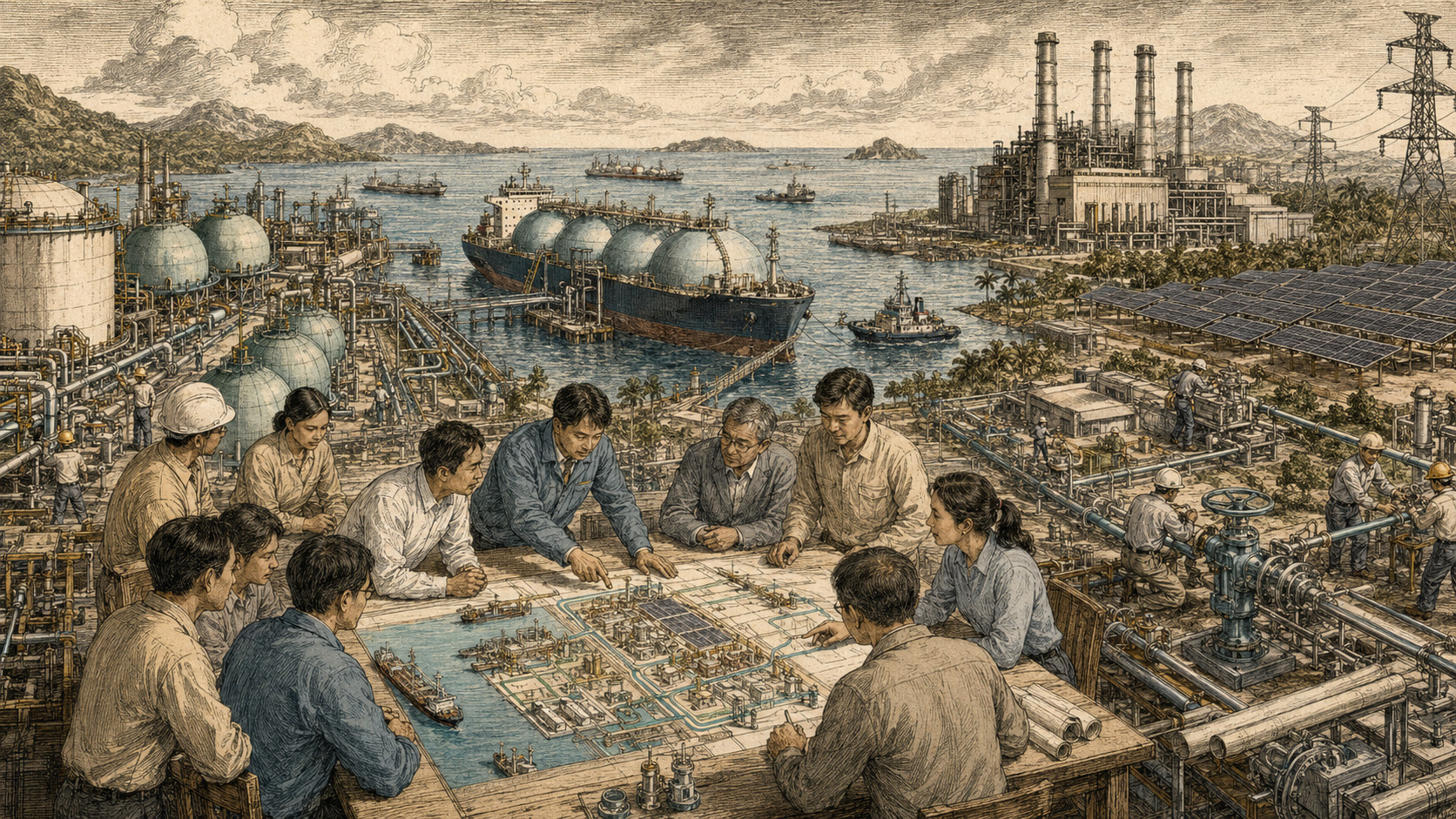
At a ceremony in Tokyo, four officials stood behind a document that contained an entire industrial landscape in outline. On one side was JERA, Japan’s largest generator and one of the world’s largest LNG buyers. On the other was EGAT, the state enterprise that operates Thailand’s transmission system, owns power stations and buys most of the electricity produced by others.
Their memorandum is short. It asks whether Thailand can support a hydrogen and ammonia value chain from production and supply through transport, storage and use. It includes power generation and fuel substitution. It includes the rules and environmental questions that determine whether a molecule can be called low-carbon. It promises evaluation, not construction.
That restraint should not be mistaken for insignificance. Hydrogen projects often fail in the empty space between a producer seeking a buyer and a buyer waiting for cheap supply. JERA brings the experience of building a production-to-ship-to-power-station chain for Japan. EGAT brings something equally valuable: the ability to see the Thai power system as one system, rather than as a collection of disconnected pilot plants.
The partnership also represents a larger diplomatic bet. Japan hopes the knowledge, equipment, financing and fuel networks it is assembling at home can become an exportable model for Asian economies. Thailand hopes to protect energy security and industrial growth while moving its net-zero goal forward to 2050. The MOU is where those ambitions meet. Whether they become infrastructure depends on details that have not yet been chosen.
The MOU is a map, not yet a road
JERA’s announcement identifies three workstreams. First, the companies will identify market opportunities and evaluate technical, economic and commercial feasibility. Second, they will study hydrogen and ammonia in power generation, including fuel substitution. Third, they will assess policy, regulation and environmental considerations.
EGAT’s account describes the chain more physically: production, supply, transportation, storage and utilization, with particular attention to ammonia as a hydrogen carrier and power-generation fuel. Read together, the statements cover nearly everything required to draw a concept diagram. They do not select one line on that diagram.
Thailand could import ammonia and burn it directly. It could crack imported ammonia back into hydrogen for turbines or factories. It could produce renewable hydrogen domestically and use it directly or synthesize ammonia. It could manufacture natural-gas-based hydrogen while capturing and storing most process CO₂. A port could serve one power station, several industrial estates, ships, trucks or all of them. Each pathway requires different equipment, economics and carbon accounting.
A memorandum permits those options to coexist while engineers and officials eliminate the ones that do not work. That is useful. It is also why an MOU should not be reported as a plant. No land has been named, no engineering contractor appointed, no cargo booked and no money committed in the public documents.
| Development stage | What it normally answers | JERA–EGAT status |
|---|---|---|
| Cooperation MOU | Who will study which opportunities. | Reached. Broad market, technical, power-use and policy scope. |
| Feasibility / pre-FEED | Candidate site, technology, supply route, rough cost and demand. | Work contemplated; no result disclosed. |
| FEED and permits | Engineering design, safety case, environmental review and bankable cost. | Not announced. |
| Offtake and financing | Who buys how much, for how long, at what indexed price and with what support. | Not announced. |
| Final investment decision | Capital is committed and construction can proceed. | Not announced. |
Why EGAT is the partner that changes the scale of the question
EGAT was established on May 1, 1969, by combining three earlier generating authorities. Its original capacity was 908 MW. By the end of 2025 it listed 16,235 MW of installed generation and more than 40,000 circuit-kilometers of transmission lines. The June 2026 system table placed Thailand’s total contracted capacity at 48,852 MW.
EGAT did not own all of that capacity. Its stations represented 31.02% of the contracted system; independent power producers, small power producers and imports supplied the other 68.98%. In June, purchases accounted for 74.69% of the electricity EGAT generated or procured. This is why the label “single buyer” matters. EGAT is both producer and market organizer: it can connect state plants, private generators, cross-border imports, grid constraints and national planning.
A new fuel needs precisely that coordination. A producer will not build an ammonia plant without dependable demand. A shipowner will not order or dedicate vessels without cargo. A terminal will not be financed for occasional deliveries. A generator cannot promise demand until fuel, regulation and cost recovery are credible. EGAT can help aggregate the far side of those contracts; JERA can help assemble the supply side.
The relationship is not new. JERA’s Nakhon Ratchasima wind project—originally entered by Chubu Electric in 2011 and inherited by JERA in 2016—sells electricity to EGAT under a power-purchase agreement. Its public project page lists 173 MW of contracted capacity. JERA also inherited a stake associated with EGCO, a major Thai generator whose founding shareholder is EGAT. The new MOU moves the conversation from investments around the system to the authority at its center.
Thailand’s power system explains both the opportunity and the difficulty
Natural gas remains the dominant fuel. EGAT’s system-wide fuel table for June 2026 reported gas at 64.48% of generation, lignite at 14.76% and renewable energy, including hydropower, at 20.05%. Another EGAT account says imported LNG now supplies up to one-quarter of Thailand’s electricity generation. Fuel can represent 50% to 60% of the electricity cost.
This creates two opposing arguments for hydrogen. Gas turbines provide the flexible output needed beside solar and wind, but domestic gas supply and imported LNG expose consumers to resource decline, cargo prices and geopolitics. Hydrogen could eventually reduce the carbon content of that thermal fleet and diversify supply. Yet imported hydrogen or ammonia can introduce another expensive commodity chain rather than eliminate fuel dependence.
Thailand is also not waiting on one molecule. EGAT is expanding floating solar, pumped storage, batteries, renewable forecasting, transmission and electric-vehicle infrastructure. It has discussed small modular reactors and CCUS. Energy efficiency and direct renewable electricity avoid the conversion losses involved in making hydrogen, turning it into ammonia, shipping it and sometimes cracking it back again.
The rational question is therefore not “hydrogen or renewables.” It is where hydrogen earns its place after cheaper direct solutions are used. Firm power during long renewable shortfalls, high-temperature industry, chemical feedstock, shipping fuel and storage may justify the premium. Routine electricity that can be supplied directly by solar, wind, grids and storage may not.
Japan and Thailand have built industrial systems together before
Formal diplomatic relations date to September 1887. The modern economic relationship was forged in concrete, steel and electricity. During Thailand’s industrial acceleration, Japanese capital, companies and official development assistance helped create ports, roads, factories, transmission lines and power plants around which supply chains grew.
The Eastern Seaboard program of the 1980s built deep-sea ports and industrial estates southeast of Bangkok, opening a manufacturing corridor that attracted Japanese automakers and suppliers. Japanese loans supported provincial transmission expansion as industry spread. A 1994 loan of ¥18.242 billion supported the Lam Takhong pumped-storage project in Nakhon Ratchasima, increasing the system’s ability to meet Bangkok-area peak demand. A 1997 project financed substation and distribution improvements as metropolitan electricity demand had been growing at an annual average of 10.3% from 1990 through 1996.
That older development model delivered assets with visible outputs: a port, a megawatt, a kilometer of line. The hydrogen era is harder to see. Its infrastructure connects a renewable generator or gas field, electrolyzer or reformer, nitrogen unit, synthesis plant, carbon store, terminal, carrier, storage tank, cracker and end user. It also connects standards and certificates—the documentary chain that says how much carbon followed the molecule.
The institutional depth remains. The two countries’ economic partnership agreement entered force in 2007. Japanese foreign direct-investment applications in Thailand reached about 120 billion baht in 2025, according to Thai data summarized by JETRO, fourth by stated origin. More than 70,000 Japanese nationals lived in Thailand in 2024, while visits exceeded one million in each direction. Energy diplomacy rests on a much wider commercial society.
1887 Japan and Siam establish formal diplomatic relations.
1969 EGAT is formed with 908 MW of generation.
1980s–1990s Thailand’s Eastern Seaboard, ports, industrial estates and power networks expand with major Japanese participation.
1994 Japan finances the Lam Takhong pumped-storage project.
2007 The Japan–Thailand Economic Partnership Agreement enters force.
2011 Chubu Electric enters Thailand’s first full-scale commercial wind project.
2016 JERA inherits Chubu and TEPCO overseas energy interests, including Thai assets.
January 2022 The two energy ministries sign a memorandum establishing an energy partnership framework.
2022–2023 JERA signs transition, ammonia and supply-chain studies with EGCO, BLCP partners and PTT.
2024 A JERA–Toyo Engineering ammonia-cracking and Thai demand study receives NEDO support.
2025 The seventh bilateral policy dialogue highlights JERA–PTT hydrogen and ammonia supply-network work.
June 2026 JERA and EGAT put the national power-system operator directly into the value-chain study.
The new agreement joins a web of earlier Japanese–Thai studies
JERA’s Thailand work has developed through overlapping relationships. In April 2022, it agreed with EGCO to discuss LNG projects and large hydrogen and ammonia supply chains. In January 2023, JERA Asia and EGCO expanded the work to decarbonization roadmaps, CCUS and a study of up to 20% ammonia co-firing at the 1,434-MW BLCP coal station with Mitsubishi Heavy Industries, Mitsubishi Corporation, Banpu Power and BLCP.
In May 2023, JERA and state energy company PTT agreed to study a Thai supply chain, ammonia cracking and upstream production or investment opportunities. In 2024, NEDO selected a one-year project by JERA, JERA Asia and Toyo Engineering to investigate Thai hydrogen demand, stable ammonia-cracker operation and hydrogen-storage design. The seventh Japan–Thailand Energy Policy Dialogue in July 2025 welcomed another JERA–PTT supply-network MOU and visited PTT’s LNG terminal in Rayong.
EGAT has built its own network of Japanese studies. At the 2024 policy dialogue it signed with Mitsubishi Heavy Industries to examine large gas-turbine hydrogen co-firing and with IHI to study biomass-pellet manufacturing and combustion. At the June 2026 meeting, EGAT also signed with Tokyo Gas Asia to study low-carbon fuels and efficient gas use during the transition.
This density is both strength and warning. It creates shared data, trained teams and multiple routes to a project. It also risks producing an archipelago of memorandums—each reasonable, none large enough to create a market. The JERA–EGAT agreement matters most if it consolidates prior knowledge into a decision rather than starting one more study from zero.
The molecule can be a fuel, a carrier—or an expensive detour
Ammonia contains hydrogen and nitrogen. It can be liquefied at about minus 33 degrees Celsius at atmospheric pressure, far warmer than liquid hydrogen at about minus 253 degrees. The global fertilizer trade already moves ammonia through ports and tanks. These properties make it attractive for long-distance transport.
At the destination, Thailand would face a choice. Burn ammonia directly and avoid the energy cost of recovering hydrogen, while controlling nitrogen oxides, nitrous oxide and ammonia slip. Or crack ammonia—NH₃—into hydrogen and nitrogen, purify the hydrogen and supply equipment that needs an H₂ molecule. Cracking expands potential uses, but consumes energy and adds reactors, catalysts and storage.
The International Energy Agency’s 2026 assessment gives the scale of that penalty: where pure hydrogen is required after shipping, liquefaction or reconversion such as ammonia cracking can impose minimum costs around $2 per kilogram of hydrogen and consume more than 10 kWh per kilogram—over 30% of hydrogen’s energy content. That is a global estimate, not a JERA–EGAT cost forecast, but it explains why the end use must be selected before the carrier.
| Possible Thai pathway | Potential advantage | Question the MOU must answer |
|---|---|---|
| Import ammonia and burn it in power generation. | Uses a shippable molecule and avoids cracking. | Which plant, what ratio, what emissions controls and what power premium? |
| Import ammonia and crack it into hydrogen. | Supplies turbines or industrial processes that need H₂. | Can demand justify the reconversion cost and energy loss? |
| Produce green hydrogen in Thailand. | Uses domestic renewable resources and reduces fuel imports. | Is surplus clean power available at a competitive, high-utilization price? |
| Produce gas-based hydrogen with CCS. | Could use gas infrastructure and geological storage. | What capture rate, upstream methane level, storage law and verified lifecycle intensity? |
| Build a multipurpose port hub. | Aggregates power, industry, fertilizer and shipping demand. | Which anchor customer pays for shared tanks, pipelines and safety systems? |
The policy dialogue is industrial diplomacy in working clothes
The MOU was presented at the eighth Japan–Thailand Energy Policy Dialogue, not at a trade show. Japan’s Ministry of Economy, Trade and Industry and Thailand’s Ministry of Energy created the current partnership framework in January 2022. Subsequent meetings have paired policy discussion with corporate agreements and site visits: the Mae Moh coal complex in 2023, a Japanese green-hydrogen demonstration site in 2024, PTT’s Rayong LNG terminal in 2025 and Japanese CCUS facilities in 2026.
This is the operating style of the Asia Zero Emission Community, proposed by Japan in 2022 and launched with ten other countries in 2023. AZEC argues for multiple transition pathways suited to national conditions while pursuing decarbonization, growth and energy security together. By October 2025, METI said the broader AZEC pipeline contained roughly 540 projects and cooperation items.
For Japan, the strategy creates overseas demand for engineering, trading, shipping, turbines, boilers, catalysts and finance. It also offers a regional role at a time when Chinese capital dominates much new investment in parts of Southeast Asia. For Thailand, Japanese partners offer long experience with infrastructure, manufacturing supply chains and fuel procurement without requiring the country to copy Japan’s energy mix exactly.
The criticism is that “multiple pathways” can become permission to keep fossil assets operating through modest blends and distant promises. That is why the quality of carbon rules matters. A 20% ammonia blend leaves 80% of heat from the original fuel. Ammonia that emits no CO₂ in the burner may carry substantial emissions from gas extraction, hydrogen production, electricity, shipping and incomplete carbon capture. Diplomacy can launch the market; transparent lifecycle accounting must discipline it.
Thailand moved its climate deadline forward; the implementation clock moved faster
Thailand’s policy context changed materially after JERA’s earliest Thai hydrogen agreements. The 2022 long-term strategy aimed for carbon neutrality in 2050 and net-zero greenhouse gases in 2065. In November 2025 the Cabinet approved NDC 3.0, moving net zero forward by 15 years to 2050 and targeting net emissions of 152 million tonnes of CO₂-equivalent in 2035—a 47% reduction from 2019.
The stronger target increases the value of options that can decarbonize firm power and industry. It also raises the standard those options must meet. A demonstration beginning in the mid-2030s cannot count as success if it locks in high emissions beyond 2050. Thailand’s next Power Development Plan is being revised around the new deadline. A preceding draft contemplated hydrogen blending in gas power beginning at 5% and rising toward 20% in 2035–2037, but draft targets are not bankable demand.
Globally, the distance between hydrogen announcements and investment remains wide. The IEA found Southeast Asian hydrogen demand reached 4 million tonnes in 2024, almost entirely in established chemical and refining uses and largely supplied from unabated natural gas. Announced low-emissions production in the region could reach 480,000 tonnes a year by 2030, but only 6% had reached final investment decision in the 2025 assessment.
That history turns the MOU’s commercial-feasibility language into its most important clause. Technology is not the only gate. A project needs a creditworthy buyer, a tariff or power-purchase mechanism that recovers the premium, carbon rules trusted by exporters and customers, and finance that can survive currency and commodity risk.
The business case must begin with a customer, not a carrier
A value chain is sometimes drawn from left to right: production, ship, storage, use. Commercially, it should be designed backward from the user. A power station specifies hourly fuel demand, pressure, purity and dispatch pattern. A steel or chemical plant specifies continuity and product carbon requirements. A ship specifies bunkering location and safety. Only then can developers choose domestic production or imports, ammonia or hydrogen, tank size, vessel frequency and financing.
EGAT’s bulk-buying role can make a power station an anchor, but electricity customers will ultimately bear some combination of fuel premium, infrastructure cost and policy support. Thailand will need to compare that cost with renewables, transmission, storage, efficiency, gas with CCS and other firm-power options. Japan’s Hekinan project is moving because a giant power unit creates dependable ammonia demand and Japanese policy provides long-term price-gap support. No equivalent support package was announced with the Thai MOU.
Carbon intensity must become a traded attribute, not a marketing adjective. The project will need a numerical threshold, lifecycle boundaries, treatment of upstream methane and shipping, measurement of CO₂ storage where applicable and rules preventing the same reduction from being claimed twice. Japan and Thailand already participate in regional carbon-market and supply-chain accounting discussions. The commercial agreement must turn those principles into contract terms.
- A long-term low-carbon fuel supply agreement with volume, quality and carbon-intensity warranties.
- Shipping, terminal and storage contracts sized to the same operating rhythm.
- A power-purchase, tariff or industrial offtake arrangement that pays the clean-fuel premium.
- A rulebook for lifecycle emissions, certification, custody transfer and independent verification.
- Permits and safety responsibilities covering toxic ammonia from ship to end use.
- Financing that allocates construction, commodity, currency, policy and demand risk.
The next announcement should contain nouns and numbers
The June document succeeds if it produces specificity. The next meaningful milestone would name a candidate use and site; quantify annual tonnes and hourly demand; choose imported or domestic supply; publish a target lifecycle carbon intensity; identify the equipment and partners; estimate delivered cost; and explain how the premium will be paid.
- Use: direct ammonia firing, hydrogen co-firing, industrial hydrogen, marine fuel or a combined hub.
- Place: named plant, port and industrial cluster, with land and pipeline requirements.
- Scale: tonnes per year, energy delivered, blend ratio, operating hours and anchor demand.
- Carbon: verified well-to-use intensity and emissions avoided against a defined baseline.
- Cost: production, conversion, shipping, storage and end-use price, plus every subsidy.
- Decision: feasibility completion, FEED, permits, offtake and a dated final-investment gate.
There is a compelling possibility here. Thailand sits at the center of mainland Southeast Asian industry, trade routes and electricity interconnection. It has ports, gas infrastructure, chemical demand, a large power market and relationships with neighboring generators. JERA has fuel-trading reach, power-plant experience, an ammonia production investment in Louisiana and four chartered carriers intended for Japan. EGAT can translate a national energy problem into aggregate demand.
There is also a clear failure mode: another beautifully photographed MOU joins hundreds of regional cooperation documents while fuel remains too expensive and carbon rules remain unsettled. The best defense is honest sequencing. Study first, disclose the result, reject weak pathways, develop the strongest one and commit capital only when the emissions and economics survive examination.
Stradanus turned Renaissance workshops into theaters of invention, showing not only a finished object but the people, tools and flows that made it possible. The JERA–EGAT theater is still a drawing on the table. Its achievement will not be the number of officials around that table. It will be the moment one line on the drawing becomes a safe pipe, a contracted cargo and a measured tonne of carbon kept out of the atmosphere.
Reporting notes and principal sources
System figures are reproduced with EGAT’s stated June 2026 definitions. The 48,852-MW total is contracted system capacity; EGAT-owned plants represented 31.02%, while IPPs, SPPs and imports represented 68.98%. The 64.48% gas figure comes from EGAT’s separate system fuel table and should not be read as the ownership share. Historical references to JERA’s EGCO stake use the company’s dated project and 2022 MOU disclosures and are not presented as a new 2026 ownership update. No public document checked by the reporting cutoff identified a JERA–EGAT project site, volume, price, deadline, subsidy or final investment decision.
- JERA: June 2026 MOU scope and participating institutions
- JERA: Japanese-language MOU announcement
- EGAT: production-to-use value-chain scope and parallel Tokyo Gas Asia agreement
- METI: eighth Japan–Thailand Energy Policy Dialogue
- EGAT: 2025 generation, transmission, financial and organizational profile
- EGAT: June 2026 contracted system capacity and ownership categories
- EGAT: June 2026 net generation and purchased electricity
- EGAT: June 2026 system generation by fuel
- EGAT: LNG exposure, fuel-cost share and renewable forecasting
- JERA: Nakhon Ratchasima wind project and EGAT power-purchase agreement
- JERA: history of its EGCO investment
- JERA: 2022 transition and fuel-chain MOU with EGCO
- JERA: EGCO decarbonization and BLCP ammonia co-firing study
- JERA: 2023 supply-chain and ammonia-cracking MOU with PTT
- JERA: NEDO-backed Thai demand, cracking and storage study
- METI: sixth policy dialogue and EGAT’s MHI/IHI studies
- METI: seventh policy dialogue and JERA–PTT supply-network MOU
- Thai government: NDC 3.0, 47% reduction and 2050 net-zero goal
- IEA policy database: draft Thai hydrogen-blending targets
- IEA: Southeast Asian hydrogen demand and project maturity
- IEA: shipping, reconversion and ammonia-cracking cost and energy penalty
- Japan MOFA: bilateral relations, trade, residents, travel and 2007 EPA
- JICA: history of Thailand’s Eastern Seaboard development
- JICA: Lam Takhong pumped-storage project
- JICA: Bangkok metropolitan distribution expansion
- JETRO: 2025 foreign-investment applications in Thailand
- Agency for Natural Resources and Energy: AZEC’s ten-year action plan
- METI: 2025 AZEC project and MOU count