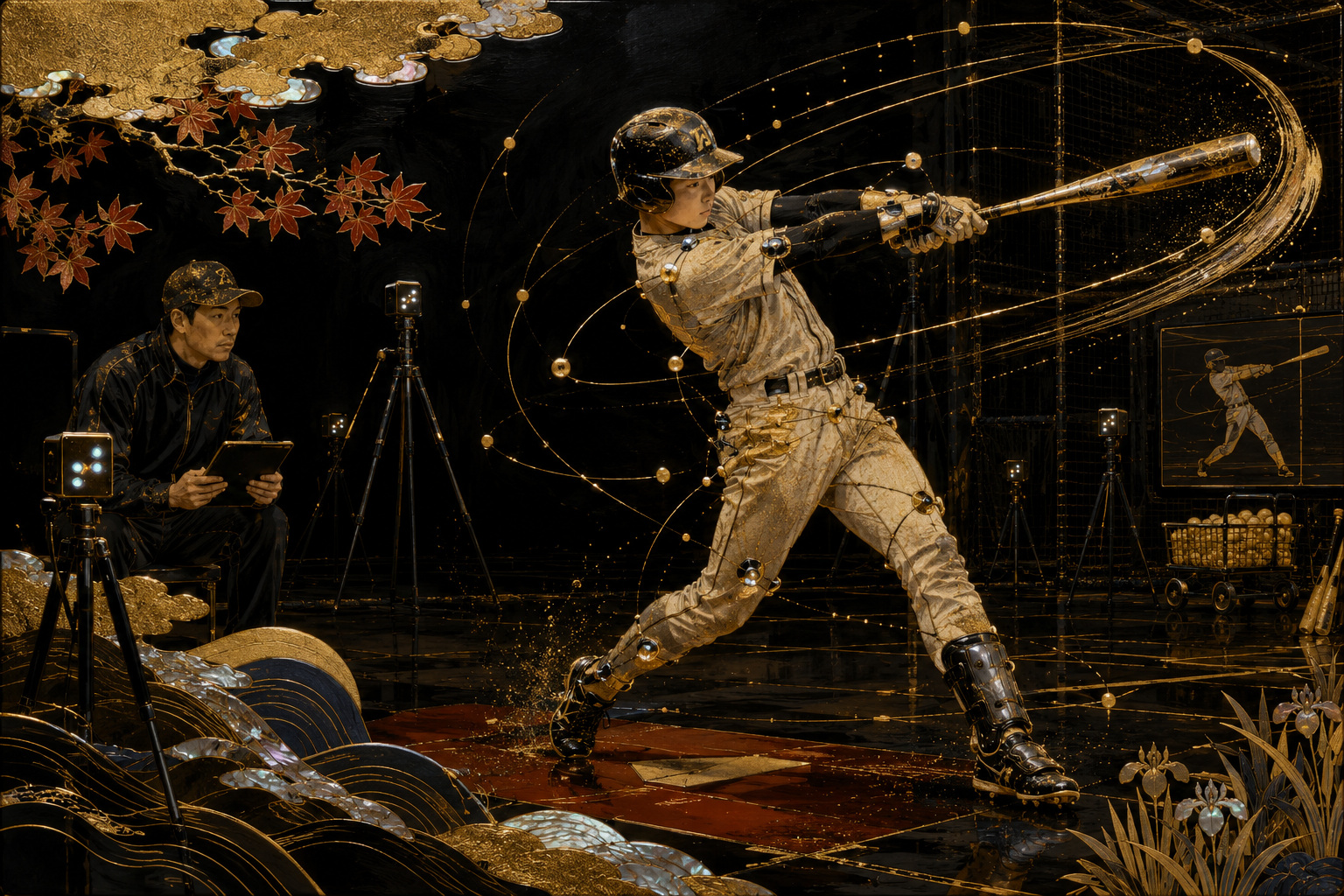
A pitcher lifts his leg. Force enters through the ground, the pelvis turns, the chest follows, and speed passes through the shoulder, elbow, wrist and fingers. A movement lasting little more than a second may be compressed by the naked eye into a familiar instruction: use your lower body. At a laboratory in Ichikawa, Chiba Prefecture, cameras and sensors divide that second. When did the pelvis rotate? In what order did the shoulder and elbow accelerate? How fast did the ball spin, and on what axis did it cut through the air? A pitch once described by feel becomes a set of curves and coordinates.
NEXT BASE Corp., a privately held venture headquartered in Shinagawa, Tokyo, is opening NEXTBASE Baseball Academy inside its measurement facility, NEXTBASE Athletes Lab. It will serve fifth- and sixth-grade elementary pupils and first- and second-year junior-high students. Four classes will run on Wednesdays, each capped at just six athletes.
The company says regular movement assessments and physical tests will make growth visible, adapt analysis developed around professionals to growing players, and use group lessons to teach athletes to think for themselves. Tuition ranges from ¥24,200 to ¥34,100 a month. The proposition is not another place to throw as many baseballs as possible. It is a classroom for learning how to read the body and its data.
Baseball began in Japan as a lesson
Japanese baseball did not begin with a professional club or a paying crowd. The Baseball Hall of Fame and Museum marks 1872, when American teacher Horace Wilson taught the game to students at the First Middle School of the First University District in Tokyo, as the point at which baseball was introduced to Japan.
A ball, a bat and open ground were enough to begin. Offense and defense exchanged places according to clear rules; an individual contest accumulated into a team score. The game suited the discipline, cooperation and physical education sought by modern schools. Students carried it to other institutions. In 1878, railway engineer Hiroshi Hiraoka organized the Shimbashi Athletic Club, helping move baseball from a lesson to a club, then into universities and communities.
When First Higher School defeated a foreign residents’ team in Yokohama in 1896, an imported pastime became a vessel for national confidence. The first National Middle School Championship began in 1915. In 1924, its tenth tournament moved to the new Koshien Stadium. The enormous story now called high-school baseball was built from regional representation, education, newspaper promotion and a single-elimination tournament that turns every defeat into an ending.
1872 Horace Wilson teaches baseball at a Tokyo school
1878 Hiroshi Hiraoka organizes the Shimbashi Athletic Club
1915 First National Middle School Championship
About 1918 A rubber baseball for children is developed in Kyoto
1924 The national tournament moves to the new Koshien Stadium
2001 Japan Institute of Sports Sciences opens
2014 NEXT BASE is established
2026 The youth academy is due to open in Ichikawa
The rubber ball of 1918 was sports science, too
The idea that children need something designed differently from adults is not new. In the early twentieth century, boys played with hard balls and tennis balls, but cost, durability and injury risk impeded wider participation. Sakae Suzuki and educators associated with a Kyoto youth-baseball study group helped devise an inexpensive, safer rubber ball for children around 1918. Rubber-ball baseball went on to become a vast, distinctly Japanese sporting culture.
That was engineering before sensors. Change the material and the collision force, rebound, grip, batted-ball speed and required playing space all change with it. The principle—do not simply hand a small athlete an adult product—is a distant ancestor of NEXT BASE’s promise to adapt professional analysis to developing bodies.
A softer ball did not automatically make the environment safe. Throwing volume, consecutive games, playing position, rest and whether a child could admit pain still mattered. Science is not one product or graph. It is the design of the entire sporting environment.
From a national institute to a neighborhood laboratory
After the war, sports science became institutionalized through fitness testing, physiology, film analysis and sports medicine. A major step came in 2001, when the Japan Institute of Sports Sciences, or JISS, opened in Tokyo’s Kita Ward. Laboratories, training, medicine, nutrition, imaging and even a wind tunnel were brought together to support Japan’s international athletes.
NEXT BASE director Tsutomu Jinji holds a doctorate in physical education and previously worked as a JISS researcher. His work covers pitching biomechanics and how spin-axis direction and spin rate affect aerodynamic forces. He supported Japan’s gold-medal women’s softball team at the Beijing Olympics and later worked in the Tohoku Rakuten Golden Eagles’ strategy and R&D group through 2016.
President Shinichi Nakao came from a different direction. He planned and sold new IT businesses at NTT and helped establish the IT venture Neuphoria in 2008. He also played for Rikkyo University alongside athletes who would become professionals. Founded in 2014, NEXT BASE made a business of connecting people who knew baseball to IT, and researchers who could apply IT to sport.
The company does not publish capital or employee numbers on its official profile, so it would be misleading to manufacture precision around its size. The important fact is that it is neither a listed conglomerate, a ball club nor a university. It is a private venture combining its own lab, assessment services, team systems and sports-media data. Analysis once housed inside national performance centers and professional organizations is now being sold directly to local families as monthly instruction.
What appears when one pitch is taken apart
Pitching is not an arm movement alone. It is a kinetic chain: force from the ground moves through the legs, pelvis and trunk before reaching the shoulder, elbow and hand. Three-dimensional motion capture records the position, speed, angle and timing of body landmarks. Force plates can show what each foot applies to the ground. High-speed cameras can isolate the instant around release.
Ball-tracking systems go beyond velocity to report spin rate, spin axis, release point and movement. Whether a four-seam fastball appears to resist gravity, or a breaking ball runs sideways, depends not only on finger sensation but on gravity, drag, Magnus force and asymmetrical airflow around the seams. Jinji’s research domain occupies precisely this physics after release.
For hitting, systems can measure bat speed, attack angle, exit velocity, launch angle, and the sequence of pelvis and trunk rotation. Numbers can turn “why did that one carry?” into a hypothesis that can be tested again. When video, measurement and sensation agree, athletes can begin to explain their movement instead of waiting for a coach to define it.
Four classes, at most 24 seats
The academy will operate on Wednesdays at NEXTBASE Athletes Lab. Multiplying the four published slots by the six-person cap produces a theoretical opening capacity of 24 students. That is an inference from the schedule, not a company announcement that 24 students are enrolled. A small class may provide more observation time, while also limiting the business’s reach.
| Class | Age and duration | Cap | Monthly tuition |
|---|---|---|---|
| Elementary rubber-ball pitching/hitting | Grades 5–6 · 70 minutes | 6 | ¥24,200 |
| Junior-high hardball pitchers I | Years 1–2 · 70 minutes | 6 | ¥28,600 |
| Junior-high hardball pitchers II | Years 1–2 · 70 minutes | 6 | ¥28,600 |
| Junior-high hardball hitting | Years 1–2 · 90 minutes | 6 | ¥34,100 |
The joining fee is ¥33,000, waived for students entering in fiscal 2026. An ¥11,000 annual renewal fee applies from the following year. A T-shirt and resistance bands are included, with a Kinetic Ball training ball for the pitching classes. Students also receive membership privileges including 20% off other lab programs.
There is a neat business logic here. The lab’s public information lists Wednesday as a normal closed day, so the academy appears to repurpose a day without general clients for recurring classes. That is an inference from public schedules, not an explanation supplied by the company. It also moves NEXT BASE from one-time assessments toward its first academy and a stream of monthly revenue.
A growing body is a moving baseline
From fifth grade through the second year of junior high, height, weight, strength, skeletal maturity and limb length can change rapidly. Six months later, the same athlete may be controlling a materially different body. If velocity rises, one must separate improved technique from added mass and strength, a different mound or a different ball.
Regular assessment can help. Instead of a single velocity leaderboard, data can be read alongside growth rate, mobility, asymmetry, fatigue and workload. A player whose timing changes during a height spurt need not be mistaken for someone who has suddenly become less skillful.
Numbers can also freeze children too early. Label an 11-year-old with low velocity untalented, or an early-maturing child a certain prospect, and measurement merely makes old selection biases more precise. Developmental data are best used to read a player’s own long-term trajectory, not to build a ranking at one moment in biological time.
Elbow pain does not yield to spirit
Injury is not an abstract concern in Japanese youth baseball. A 2013 prospective study followed players aged 7 to 12 in Tokushima Prefecture. Of 449 who began without elbow pain, 30.5% reported pain during the season. Being 12, pitching or catching, and playing more than 100 games in a year were risk factors. Another survey of more than 1,000 players found that 29.2% had experienced throwing-arm elbow pain in the preceding year.
A growing elbow contains physes and cartilage that have not fully matured. Repeated high-velocity throwing generates tensile force on the inner side, compression on the outer side and impingement at the back. Pain can be a signal that tissue is not tolerating load, not evidence of weak character.
The Japan High School Baseball Federation introduced a limit of 500 pitches per week in 2020 and now places it in the special rules for high-school baseball. But a high-school ceiling of 500 is not a safety prescription for an elementary or junior-high athlete. Frequently cited recommendations from the Japanese Society of Clinical Sports Medicine call for no more than 50 full-effort pitches a day and 200 a week for elementary players, and 70 a day and 350 a week in junior high.
Even those numbers have limits. Who adds bullpen work, long toss, defensive practice and appearances for another team? A weekly academy can improve movement during its session, but it cannot manage safety if it knows nothing about the other six days. Athletes, families, school or club coaches, clinicians and outside instructors need a shared account of workload and pain. A sensor only sees the throws made in front of it.
- Who records total throwing across games, bullpens, long toss, defense and multiple teams?
- Can a player report pain or fatigue without losing status or playing opportunity?
- How are growth spurts, biological maturity and previous injuries included?
- Will the program track rest, sleep, mobility and enjoyment as well as velocity?
- Can the athlete take data to a school coach or clinician?
- Who sets the thresholds for stopping, referral and return to play?
The opposite of “guts” is not ease
NEXT BASE contrasts its scientific reading of movement with blind repetition and konjōron, the doctrine that spirit and endurance overcome limits. The language lands as a criticism of a baseball culture in which long practices and an ace pitcher’s repeated complete games have often been narrated as moral achievement.
Yet replacing spirit with numbers is too crude a choice. Repetition is necessary for motor learning. Patience, responsibility to teammates and performance under pressure belong to sport. The problem begins when suffering itself becomes proof of progress, pain becomes a loyalty test, and purposeless volume is rewarded simply because it is large.
Sports science does not merely make effort easier. It asks which effort caused which change, reduces load that has little benefit, and protects a body capable of practicing again tomorrow. The best relationship between data and determination is not one in which measurement replaces the heart. It is one in which the heart is not wasted.
If numbers are shared, is authority shared?
The company says athletes, coaches and parents will view the same data, creating a common picture of the next task. That is a meaningful promise. In traditional instruction, a manager’s experience and authority can become the end of explanation. Video and measurements may let an athlete ask why a drill is being prescribed.
Graphs acquire authority of their own. “The system says so” may be harder to challenge than a coach if the algorithm is a black box. Give a child a score without teaching measurement error, day-to-day variation, differences among devices and bias in the reference sample, and data education becomes data obedience.
A good class lets the athlete form a hypothesis. Why was the release point lower today—sleep, fatigue, or an intentional adjustment? What one thing should change next, and which measure would test it? Whether the academy’s promise of social learning and self-direction proves real will depend on whether numbers become a competitive ranking or a shared language for inquiry.
Who owns a child’s body data?
Motion capture, video, height, weight, mobility, velocity, spin axis, pain and medical history can create a detailed physical profile of a minor. A parent may consent, but a child cannot always understand how far into the future a record may travel.
Before enrollment, the academy should state what it collects, who can access it, how long it is retained, and whether it may be reused for research, product development, marketing or AI training. Can families obtain a portable report? Can records be deleted on withdrawal? How are they notified after a breach? If a youth record is compared with a large professional database, is de-identification enough to prevent re-identification?
The release is detailed about curriculum and price but does not describe this data governance. The existence of a general privacy policy is not the same as understandable, child-specific consent for sports measurement.
The price of an entrance to science
Small classes, sophisticated equipment and specialist labor cost money. But once monthly tuition of ¥24,200 to ¥34,100 is combined with transport, team dues and equipment, only some households can participate. Geography and time matter too: a family must be able to reach Ichikawa on a Wednesday afternoon or evening.
A private company is entitled to charge for value, and it would be unfair to demand the public reach of a large institution from a classroom with roughly two dozen seats. Still, if the scientific turn in youth sport happens only as additional paid education, the distance may widen between athletes who can buy measurement and those practicing under experience alone.
The possibility that this little company changes baseball culture should not be measured only by whether every seat fills. Can it carry safe workload, age-appropriate instruction, permission to report pain and data literacy into school and community coaching? Can discoveries made in an expensive lab be translated for a ground with only a stopwatch and a smartphone?
Bringing a “300 professionals” sign down to a child’s height
NEXT BASE says it has supported more than 300 professional players, including Saitama Seibu Lions pitcher Kaima Taira, as well as teams in Japan, Major League Baseball, Taiwan and South Korea. That is relevant evidence of specialist experience, but it is the company’s count; it has not published comparative outcome data or a consistent definition of support. More importantly, advice that works for a professional may not work for a child.
A professional has survived selection, possesses a mature body and competes as a year-round occupation. An 11-year-old is still growing. Enjoyment, other sports, school life and long-term health deserve priority. The transfer becomes valuable if it does not mean delivering elite technique earlier, but adapting the questions learned from elite analysis to child development.
After the Sept. 2 opening, the outcomes worth watching extend beyond velocity: pain-related withdrawals, days of rest, enjoyment, athlete autonomy, retention, reasons for leaving, treatment of late maturers and family burden. If NEXT BASE measures and publishes those, its phrase “visualizing growth” will move from advertising toward evidence.
Baseball returns to the classroom
When Wilson taught students in 1872, there was no spin-rate display. He passed on rules and a method of learning together through the body. In Kyoto around 1918, educators made a ball suitable for children. In 2001, JISS assembled scientists, clinicians and coaches in one center.
In Ichikawa in 2026, that history folds back on itself at a smaller scale. This classroom has cameras, and equations can describe a ball’s path. Yet its most important questions are old. What are children being taught? Is the body used up in pursuit of victory, or understood so that sport can last? Does instruction produce athletes who obey, or athletes who can think?
NEXTBASE Baseball Academy has not answered those questions. Its doors have not formally opened. That is why it deserves expectation and scrutiny at the same time. Sensors can give new eyes to the culture of effort that Japanese baseball built over more than 150 years. But numbers protect and liberate a young player not when they are collected. They do so when adults teach their meaning—and their limits—honestly.
Reporting notes and principal sources
This article is based on public information checked through Aug. 5, 2026 at 9:41 a.m. JST. Because the service has not opened, company goals are distinguished from demonstrated results. Unless otherwise stated, participant and support figures are company claims.
- NEXT BASE: NEXTBASE Baseball Academy opening announcement, July 7, 2026
- NEXT BASE: executive and research biographies
- NEXTBASE Athletes Lab: facilities and programs
- Baseball Hall of Fame and Museum: history of baseball in Japan
- Baseball Hall of Fame and Museum: Horace Wilson
- Japan High School Baseball Federation: tournament history
- Japan Sport Council: Japan Institute of Sports Sciences
- Matsuura et al.: one-year prospective study of elbow injuries in youth baseball, 2013
- Matsuura et al.: epidemiology of shoulder and elbow pain in youth baseball, 2016
- Study of Japanese youth pitch recommendations and game workloads, 2022
- Japan High School Baseball Federation: 2025 rules guide and 500-pitch weekly limit
- Fleisig et al.: review of elbow-injury prevention in youth pitchers, 2012