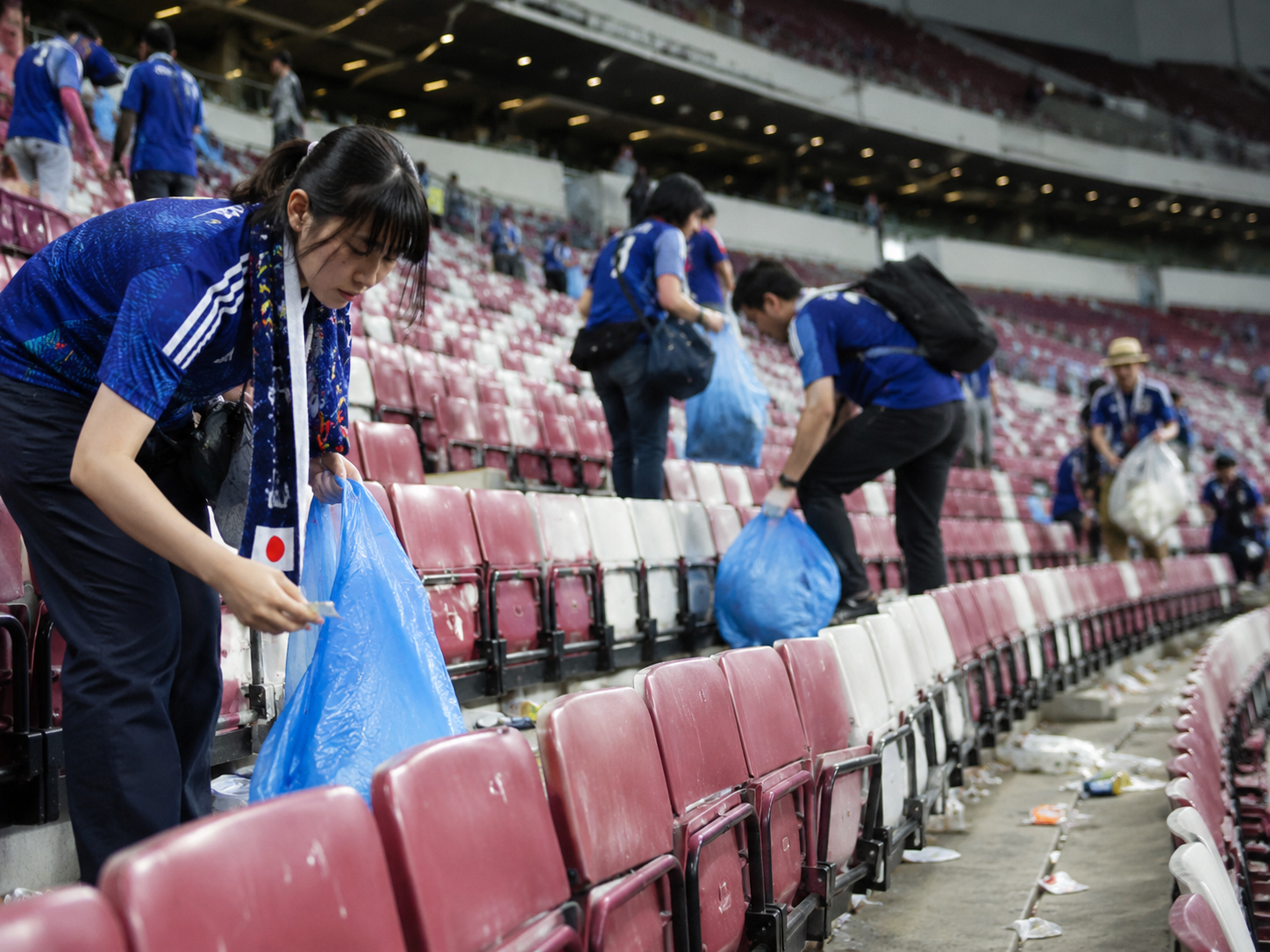
When the final whistle fades, most spectators move toward the exits. Some Japanese supporters do something else first. They open bags, bend between the rows and begin collecting cups, wrappers and paper from the seats around them. After Japan’s 2-2 draw with the Netherlands at the 2026 World Cup, that familiar post-match ritual again drew global attention. The team had earned a point. The fans earned another round of fascination.
But the cleanup is no longer a one-off “feel-good” story. The Associated Press traces international attention to Japanese fans cleaning stadiums back to the 1998 World Cup in France, Japan’s first appearance in the tournament. The pattern continued in later tournaments: in 2018, Japanese players cleaned their dressing room after a heartbreaking loss and left a thank-you note in Russian; in 2022, fans left thank-you messages on rubbish bags in Arabic, English and Japanese. The 2026 scene is the latest chapter in a long-running public ritual.
It is not just about being “clean”
Foreign coverage often summarizes the practice by saying that Japanese people value cleanliness. That is true, but incomplete. Japan has litter, messy streets, overflowing trash after festivals and all the imperfections of ordinary public life. The stadium ritual is better understood as a rule about how to return a shared place after using it.
The AP story highlights the Japanese phrase “tatsu tori ato wo nigosazu,” often rendered as “a bird leaves nothing behind.” The idea is close to leaving a place as clean as, or cleaner than, one found it. What matters is not a grand gesture of virtue. It is the ordinary expectation that the space one has used should not become someone else’s burden.
The school-cleaning foundation
The deepest roots are often found in Japanese schools. In many schools, students clean their classrooms, corridors, stairs and schoolyards. This is not framed as punishment; it is part of education. A Japan National Tourism Organization education page explains that cleaning time is treated as an extracurricular activity that helps students understand work, social participation, cooperation and their role within a group.
That educational framing matters. Children learn how to wring a rag, move desks, sweep corners, use a dustpan and help younger students. The lesson is not only technical. It teaches that a classroom, hallway or playing field is not just a space provided by someone else. It is a shared environment that students themselves help maintain.
Meiwaku and the crowded-society logic
The second key idea is meiwaku: not causing trouble or inconvenience to others. In a dense country with crowded trains, small apartments, narrow streets and highly shared public systems, everyday life depends on small forms of restraint. Leaving a stadium messy may not be illegal. But it adds work for someone else, blocks another person’s use of the space and breaks the quiet contract of shared life.
This value has both good and difficult sides. “Don’t cause trouble” can encourage consideration, but it can also create pressure to conform or discourage people from asking for help. In the stadium context, however, it becomes easy to see: fans pick up not only their own trash but nearby trash as well. The act is not mainly about replacing paid cleaners. It is about users accepting a share of responsibility for a public space they enjoyed.

Why football made it visible
Soccer matters here. The AP story notes that the cleanup tradition appears particularly tied to football culture, with Japan’s professional J.League emphasizing community embeddedness from its early years. The J.League, launched in 1993, was not only about creating a professional competition. It also promoted home towns, club identity, volunteers, youth programs and a sense of local belonging.
In that culture, fans are not merely ticket buyers. They are participants in the life of a club and its stadium. Cleaning after a match can be read as an extension of that relationship. When Japanese supporters travel abroad for the national team, they bring some of that “our place, our responsibility” logic with them—even when the stadium is in Qatar, Russia, Texas or Mexico.
Why the world keeps being surprised
In many countries, large sports events are structured around the assumption that spectators leave and cleaning crews clean. That system is not wrong; it is simply different. Japanese fans disrupt that expectation. The sight of supporters in jerseys collecting garbage looks unusual because it crosses the line between consumer and caretaker.
Still, it is important not to turn the practice into a simplistic national myth. Not every Japanese person behaves this way. Japan has its own civic failures and social pressures. Cleanup culture can also make cleaning labor less visible. The better interpretation is not “Japan is perfect.” It is that a particular social habit, learned at school and reinforced by football culture, has become a recognizable international symbol.
What changed in 2026
The 2026 episode came after Japan’s dramatic 2-2 draw with the Netherlands. The match itself mattered: Japan twice came from behind and left the group opener with credibility. But the post-match cleanup created a second story—one about behavior, civic pride and cultural transmission. This time, international sports figures and fans also joined or amplified the cleanup, turning it from a Japanese-only ritual into a small shared act.
That is the power of the gesture. No speech is required. No one needs to lecture other fans. Someone opens a bag. Someone bends down. Someone else joins. A photo moves around the world. The message is simple enough to travel.
- The practice has been visible at World Cups since Japan’s first tournament in 1998
- Its roots include school cleaning, meiwaku and football community culture
- It is not adequately explained by saying “Japan is clean”
- Global praise has reinforced the behavior and made it a point of fan pride
- The deeper issue is how people use and return shared public spaces
Support is also how you treat the place
Cheering is not only sound. It is also conduct. Flags, songs and jerseys define fan culture, but so does the way spectators treat the place that hosted them. For Japanese supporters, cleanup can be a way to thank the host country, honor the national team and avoid leaving embarrassment behind.
Matches end quickly. Impressions last longer. In 2026, Japan’s supporters again showed that a small act in the stands can carry cultural meaning far beyond the stadium. The bags were not glamorous. The gesture was quiet. But in a tournament built on spectacle, that quietness was precisely why the world noticed.
Sources and references
This Japan.co.jp report is based on reporting from the Associated Press, Japan Educational Travel / JNTO, and 2026 World Cup coverage.