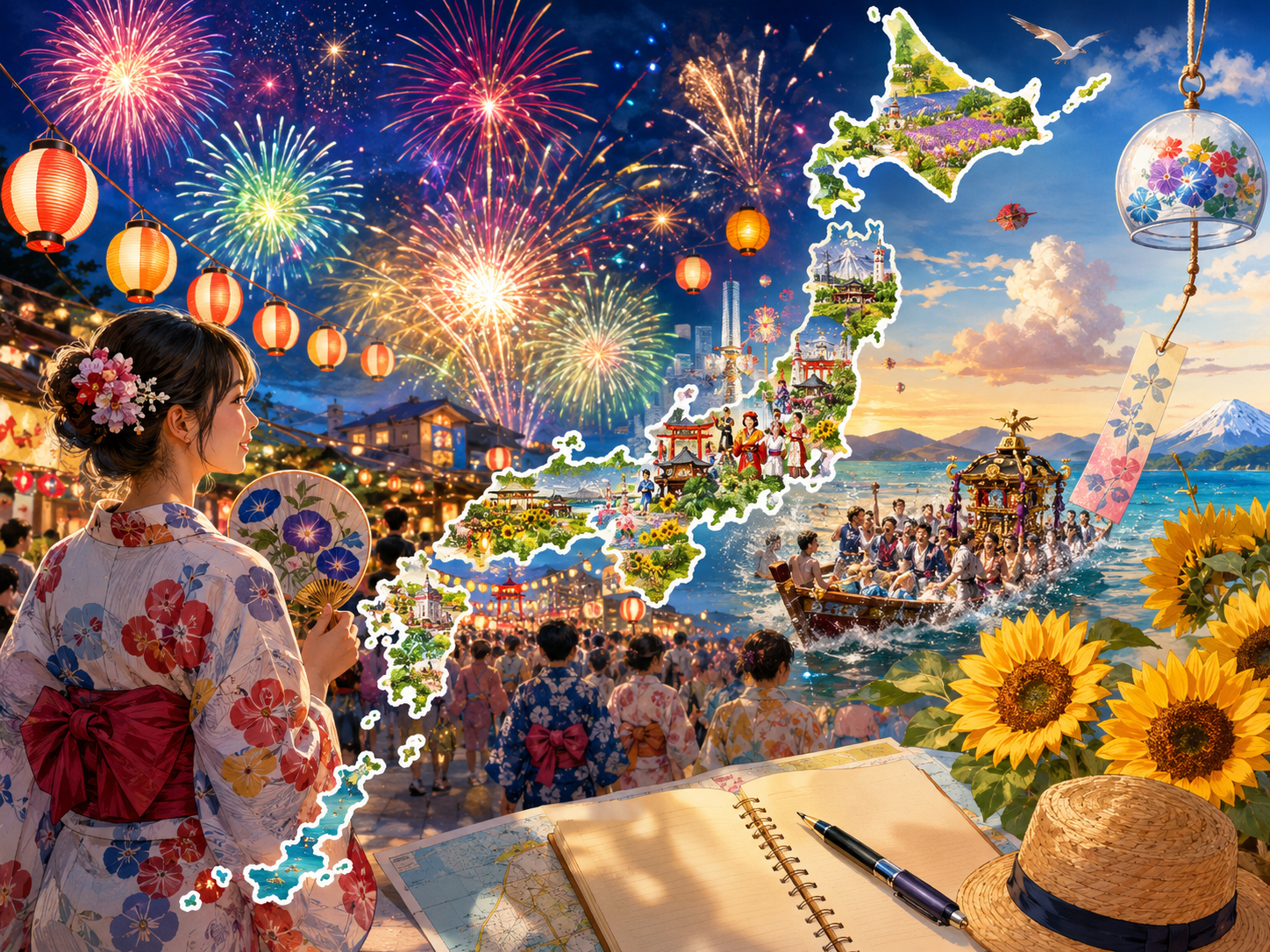
Japan in summer is best read as a map. The Sumida River in Tokyo, Kyoto’s Gion Matsuri, Aomori’s Nebuta, Yamagata’s Hanagasa, Akita’s Kanto, seaside fireworks in Kumano, shopping-street festivals, shrine precincts, port towns and neighborhood bon-odori circles: from July into August, the country becomes a chain of night events. JAPAN 47 GO’s release of selected July event information is not just a travel-calendar item. It is an invitation to rediscover the country by prefecture.
Inbound travelers often think of Japan through the golden route: Tokyo, Kyoto and Osaka. Summer festivals and fireworks tell a different story. They reveal Japan as a series of local stages — a river, a harbor, a shrine, a castle town, a hot-spring street, a schoolyard, a shopping arcade. In one evening, a place compresses its history, merchants, inns, railway access, food stalls, craft traditions and civic pride into a public event. Summer events are tourism products, but they are also regional self-portraits.
What JAPAN 47 GO opens
JAPAN 47 GO, connected with the Japan Travel and Tourism Association, functions as a gateway to regional tourism information: events, local attractions and travel materials across the country. Its June 15 release of selected July events is timed for the summer-planning window. The point is not only the list itself. The point is that it encourages travelers to think across all 47 prefectures.
Travel planning often starts with a city name. Japanese summer becomes richer when planned by prefecture, region, rail corridor, river, coast, onsen town or castle town. That is why Japan.co.jp’s 47 Prefectures hub fits naturally with the story. Find an event, choose a prefecture, then widen the itinerary into food, lodging, transport and culture. A summer trip can begin with a single fireworks display.
Explore Japan.co.jp’s 47 Prefectures guide →Why fireworks are Japanese summer
The Japanese word hanabi means “fire flowers.” Fireworks developed as urban entertainment in the Edo period, and the Sumida River fireworks tradition remains one of the best-known examples. Their meanings have overlapped: mourning, purification, riverbank cooling, merchant culture, craft competition, public entertainment and seasonal memory. A Japanese fireworks festival is not just light in the sky; it is a culture of place, water and impermanence.
JNTO describes summer as the season for fireworks, with July and August as the peak period. Viewers wear yukata, buy yakisoba and shaved ice, sit by rivers or bays, and wait for the night to bloom. The explosion lasts only seconds, but the experience includes seat reservations, crowd flow, train schedules, hotel rooms and the long walk home. Japanese fireworks are not simply something to watch. They are something to attend.
Gion Matsuri, bon-odori and the local night
No July in Japan can ignore Kyoto’s Gion Matsuri. Its origins are often traced to a ninth-century ritual against plague, and the festival grew into a month-long expression of Kyoto’s neighborhood culture, floats, textiles, music and night streets. To visitors, it is a grand procession. To local communities, it is preservation, continuity and responsibility.
Across the country, smaller bon-odori dances and neighborhood festivals create a different, more intimate summer memory. A schoolyard. A station square. A park. A shrine compound. Lanterns hang, drums sound, children play festival games, elderly residents sit and watch, and food stalls define the night. These small events may not dominate global travel lists, but they carry the temperature of Japanese summer. Regional-information services like JAPAN 47 GO matter because they can surface these small doors into local life.

Festivals are local economies
Festivals and fireworks are emotional events, but they are also economic systems. Railways, buses, taxis, inns, hotels, restaurants, stalls, security, cleaning, temporary toilets, pyrotechnicians, sponsorships and city tourism offices all participate. A single night of crowds can bring revenue, but it also brings costs and risk. Inflation, labor shortages, policing, heatstroke prevention and crowd management now shape whether events can continue.
The rise of paid seating at major fireworks events is not simply commercialization. It can help create safer viewing zones, reduce crowd pressure, fund security and improve the visitor experience. But it also raises a public question: how should a festival balance open access with the real cost of staging it? Japanese summer events are quietly searching for new operating models.
Festivals in the age of heat
Today’s summer festivals also have to manage heat. Climate change means July daytime events require careful heatstroke planning: shade, hydration, first aid, misting, evening schedules, crowd avoidance and real-time information. Festivals are traditional, but their operations change every year.
In that sense, the evening festival is also a cultural form of climate adaptation. People avoid the hottest daytime hours, gather after sunset, use river breezes or sea air, and rely on yukata, fans, cold foods and communal pacing to survive the season. Old wisdom and new safety management overlap in the contemporary Japanese summer.
- For major fireworks events, check lodging and transport before committing.
- If paid seats are available, review rain and cancellation policies.
- Expect railway crowding after the event; plan a slower exit.
- Yukata are fun, but comfortable footwear and hydration matter.
- Use the event as an entry point into the surrounding prefecture, food and local history.
Reading the 47 prefectures as a night map
Summer travel in Japan is not complete with daytime sightseeing alone. Night festivals, river fireworks, harbor stalls, mountain bon-odori dances and onsen-town lanterns change the meaning of a prefecture. Hokkaido’s open scale, Tohoku’s festival force, Hokuriku’s ports, Kanto’s riverbanks, Chubu’s mountains and castle towns, Kansai’s old capitals, the Inland Sea, Kyushu’s volcanic landscapes and Okinawa’s island nights — each gains sound and light in summer.
JAPAN 47 GO-style event information is the doorway into that sound and light. What deepens the trip is what travelers read before and after the event: the history of the prefecture, the food of the region, the reason the festival exists and the people who keep it running. Japanese summer is not only about seeing fireworks. It is about visiting the place from which they rise.
One firework can become the entrance to the next prefecture. From there, Japan appears not as a checklist, but as 47 stories.
Sources and references
This Japan.co.jp report is based on JAPAN 47 GO / PR TIMES, JNTO, Nippon.com and tourism and festival references.