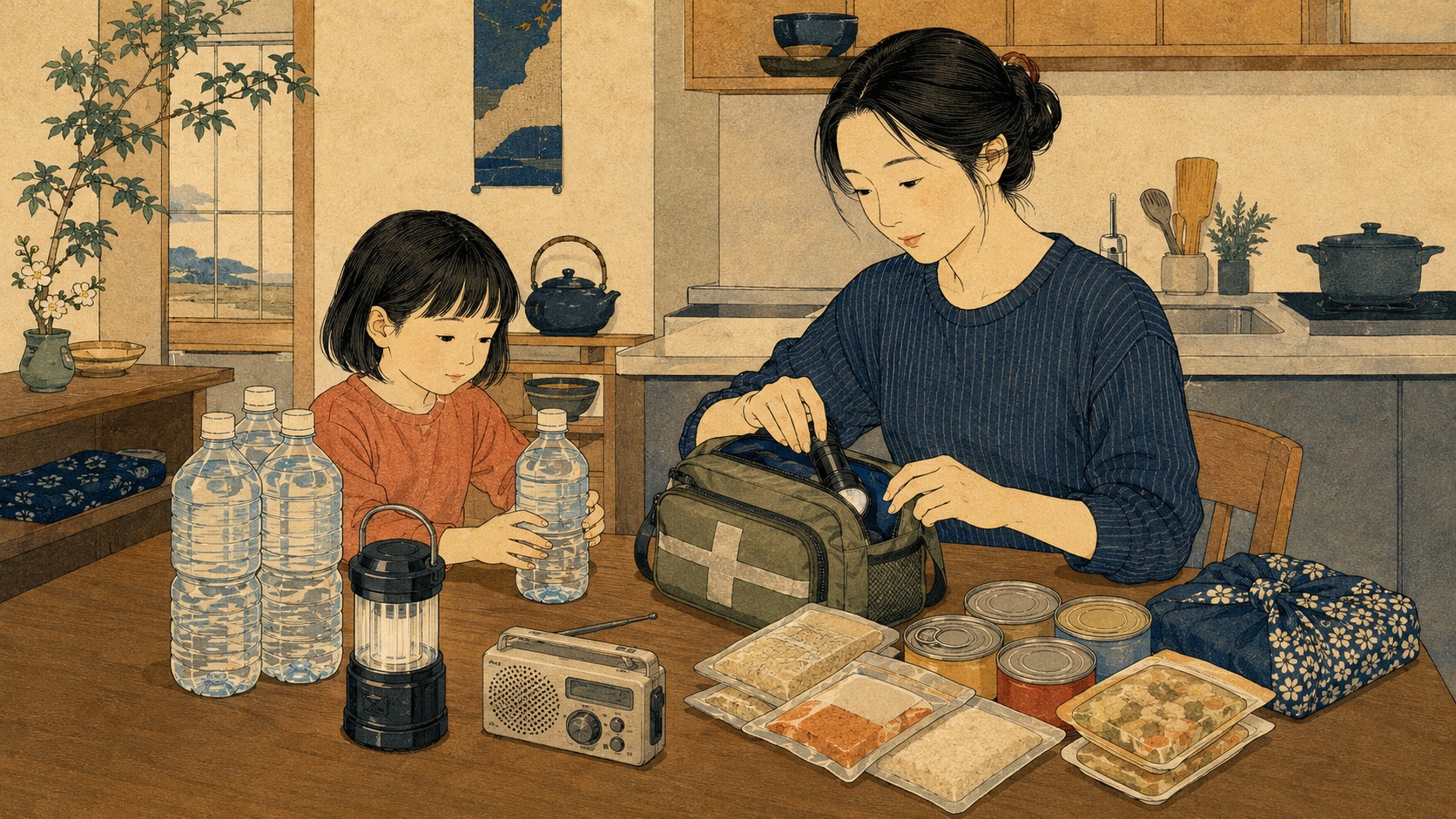
On the kitchen table are not only silver packets bought for an unknowable future. There is the water the family normally drinks, rice and canned food the child recognizes, batteries, a lamp and a small radio. At the entrance is the yellow school hat worn every morning. A contact card sits in the randoseru backpack. The safest route is marked on paper, but it was not drawn by an adult alone: parent and child walked it, looking for blind intersections, unstable walls, water points and places where help could be requested.
This is not a new national program. It is the summer activity report of Peekaboo Co., the Asaka, Saitama, company behind the UV-protective clothing brand EPOCHAL. In an August 14 announcement, the company presented three projects under one phrase—nichijō bōsai, or “everyday disaster preparedness”: its 3-Way & Multi-Guard school hat, a parent-child safety-mapping workshop with Asaka Library and Ritsumeikan University’s Institute of Disaster Mitigation for Urban Cultural Heritage, and instructions for cooking familiar food in heat-resistant bags.
Because the central document is a company release, its performance claims and descriptions of impact cannot simply be treated as independent findings. Yet the weakness identified by the three projects is real. A disaster seldom waits until every family member is standing beside the emergency cabinet. A child may be between home and school. A parent may be at work. Water and electricity may have stopped. The value of preparedness depends not only on whether a family owns something, but whether it is present, understood and usable without hesitation.
The distance tax on emergency supplies
Dedicated disaster products can create a satisfying sense of completion. Buy the kit, close the zipper, put it away. But a bag that is too heavy may not be carried. Food no one rotates goes out of date. A radio or portable toilet first opened during an outage arrives with an instruction manual no one has read. A child’s helmet at home cannot cross the distance to a school route when an earthquake begins.
Everyday preparedness tries to reduce that distance and the friction of unfamiliarity. Buy a little more of the food a family already eats, use the oldest items and replace them—the rolling-stock method. Put a contact card or safety function into something carried routinely. Walk an evacuation route as part of an ordinary afternoon. Use the cassette stove before an emergency and discover whether the fuel is old, the pot too large or the meal unacceptable to a child.
Japan’s Ministry of Agriculture, Forestry and Fisheries recommends at least three days of household food, and preferably a week, for each person. The Cabinet Office uses three liters of drinking water per person per day as a planning figure and names portable toilets, a cassette stove and household necessities alongside food. Rolling stock does not mean that every item must be a special, decades-long ration. Its advantage is circulation: people learn the taste, the cooking water and fuel required, and whether a child, older adult or person with an allergy can actually eat it.
The yellow school hat was already an everyday safety device
Japan’s yellow elementary-school hat has become such an ordinary sign of spring that its origin can disappear into the scenery. It emerged during the country’s postwar “traffic war,” when car ownership and crashes were rising faster than sidewalks and signals could be built. Reporting based on the Wakayama Prefectural Police archive traces the idea to Toshirō Sakashita, a traffic officer at Wakayama Nishi Police Station. In 1960 he proposed putting the most visible color at the highest point of a small child’s body. The practice spread with help from the local board of education and parents; Sakashita later received a prime minister’s commendation for traffic-safety work.
In that same year, the national government established September 1 as Disaster Prevention Day, preserving the lesson of the Great Kantō Earthquake of September 1, 1923, while placing preparation in the middle of typhoon season. The school hat and the commemorative day were separate initiatives, but they shared a method: safety would not be a lecture heard once. It would become a visible daily habit and a repeated civic ritual.
Major disasters later widened Japan’s understanding of what household readiness meant. The Great Hanshin-Awaji Earthquake of January 17, 1995, killed 6,434 people and made broken lifelines, neighbor-to-neighbor rescue, evacuation conditions and household supplies immediate national concerns. The Great East Japan Earthquake of March 11, 2011, forced schools to look beyond faithful execution of a fixed manual. Education policy increasingly emphasized children’s capacity to read a changing situation, act independently and work with households and communities.
1923 The Great Kantō Earthquake devastates the capital region through collapse, fire and cascading system failures.
1960 Wakayama’s yellow school-hat initiative begins; Japan also establishes Disaster Prevention Day.
1995 The Great Hanshin-Awaji Earthquake exposes lifeline, household and neighborhood vulnerabilities.
2007 Ritsumeikan begins its safety-and-security mapping contest for elementary pupils.
After 2011 School disaster education places greater weight on judgment, varied scenarios and community links.
2026 Peekaboo presents a hat, a walked map and a practiced meal as one everyday-preparedness project.
What can an 80-gram insert protect against?
Peekaboo’s school hat combines several purposes. The company describes UV-blocking material, heat and ventilation features, reflective trim, a pocket for contact information or a GPS device, and an internal impact-mitigating insert weighing 80 grams. It says the design is intended for light-to-moderate everyday impacts such as falls, contact and some flying objects, and has announced plans for consumer sales in autumn 2026.
The 2026 recommendation list of the Japan Society of School Health includes the “UV-cut wear school series / 3-Way & Multi-Guard school hat.” The society describes the internal component as a kan’i herumetto—a “simple helmet”—intended to minimize injury. That confirms a school-health recommendation for the listed period, from April 2026 through March 2027.
But the vocabulary matters. A “simple helmet” is not automatically a bicycle helmet or an industrial protective helmet. Japan’s Consumer Affairs Agency advises cyclists to choose a product carrying a safety mark or standard appropriate to bicycle crashes. It specifically warns consumers not to confuse the European EN 812 industrial bump-cap standard with the EN 1078 bicycle-helmet standard. Protective helmets for workplace falling-object and fall hazards are governed through a separate Japanese type-testing system. The public documents reviewed for this story do not establish that the school hat is certified for either of those uses.
| What the public record supports | What it does not establish |
|---|---|
| The product appears on the Japan Society of School Health’s 2026 recommendation list. | That the recommendation is equivalent to certification under bicycle, industrial or specialist disaster-helmet standards. |
| The maker states that the insert weighs 80 grams and is designed to mitigate impact. | That it protects against every falling object, vehicle collision or structural collapse. |
| The design combines reflectivity, UV, ventilation and a contact/GPS pocket. | That combining functions eliminates the need for hazard-specific protective equipment. |
| Routine wear may make some protection more likely to be present. | That correct sizing, fit, replacement, evacuation planning or adult supervision become unnecessary. |
This distinction is not an argument that a multifunction hat has no value. It is the only way to measure that value honestly. Lightness, heat comfort and visibility affect whether a child will keep a hat on. Protection against a severe impact is a different axis. A school considering adoption would need information on test conditions, fit across sizes, retention, vision and hearing, wear during evacuation, deterioration and replacement—not only whether the hat feels comfortable in a demonstration.
From looking at a map to reading a neighborhood
At the July 5 workshop in Asaka, participants first learned common disaster symbols, then walked around the library in groups of five or six. They recorded emergency locations, “Child 110” safe houses, fire-water tanks, cooling places, blind crossings and other features before assembling notes and photographs into maps. The important result was not the poster alone. It was the sequence of questions generated by walking: Is this wall safe after an earthquake? Would the same route make sense in a flood? If the family is separated, which adult can a child approach?
Ritsumeikan University’s Institute of Disaster Mitigation for Urban Cultural Heritage has run its elementary-student safety-and-security map contest since 2007. Its published project research connects mapmaking with self-involvement: a child who gathers and shares information is more likely to treat risk as something personally relevant. It also notes that shared mapping can particularly raise awareness among pupils who began with less attention to hazards.
A hand-drawn map can capture what a government hazard layer misses: a wall at a child’s eye level, a slope slippery only in rain, a dark street, a business that closes at night. An official map contributes something the child cannot calculate: modeled flooding, landslides, storm surge, tsunami exposure and evacuation sites designated for specific hazards. Japan’s national hazard-map portal itself says the displays are one source for planning, contain assumptions and errors, and should be used with municipal maps.
The choice is therefore not paper versus digital. Families can combine knowledge collected on foot with the latest municipal hazard map, school handover rules, construction closures, season and time of day. Nor should a child memorize one instruction—“always go to school” or “always go to the shelter”—as if every emergency were the same. Earthquake, fire, flood and tsunami change both the dangerous direction and the appropriate destination.
- Hazards: Examine earthquake, fire, flood, landslide and tsunami separately, as relevant locally.
- Destinations: Distinguish an emergency evacuation place from a shelter used for longer-term living.
- Blocked routes: Mark walls, narrow roads, riversides, underpasses, work zones and poor night visibility.
- Places to seek help: Add police boxes, shops, public facilities, Child 110 houses and known neighbors.
- Communication: Record school handover policy, two family meeting candidates and the number used for 171/web171.
- Revision: Write the date walked, the date official maps were checked and the next review date.
Pack cooking is really a design for fuel and water
The third practice in Peekaboo’s report appeared in a July 10 company blog post: pack cooking, in which ingredients are sealed in a heat-resistant food bag and simmered in water. A staff member who experienced the Great Hanshin-Awaji Earthquake emphasized the difference between knowing a technique and having performed it once. Familiar ingredients can be heated in separate bags in one pot, and the bag can reduce washing-up when water is scarce.
Japan’s agriculture ministry describes the same advantages: ordinary food can be used, the heating water stays comparatively clean for reuse, and dishes need not be soiled. But “a plastic bag” is not a sufficient specification. Osaka City guidance calls for a food bag made of high-density polyethylene labeled for boiling, or with a stated heat resistance of at least 130°C; a heatproof plate in the bottom of the pot; air pressed out before tying high on the bag; and care to prevent the plastic from touching a hot pot wall. Ingredients should be small and spread flat enough to heat evenly.
The cassette stove introduces a different risk system. Japan’s National Institute of Technology and Evaluation warns against cookware large enough to cover the fuel-canister compartment, using two stoves side by side, and operating near combustibles or in enclosed places such as a vehicle or tent. Those conditions can lead to canister overheating, fire or carbon-monoxide poisoning. NITE also cites replacement and inspection guidance of roughly ten years for a cassette stove and seven years for a canister kept in long storage.
| Practice in ordinary time | Failure it can prevent in an emergency |
|---|---|
| Choose a food bag explicitly labeled for boiling and place a heatproof plate below it. | Softening, rupture or sticking to the hot base of the pot. |
| Limit a bag to one or two portions, remove air and flatten the ingredients. | Floating, expansion and uneven heating. |
| Test the taste, texture and portion with each family member. | A meal a child or vulnerable adult will not or cannot eat. |
| Check stove age, canisters, ventilation and the pot’s footprint. | Gas leakage, overheating, fire and carbon-monoxide poisoning. |
| Use clean hands and tools, heat food thoroughly and eat it promptly. | Foodborne illness risks amplified by a power and water outage. |
Separate bags may help warm an allergy-safe meal beside other food, but separation alone does not guarantee allergen control. Families must still manage labels, hands, utensils, bag damage and mix-ups. Households with infants, older adults, chronic illness, swallowing difficulty or food allergies need appropriate reserves selected in ordinary time, using the ministry’s guidance for people requiring special consideration and advice from clinicians where necessary.
Use a mother’s perspective without making it only a mother’s job
Peekaboo was incorporated in 2005 and says the EPOCHAL brand began in 2002 from mothers seeking UV protection for their children. The details of care can reveal flaws that a procurement list misses: which hat a child will tolerate, which route is taken at 7:40 in the morning, which food will be refused, and the hours when members of a household are dispersed.
But the “mothers” in this headline must not become a new assignment of unpaid emergency labor. After the Great East Japan Earthquake, Japan’s Gender Equality Bureau told governments to treat women not only as recipients of aid but as decision-makers in prevention and recovery. A government review described in 2024 found that municipalities with higher female participation in disaster departments and councils tended to stock women’s and infant supplies at higher rates. The lesson is not that women should manage the stockroom. It is that people with lived knowledge belong in the room where plans and budgets are decided.
The same rule applies at home. If one person alone tracks food dates, medicine, pets, grandparents’ numbers and school handover policy, the entire household system can fail when that person is absent. Children, fathers, grandparents, schools, local government and manufacturers all need to know and carry parts of the plan. An insight can begin with mothers without ending as a burden placed only on them.
Does adding functions to school gear reduce public responsibility?
Strengthening an everyday object has a distributed advantage. If hundreds of pupils wear it, some safety capacity is spread across hundreds of locations. That can reduce a single point of failure—the emergency store is far away, the door is locked, or the person with the key is absent. Memories of a walked route and practiced cooking are distributed inside people rather than a warehouse.
There is also a danger. Moving protection into an individual purchase can make institutional hazards less visible. A hat does not repair an unstable block wall, build a guardrail, shorten an extreme-heat commute or retrofit an old school. Pack cooking does not replace water systems, logistics, sanitary shelters or public support for people with medical needs. Nor should a child’s protection depend on whether a parent can afford premium multifunction equipment.
A strong model connects private discovery to public correction. If a child’s map finds a dangerous crossing, the result goes to the road manager. If a school adopts a product, it examines performance and provides financial support so access is equitable. If a household drill exposes a gap in water, toilets or cooling, the municipality uses that knowledge in supply and shelter plans. “Everyday” must not become a polite word for privatizing public duty.
A 30-minute family rehearsal after Obon
As work and school schedules return after Obon, it is easy to picture a weekday when everyone is in a different place. A household does not need to become perfectly prepared in one evening. It can start by testing one object, one route, one communication method and one meal.
- 5 minutes · Entrance: Check shoes, light, whistle, contact card and hat. Ask the child to show where each item is.
- 10 minutes · Map: Use the latest municipal hazard map to examine home, school and the route for each local hazard. Choose two possible meeting points.
- 5 minutes · Contact: Choose the family phone number used for 171/web171 and mark a practice day, including the 1st and 15th of each month.
- 5 minutes · Water and toilets: Count drinking water using people × three liters × days; check portable-toilet quantity, expiry and location.
- 5 minutes · Food: Schedule one meal this week using stored food. If pack cooking, read the bag and stove instructions and practice the safety steps in normal conditions.
Communication practice should offer an alternative to repeatedly calling a congested phone. NTT’s Disaster Emergency Message Dial 171 and web171 have trial periods on the first and fifteenth of every month, during the New Year period, Disaster Prevention Week and other specified dates. Families can choose which phone number anchors the messages, decide who records and who retrieves, and check that the plan is consistent with the school’s handover policy.
Going from home to a shelter is not automatically the correct action in every event. Staying at home may be appropriate if the structure and surrounding hazard permit it; flood or tsunami conditions can demand early movement or vertical evacuation. Families must combine municipal information, weather alerts, school instructions and visible conditions. A child needs more than one memorized command. The useful questions are: What is happening? Is this place safe for this hazard? Who is the next trusted adult I can reach?
How should the 2026 projects be judged?
Peekaboo’s August 14 announcement is a report on its own activity, not an independent evaluation. Sales and event attendance would be weak measures of success. For the hat, evaluators should ask whether children keep it on in heat, how much impact it mitigates under publicly described conditions, how fit and aging change performance, and whether access differs by family income. For mapping, they should ask whether children can explain decisions months later and whether identified hazards reach schools and public works. For cooking, they should measure water and fuel, safe repetition of the method, nutrition, acceptance and allergy control.
| Activity | A meaningful measure |
|---|---|
| Multifunction school hat | Wear rate, fit, heat comfort, hazard-specific testing, replacement criteria and equitable access. |
| Parent-child safety map | Hazard-specific judgment, retention, revision and transmission of local problems to responsible authorities. |
| Pack cooking | Safe procedure, water and fuel use, nutrition, child acceptance and allergy management. |
| Everyday preparedness overall | Whether knowledge and responsibility spread across the family, school and government instead of settling on one mother. |
This scrutiny is not hostile to invention. Disaster protection becomes trustworthy through repetition and verification, not good intentions alone. Products for children especially require the emotional promise—“we want to protect them”—to be paired with test methods, standards and a plain account of limitations.
Draw one line through the hat, the route and the meal
The most appealing quality of everyday preparedness is that it need not begin with fear. Put on a hat. Walk with a parent. Cook dinner. Each is an ordinary act. Inside those acts, a child can participate in safety—not only as someone protected by adults, but as a person who notices a hazard, seeks help and returns information to the family.
Everyday tools are not universal ones. A light hat does not replace certified protection for a severe hazard. A hand map does not replace a current warning. A household cooking method does not replace public relief. Preparedness is the practice of knowing those boundaries and building overlapping layers.
In the morning, a child leaves through one door and a parent travels toward another workplace. No plan can make those separated hours free of risk. It can, however, place modest protection on the child’s head, a route in the child’s memory, a message system in the family’s hands and one familiar meal within reach. The mother-led idea behind these projects is that resilience is not made only on the day a disaster strikes. It is made in the ordinary morning before it.
- Peekaboo Co., “Report on 2026 summer disaster-prevention activities”, August 14, 2026. Company release covering the school hat, Asaka mapping and pack cooking.
- Peekaboo/EPOCHAL, “3-Way & Multi-Guard school hat”. Maker’s description of the 80-gram insert, construction and intended functions.
- Japan Society of School Health, recommended school-health products. Listing period April 1, 2026–March 31, 2027.
- EPOCHAL, parent-child disaster-mapping workshop report, July 5, 2026.
- Ritsumeikan University Institute of Disaster Mitigation for Urban Cultural Heritage, report on the safety-and-security map contest. History since 2007 and educational rationale.
- EPOCHAL, pack-cooking experience, July 10, 2026.
- Ministry of Agriculture, Forestry and Fisheries, “Pack cooking for busy days and emergencies”, and its household food-stock guide.
- Osaka City, pack-cooking guidance, December 11, 2025. Bag material, heat labeling and pot procedure.
- National Institute of Technology and Evaluation, “Product accidents associated with earthquakes”, March 12, 2024. Cassette-stove aging, overheating and ventilation.
- Consumer Affairs Agency, “Safety marks for bicycle helmets”, December 2024. Hazard-specific standards and misleading markings.
- Cabinet Office, household natural-disaster readiness check. Three days to one week, three liters per person per day, rolling stock and family communication.
- Ministry of Land, Infrastructure, Transport and Tourism / Geospatial Information Authority, Hazard Map Portal.
- NTT East, trial use of Disaster Emergency Message Dial 171.
- Ministry of Education, Culture, Sports, Science and Technology, school-safety materials, and the Third National Plan for the Promotion of School Safety.
- Cabinet Office, “The Great Kantō Earthquake of September 1, 1923”, and its Great Hanshin-Awaji “One Day Before” archive.
- Gender Equality Bureau, “Women’s perspectives strengthen disaster response”, and its 2024 summary of municipal participation and stockpiles.
- The Mainichi, “The wish of the traffic officer behind elementary pupils’ yellow hats”, October 4, 2021. Reporting from the Wakayama police archive.
Editor’s note: The central sources for the three 2026 activities are Peekaboo’s own release and blog posts; they are not independent evaluations of product performance or educational outcomes. This article distinguishes the Japan Society of School Health’s recommendation from certification under bicycle or industrial helmet standards. UV, heat and impact-mitigation figures are maker claims unless otherwise identified and were not tested by Japan.co.jp. Household evacuation decisions vary by hazard, municipal guidance and building safety. The currency time supplied in UTC has been converted to Japan Standard Time.