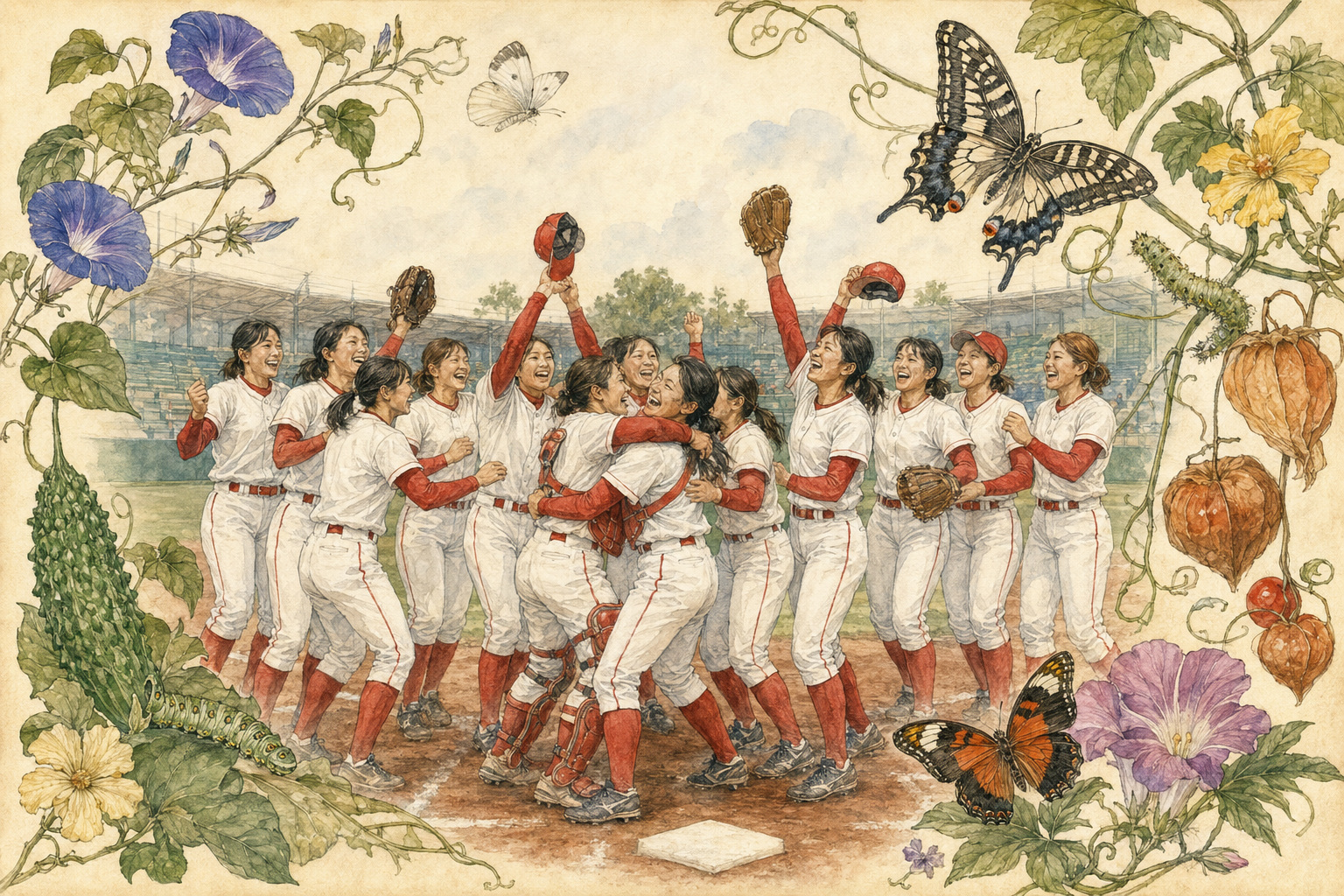
THE cleanest number from Tainan is 5–0. The more revealing number is three: the days Japan had to play all five games after rain washed out the opening two dates of the WBSC/RAXUS Women’s Baseball World Cup Group Tainan 2026.
Japan beat the Philippines, Great Britain, Venezuela, Cuba and Chinese Taipei to finish first. The official scores add up to 54 runs for Japan and two against it. Four games were shutouts, and the only runs conceded came in an 11–2 win over Chinese Taipei after qualification had already been secured.
The perfect record requires an asterisk of context, not doubt. Tournament organisers changed the entire Tainan schedule to five-inning games after the postponements. Japan’s opener lasted only four completed innings because of a lighting failure. A 54–2 aggregate under those conditions cannot be projected mechanically onto the seven-inning Finals.
Waiting All Day for a Four-Inning Opener
Japan was supposed to begin on August 23. Persistent rain delayed the group twice, and the opening game finally started late on August 25—10 and a half hours after its original time. The team had first been told there would be no game that day, then learned in the evening that play would proceed.
Miyu Shimizu steadied the uncertainty. The right-hander retired all nine batters she faced and struck out eight in three innings against the Philippines. Japan manufactured a run in each of the first three innings with a bunt single, stolen base, ground ball, squeeze and timely double.
The lights then failed as the fifth inning was about to begin. Because four innings had been completed, the 3–0 result stood. One game produced almost every form of disruption Japan would have preferred to avoid before a global tournament: prolonged waiting, a late start, shortened rules and an abrupt finish.
A Rout, Then the Game That Mattered Most
The second game supplied the largest score. Japan beat Great Britain 23–0 in four innings under the 15-run rule. Kokoa Azuma drove in six, while four pitchers combined on a perfect game without allowing a baserunner.
Venezuela posed the opposite problem later that day. Japan struck out five times in the first two innings against the opposing starter and entered the third scoreless. A single and steal by Harue Yoshii opened the route to two squeezes; two more runs followed in the fourth. Sawa Kashizaki and Michi Takemura completed the 4–0 shutout.
The contrast matters. The Great Britain result demonstrated the depth of the gap between teams in the group. The Venezuela win showed a transferable plan: advance a runner, force the defence to execute and protect a small lead with precise pitching.
Five Scores, More Than One Kind of Win
| Date | Opponent | Result | Defining detail |
|---|---|---|---|
| August 25 | Philippines | 3–0 | Started 10½ hours late; called after four innings. |
| August 26 | Great Britain | 23–0 | Four-pitcher perfect game over four innings. |
| August 26 | Venezuela | 4–0 | Two squeezes and a two-pitcher shutout. |
| August 27 | Cuba | 13–0 | Ten-run second inning clinched advancement. |
| August 27 | Chinese Taipei | 11–2 | Three first-inning runs; three errors remained. |
The sequence imposed two consecutive doubleheaders. Japan went from Great Britain to Venezuela on August 26, then returned the next morning for Cuba before meeting Chinese Taipei that evening.
That workload is a legitimate achievement, even under shorter games. It demanded repeated warm-ups, rapid tactical resets and careful use of a pitching staff. It also means the aggregate was produced under a competition format different from the one the team expects in the Finals.
Qualification Secured Before the Last Game
Japan entered August 27 needing to formalise what three shutout wins had made likely. Azuma doubled on the first pitch against Cuba and scored on Miu Shiraishi’s sacrifice fly. A 10-run second inning broke the game open, and Japan won 13–0.
The fourth victory guaranteed passage to the Finals. Japan still had first place and an undefeated finish to pursue against Chinese Taipei. It scored three times in the first inning, four in the second and four in the fourth.
Co-captains Nanako Hanabusa and Haruna Tadano delivered in the decisive innings. Hanabusa doubled home the first run after two were out; Tadano added a run-scoring hit and later a squeeze. The offence had corrected its earlier habit of taking an inning to settle, but three fielding errors showed why an 11–2 score should not end the review.
Half the Roster Was New to the World Cup
Ten of Japan’s 20 players were appearing in a Women’s Baseball World Cup for the first time. Seven members of the previous tournament squad had retired, leaving the defending champions to renew the roster while protecting a title streak.
Nakashima credited veteran structure. Hanabusa and Tadano grew into their co-captaincy as the event progressed, while Shimizu led the pitchers in the rotation, in the dugout and between games. Their work was not limited to the scorebook; it supplied a behavioural model when the schedule stopped behaving normally.
“It was difficult to prepare in such a tough schedule,” Nakashima said in the national team’s official review, adding that the experience had helped the players grow. The English rendering is a translation of her published Japanese remarks, not a separate Japan.co.jp interview.
- Tainan group: Japan, Venezuela and Chinese Taipei.
- Rockford group: United States, Canada and Australia.
- Finals venue: Rockford, Illinois, from July 19 to 25, 2027.
- Japan enters as the seven-time defending world champion.
What a 54–2 Aggregate Can Hide
Japan did not score in the first inning against Great Britain or Venezuela and managed three runs in the opener. The final two games began more sharply, but Nakashima’s standard was not improvement by the end of a group. It was readiness from the opening inning of the Finals.
She also separated pitching outcomes from pitch execution. Four shutouts do not erase location mistakes that stronger line-ups might convert into extra-base hits. Nor does a nine-run final margin erase three errors against Chinese Taipei.
Shortened games can disguise later-inning questions. They reduce the number of times a batting order sees a pitcher and limit the period over which concentration, defence and bullpen decisions are tested. Japan left Tainan with persuasive evidence of depth, but incomplete evidence about seven-inning endurance.
The Eighth Title Runs Through Rockford
Japan defeated the United States 11–6 in the 2024 world championship final to win a seventh consecutive title. That history makes the team the standard, but it does not grant a head start in 2027.
Nakashima watched the Rockford group in July and returned with a specific comparison. The national team’s official account says she noted American fastballs above 135 kilometres per hour and powerful swings. Her response was to call for greater physical strength and more accurate throwing, beginning with ordinary catch play.
Tainan answered the qualification question. Rockford will ask whether a reshaped roster can repeat Japan’s championship habits against the six best teams. The useful way to carry 5–0 forward is not as reassurance, but as a baseline for the harder work still open.
AUGUST 23–24, 2026 Rain postpones the opening of Group Tainan twice.
AUGUST 25 Japan finally opens with a 3–0 win over the Philippines.
AUGUST 26 Japan beats Great Britain and Venezuela in a doubleheader.
AUGUST 27 Wins over Cuba and Chinese Taipei complete the 5–0 campaign.
JULY 19–25, 2027 The six-team Finals are scheduled for Rockford, Illinois.
- Samurai Japan — Group Tainan overview, results, final standings and roster
- Samurai Japan — Post-tournament review and remarks from manager Risa Nakashima
- Samurai Japan — Philippines game, rain disruption and lighting failure
- Samurai Japan — Great Britain game / Venezuela game
- Samurai Japan — Cuba game and qualification / Chinese Taipei game and 5–0 finish
- WBSC — 2027 Finals host and dates / qualification format
This English report was written independently from Samurai Japan and WBSC primary material available through August 29, 2026. Official records were used to check the tournament title, team designation, names and romanisations, affiliations, scores, standings, qualification format and scheduled Finals dates. The 54–2 aggregate and plus-52 run differential were calculated by Japan.co.jp from the five official scores. The translated sentence from Risa Nakashima is identified as a rendering of the Japanese source rather than original English speech.