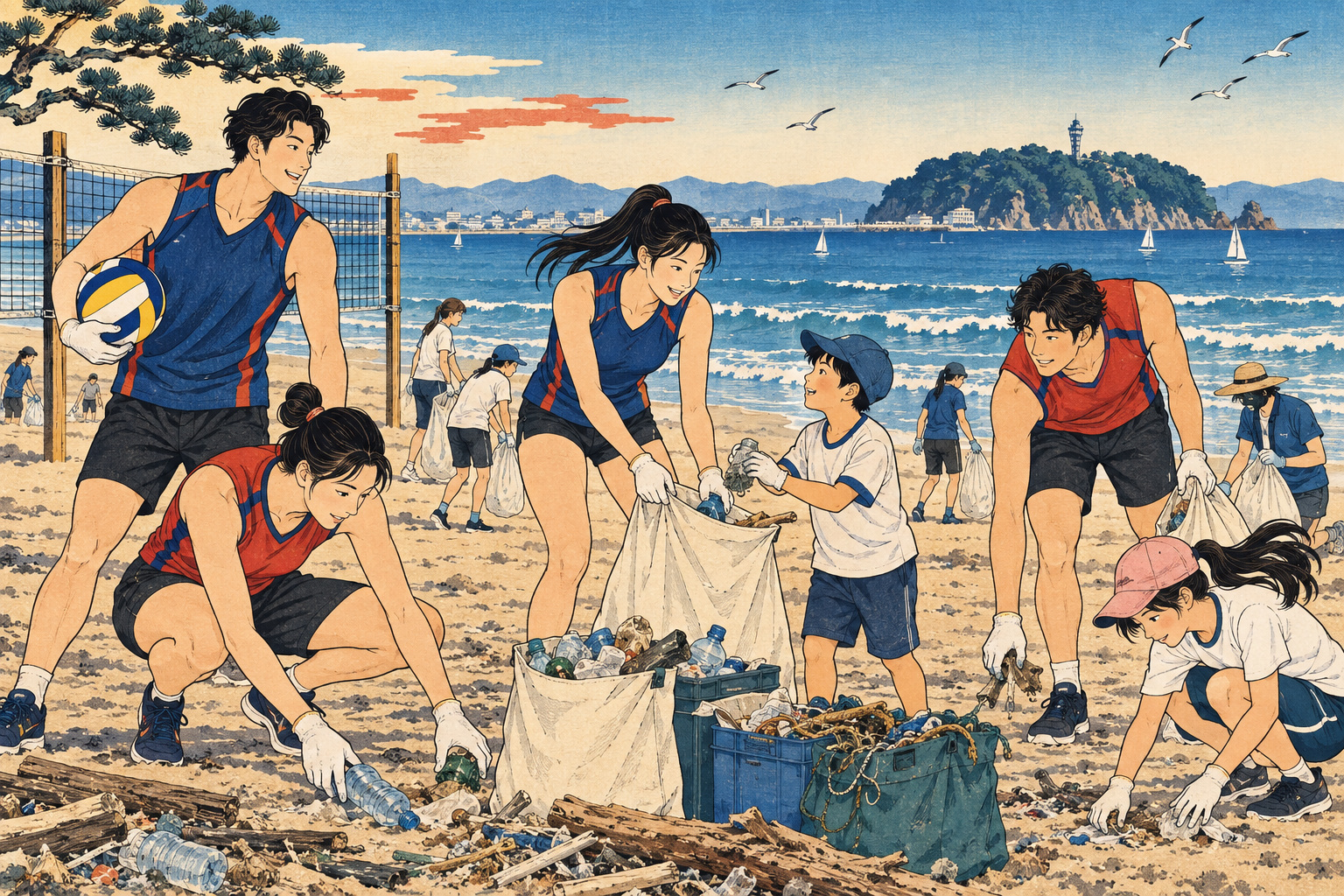
A beach cleanup bringing together active beach volleyball players and members of the public is scheduled for 2 p.m. on September 13 at Shonan Bellmare Hiratsuka Beach Park by shonanzoen in Kanagawa Prefecture. The Specially Certified NPO Riviera Future Creation Project, which is organizing the event, announced the plan on September 7.
The timing is the point. The Japan Beach Volleyball Tour 2026 Hiratsuka tournament runs at the same venue from September 10 through 13. Semifinals, finals and the awards ceremony are on the final morning; the cleanup is due to begin that afternoon. The athletes’ workplace and the volunteers’ environmental classroom will be the same stretch of sand.
The final day has a second field of play
Registration and assembly are set for 1:50 p.m.; people volunteering to help operate the event are asked to arrive at 1:30. Organizers say they will provide tongs and rubbish bags, while participants should bring drinks and wear clothes suitable for the work. The event is free and open to children, students, adults, families, companies, groups and visitors, but advance registration is required.
The institutional lines matter. The volleyball tournament—officially the Japan Beach Volleyball Tour 2026, Round 6 Hiratsuka, Arai Shoji Cup—is organized by the Japan Volleyball Association (JVA) and the Japan Beach Volleyball Federation. The cleanup is organized by Riviera Future Creation Project. They share a place and a partnership, but they are not the same event. That distinction determines who is responsible for participant information, safety, waste handling and any later claim about environmental results.
The tournament field comprises 16 men’s and 16 women’s teams. Competition starts on September 10, moves through pool play and quarterfinals, and concludes with six semifinal and final matches on the morning of September 13. Turning spectators’ attention from the ball to the sand immediately afterward gives the cleanup an audience it might not otherwise reach.
The athlete roster remains deliberately blank
The September 7 organizer release says active beach volleyball players are expected to join the public. It also names JVA Beach Volleyball Division head Kawai—whose given name is written 庶 in the Japanese announcement—as a planned participant. It does not publish a roster of individual athletes.
Japan.co.jp therefore does not name tournament entrants as cleanup participants or report participation in the past tense. Athletes associated with Hiratsuka, finalists and well-known players cannot be assumed to attend. Tournament timing, weather and physical condition can change a plan. As of publication, the number of participants, the athletes who actually take part, the volume and composition of collected waste, and the event’s completion are all unknown.
This is more than grammatical caution. Promotional announcements often compress intention and outcome into one attractive image. A credible preview keeps the future open and returns after the event for attendance, cancellations, collection records and waste-disposal details.
Hiratsuka made its shore a civic sports venue
Hiratsuka City describes the park as a coastal public space equipped for beach volleyball, beach soccer and beach football, with a boardwalk and regular national-level competition. Equipment is available to borrow free of charge. It is not merely an arena installed beside the sea; it is a municipal beach where casual users, residents and elite athletes overlap.
The city introduced naming rights in fiscal 2014. The current official nickname, “Shonan Bellmare Hiratsuka Beach Park by shonanzoen,” reflects a renewed agreement with local company Shonan Landscaping. The tournament’s own history says local corporate support began in 2015 and that Hiratsuka became a formal stop on the national tour in 2016. The 2020 tour was cancelled or reorganized amid the pandemic; the annual line resumed thereafter.
This history gives the cleanup a meaning beyond tidying an event site. Beach volleyball cannot be detached from grain size, surface safety, wind and shoreline access. Care for the court is care for a public landscape—but only if the public remains more than background scenery for the competition.
What a cleanup can remove—and what it cannot
A conventional cleanup can intercept bottles, packaging, cigarette butts, fishing-gear fragments and larger pieces of plastic before they fragment further or return to the water. Riviera says items of those kinds have appeared during earlier activities. That is the organizer’s field observation, not a composition study of the September 13 site.
Microplastics, generally defined as pieces no larger than five millimetres, are a different problem. Many are difficult to see and cannot be systematically removed with ordinary tongs and bags. A photograph of full sacks therefore cannot stand in for the amount of plastic pollution eliminated. Visible litter collected, area covered and volunteer hours are useful operational measures; they are not equivalent to avoided leakage or ecological recovery.
The strongest educational version of the event would make that limit visible. Participants can look at where material accumulates along the high-tide line, classify what they find, ask which items arrived from rivers or local use, and follow what happens after the bags leave the beach. Without that chain, “awareness” remains a claim rather than a demonstrated result.
Microplastics make the local problem measurable
Hiratsuka is not merely a convenient backdrop for a global concern. The Kanagawa Environmental Science Center sampled stranded microplastics at four Sagami Bay beaches and one Tokyo Bay comparison site 15 times between May 2017 and May 2018. Researchers marked 40-centimetre squares along the high-tide line and collected surface sand and deposited material.
At Takahamadai in Hiratsuka and Kugenuma in Fujisawa, the prefecture found all three principal polymers in its survey: polyethylene, polypropylene and polystyrene. A prefectural summary gives an average of about 1,900 pieces per square metre at Takahamadai for the non-exceptional spring samples across 2017 and 2018. Resin pellets—the industrial feedstock from which plastic products are made—were also collected there.
That figure requires discipline. It comes from a historical survey with a defined sampling method; it is not a reading of the beach in September 2026, and it should not be compared casually with bags of visible waste. Drift changes with storms, currents, rivers, wind, season and the timing of earlier cleanups. The study’s value here is not a dramatic current score. It shows that local sand can hold material far smaller than volunteers ordinarily pick up, and that repeatable sampling is possible.
Five years is long enough to ask for evidence
Riviera says its cooperation with the JVA has reached a fifth year. The NPO describes LOVE OCEAN as a program connecting 13 beaches along roughly 110 kilometres from Miura to Yugawara, a zone it calls the “Shonan Coast.” That label, distance and frame belong to the organizer’s own project; they are not an administrative definition of Shonan.
Continuity matters. Athletes can bring children and fans into a conversation that an environmental seminar may never reach. Sports bodies can normalize stewardship as part of participation, not as a specialist concern. A recurring program can also reveal whether the same material keeps returning to the same places.
But a fifth year should invite harder questions. Does the program use a standard classification of collected items? Are weight, area and volunteer time recorded consistently? How many participants return? Does tournament procurement reduce disposable material? Which leakage sources recur, and have organizers or municipalities acted on them? The September announcement provides no cleanup target or measurement protocol. That absence does not make the event worthless; it limits the environmental claims that can responsibly be made.
A certificate can open the door, but cannot be the lesson
Organizers plan to issue volunteer certificates and present them as potentially useful for school inquiry projects, job applications and corporate social-responsibility records. A certificate can lower the psychological barrier to a first day of service, especially for students looking for a concrete starting point. It proves attendance if administered clearly. It does not by itself prove learning, ecological impact or a participant’s commitment.
The learning lies in the before and after. Why does litter gather at the tide line? How can fragments of artificial turf, fishing material, packaging and resin pellets be distinguished? How do urban drains and rivers connect inland consumption to Sagami Bay? Where does collected material go, and what portion can actually be recycled? An athlete can add something distinctive by explaining how sand condition affects training and competition. A scientist or city official can add methods and pathways. The combination turns a physical task into inquiry.
The September release does not specify the certificate’s issuer, assessment criteria or documentary format. Participants who need it for a formal program should confirm those details with the organizer rather than assume that every institution will accept it.
The real contest begins upstream
Japan enacted its coastal-drift-waste law in 2009. Amendments in 2018 expanded the framework to address floating and seabed litter and added measures concerning microplastics. In 2019, the national Marine Plastic Litter Action Plan set out a broader sequence: proper collection and disposal, prevention of littering and unintended leakage, recovery before waste reaches the ocean, retrieval after release, development of alternatives, international cooperation, and scientific monitoring.
The sequence clarifies the place of Hiratsuka’s event. Cleaning the beach is necessary downstream work. Lasting reduction also requires controls in streets and rivers, fewer unnecessary disposables at events and shops, prevention of industrial pellet loss, better product design and reliable waste systems. A successful cleanup may collect more in one year because conditions were worse, not because the program was more effective. The long-term goal should be to need fewer bags.
Japan.co.jp’s analysis is that the event’s strongest asset is not the publicity photograph of a player holding litter. It is the ability of sport to gather fans, children, companies, governing bodies and local government around a place they value for different reasons. On September 13, the count that matters will not be bags alone. It will be whether observation, prevention and a reason to return survive after the tournament structures come down.
- When: Sunday, September 13, 2026, from 2 p.m.; registration and assembly at 1:50 p.m.
- Where: Shonan Bellmare Hiratsuka Beach Park by shonanzoen; look for Riviera’s blue flag.
- Access: Free, with advance registration. Organizers provide tongs and bags; bring a drink and suitable clothing.
- Athletes: Active players are expected, but no individual athlete roster had been published by September 7.
- Status: The event had not taken place when this article was published. Check the organizer for weather or schedule changes.
- Riviera’s event notice and the organizer-supplied detailed release—schedule, venue, access, equipment, expected participants and partnership history.
- Official Hiratsuka tournament site—competition schedule, field, organizers and local tournament history.
- Hiratsuka City naming-rights page and city beach-park guide—official nickname, facilities and public access.
- Kanagawa Prefecture survey results and microplastics briefing—sampling method, dates, polymer groups and spring average.
- Kanagawa Prefecture, “Microplastics Stranded in Sagami Bay”—resin pellets collected at Takahamadai.
- Ministry of the Environment on the amended coastal-litter law and the 2019 Marine Plastic Litter Action Plan—national policy history and prevention framework.
Editorial method: This is an advance report. Future plans are not presented as completed acts. Organizer descriptions are attributed; local environmental findings come from Kanagawa Prefecture primary material. Athlete identities, turnout, collected quantities and event results remain unverified and are omitted.