¥370 trillion is not a slogan. It is a bill.
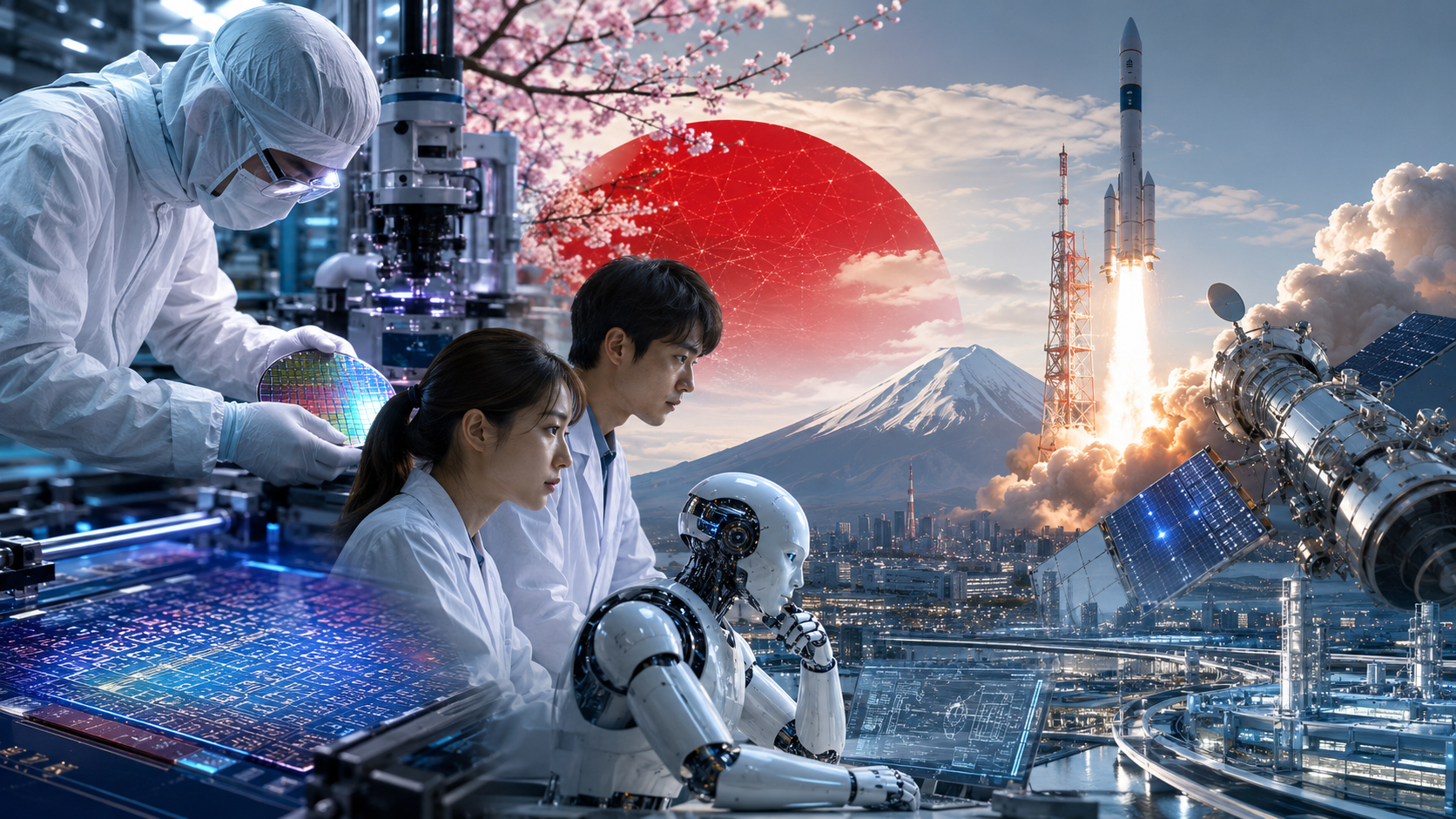
Japan’s reported plan to target roughly ¥370 trillion, or about $2.3 trillion, in combined public and private investment by 2040 asks one large question: can Japan become a building nation again? Not in the old Showa sense of mass production and export muscle, but in the new strategic economy of artificial intelligence, semiconductors, space systems, quantum technology, cybersecurity, robotics, batteries, decarbonization, biotech, defense-adjacent technology and data infrastructure.
This is not just another subsidy story. Government spends. Companies invest. Factories are built. Stocks rise. That is the cheerful version. The harder version is that ¥370 trillion is also a measure of what Japan thinks it has lost. Japan once stood at the center of semiconductors, consumer electronics, precision manufacturing, materials, machine tools and automobiles. But in digital platforms, smartphones, cloud computing, software ecosystems and generative AI, the commanding heights moved elsewhere.
If the new growth strategy matters, it cannot simply mean helping old companies survive. It must mean rebuilding the national capacity to invent, manufacture, compute, launch, secure and sell in the technologies that will shape the next fifteen years.
The news hook: public spending to move private capital
Reuters, citing Nikkei, reported that Japan plans to set a target of about ¥370 trillion in combined public and private investment by 2040 across 17 strategic sectors. The focus areas include AI, chips and space development. The government is also considering a multi-year budget framework and bridging bonds to provide stable funding for investments deemed critical to economic security.
The framework matters because Japanese corporate investment has been cautious for a long time. After the bubble burst, companies repaired balance sheets, reduced debt, accumulated cash and learned the defensive arts of survival. That caution made sense. But in a technology transition, excessive caution becomes its own form of risk. AI computing capacity, advanced semiconductor fabs, space infrastructure and quantum systems require heavy investment before profits are visible.
The state is therefore trying to absorb part of the first risk. If it works, public money becomes a catalyst for private investment. If it fails, it becomes industrial policy theater. That is the line Japan must not cross.
The MITI memory: Japan has done industrial policy before
Japan is not unfamiliar with state-guided industrial development. In the postwar decades, the Ministry of International Trade and Industry helped shape the rise of steel, shipbuilding, petrochemicals, automobiles and electronics. The government did not create Japan’s miracle by itself. Corporate execution, export markets, worker skill, bank finance, the U.S. market and the Cold War order all mattered. But the state helped set direction, coordinate bottlenecks and create conditions for competition.
The lesson is not that bureaucrats can pick every winner. The better lesson is that a capable state can create a runway. Companies still have to fly. Researchers still have to invent. Engineers still have to solve hard problems. Entrepreneurs still have to risk embarrassment and failure. Subsidies do not become industries automatically.
Japan’s new strategy will succeed only if it combines public support with real competition. If the money merely protects familiar names, it will preserve the past. If it forces new alliances, new entrants and new accountability, it may buy time for the future.
Semiconductors: the former champion returns to a different game
Semiconductors sit at the center of the strategy. In the 1980s, Japan was a global semiconductor power. Japanese memory chipmakers dominated, and the phrase “electronics nation” had real industrial weight. Then came trade friction, brutal capital expenditure cycles, the rise of South Korea and Taiwan, the shift to foundry models, and the growing importance of software and platforms. Japan retreated from the center of the chip map.
But Japan never disappeared from semiconductors. It remained strong in materials, equipment, silicon wafers, photoresists, precision components, testing tools and manufacturing know-how. In other words, Japan lost the crown in some finished chip markets but retained important parts of the machinery that makes modern chips possible.
The strategic question is whether Japan can connect those strengths to the AI era. Rapidus, the Kumamoto semiconductor cluster, advanced packaging, power chips, materials and equipment are all pieces of that answer. The government has already set a 2040 target of ¥40 trillion in domestic semiconductor-related sales and has indicated more than ¥10 trillion in public support for AI and semiconductors by fiscal 2030. This is not nostalgia for the 1980s. It is a recognition that if chips stop, cars, hospitals, defense systems, grids, factories and finance all feel it.
AI: the problem is not just models
AI is both a promise and an embarrassment for Japan. The promise is obvious. Japan has factories, robots, logistics networks, medical systems, aging-care needs, public services, gaming, animation, finance, tourism and disaster response—all domains where AI could be useful. A shrinking workforce gives companies a practical reason to automate. Aging gives government and households a practical reason to use AI in care, health and administration.
The embarrassment is that Japan has lagged in the foundations: large-scale computing capacity, cloud infrastructure, software talent, startup finance, data mobility and executive speed. Microsoft’s 2026 announcement that it would invest $10 billion in Japan through 2029 for AI infrastructure, cybersecurity and workforce development shows that global companies see Japan as strategically important. It also shows Japan’s dependence on foreign cloud giants.
The answer cannot be a simplistic call for “domestic AI.” Japan needs AI that works in Japanese, respects sensitive data, can be deployed inside factories and government agencies, and improves productivity in the real economy. The most important Japanese AI may not be flashy chatbots. It may be quiet systems that reduce hospital paperwork, predict machine failure, optimize logistics, support local governments and help small manufacturers do more with fewer people.
Space: from romance to infrastructure
Space is another pillar of the strategy because space is no longer just science, prestige or national romance. It is positioning, timing, communications, weather, disaster monitoring, maritime surveillance, missile warning, agriculture, finance, logistics and defense. Satellites are becoming part of the operating system of modern economies.
Japan has a serious space history: JAXA, H-IIA, H3, Hayabusa, asteroid sample return, the Kibo module on the International Space Station and sophisticated satellite technology. But commercial space is moving fast. The United States has private launch giants. China, India and Europe are expanding. Japan needs not just successful national missions but a private space ecosystem that can build launch services, satellites, data businesses, debris removal, lunar systems and security applications.
The Space Strategy Fund established through JAXA, aiming at ¥1 trillion over 10 years, is important because it changes JAXA’s role. The agency is not only a research and implementation body; it is becoming a funding platform for private-sector technology development. That is a different model, and it reflects a different age.
Economic security: growth policy becomes security policy
The old separation between economic policy and national security is fading. Semiconductors are commercial products and defense inputs. AI raises productivity and enables cyberattacks. Space systems serve farmers and militaries. Batteries support decarbonization and expose mineral dependence. Data centers are business infrastructure and strategic infrastructure.
Japan is especially exposed. It imports much of its energy and resources. It depends on sea lanes. It sits near China, Russia, North Korea and the Taiwan Strait. Excessive dependence on a single foreign supplier, country or region is no longer simply a corporate risk. It is a national risk.
That is why AI, chips and space are now part of economic security. But the term “economic security” can also be dangerous. It can justify almost anything. A program that strengthens national resilience is one thing. A program that protects inefficient incumbents by calling every weakness a security issue is another. Japan will need discipline.
The biggest risk: subsidies can build companies without building industries
The greatest danger in the ¥370 trillion strategy is that the number itself creates comfort. A factory is not an industry. A research center is not an invention. A fund is not a market. A subsidy is not a customer.
Japan’s problem is not a total absence of technology. It is the speed of turning technology into business, the willingness to fund young firms, the procurement culture that avoids startups, the difficulty of attracting foreign technical talent, the weakness of university-to-market pathways, the treatment of software engineers and the slow decision-making of many large companies.
Public money can help, but only if it changes behavior. If it mostly supports established firms, protects old employment models and produces elegant committee documents, it will become a preservation policy. If it creates competitive pressure, builds shared infrastructure, attracts global talent and rewards measurable progress, it can matter.
Will the regions benefit?
The geographic question matters. Will this strategy remain a Tokyo policy, or will it redraw Japan’s industrial map? Semiconductor investment in Kumamoto is already changing local labor markets, housing, infrastructure, education and water demand. Rapidus in Hokkaido, semiconductor clusters in Kyushu, materials and components in Tohoku, research centers around Tsukuba, space activity in Hokkaido and Tanegashima, batteries in Kansai—all point toward a distributed industrial strategy.
But factories do not automatically enrich regions. They require housing, schools, transport, power, water, supplier networks and living conditions for Japanese and foreign engineers. They can raise wages and tax revenue, but they can also raise rents, strain local services and compete with existing employers for labor. Industrial policy becomes regional policy, education policy and immigration policy.
The fiscal question: investment or debt?
Japan’s public debt is already large. A ¥370 trillion target therefore requires more than optimistic language. The government must define what counts as investment, how funds are allocated, what performance measures are used, when projects are reviewed, and how failures are shut down.
Multi-year budgets can be useful. Semiconductor fabs, AI infrastructure and space systems do not fit neatly into one-year fiscal cycles. If Japan wants to compete in deep technology, it needs patient capital. But patient capital cannot mean permanent capital with no discipline. Long-term funding requires long-term oversight.
What should Japan be selling in 2040?
If the strategy succeeds, what will the world buy from Japan in 2040? Advanced chip materials. Low-power AI hardware. Factory AI systems. Disaster-monitoring satellite data. Space debris removal. Secure administrative AI. Medical and elder-care robotics. Decarbonization materials. Trusted data-center infrastructure. Precision sensors. Hydrogen and ammonia control systems. Integrated resilience technology for cities, factories and defense.
The key is combination. Japan’s strength has never been only one product. It lies in materials, components, equipment, production discipline, trust, reliability and complex integration. The U.S. may lead in foundational AI models. Taiwan and South Korea may dominate advanced chip manufacturing. China and the U.S. may lead in launch scale. But Japan can compete where AI meets manufacturing, where space meets disaster response, where robotics meets aging, and where materials meet energy security.
Conclusion: this is not a second high-growth era
It is tempting to call the ¥370 trillion plan a new high-growth strategy. But postwar high growth was built on a young population, urbanization, export expansion, reconstruction, cheap energy and the Cold War order. Japan’s 2040 strategy must work in a different world: aging, population decline, climate risk, fiscal constraint, geopolitical tension and labor scarcity.
That means the goal is not to return to the past. It is to make a smaller, older society more productive, secure and technologically valuable. Japan may not become bigger. But it can become harder to replace.
The ¥370 trillion number is large. The more important number is the time left. 2040 is not distant. Today’s elementary school students will be entering the workforce. Today’s young engineers will be mid-career leaders. Today’s factories, universities and startups will either have proved themselves or missed the window.
Government can provide money. Companies can build plants. Universities can conduct research. But the future does not come out of a budget document. It comes from people willing to take risk, build hard things and sell them to the world.
- The reported ¥370 trillion target is a strategic investment plan across 17 fields, including AI, semiconductors and space.
- The goal is not only growth, but economic security, technological resilience and industrial renewal.
- Japan’s semiconductor strategy builds on remaining strengths in materials, equipment and precision manufacturing.
- AI success will depend on computing power, talent, data governance and practical deployment in real workplaces.
- Space is shifting from national prestige to commercial and security infrastructure.
- The biggest risk is that subsidies preserve incumbents instead of creating competitive new industries.
Sources and reference
This article is based on Reuters reporting, METI materials, JAXA information and related official documents. Parts of the investment plan remain at the reported stage and may change as formal policy and budget details are released.
- Reuters: Japan to target $2.3 trillion public-private investment by 2040, Nikkei reports
- Reuters: Japan targets fivefold rise in domestically made chip sales by 2040
- METI: Industrial Structure in 2040 Led by Growth Investment
- METI: Space Strategy Fund Basic Policy and Implementation Policy
- JAXA: Overview of the Space Strategy Fund
- Reuters: Microsoft to invest $10 billion in Japan for AI and cyber defence expansion
- Reuters: Japan approves additional support for Rapidus