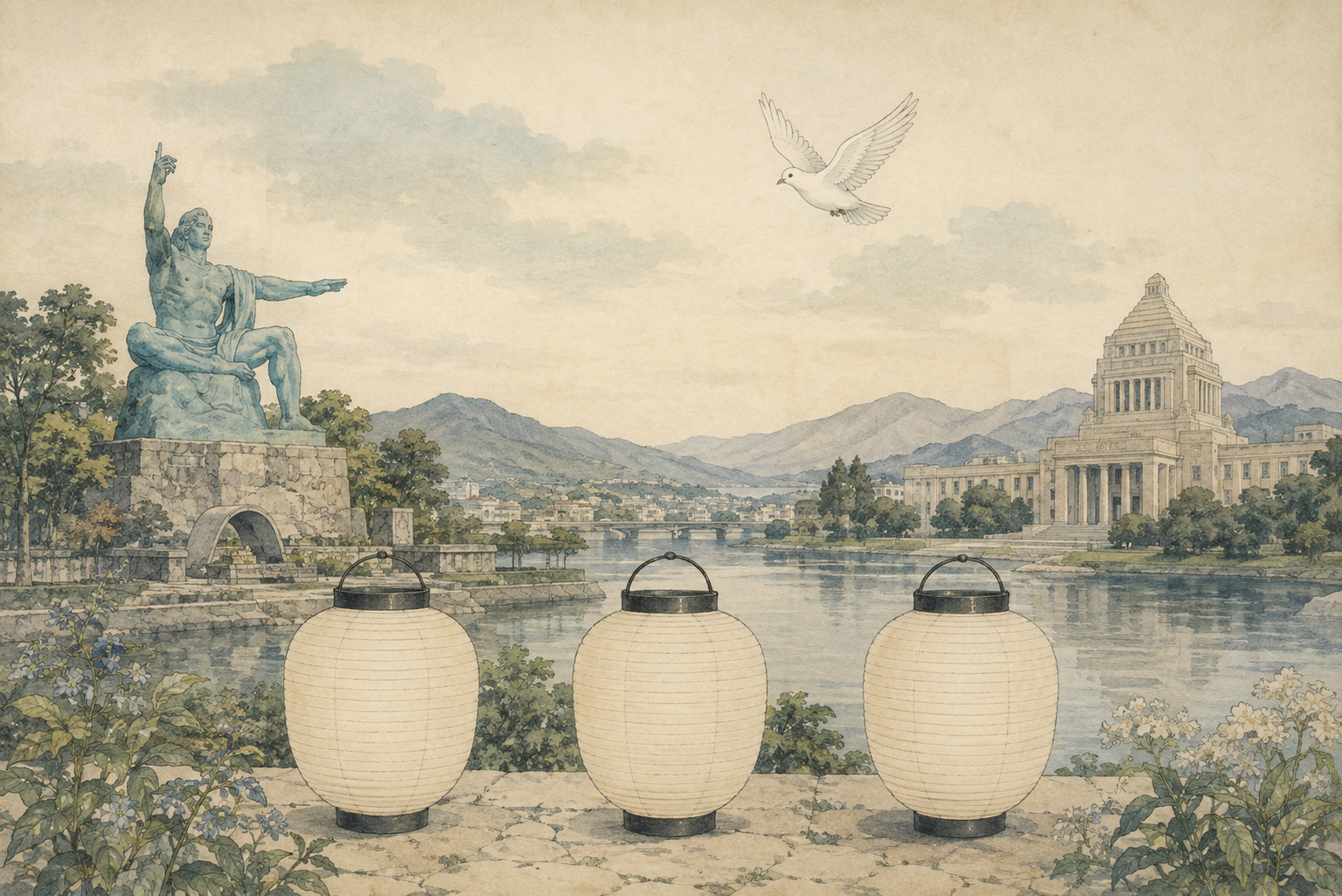
In Nagasaki, time stops at 11:02. In Tokyo, the clock of security policy never does. One measures the instant a plutonium bomb destroyed a city. The other measures Chinese warheads, North Korean missiles, Russian threats and the credibility of an American promise. In August 2026, those two clocks met inside thirteen Japanese characters: mottazu, tsukurazu, mochikomasazu — do not possess, do not produce, do not permit nuclear weapons to be introduced.
The collision had been building. In July, Defense Minister Shinjiro Koizumi argued that Japan should discuss nuclear-related choices without taboos or prematurely excluding options, citing the changing security debate in Europe. On August 4 he repeated the government’s adherence to the principles, but also said policy should be debated without taking choices off the table and that revisions to the National Security Strategy and two companion documents remained under consideration.
That same day in Nagasaki, 32 civic organizations, including groups representing atomic-bomb survivors, issued a joint protest. Their fear was not that Japan would begin building a bomb the next morning. It was that the boundary between what may be discussed and what may be done would move by degrees — and that a norm hibakusha spent 81 years building against nuclear use would weaken without one unmistakable decision.
Takaichi, questioned after the Hiroshima ceremony on August 6, said the government upheld the principles as a policy position. She also said work on the security documents was continuing and their contents were not fixed. That formulation is politically important. It preserves the present rule while declining to declare every element permanently closed to review.
The public has not issued a blank check for change. A nationwide Japan Public Opinion Research Association survey of 3,000 people conducted in June and July found 76 percent favored maintaining the principles. Seventy-seven percent opposed nuclear sharing with the United States, while 55 percent supported Japan joining the Treaty on the Prohibition of Nuclear Weapons. A debate may be occurring inside government, but public permission for a new nuclear posture has not followed.
Before the three promises, Japan experienced a “third exposure”
Japan’s antinuclear consciousness did not end with Hiroshima and Nagasaki, and it did not emerge fully formed in August 1945. On March 1, 1954, the United States detonated the Castle Bravo hydrogen bomb at Bikini Atoll. The explosion was far more powerful than expected. Radioactive fallout dusted the Japanese tuna boat Daigo Fukuryu Maru — Lucky Dragon No. 5 — even though the vessel was roughly 160 kilometers from the blast.
All 23 crew members were exposed. Radio operator Aikichi Kuboyama died six months later. Contaminated tuna entered Japanese ports and was discarded, pulling an invisible nuclear danger into kitchens and markets. At a moment when Hiroshima and Nagasaki could be treated as terrible but distant events of wartime, Bikini demonstrated that testing in peacetime could injure fishermen, contaminate food and cross national borders.
Petitions demanding a ban on atomic and hydrogen bombs spread rapidly. In 1956, survivor groups formed Nihon Hidankyo, the Japan Confederation of A- and H-Bomb Sufferers Organizations. Hibakusha connected medical relief and legal recognition at home with an international demand for abolition. Their intervention put the body — burned, irradiated, stigmatized and aging — into what governments preferred to discuss as strategy.
This history matters because the Three Non-Nuclear Principles were not simply bestowed by a visionary prime minister. They grew from civic pressure, electoral constraint, Cold War diplomacy and a repeated public insistence that Japan’s security identity must reflect what nuclear weapons had done to Japanese cities and citizens.
1967: a peace principle born inside an Okinawa negotiation
Prime Minister Eisaku Sato first stated the three principles together in the House of Representatives Budget Committee on December 11, 1967. Japan, he said, would not possess nuclear weapons, would not produce them and would not permit their introduction into Japanese territory. The sentence became famous. Its setting is just as important: Sato was negotiating the return of Okinawa from American administration.
U.S. forces had stationed nuclear weapons in Okinawa. Reversion posed an unavoidable question. Would the islands remain a nuclear outpost after returning to Japan, even while the home islands lived under a nonnuclear declaration? Sato demanded reversion “without nuclear weapons and on the same footing as the mainland.” In the 1969 Sato-Nixon joint communiqué, the United States pledged to carry out reversion in a manner consistent with Japan’s nonnuclear policy. Administrative rights returned in 1972.
The Diet gave the principles further authority. In 1971, the House of Representatives adopted a resolution asking the government to observe them and ensure that Okinawa was free of nuclear weapons at reversion and afterward. During Japan’s 1976 ratification of the Nuclear Non-Proliferation Treaty, committees in both houses described the principles as a national policy and called for their faithful implementation.
Yet the principles are neither a clause of the Constitution nor a standalone statute. They are a political norm accumulated through a prime minister’s statement, Diet resolutions and repeated commitments by successive cabinets. Legally, that makes them easier to change than the Constitution. Politically, it makes change unusually expensive: a government would have to reverse half a century of official language, parliamentary intent and international identity.
The nuclear umbrella was part of the design from the start
Sato’s nuclear policy contained more than the three prohibitions. It combined support for disarmament, the peaceful use of atomic energy and dependence on U.S. extended deterrence under the security alliance. Japan would possess no nuclear weapon of its own, but an adversary would be deterred by the possibility that the United States — using forces outside Japan if necessary — could retaliate after an attack.
This is the nuclear umbrella. Its paradox is not a later corruption of the principles; it is embedded in their original architecture. Japan could present itself as nonnuclear at home while relying on a nuclear-armed ally abroad. Officials argued that submarines, bombers and intercontinental missiles allowed U.S. deterrence to function without stationing nuclear arms on Japanese territory. Critics asked whether a state that ultimately relied on the threat of nuclear use could credibly lead abolition.
Sato received the Nobel Peace Prize in 1974, with the principles central to his international reputation. Fifty years later, in 2024, Nihon Hidankyo received the same prize. The two awards illuminate Japan’s competing nuclear narratives. One celebrates a state that renounces domestic nuclear arms while borrowing deterrence from an ally. The other honors survivors who argue that deterrence itself rests on a credible threat to burn cities.
Each side begins with a different danger. Deterrence advocates fear that removing a threat of retaliation invites coercion or attack. Abolitionists fear that maintaining thousands of weapons guarantees some continuing risk of accident, miscalculation, escalation or deliberate use. Nagasaki makes the second risk impossible to treat as an abstraction; alliance planners insist that present adversaries make the first impossible to ignore.
Why “not permitting introduction” was always the vulnerable promise
The first two principles regulate acts by Japan: possession and production. The third regulates activity by Japan’s ally — port visits, overflights, transit and base operations by American forces. It therefore touches classified deployments and the former U.S. policy of neither confirming nor denying the presence of nuclear weapons. At precisely that seam, verification and explanation became uncertain.
Under arrangements made when the Japan-U.S. Security Treaty was revised in 1960, the introduction of nuclear weapons into Japan was subject to prior consultation. But Tokyo and Washington did not share a clear public definition of “introduction.” Did it include a short port call by a nuclear-armed vessel or passage through Japanese waters? Japanese governments said that because Washington had never requested prior consultation, no introduction had occurred. The answer assumed the United States defined the trigger in the same way.
A Foreign Ministry investigation released in 2010 found no explicit secret written agreement authorizing nuclear-armed ship visits. Its expert panel nevertheless concluded that an implicit understanding had developed because both sides deliberately left their differing interpretations unresolved. In the panel’s language, that could be regarded as a secret agreement in the broader sense. The distinction mattered: there may have been no signed permission slip, but there was a political arrangement sustained by ambiguity.
Then-Foreign Minister Katsuya Okada acknowledged that past nuclear entry could not be ruled out conclusively. He also said that in a grave emergency threatening Japan’s survival, a government might have to make a decision and explain it to the public. That statement anticipated today’s debate. The vulnerability of the third principle does not begin with the Takaichi government; it has existed wherever a categorical public promise met the operational logic of a nuclear alliance.
- Three Non-Nuclear Principles: Japan will not possess, produce or permit the introduction of nuclear weapons.
- Extended deterrence: a U.S. commitment to deter attacks on Japan using the full range of capabilities, including nuclear forces.
- Nuclear sharing: arrangements — associated most visibly with NATO — in which allied territory, aircraft, planning or personnel play roles connected to U.S. nuclear weapons. Models differ.
- NPT: the Nuclear Non-Proliferation Treaty, which distinguishes five recognized nuclear-weapon states and obliges other parties, including Japan, not to acquire nuclear arms.
- TPNW: the Treaty on the Prohibition of Nuclear Weapons, which comprehensively prohibits possession, use and assistance with nuclear weapons for its parties.
Why the argument returned in 2026
Japan’s strategic environment is harsher than it was when the principles were proclaimed. China has expanded and diversified its nuclear arsenal alongside conventional missile and naval forces. North Korea has developed nuclear devices and missiles capable of reaching Japan. Russia’s invasion of Ukraine, nuclear signaling and closer military activity with China have changed how officials discuss escalation. Washington’s political polarization has also sharpened a long-standing question: would an American president risk a U.S. city to defend an ally?
Tokyo’s answer so far has been to strengthen, not abandon, extended deterrence. In June 2026, Japanese and American officials meeting through the Extended Deterrence Dialogue reaffirmed that the United States would defend Japan using the full range of capabilities, including nuclear ones. The alliance consults on threat assessments, crisis communication, force posture and how deterrence messages are understood by adversaries.
Supporters of reviewing the third principle argue that a categorical ban may reduce flexibility in an extreme crisis. If the United States needed to disperse forces, make a port call or demonstrate resolve, they say, an absolute territorial prohibition could weaken deterrence precisely when credibility mattered most. Some proponents also argue that discussing contingencies publicly can reveal tradeoffs before an emergency rather than improvising under pressure.
Opponents answer that this logic turns every exceptional scenario into a lever against a rule built from exceptional suffering. Japan already receives extended deterrence from submarines, bombers and missiles that do not need to be based in Japan. Allowing nuclear introduction might make Japanese bases more prominent targets, provoke regional arms competition and destroy the trust Japan uses in disarmament diplomacy. Above all, they argue, a threat to incinerate civilians cannot be normalized merely by calling it reassurance.
The dispute therefore concerns more than a weapon’s location. It concerns whether visibility produces credibility or danger; whether ambiguity protects an alliance or deceives citizens; and whether the experience of Hiroshima and Nagasaki should limit what Japan may prepare for even when other states refuse the same restraint.
Nuclear sharing is not the same as an independent Japanese bomb
Public arguments often leap from “review” to “nuclear armament,” collapsing very different choices. Maintaining current policy, creating an emergency exception, entering a sharing arrangement and building a national arsenal carry different legal, strategic and operational consequences. None has been adopted by Japan as a new policy.
| Option discussed | What it would mean | Principal consequence |
|---|---|---|
| Keep all three principles unchanged | No Japanese possession or production and no permitted introduction by an ally. | Preserves the clearest continuity with postwar policy while relying on offshore or distant U.S. nuclear forces. |
| Emergency exception | A government could permit entry in a narrowly defined national-survival crisis. | May add operational flexibility but makes the third principle conditional and raises hard questions about who decides and when. |
| Nuclear sharing | Japan would assume some role connected to U.S. weapons, planning or delivery under an agreed model. | Would demand major policy, alliance, basing and public-consent changes; it is not equivalent to Japanese ownership. |
| Independent arsenal | Japan would design, produce and control its own nuclear weapons and delivery system. | Would overturn all three principles, collide with NPT obligations and transform Japan’s diplomacy and regional security. |
An independent arsenal is not a simple extension of Japan’s civilian nuclear program. It would require weapon design, production decisions, delivery systems, command-and-control arrangements, secure communications, doctrine, testing or alternative validation, and long-term stewardship. It would also require a political decision to breach or leave treaty commitments, absorb sanctions and alliance consequences, and accept the risk of triggering new military responses in the region.
What 44.4 tons of plutonium does — and does not — mean
Japan reported about 44.4 metric tons of separated plutonium held domestically and overseas at the end of fiscal 2025. Because plutonium can be used in nuclear explosive devices, the number is frequently cited in arguments that Japan is a “threshold” state. The stockpile deserves scrutiny, but it must be described accurately.
The material belongs to a declared civilian fuel cycle and is subject to international safeguards. The government maintains a policy of not holding plutonium without a specified use and publishes inventory data. A large civil stock does not equal an assembled arsenal. Turning safeguarded material into deployable weapons would require a chain of prohibited, observable and politically consequential acts.
That does not make the inventory irrelevant. Reprocessing plans, delays in consuming mixed-oxide fuel and the gap between separated material and realistic demand have long raised nonproliferation questions. Transparency and reduction matter precisely because Japan asks other countries to trust its nonnuclear identity. But technical capability is not policy inevitability, and material is not a bomb.
The NPT, the prohibition treaty and Japan’s contested “bridge”
Japan signed the Nuclear Non-Proliferation Treaty in 1970 and ratified it in 1976. As a non-nuclear-weapon state party, it undertook not to manufacture or acquire nuclear weapons. Japanese diplomacy treats the NPT — with its near-universal membership, safeguards system and bargain linking nonproliferation to disarmament — as the practical center of global nuclear order.
The Treaty on the Prohibition of Nuclear Weapons begins from a different premise: the humanitarian effects are so unacceptable that possession, use, threatened use, stationing and assistance must be prohibited. It entered into force in 2021. Japan has not joined and has not participated as an observer at meetings of states parties, arguing that the treaty lacks the nuclear-armed states and that deterrence remains necessary in the current environment.
Successive governments have described Japan as a bridge between nuclear-weapon states and nonnuclear states. Hibakusha and prohibition-treaty supporters challenge the metaphor. A bridge, they say, must actually be walked across. If Japan seeks stronger nuclear guarantees while staying outside negotiations designed to stigmatize the weapons, its claim to connect the two camps begins to sound like a way of occupying both banks without moving either.
Defenders of the government’s approach respond that disarmament without the participation of nuclear powers cannot reduce a single operational warhead. They favor risk-reduction, transparency, arms control and incremental reductions through the NPT framework. The difficult truth is that the two approaches answer different questions: one asks what law and morality should prohibit; the other asks what adversaries can be persuaded to do now.
After the secret-agreement inquiry, Nagasaki asked for law
The 2010 disclosure of deliberate ambiguity intensified calls in Nagasaki to place the principles in legislation. A legal guarantee, supporters argue, would prevent a cabinet from weakening a national commitment through reinterpretation or an executive decision. It would turn a moral promise into a rule with procedures, definitions and democratic accountability.
Codification creates difficult design questions of its own. Would the statute define “introduction” to include transit, overflight and brief port calls? How would compliance be verified when an ally refuses to confirm a weapon’s location? Would an emergency exception exist, and who could invoke it? Could operational secrecy coexist with a public evidentiary standard? A vague law might reproduce the old ambiguity; an absolute one would deliberately constrain alliance choices.
Still, those questions are an argument for drafting carefully, not for pretending the current arrangement is self-executing. The principles’ history shows that ambiguity is itself a policy choice. It may preserve diplomatic room, but it transfers risk from officials to public trust.
The political test of August 9
A peace ceremony can become a place where national leaders say things that no longer govern their choices. That is the danger of ritual. The words “only country to have suffered atomic bombings in war” are repeated so often that they can become ceremonial insulation — a way to honor a past catastrophe without allowing its evidence to constrain present strategy.
Nagasaki’s intervention is more demanding. The city insists that any account of deterrence include burns, blast injuries, radiation sickness, collapsed hospitals, missing families and decades of cancer and discrimination. Strategy cannot be evaluated only by asking whether a threat changes an adversary’s behavior. It must also ask what happens if the threat fails and the weapon performs exactly as designed.
Security officials are right that memory alone does not intercept a missile or answer coercion. Survivors are right that a policy emptied of human consequences can become technically sophisticated and morally illiterate. A serious democratic debate must hold both facts together. It should specify the choice under consideration, explain the evidence that makes it necessary, identify the legal and alliance consequences, and allow the public to judge before a crisis supplies its own momentum.
That standard rules out two easy stories. The first is that Japan is already on an inevitable path to a bomb. It is not. The second is that a verbal commitment means no meaningful change is being contemplated. The review is unfinished, and senior officials have deliberately defended discussion without excluding options. Accuracy requires watching the space between those statements.
At 11:02 on August 9, Nagasaki’s silence is directed backward. When the silence ends, policy begins again. The Three Non-Nuclear Principles have survived not because history settled the nuclear question, but because every generation had to decide what weight to give that history. The 81st anniversary asks Japan to do so in public, with precise language and without hiding either the danger outside the country or the danger contained in the weapon itself.
March 1, 1954 Lucky Dragon No. 5 is exposed to fallout from the U.S. Castle Bravo hydrogen-bomb test at Bikini Atoll.
1956 Nihon Hidankyo is founded, linking survivor welfare with nuclear abolition.
December 11, 1967 Prime Minister Eisaku Sato states the Three Non-Nuclear Principles in the Diet.
1969 Sato and President Richard Nixon agree on the framework for Okinawa’s reversion consistent with Japan’s nonnuclear policy.
1971 The House of Representatives adopts a resolution calling for observance of the principles.
1972 Administrative rights over Okinawa return to Japan.
1974 Sato receives the Nobel Peace Prize.
1976 Japan ratifies the NPT; Diet committees affirm the principles as national policy.
2010 A Foreign Ministry inquiry documents deliberate ambiguity and an implicit understanding over nuclear-armed ship visits.
2021 The Treaty on the Prohibition of Nuclear Weapons enters into force without Japan as a party.
2024 Nihon Hidankyo receives the Nobel Peace Prize.
August 2026 Debate over the third principle shadows Hiroshima and Nagasaki’s 81st anniversaries as Japan revises its security documents.
Reporting note and principal sources
This article uses public information verified through 6:00 a.m. JST on August 8, 2026. It distinguishes policy review from an adopted policy change and nuclear sharing from independent nuclear armament. Where U.S.-Japan understandings remain historically contested, the wording follows the Foreign Ministry’s 2010 inquiry and expert-panel assessment.
- Prime Minister’s Office: August 6, 2026 press conference
- Ministry of Defense: Defense Minister Koizumi press conference, August 4, 2026
- Ministry of Defense: Defense Minister Koizumi press conference, July 24, 2026
- Ministry of Foreign Affairs: Japan-U.S. Extended Deterrence Dialogue, June 2026
- NCC Nagasaki: 32 organizations protest nuclear-policy remarks
- Kyodo / The Straits Times: 2026 public-opinion survey
- Ministry of Foreign Affairs: The Three Non-Nuclear Principles
- Ministry of Foreign Affairs: Diet resolutions on the principles
- Diplomatic Bluebook 2010: Inquiry into the so-called secret agreements
- Ministry of Foreign Affairs: Foreign Minister Okada on the 2010 inquiry
- Japan Atomic Energy Commission: Status report on plutonium management, March 2026
- Daigo Fukuryu Maru Exhibition Hall: History of Lucky Dragon No. 5
- Nobel Prize: Eisaku Sato’s 1974 Nobel lecture
- Nobel Prize: Facts on Nihon Hidankyo
- Nagasaki City Council: Opinion calling for legal codification of the principles
- United Nations Treaty Collection: Treaty on the Prohibition of Nuclear Weapons