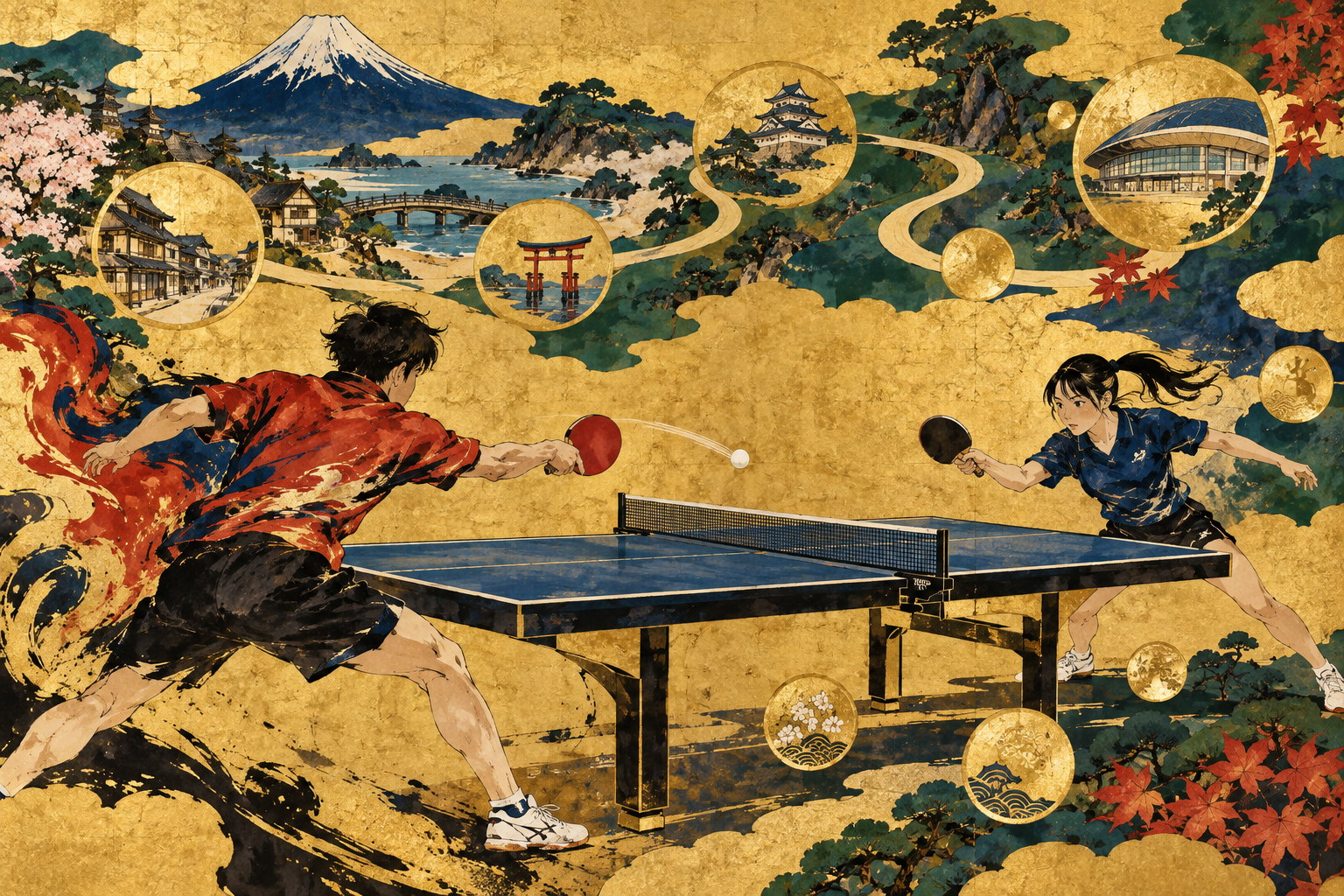
A table-tennis trip has a fixed point—the match—and a more open question: what to do with the hours around it. The T.League is putting that second question on a digital map, using collectable coins to encourage fans to look beyond the arena.
Announced on September 9, its Japan-wide coin-collection rally launches with the Naruto fixtures on September 12 and runs through March 7, 2027. Some treasure boxes are scheduled for early release on September 10. The league presents the initiative as a way to connect spectatorship with regional tourism. [1]
That is an ambition to examine as the programme develops, rather than an economic result already demonstrated. The immediate story is a new way to organise the relationship between following a team and discovering a place.
A collection built around a map
Participants collect T.League Coins from digital treasure boxes on the official web map. The announced locations include hometown attractions, landmarks and match venues, as well as sightseeing spots in Taiwan. The announcement distinguishes daily coins from venue-limited coins. [1]
The idea gives a place on the map a second purpose. Someone checking an opponent or fixture may also begin asking where the venue sits within the town, and what else could form part of the day.
The most useful outcome need not be a longer or more expensive journey. A walk before the doors open, or time spent in the surrounding neighbourhood, can change how a visitor remembers a match. Collecting everything need not become the condition for enjoying the sport.
Milestones and a competitive prize
The headline rewards are a serial code for an official digital card at each 500-coin milestone, and, for the annual ranking’s first-place finisher, a pair of playoff-final arena invitations with accommodation for two. The winner can choose the men’s or women’s final. Rally participation is free; users pay their communication costs. [1]
A collection milestone and a ranking prize create different experiences. One measures an individual’s progress; the other depends on competition with other participants. Understanding that distinction helps a fan decide how much attention to give the game around the matches.
Free participation does not turn transport, accommodation or ordinary match admission into free services. Those remain separate arrangements to check when planning a trip. Nor should a prize be treated as a reason to commit to travel before its detailed conditions are understood.
The launch weekend in Naruto
The September 12 fixture brings Kanazawa Port and Okayama Rivets to Amino-Value Hall in Naruto. Nippon Life Red Elf and Kyoto Kaguya Rise play there on September 13. Both matches are scheduled for 2 p.m. JST. [2][3]
| Date | Match | Start |
|---|---|---|
| September 12, Saturday | Kanazawa Port v Okayama Rivets | 2 p.m. |
| September 13, Sunday | Nippon Life Red Elf v Kyoto Kaguya Rise | 2 p.m. |
The weekend illustrates why the actual venue matters more than a location in a team’s name. Following the league’s geography means checking where a particular match is being played, then connecting that address with the surrounding area.
A map of the competition and a route to the arena serve different purposes. Used together, they can help turn a fixture into a workable day out.
From the first season at Ryogoku
The league’s official 2018–2019 archive begins on October 24, 2018 at Ryogoku Kokugikan, where Kinoshita Meister Tokyo beat T.T Saitama 3–1. The following day, Nippon Life Red Elf defeated Top Otome Ping Pongs Nagoya by the same score at the same venue. [4]
Those opening records offer a starting point for understanding the current initiative. A league gives spectators teams to follow across repeated contests. The coin rally attempts to add something to the time between those contests, keeping places and future visits within a fan’s attention.
That is an interpretation of how the promotion fits the sporting structure, not a claim that the present digital experience was part of the original launch. The history is relevant because the new activity builds around an established calendar of team competition.
Home, away and a wider map
The 2026–2027 overview lists six men’s and six women’s teams. Each plays 12 home matches, 12 away and one central fixture, for 25 per team and 150 regular-season matches across the league. [5]
That creates opportunities to see a familiar team in different settings. In Japan.co.jp’s view, the map becomes useful when it makes those settings easier to explore, rather than simply adding another number to a fan’s account.
Taiwan also has a concrete connection to this season. The official schedule records men’s and women’s matches at Hsinchu County Gymnasium on July 25. Its place in the rally’s geography follows an actual location on the season’s calendar. [6]
That history does not establish retrospective credit for a July visit. A past trip and the collection conditions of a September launch are separate matters. Participants should check the current instructions rather than assume earlier attendance qualifies.
For a first-time spectator, follow the team contest
The T.League’s standard team match comprises three singles contests and one doubles contest. If the score is 2–2 after those four, a one-game Victory Match decides the outcome. [5]
For someone accustomed to thinking of table tennis as an individual sport, this provides another way into the action. One player’s result changes the situation inherited by the next. A visitor can follow that collective progression even without knowing every player beforehand.
The experience at the table still needs to justify the trip. A collection feature can prompt a visit, but the match gives the day its centre. The most effective relationship would allow both the sport and its setting to remain memorable.
Connection is an aim; impact requires evidence
The league’s Tsunagu Project sets out a broader intention to connect generations, players and fans, and Japan with the wider world through table tennis. It also describes health and social contributions among its goals. These are the league’s stated directions. [7]
For the rally, coins collected would measure activity within the promotion. They would not, by themselves, establish how much time participants spent outside the arena, whether local businesses benefited or whether visitors wanted to return.
Japan.co.jp would look for those additional outcomes when assessing the tourism claim. First visits, time spent locally and interest in returning would provide context that a leaderboard alone cannot offer. There is no basis at launch to attach an invented economic-impact figure to the initiative.
Japan.co.jp analysis: let the match become a memory of the town
A practical starting point is to choose the match and confirm its venue, then consult the official map and rally announcement. Collection and reward conditions should be checked before arranging travel around them.
The programme’s most appealing possibility is a small change in how an existing trip is spent. A fan returns with a memory of a street or neighbourhood alongside the score. If collecting coins encourages that attention, the rally could deepen the connection between a day of table tennis and the place that hosted it.
- T.League, coin-collection rally announcement, September 9, 2026
- T.League, September 12 Kanazawa Port–Okayama Rivets fixture
- T.League, September 13 Nippon Life Red Elf–Kyoto Kaguya Rise fixture
- T.League, official 2018–2019 results archive
- T.League, 2026–2027 league overview and match format
- T.League, 2026–2027 schedule and results
- T.League, Tsunagu Project and stated social aims