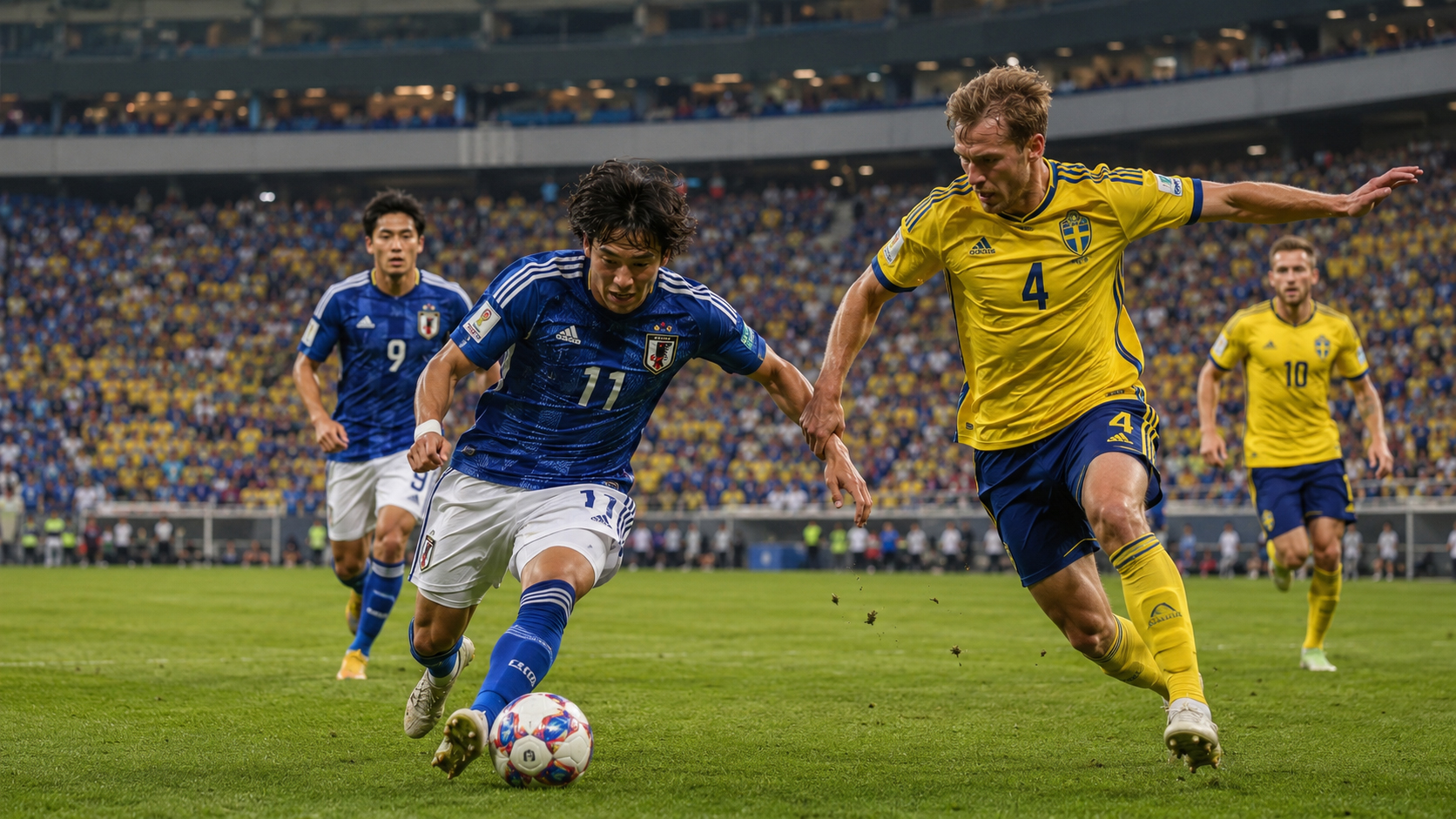
Night in Dallas, morning in Japan
There is always a time difference in Japan’s World Cup life. In the stadium, it is evening noise, floodlights, flags, and heat. In Japan, it is morning coffee, half-awake children, phones on desks, train platforms, office televisions, and people quietly deciding whether the first meeting of the day can wait.
Japan against Sweden in Dallas is more than the third group match. It is the border between being a good team and becoming a dangerous team. Japan have already shown enough to be respected. They drew 2-2 with the Netherlands. They beat Tunisia 4-0. They have goals, combinations, squad depth, and a coach willing to use his bench. But the World Cup does not only ask whether a team can play well. It asks whether a team can manage the difficult match after the good one.
Sweden are exactly the kind of opponent who make that question uncomfortable. They opened by beating Tunisia 5-1, then were beaten 5-1 by the Netherlands. That does not mean they are confused. It means they are volatile. Sweden can break. Sweden can also break you.
Japan are no longer just happy to be here
Japan’s World Cup history has changed dramatically in a single generation. In 1998, at their first tournament, Japan were simply trying to stand on the stage. They lost to Argentina, Croatia, and Jamaica. There were no points, but there was a beginning.
In 2002, as co-hosts, Japan reached the knockout stage for the first time. In 2010, they did it again with discipline, set pieces, and nerve. In 2018, they came within seconds of taking Belgium into extra time, before the counterattack that still hurts. In 2022, they beat Germany and Spain and showed the world that Japanese football was no longer a polite guest at someone else’s tournament.
By 2026, the mood is different. Japan are not here merely to surprise. They are here to win. The round of 16 is no longer a dream destination; it is becoming the minimum serious ambition. The larger national obsession is the quarterfinal, a door Japan have seen but never opened. To talk about that door, however, Japan first have to handle days like this.
Beating a giant requires explosion. Surviving and winning a match you are expected to manage requires maturity. In Dallas, Japan need more of the second than the first.
Sweden are not Nordic quiet. Their front line is a storm
The idea of Sweden can mislead people: cool air, clean design, calm social order, reserved public manners. On a football pitch, this Sweden are not reserved. Their front line is direct, physical, and capable of making defenders feel very small.
Alexander Isak is elegant danger. Tall, smooth, technically refined, and hard to read, he is not merely a target forward. He receives, turns, glides, combines, and finishes. For Japan’s centre-backs, the problem is not only his size. It is his timing.
Viktor Gyökeres is a different kind of problem. He is force moving forward. He runs through contact, attacks space, and turns defenders toward their own goal. If Isak is a long blade, Gyökeres is a heavy axe. Together, they give Sweden a way to turn a tactical game into a physical emergency.
Japan cannot defend them cleanly all night by simply being brave. They must defend the supply. Press the passer. Win second balls. Manage the space behind the line. Avoid cheap fouls near the box. Above all, they must not let Sweden’s strikers receive near the penalty area, turn, and choose.
Graham Potter’s Sweden are unfinished. That makes them dangerous
Graham Potter is known as a coach who thinks in spaces. At Brighton, his teams won admiration for structure, movement, and the ability to change shapes without losing the plot. International football is harder. There is less training time, less tactical repetition, and less control over what players do the rest of the year.
Sweden’s tournament has shown both sides of that reality. Five goals scored against Tunisia. Five conceded against the Netherlands. The attacking talent is obvious. So is the defensive fragility. Potter has said Sweden must control space against Japan’s synchronized, well-organized play. He is right. If Sweden leave gaps, Japan can pass through them. If Sweden sit too deep, Japan can move them side to side. If Sweden get stretched, the match can become exactly what Japan want.
But this is also the trap. If Japan chase those gaps too greedily, Sweden will use the space behind them. If Japan become impatient, the match turns into transitions, long runs, duels, and chaos. That is Sweden’s language. Japan must make Sweden speak Japanese football: rhythm, distance, collective pressure, and timing.
What Moriyasu’s Japan need now: not courage, but game management
Hajime Moriyasu’s team have become deep. Against Tunisia, even without injured playmaker Takefusa Kubo, Japan’s attack moved. Ayase Ueda scored twice and assisted another goal. Daichi Kamada and Junya Ito also scored. Reports that Moriyasu has used 22 of his 26 players point to something important: this is not a national team surviving on one superstar’s weather.
That is why the key question today is not “Who will be the hero?” It is “Who will avoid breaking the match?” In a World Cup group finale, small decisions become enormous. Do not force a vertical pass when the team shape is bad. Do not lose the ball in the centre with both fullbacks high. Do not give away cheap set pieces. Read the referee early. Kill a counter before it grows teeth.
Japan’s rise has not come only from technique. It has come from Europe, from the J.League, from youth development, from players learning pressure, travel, physicality, tactical shifts, and the ugly little habits required to win. Japan are more adult now. Dallas is a test of that adulthood.
| What Japan need | Why it matters |
|---|---|
| A calm first 15 minutes | If Sweden gain early momentum, their strikers can turn the match into a physical contest. |
| Courage through the middle | Only going wide lets Sweden’s big defenders feel comfortable. Japan need central risk at the right moments. |
| Control of the space behind | Isak and Gyökeres become most dangerous when Japan’s line is running toward its own goal. |
| Set-piece discipline | Giving Sweden unnecessary free kicks and corners is a self-inflicted problem. |
| Smart substitutions | Heat, fatigue, and momentum will matter. Moriyasu’s bench can change the temperature of the match. |
Dallas is huge. Japan cannot play small
Dallas Stadium is an American World Cup stage in the fullest sense: massive, loud, bright, corporate, international, and built for spectacle. It is not the intimate football theatre of an old European ground. It is event architecture. It can make a team feel small if the team lets it.
Japan should not let it. This national team is no longer an anonymous group of disciplined workers. It contains players known across European leagues, players who have beaten Germany and Spain, players who carry the expectations of a country that now watches the World Cup differently.
The right response to the size of Dallas is not caution. It is expansion. Play the passes. Step into midfield. Attack the space. Make Sweden defend backward. Japan’s identity is organization, but organization does not mean timidity. The best Japanese teams move with order and bite.
The quarterfinal door is still closed
Japan’s World Cup story keeps returning to one door: the quarterfinals. They have reached the round of 16 multiple times, and each time the exit has left a different scar. Belgium in 2018 was the most cinematic pain: a two-goal lead, then the late counterattack in Rostov. Croatia in 2022 was quieter but no less painful, ending on penalties after a match Japan had every right to believe they could win.
Those losses shaped this team’s ambition. The lesson was not that Japan lacked talent. It was that talent must be joined to match closure, emotional control, penalty-box detail, and the ability to survive ugly minutes. The last step is not usually a trick. It is a habit.
Sweden in Dallas are not yet a knockout opponent. But this is a knockout-style match. The opponent is dangerous. The stakes are clear. The group table is tight. The atmosphere is big. Japan have enough quality to win, but not enough margin to drift. These are the matches quarterfinal teams handle.
There is more than one way to win
Japan do not need to be beautiful. They can be, of course. The ideal version is easy to imagine: quick combinations, wide runners stretching Sweden, Ueda arriving in the box, Kamada finding spaces between lines, wingers attacking tired fullbacks, the ball moving faster than Sweden’s defensive block.
But World Cups often reward the less romantic version. The team that suffers without panicking. The team that accepts a 0-0 phase. The team that leads 1-0 and does not become greedy. The team that concedes and does not become frantic. The team that turns disorder into order.
If Sweden press, Japan can go behind them. If Sweden drop, Japan can move them. If Sweden make it physical, Japan can make them run. What Japan cannot do is let the match become Sweden’s emotional property. Sweden thrive when the game opens into collisions and broken transitions. Japan must keep the match in grammar.
At 8:00 AM, Japan’s day begins with this match
World Cup matchdays change the mood of a country. People who do not usually watch football check the score. Train platforms become scoreboards. Office conversations begin with lineups. Schools hear the result before the first bell has properly settled. The World Cup is sport, but it is also a national clock.
This Japan team has earned that clock. From the first appearance in 1998 to the shock wins of 2022 and the poised start to 2026, the national team has moved from participation to expectation. That expectation is heavy, but it is also a compliment.
In Dallas, the ball will roll. In Japan, the morning will open. Sweden’s strikers will run. Japan’s centre-backs will decide whether to drop or hold. The midfield will decide whether to hide or receive. The wings will decide whether to recycle or attack. The match will not be decided by one grand speech, but by dozens of small decisions made at speed.
Japan do not need to dream today. They need to begin correctly. First duel. First pass. First defensive step. First second ball. First moment of pressure. In those small moments, the match will reveal whether Japan are still a team with potential or already a team with authority.
The dreaming part is over. Today is for taking the result.
- Japan vs Sweden kicks off June 25 at 6:00 PM in Dallas, which is June 26 at 8:00 AM in Japan.
- Japan have four points after a 2-2 draw with the Netherlands and a 4-0 win over Tunisia.
- Sweden have three points after a 5-1 win over Tunisia and a 5-1 loss to the Netherlands.
- The key defensive problem for Japan is the Isak-Gyökeres strike partnership.
- If Japan want to speak seriously about the quarterfinals, this is the kind of match they must manage maturely.
Sources and references
This article was based on public information from FIFA, the Dallas FIFA World Cup 26 Host Committee, Reuters, FIFA World Cup historical records, and Japan Football Association sources.
- FIFA: Japan v Sweden match information
- Dallas FWC26: Match schedule and host city events
- Reuters: Japan seeking to shackle Swedish strike force in World Cup showdown
- Reuters: Sweden need to control space in Japan clash, says Potter
- Reuters: Japan's firepower comes to the fore as Ueda bags a double
- FIFA: World Cup tournament information
- Japan Football Association: Samurai Blue