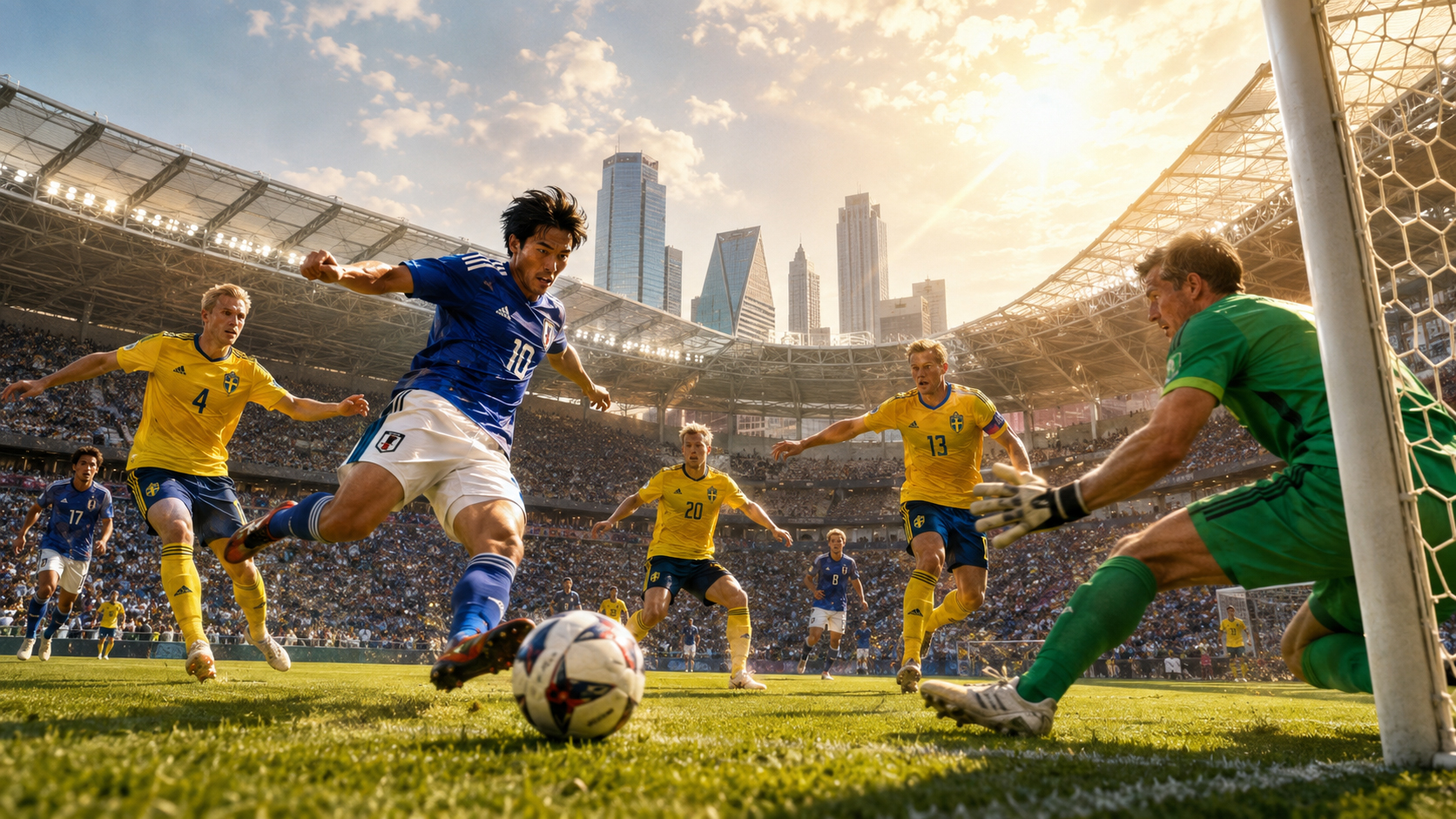
Dallas is not just another group-stage game
The final match of a World Cup group has its own kind of fear. Before the first whistle, the mathematics has already begun: points, goal difference, goals scored, the other match in the group, the shape of the knockout bracket. Players chase the ball, coaches watch the clock, supporters refresh their phones, and two matches are lived at once.
Japan vs Sweden on June 25 is exactly that kind of game. FIFA lists it as Group F Match 57 at Dallas Stadium, with kickoff at 23:00 UTC. The Dallas organizing committee gives the local kickoff as 6:00 p.m. in Arlington, Texas. In Japan, that means 8:00 a.m. on June 26, the hour when a country’s morning coffee may suddenly become World Cup fuel.
Japan drew 2-2 with the Netherlands in its opener. Then came the statement: a 4-0 demolition of Tunisia in the 1,000th match in World Cup history. Reuters reported that Ayase Ueda scored twice, while Daichi Kamada and Junya Ito also scored. Even without Takefusa Kubo, Japan’s attack did not lose its rhythm.
Sweden’s tournament has been two different stories. First, a 5-1 win over Tunisia: power, structure, forward threat, and the old Nordic confidence. Then, a 5-1 defeat against the Netherlands. Reuters reported that Brian Brobbey scored twice early, Cody Gakpo added two more, and Crysencio Summerville finished the rout. Afterward, Sweden coach Graham Potter defended captain Isak Hien, who had been heavily criticized, and said blame should fall on him as coach.
Berlin, 1936: “Japanese, Japanese, Japanese — another Japanese”
To understand Japan and Sweden in football, you have to go back to Berlin in 1936. The Olympics were wrapped in the dark pageantry of Nazi Germany. In the football tournament, Japan met Sweden, one of Europe’s established sides.
At halftime, Japan trailed 2-0. Against a European power, for a team still young on the international stage, that felt like the expected order of things. But in the second half, Japan turned the match upside down. Taizo Kawamoto, Tokutaro Ukon, and Yukio Matsunaga scored. Japan won 3-2. The match became known as the “Miracle of Berlin.”
The most famous memory is the Swedish radio commentary. As Japanese players seemed to appear everywhere, stopping Swedish attacks again and again, the broadcaster is said to have cried, “Japanese, Japanese, Japanese — another Japanese.” Football’s beauty lies in that possibility. Size, reputation, and history matter, but they do not decide everything. Eleven players run, believe, endure, and strike. In 1936, Japan showed that to the world.
Ninety years later, the stage is not Berlin. It is Dallas. The opponent is still Sweden. The world is different, the players are different, the tactics are different. But for Japanese football, the name “Sweden” still carries a strange echo. In 1936, Japan scratched a small mark onto the football map. In 2026, Japan returns to the same old opponent not as a curiosity, but as a contender.
Japan is no longer a nation of “brave losses”
Japan’s World Cup history is young but dense. The first appearance came in 1998 in France. Japan lost to Argentina, Croatia, and Jamaica. The wall was high. In 2002, as co-host, Japan earned its first World Cup wins and reached the knockout stage. It returned to the Round of 16 in 2010, 2018, and 2022.
But one wall has remained: the Round of 16. Japan surprises the world. Japan troubles giants. Japan beats Germany and Spain. Yet the deeper knockout rounds have stayed just out of reach. “So close.” “So brave.” “Well played.” Japanese football has heard those words too many times.
The 2026 team no longer needs comforting language. More players are hardened in Europe. More players understand pressure. Kamada, Ito, Ueda, Endo, Doan, Mitoma, Kubo: the names point to a depth that older Japan teams did not possess. Japan is no longer merely the fast, disciplined Asian side that works hard. It is a team expected to analyze, control, change matches from the bench, and win.
That is why the Sweden match is dangerous. Japan is no longer in the category of being applauded simply for competing. Japan is expected to win. Expectation is one of the hardest positions in world football.
Do not mistake wounded Sweden for weak Sweden
Sweden is an old football country. It finished second at the 1958 World Cup, third in 1994, and reached the quarter-finals in 2018. Sweden’s football identity has long been built on structure, height, discipline, set pieces, and the occasional world-class attacker.
In 2026, Sweden showed its threat against Tunisia. Then the Netherlands exposed the cracks. The 5-1 defeat created a search for blame, and Hien, the captain and centre-back, became the obvious target. Potter pushed back hard. That matters. A 5-1 loss is almost never about one defender. It is about spacing, pressure, mood, timing, and a structure that stops protecting itself.
How will Sweden respond against Japan? By becoming cautious and compact? By pressing early to repair its pride? Japan cannot afford to see Sweden only as the side that conceded five. It must also remember that Sweden is the side that scored five.
| Team | So far | Against Japan |
|---|---|---|
| Japan | 2-2 vs Netherlands, 4-0 vs Tunisia. Strong attack, deep squad, growing confidence. | Score first. Control the match without turning it into a heat-draining track meet. |
| Sweden | 5-1 win over Tunisia, 1-5 loss to the Netherlands. Big attacking threat, exposed defensive nerves. | Repair the back line. Stop Japan between the lines and protect wide areas. |
| Other match | Netherlands vs Tunisia also shapes Group F. | Japan must manage its own match while understanding the late-game table. |
The Dallas heat: the third opponent
This match has another opponent: heat. Climate Central gives Japan vs Sweden a 98% chance of “performance-impairing heat,” with the likelihood increased by two percentage points because of climate change.
Dallas Stadium is a giant modern venue, known for its roof and climate-controlled environment. But World Cup heat is not only a stadium issue. Players train, travel, warm up, recover, and sleep inside a broader climate. Heat can decide a match in a single afternoon, but it can also work slowly over a week, stealing one step at a time.
Heat does not always make a strong team suddenly weak. It blunts judgment. A press arrives half a second late. A fullback returns one stride short. A cross floats. A set-piece mark is lost. Football is not only decided by great events; it is decided by small errors. The 98% figure is not just weather. It is tempo, substitutions, hydration, and late-game concentration.
Japan may have an advantage here. Many Japanese players know summer football. They know humidity, patience, and controlled suffering. Dallas is not Tokyo or Osaka, of course. But the ability to manage a hot match without panic may become one of Japan’s quiet weapons.
Three keys for Japan
The first key is the opening 20 minutes. Against Tunisia, Kamada’s early goal gave Japan control. Sweden carries the psychological damage of the Netherlands defeat. If Japan can expose that anxiety early, the match may tilt quickly.
The second key is set pieces. Against a team like Sweden, cheap fouls and careless corners are invitations. Japan may be better in open play for long stretches, but one aerial duel can erase that superiority. The discipline not to foul in bad areas may be as important as any clever attacking pattern.
The third key is the bench. In a heat-risk match, the starting eleven rarely wins alone. After the hour mark, who can stretch tired legs? Who can hold the ball? Who can close space? Japan’s depth is one of its strengths, and Dallas may be the place where depth becomes destiny.
8 a.m. in Japan, 6 p.m. in Dallas
For Japanese viewers, kickoff comes at 8:00 a.m. on June 26. Before work, before school, on phones, in cafes, in offices, maybe on a train where everyone pretends not to be watching the same thing. A nation will be slightly distracted at breakfast.
The charm of the World Cup is that it forces world time into daily life. Dallas evening enters Japan’s morning. Before a salaryman opens his inbox, Ueda may rise for a header. Before a student enters class, Ito may run down the right. While someone invents an excuse for being late, Japan’s tournament may turn.
That is sport’s small luxury. Politics and economics make the morning news heavy: yen weakness, prices, heat, population decline, international tension. Then eleven players in blue appear with a chance to change the national mood for a few hours. Football does not erase reality. But sometimes it puts electricity back into the chest.
From the miracle of 1936 to the responsibility of 2026
In 1936, Japan beat Sweden and shocked the world. In 2026, if Japan beats Sweden, the world may no longer call it a miracle. That is a good thing. It means Japanese football has reached a place where victory is interpreted not as wonder, but as evidence.
But that place comes with responsibility. Win, and there is praise. Lose, and there are questions. Why did it happen? What was missing? Was the substitution right? Was the plan right? Becoming a serious football nation means being judged seriously.
On the grass in Dallas, Japan will play Sweden. It will also play its own history: the Round of 16 wall, the memory of brave defeats, the burden of representing Asia, and the growing demand to go further this time.
If Japan wins, this match will not only be a step toward the knockout stage. It will extend a strange line that began in 1936 and reaches all the way to Dallas in 2026. The country once described in panic by a Swedish broadcaster — “Japanese, Japanese, Japanese” — now stands again in front of Sweden on the biggest stage in football.
This time, not to surprise. To win.
- Can Japan turn the 4-0 Tunisia win into confidence rather than comfort?
- Can Sweden rebuild its defense after the 5-1 collapse against the Netherlands?
- How will Dallas heat affect pressing, substitutions, and concentration after the 60th minute?
- Can Japan avoid cheap fouls and set-piece danger?
- Will the 1936 Berlin memory gain a new meaning in 2026 Dallas?
Sources and references
This article is based on public information from FIFA, Dallas FIFA World Cup 26, Reuters, Climate Central, FIFA Museum, Olympics.com and related official sources. The market strip uses 1 US dollar = 161.55 Japanese yen, last updated June 23, 2026 at 3:07 a.m. UTC, equal to June 23 at 12:07 p.m. Japan time.
- FIFA Match Centre: Japan v Sweden, Group F, Match 57
- Dallas FIFA World Cup 26: Match schedule
- Reuters: Japan rout Tunisia 4-0 as Ueda shines in World Cup's 1,000th match
- Reuters: Netherlands dismantle Sweden 5-1
- Reuters: Potter defends Isak Hien after Sweden defensive collapse
- Climate Central: Group F heat risk, Japan v Sweden
- FIFA Museum: The Japan Football Association at 100
- Olympics.com: Japan's Olympic football history
- FIFA: Japan team profile and World Cup history
- FIFA: Sweden team profile and World Cup history