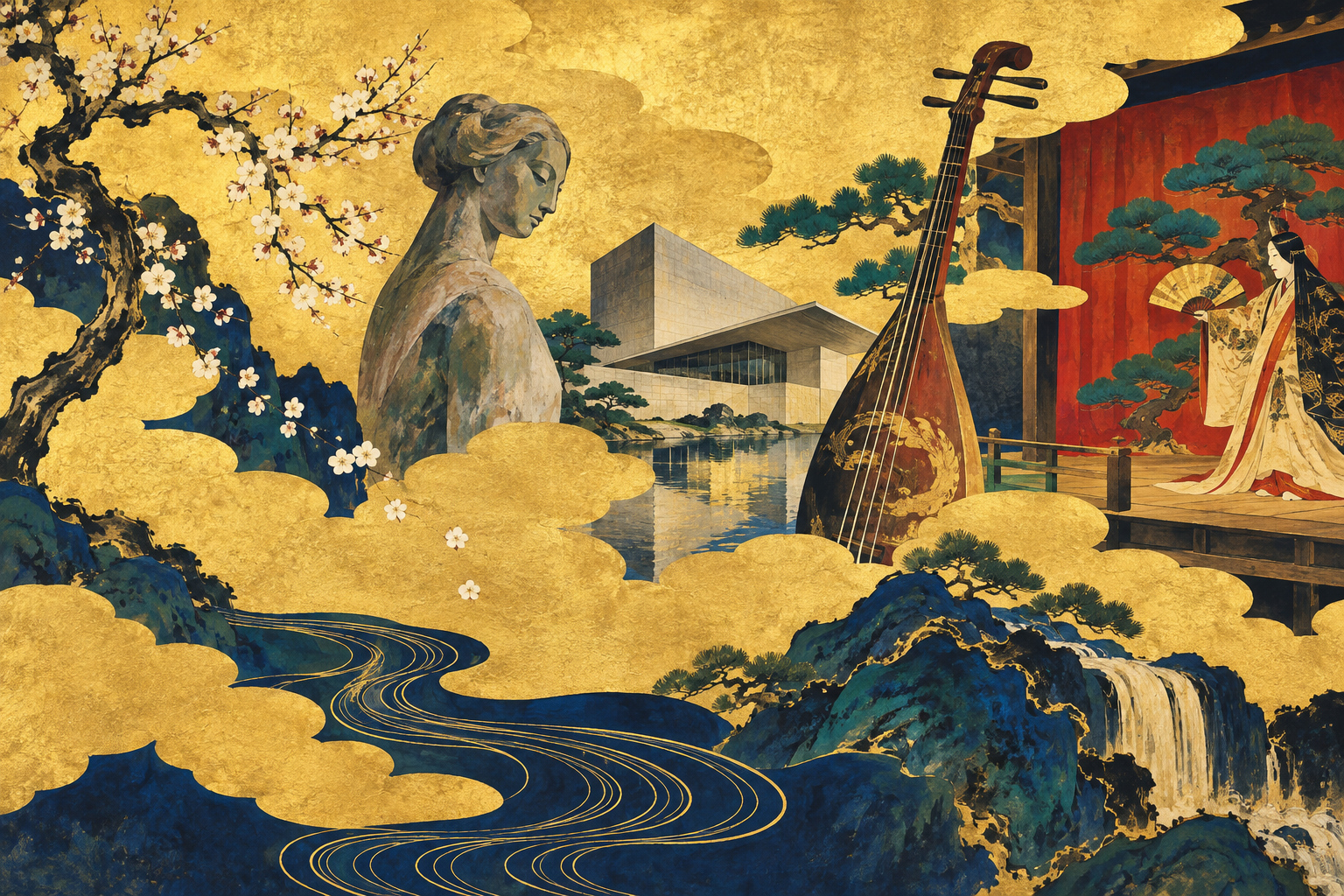
An illuminated sentence, a wall of stone, a building shaped by absence, an orchestral performance and an actor at work: the 2026 Praemium Imperiale offers five very different starting points for thinking about what art can do. Its laureates also make the award's apparently neat categories look much more porous.
The Japan Art Association announced Jenny Holzer, Andy Goldsworthy, Daniel Libeskind, Herbert Blomstedt and Cate Blanchett on September 8 as the recipients of the 37th award. The ceremony is scheduled for October 28 at Meiji Kinenkan in Tokyo. Each receives a medal, a testimonial and ¥15 million. [1]
| Category | Laureate | Country listed by organiser |
|---|---|---|
| Painting | Jenny Holzer | United States |
| Sculpture | Andy Goldsworthy | United Kingdom |
| Architecture | Daniel Libeskind | United States |
| Music | Herbert Blomstedt | Sweden |
| Theatre / Film | Cate Blanchett | Australia |
The list recognises sustained careers across disciplines, rather than selecting a single best work of the year. For readers in Japan, it combines artists with long histories of exhibitions or performance here and others whose work may be encountered through cinema or travel. [1][7]
Jenny Holzer: reading beyond the gallery wall
Holzer's place in the painting category is a useful invitation to reconsider its boundaries. The association traces her text-based practice through Truisms (1977–79) and the use of LED displays and public sites. Japan has its own chapter in that history: Art Tower Mito presented a solo exhibition in 1994. [2]
A sentence in public space poses questions beyond its literal meaning. Is it advertising, instruction, testimony or a provocation? Does its apparent authority come from the words or the technology displaying them? These are ways into the work, without requiring a reader to begin with a specialised vocabulary.
Japan.co.jp sees that encounter with everyday reading as a particularly accessible starting point. The viewer brings an existing skill—reading—and finds reasons to reconsider how it operates in the world.
Andy Goldsworthy: looking at duration
Goldsworthy works with materials including stones, branches, leaves and snow. His practice encompasses temporary constructions recorded in photographs and enduring projects such as Storm King Wall (1997–98). The award biography dates his first Japanese invitation to 1987, in the former village of Ouchiyama, Mie Prefecture; the exhibition Two Autumns followed at the Tochigi Prefectural Museum of Fine Arts and Setagaya Art Museum in 1993–94. [3]
One way to approach this work is to consider what happens after a form is made. The possibility of change or disappearance, the particular place and the photograph that remains all complicate the idea of sculpture as a stable object.
Using natural materials does not by itself establish a measurable environmental benefit. The artistic question here concerns a relationship with material, place and time, rather than a claim of demonstrated conservation outcomes.
Daniel Libeskind: space as an encounter with history
Libeskind won the competition for the Jewish Museum Berlin in 1989; the museum opened in 2001. Its building is a central reference in the award's account of his work with history and memory. [4][10]
The museum's own architectural explanation connects the voids running through the building with the absence of Jewish life destroyed in the Shoah. Movement and interruption become part of the encounter, alongside the objects and accounts on display. [10]
For Japan.co.jp, this offers a concrete question with which to approach architecture: how can a building communicate loss, as well as accommodate activity? Looking only at an exterior silhouette would miss much of what makes this project significant. A visitor's route through space can carry meaning too.
Herbert Blomstedt: a career heard across generations
Born in 1927, Blomstedt turned 99 this year. The association dates his professional conducting debut to 1954 and recounts leadership roles in Dresden and San Francisco. His Japanese connections are substantial: he first appeared with the NHK Symphony Orchestra in 1981 and holds its title of honorary conductor laureate, 桂冠名誉指揮者. [5]
Longevity is striking, but age alone does not describe a performance. Listeners can attend instead to the relationships between players, the shaping of a phrase and the way an ensemble enters or releases a sound.
There is also a wider distinction here. A work of visual art may endure as an object; music is made audible again through performance. Placing both within one award encourages a broader view of cultural continuity, embracing repeated acts of interpretation as well as preservation.
Cate Blanchett: the screen and the institution behind the stage
Blanchett's career includes Elizabeth and Academy Awards for her supporting performance in The Aviator and leading performance in Blue Jasmine. The official profile also records her joint leadership of Sydney Theatre Company with Andrew Upton from 2008 to 2012. [6]
The screen allows a filmed and edited performance to be watched repeatedly. Theatre places actors and an audience in a shared present. Her career offers a way to consider those different conditions within the award's combined theatre and film category.
It also extends attention beyond individual roles. Helping lead a theatre company involves the setting in which performances are made. A career award makes room to consider that institutional contribution alongside the work audiences recognise on screen.
Why an international arts award is rooted in Japan
The Japan Art Association established the Praemium Imperiale in 1988, its centenary year, explaining the award as a continuation of the wishes of Prince Takamatsu, its longtime patron. The first laureates were announced in New York on September 15, 1989, and the inaugural ceremony took place at Meiji Kinenkan on October 27 that year. [7][8]
The selection structure links nominations through international advisers and their committees with deliberations by selection committees in Japan and a final decision by the association's board. Published criteria consider artistic achievement, international influence and contributions to enriching global culture. [7][9]
This is a Japan-based institution looking outward, rather than an award restricted to Japanese artists or work produced in Japan. That structure helps explain the variety of connections a Japanese reader may already have with the laureates: an exhibition remembered, a concert attended, a film watched or a museum visited abroad.
The next generation needs a place to begin
The accompanying Grant for Young Artists, established in 1997, adds another perspective. This year's 29th recipient is France's La Source Garouste. The association says its ¥5 million grant was presented at the September 8 announcement press conference in Paris. [1][7]
Founded in 1991 by Gérard and Élizabeth Garouste, the organisation runs artist-led activities chiefly for children aged six to 18. The official profile describes its work supporting children facing economic and social difficulties through opportunities to create. [11]
Japan.co.jp's reading is that the two forms of recognition raise complementary questions: how to acknowledge an established artistic life, and how to make participation possible near its beginning. This interpretation should not be mistaken for an independent evaluation of the programme's social outcomes.
A practical way into Libeskind's work
An award-related architecture lecture gives readers a possible next step. Libeskind is scheduled to speak on October 29 from 4 to 5:30 p.m., with doors opening at 3:30 p.m., in the main conference room of the Kajima KI Building, 6-5-30 Akasaka, Minato-ku, Tokyo. The lecture will be in English with simultaneous Japanese interpretation. [12]
Applications are accepted using the official notice's two-dimensional code or by postal postcard, with a September 30 arrival deadline. Two hundred applicants will be selected by lottery; invitations are scheduled to be mailed on October 5. Attendance is limited to the successful applicant, who must bring the invitation. This application concerns the lecture, not admission to the awards ceremony. Consult the official notice for the application instructions. [12]
Japan.co.jp analysis: let recognition lead to looking
A prize list can make culture resemble a set of separate compartments. These careers suggest another picture: language enters the street, sculpture engages with change, architecture addresses memory, and performers shape an experience shared with an audience.
The most useful response need not be agreement with a ranking the award never attempts to provide. It can be a modest act of attention: read one work, listen to one performance or investigate one building. That is how an international announcement can become part of an individual's cultural life.
- Japan Art Association: 2026 laureates and young artists grant announcement
- Praemium Imperiale: Jenny Holzer
- Praemium Imperiale: Andy Goldsworthy
- Praemium Imperiale: Daniel Libeskind
- Praemium Imperiale: Herbert Blomstedt
- Praemium Imperiale: Cate Blanchett
- Japan Art Association: about the award
- Japan Art Association: award chronology
- Japan Art Association: selection criteria
- Jewish Museum Berlin: Libeskind Building
- Praemium Imperiale: La Source Garouste
- Japan Art Association: 2026 architecture lecture