Japan Takes a Bigger Pacific Security Role
Facing Chinese pressure around Taiwan and uncertainty over U.S. policy, Japan is standing more visibly in the Indo-Pacific — through defense spending, joint drills, regional partnerships, and a sharper public stance on Taiwan.
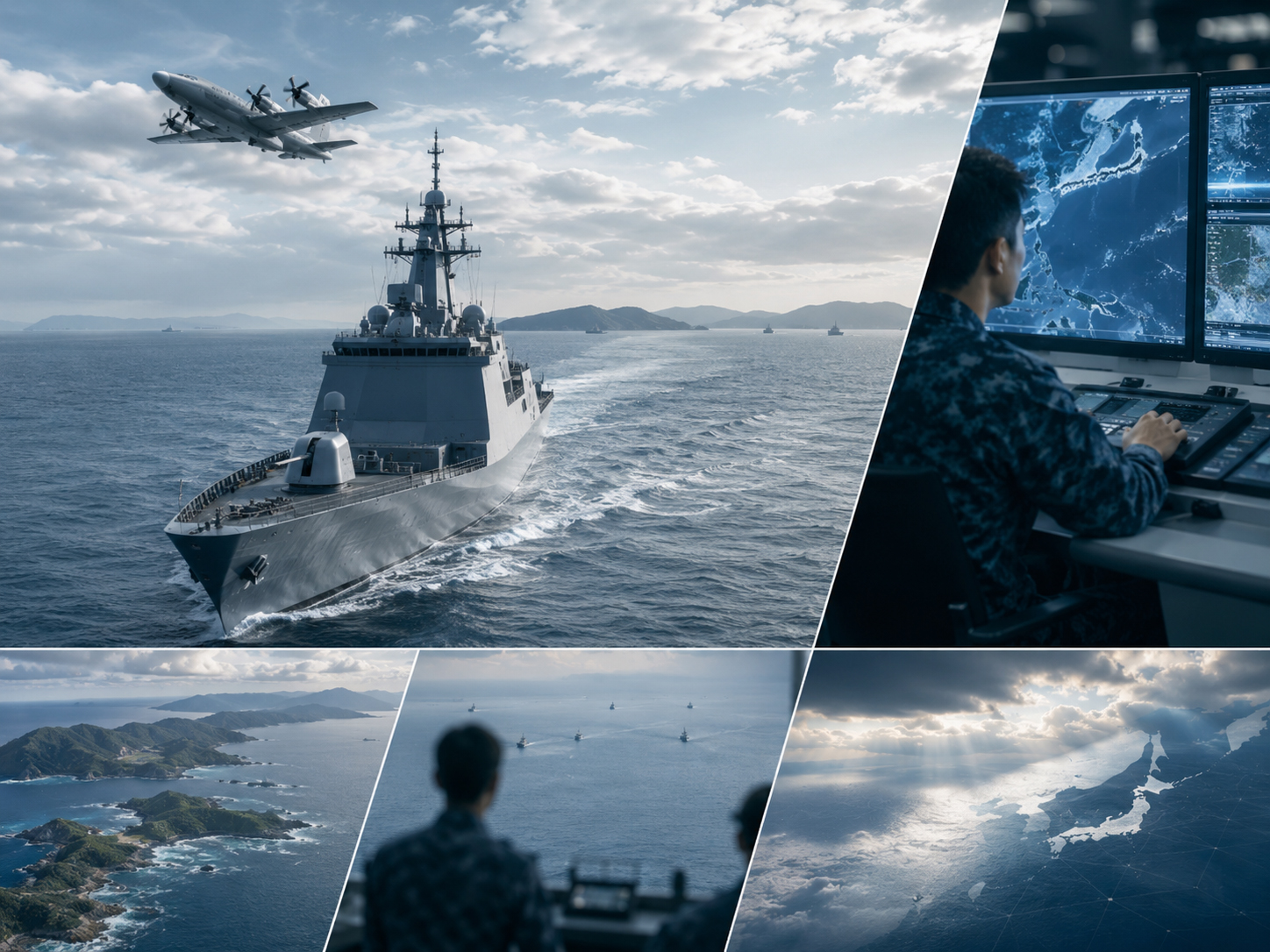
Japan is taking a larger security role in the Pacific as Chinese pressure around Taiwan increases and U.S. policy appears less predictable. Reuters described the shift this week as Japan “standing taller” in the region, with Tokyo expanding joint drills, deepening cooperation with partners, and treating a Taiwan crisis as a direct national-security concern.
The shift is not a single announcement. It is a pattern: larger defense budgets, closer links with the United States, South Korea and the Philippines, more activity beyond Japan’s territorial waters, and a willingness to speak more plainly about the consequences of a Taiwan contingency.
Why Japan is moving
Japan’s geography makes Taiwan more than a distant issue. The waters around Taiwan, the Ryukyu island chain, and the East China Sea form a connected security space. If a Taiwan crisis disrupted sea lanes, airspace, energy shipping, or U.S. bases in Japan, Tokyo would face immediate choices.
China rejects any outside role in Taiwan and has criticized Japan’s stronger posture. Beijing has also increased pressure around Taiwan and near the disputed Senkaku Islands, which Japan administers and China claims. That keeps the regional tension both strategic and local.
Japan’s Pacific question is no longer whether it can avoid the region’s hardest security problems. It is whether it can shape them before they reach Japan’s own shores.
The U.S. uncertainty factor
For decades, Japan’s security posture rested on a clear assumption: the United States would remain the central guarantor of the regional order. That assumption still matters, but Reuters notes that uncertainty in U.S. policy has become part of Japan’s calculation.
The result is not a break with Washington. It is a more layered strategy. Japan is integrating more deeply with U.S. forces while also building stronger ties with South Korea, the Philippines, NATO partners, and technology allies.
Japan.co.jp’s view
A quieter country becomes harder to ignore
Japan is not abandoning restraint. But restraint now looks different. A quiet Japan can still spend more, drill more, export more, coordinate more, and say more. The country’s security policy is moving from postwar minimalism toward regional burden-sharing — carefully, but visibly.
Why it matters
Japan’s shift affects more than military planning. It touches trade routes, semiconductor supply chains, energy shipping, diplomacy with China, relations with South Korea, and the future of U.S. power in Asia. A more active Japan can reassure partners, but it can also deepen tension with Beijing.
The balance will be delicate: Japan wants deterrence without provocation, readiness without panic, and partnership without losing control of its own strategic choices.