One percent is a modest number, almost designed not to frighten a budget committee. Yet in a new energy market, the first percentage point can be harder than the next ten. It requires someone to approve a more expensive fuel, find a vehicle that can refuel, modify a burner, certify a product, sign a logistics contract or explain to shareholders why an unfamiliar molecule belongs in ordinary procurement.
On June 4, the Japan Hydrogen Association—formally the Hydrogen Value Chain Promotion Council, or JH2A—put that difficulty at the center of its seventh general meeting. Sixty-two companies and organizations joined a “1% Hydrogen Procurement Declaration.” The launch reported 33 transport proposals, 21 fuel proposals, one raw-material proposal and two proposals classified as other. By July 22, JH2A’s public portal said the participant count had risen to 65.
The initiative reverses the usual hydrogen story. Instead of beginning with an electrolyzer, ship or tank, it begins with a purchase order. Suppliers often say they cannot finance production without dependable customers. Customers say they cannot commit without affordable supply and infrastructure. Stations, vehicles and logistics providers wait for one another. The declaration tries to move the entire circle with a deliberately small wedge.
One percent of what?
The public rule is broader—and more demanding—than a slogan alone suggests. JH2A says a declarer should procure or use hydrogen, or a product or service made with hydrogen, at least one percentage point more than before. Participants select their own practical denominator inside three main categories.
Transport can mean moving 1% of company freight by fuel-cell truck, converting 1% of a company or government fleet to fuel-cell vehicles, adding a fuel-cell bus, changing 1% of forklifts, or directing at least 1% of internal taxi use to hydrogen taxis. Fuel can mean replacing 1% of boiler gas, factory city gas, electricity or power-station fuel with hydrogen-derived energy. The raw-material example is purchasing 1% of steel made through hydrogen reduction. “Other” can mean directing 1% of an energy-finance portfolio toward the hydrogen value chain.
JH2A’s example list even reaches the office coffee pot: an organization could make at least 1% of the coffee it consumes hydrogen-roasted. That sounds whimsical beside a turbine, but it reveals the campaign’s design. It wants procurement officers who do not own trucks, furnaces or chemical plants to participate. UCC began commercial-scale hydrogen roasting in 2025 and has since put the product into convenience stores, offices, hotels and consumer packages.
The weakness is mathematical. A vehicle, a litre of fuel, a kilowatt-hour, a tonne of steel, a cup of coffee and a yen of financing cannot be added without conversion rules. JH2A reported 57 launch proposals from 62 participating organizations; the public summary does not explain the one-to-one mapping. It publishes illustrative actions, not a combined number of tonnes of hydrogen-equivalent demand.
The denominator can turn one percent from symbol into infrastructure
Aichi Prefecture provides the clearest small-scale example. One percent of its public fleet is 20 fuel-cell vehicles, which it plans to reach by fiscal 2030. Nagoya made the same category choice—1% of municipal vehicles by 2030—without publishing a vehicle number on its announcement page. These targets can support local refuelling, maintenance and driver familiarity, but twenty cars alone cannot underwrite a large station.
Toyota City shows how a floor can become a staircase. It said fuel-cell vehicles already represented 1% of its public fleet on June 5. Rather than declare victory, the city pledged to raise the share to 11% over five years. The city’s programme therefore uses the campaign as a starting line, not an end point.
JR East chose a far larger denominator. At its Kawasaki thermal power station, it aims to make hydrogen at least 1% of the fuel used by its thermal generation equipment by introducing a small dedicated hydrogen unit and beginning hydrogen power generation in fiscal 2030. The railway says it is considering imported supply. It has not published the required hydrogen tonnage or contract, but one industrial site can generate more demand than a dispersed passenger fleet.
Kobe Steel connects the declaration to potential 20% low-carbon-ammonia co-firing at Kobe Power Plant units 1 and 2 and to industrial hydrogen work at its Takasago test field. Because ammonia contains hydrogen, Japanese policy treats low-carbon ammonia as part of the broader category of “hydrogen and derivatives.” The declaration’s one-percent frame can therefore contain a project whose eventual blend target is much larger.
| Declarer or example | Chosen denominator | Public commitment | Still needed for market value |
|---|---|---|---|
| Aichi Prefecture | Government vehicle fleet | 20 FCVs, equal to 1%, by FY2030 | Purchase schedule, hydrogen use and station plan |
| Nagoya City | Municipal vehicle fleet | 1% FCVs by 2030 | Vehicle count and annual fuel demand |
| Toyota City | Municipal vehicle fleet | Raise FCV share from 1% to 11% in five years | Fleet baseline, replacements and fuel demand |
| JR East | Fuel used by owned thermal generation | At least 1% hydrogen; power generation targeted for FY2030 | Tonnes, carbon intensity, supplier, price and contract |
| Kobe Steel | Hydrogen-derived energy in group operations | Study low-carbon ammonia, including 20% co-firing at Kobe | Final investment, supply contract and lifecycle emissions |
Japan’s hydrogen problem has always been a three-way wait
METI described the mobility deadlock unusually plainly in 2023. Automakers, logistics companies, cargo owners and hydrogen suppliers could not form investment plans because each lacked a credible forecast for vehicles, stations and fuel demand. The ministry called it a “three-way stalemate.” A truck is hard to buy without a dependable station; a station is hard to finance without trucks; a supplier is hard to build without throughput.
The same logic reaches beyond roads. A steelmaker will not redesign a process around fuel whose long-term price and carbon credentials are uncertain. A low-emissions-hydrogen producer cannot finance an electrolyzer or carbon-capture plant on a press release. A port cannot build storage for cargoes that may never arrive. Each waits for evidence that the next actor will commit.
The global figures show why demand has become the decisive variable. The International Energy Agency says total hydrogen demand exceeded 100 million tonnes in 2025, but low-emissions production was still just under one million tonnes. New low-emissions-hydrogen offtake agreements covered about 1.7 million tonnes a year in 2025, and only around 20% of that volume was backed by firm contractual commitments.
Announced production for 2030 has been cut as projects were delayed or cancelled. The IEA estimates 22 million tonnes of proposed output could lose any realistic path to operation by 2030 if investment decisions are not made by early 2027. Technology is not the only missing piece. A customer willing to sign for years of delivery at a defensible clean premium is infrastructure too.
From the world’s first hydrogen strategy to the purchasing desk
Japan published what the government describes as the world’s first national hydrogen strategy in December 2017. That strategy was largely a supply-and-technology map: lower the delivered cost, build international chains, deploy fuel cells, develop hydrogen power and expand infrastructure. The 2023 revision added industrial and safety strategies and set supply ambitions of up to 3 million tonnes in 2030, 12 million in 2040 and about 20 million in 2050, counting hydrogen and derivatives.
The cost goals made the scale logic explicit. Japan aimed for hydrogen at ¥30 per normal cubic metre in 2030 and ¥20 by 2050. The government’s own explanation said cheap feedstock and mass transport were not enough; large demand in vehicles, power and industry was the third condition for reducing cost.
JH2A grew inside that policy era. Eighty-eight companies formed the original organization in December 2020. It became an incorporated association in April 2022 and expanded into an unusually broad coalition of energy suppliers, manufacturers, banks, insurers, construction companies, universities and governments. Aichi reported 543 member organizations in May 2026. The 65 declarers as of July were therefore about 12% of the membership—not yet the whole association.
The Hydrogen Society Promotion Act, enacted in 2024, added long-term price-gap and hub support for qualifying low-carbon hydrogen and derivatives. Japan’s first selected projects are much closer to conventional bankability: specified suppliers, users, volumes, carbon requirements and public support. The 1% declaration plays an earlier role. It tries to enlarge the field of potential users from which serious offtake can emerge.
May 2000 Japan’s earlier Green Purchasing Law is enacted, establishing a demand-side precedent.
December 2017 Japan adopts its first Basic Strategy for Hydrogen.
December 2020 Eighty-eight companies establish the organization that becomes JH2A.
April 2022 JH2A begins operating as an incorporated association.
June 2023 Japan revises the hydrogen strategy and adds 2040 supply ambitions.
May–October 2024 The Hydrogen Society Promotion Act is enacted and takes effect.
May 28, 2026 JH2A submits policy proposals to the prime minister.
June 4, 2026 The declaration launches with 62 participants alongside the Hydrogen Backbone meeting.
July 22, 2026 JH2A reports 65 declarers and publishes a broader example list.
Japan has used purchasing power to build a market before
The closest historical ancestor is not a hydrogen project. It is the Green Purchasing Law enacted in May 2000. Beginning in April 2001, national institutions had to create procurement policies and prioritize environmentally preferable goods under common criteria. Japan’s environment ministry described it as the world’s first law-based green procurement system for government agencies.
The first basic policy covered 101 products and services in 14 categories, from office supplies to public-works materials. The government also directed ministries to replace 6,773 general-use vehicles with low-emission vehicles by the end of fiscal 2004. Procurement did more than reward products already competitive on price. It gave suppliers a visible customer, defined what qualified and required institutions to publish plans and results.
The 1% hydrogen declaration borrows the demand-side instinct but not the legal machinery. It is voluntary. The declarer selects the denominator. The public campaign page does not state a universal completion date, penalty, audit protocol, minimum contract length or lifecycle-emissions threshold. Its breadth invites participation; its softness limits what an investor can count.
International first-mover programmes choose the opposite trade-off. The First Movers Coalition asks members for sector-specific 2030 commitments—for example, at least 10% low-carbon primary aluminium and at least 5% highly reduced-emissions sustainable aviation fuel for relevant purchasers. Those thresholds are harder to sign but easier to aggregate. JH2A’s one percent is lower and more flexible because its immediate purpose is to start institutional behaviour.
| Demand instrument | Strength | Limitation |
|---|---|---|
| JH2A 1% declaration | Low entry barrier; many sectors; additional procurement; local experimentation | Different denominators; voluntary; no public aggregate tonnes or common verification |
| Japan’s Green Purchasing Law | Government plans, defined items and criteria, published results | Applies through public procurement and product lists, not every private buyer |
| First Movers Coalition | Sector-specific percentages, deadlines and emissions conditions | Higher commitment threshold; limited membership and eligible technologies |
| Price-gap contract | Can make a named project and long-term offtake financeable | Requires public money, rigorous selection and a durable reference price |
| Mandate or quota | Creates predictable demand across an industry | Raises compliance cost and can lock in a poorly designed pathway |
The “Hydrogen Backbone” gives the one percent a geography
The declaration was announced beside METI’s first meeting to realize a “Hydrogen Backbone.” Mobility is the opening move: connect large fuel-cell trucks, freight customers and high-capacity stations along the industrial and logistics axis from Fukushima toward Fukuoka. JH2A’s May proposal called for roughly 30 large stations over ten years as commercial vehicles spread.
At the June meeting, the model presented publicly was 30 stations serving 50 heavy trucks each—1,500 vehicles consuming about 7,500 tonnes of hydrogen annually. That number does not come from adding the 65 declarations. It is a separate backbone scenario. The declaration can help populate it if freight owners actually contract fuel-cell transport and operators route vehicles through the same stations.
Clustering matters more than a national percentage. Twenty vehicles divided among distant depots may be almost useless to one station. Fifty heavy trucks returning daily to a logistics hub can create stable throughput. A boiler, forklift fleet, bus depot and power unit near the same hydrogen source can flatten demand across hours and share storage, delivery and maintenance.
Japan selected five priority regions for fuel-cell commercial vehicles in 2025—Tohoku, Kanto, Chubu, Kinki and Kyushu—and offered additional support for the gap between diesel and hydrogen fuel costs. The 2026 backbone tries to connect such clusters rather than scatter demonstration assets. A procurement campaign is valuable only if its members reveal enough location and timing to make that coordination possible.
A percentage does not close the price gap
Hydrogen remains expensive because small demand causes low equipment utilization, while low utilization keeps supply expensive. Procurement can improve that equation, but an instruction to buy one percent does not decide who absorbs the premium.
Tokyo’s renewable-hydrogen market trial put the gap in public numbers. In the June 2025 trailer category, the successful supply-side offer was ¥280 per normal cubic metre while the demand-side bid was ¥100; government subsidy bridged the difference. For cylinders, the gap was narrower—¥355 versus ¥280—but the absolute price was higher. Different delivery forms, volumes and customers produce very different economics.
A declarer therefore needs an internal rule for the clean premium. It can assign a carbon price, reserve a procurement budget, pass some cost into a low-carbon product, use public support or accept lower near-term margins. Without that rule, the buyer may remain in “study” status while still displaying the campaign logo.
Finance members can help transform percentages into contracts. Banks and insurers can standardize diligence, require carbon warranties and allocate capital to production, storage, vehicles and end-use conversion. But financing 1% of an energy portfolio is not demand for one kilogram of hydrogen unless it reaches an actual project with an actual customer. The chain must end in use.
The climate value depends on which hydrogen is bought
Hydrogen contains no carbon and produces no carbon dioxide at the point of use, but most of the world’s hydrogen is still made from unabated fossil fuels. Ammonia, electricity, steel and coffee can all be described as hydrogen-enabled while carrying very different lifecycle emissions. A procurement campaign designed for climate and energy security cannot stop at the word “hydrogen.”
The public JH2A declaration page does not specify a common lifecycle-carbon ceiling. It requires additional use, which protects against counting an unchanged activity, but additionality is not the same as low emissions. Kobe Steel explicitly refers to low-carbon ammonia. JR East says it is considering imported hydrogen. A city announces FCVs, but the climate result still depends on the hydrogen dispensed over their lifetime.
The coffee example makes the boundary problem tangible. A hydrogen flame can eliminate carbon dioxide during roasting, yet a complete claim also needs the production route for the hydrogen, compression and delivery, and the rest of the product lifecycle. “Zero at the burner” and “low-carbon product” are related statements, not synonyms.
- The baseline denominator, base year and why the chosen activity qualifies.
- The promised date, annual hydrogen-equivalent volume and geographic location.
- Whether the figure represents an intention, tender, purchase order, operating asset or completed use.
- The hydrogen production route, lifecycle carbon intensity and certification system.
- The price premium, public support and contract duration where commercially publishable.
- Rules preventing the same hydrogen or environmental attribute from being counted by several participants.
- Annual progress, including declarations delayed, changed or withdrawn.
Common reporting would not destroy the initiative’s flexibility. Participants could keep their own denominator while also translating the result into kilograms of hydrogen equivalent, delivered energy and avoided lifecycle emissions. Those three common outputs would allow cities, fleets, factories and financial portfolios to be compared without pretending they are identical.
The registry must become an order book
Membership is an early indicator, not the outcome. A more useful registry would show each declaration moving through recognizable commercial stages: announced, budgeted, tendered, contracted, delivered and operating. It could publish company-level details where participants consent and aggregate the rest by region, end use and year.
That progression would tell suppliers which demand can be financed. Ten organizations considering trucks are less valuable than five that have synchronized vehicle delivery, depot location, station access and a five-year fuel commitment. A large factory’s one-percent trial becomes more credible when its engineering design, shutdown window and purchase tender appear on the same timeline.
Commercial confidentiality is not a reason to publish nothing. JH2A could report anonymous ranges for tonnes, price premiums and contract duration while preserving individual negotiations. The association already has the cross-sector membership needed to match users with suppliers, logistics providers, banks and insurers. The next institutional invention is a pipeline that distinguishes interest from transactions.
The first percent should be judged by the second
The initiative deserves neither ridicule nor automatic celebration. Voluntary declarations can become logo collections. They can also change the behaviour of organizations that were waiting for someone else. The difference appears in procurement documents, delivery records and repeat orders.
By the next annual meeting, the useful questions will be concrete. How many of the 65 declarers issued tenders? How many bought equipment or fuel? How many disclosed tonnes and carbon intensity? Did freight commitments cluster around the same stations? Did the one raw-material proposal become a steel contract? Did organizations that reached one percent set a second target, as Toyota City already has?
The campaign’s greatest contribution may be administrative. Hydrogen engineers have spent decades improving stacks, tanks, turbines and ships. Markets also need accountants who define a denominator, lawyers who write a carbon warranty, buyers who compare bids, fleet managers who align routes and public officials who publish results. Those people fill the foreground of a true theater of invention.
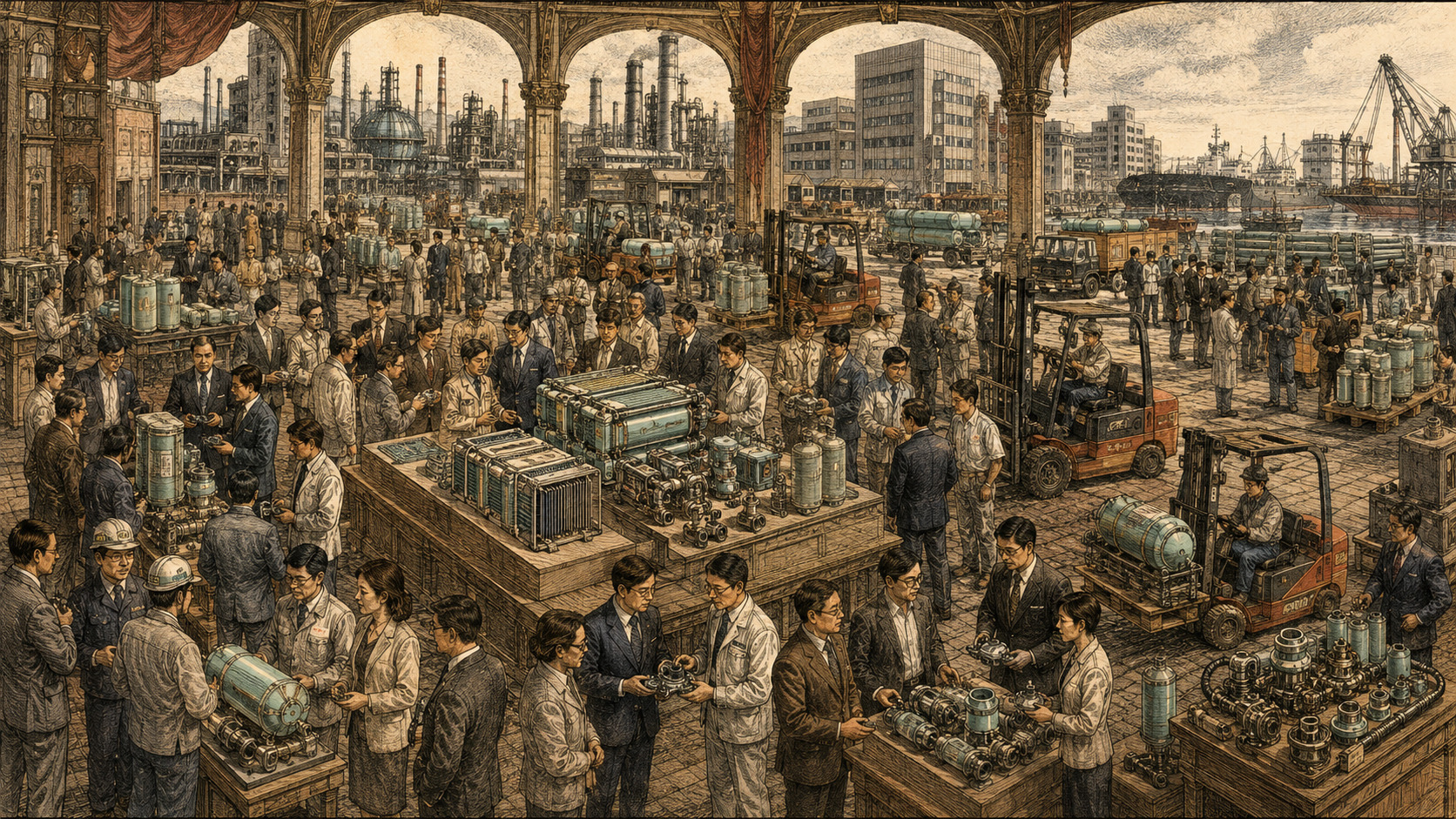
Stradanus drew technology as a crowded social act: furnaces burning, goods changing hands, vessels arriving, craftsmen inspecting each other’s work. The hero illustration for this story imagines the same bustle around hydrogen. JH2A has assembled part of the crowd. Its 1% declaration has opened the market hall. The decisive moment comes when the promises on the tables turn into measured, certified and repeated purchases—and when the first percentage point is no longer the last.
Reporting notes and principal sources
JH2A launched the declaration with 62 companies and organizations and reported 65 as of July 22. The launch count of 57 category proposals is not an aggregate hydrogen-volume target and is not presented publicly as one proposal per participant. The roughly 12% membership share is an editorial calculation using 65 declarers and Aichi Prefecture’s reported JH2A membership of 543 on May 18. No public campaign document checked by the reporting cutoff stated an aggregate tonnage, common completion date, enforcement penalty, universal contract term, lifecycle-carbon threshold or third-party verification protocol. Participant examples are described only to the extent disclosed by the organizations themselves.
- JH2A: June 4 launch, 62 participants and proposal categories
- JH2A: declaration rule, July 22 status, examples and public participant list
- JH2A: May 2026 policy proposal and Hydrogen Backbone target
- JH2A: purpose and organizational history since 2020
- JH2A: leadership and cross-sector governance
- Aichi Prefecture: 20 public FCVs by FY2030 and JH2A membership
- Nagoya City: 1% of public vehicles and category definitions
- Toyota City: from an existing 1% FCV share to 11% in five years
- JR East: Kawasaki power-station commitment and FY2030 objective
- Kobe Steel: low-carbon ammonia and industrial hydrogen declaration
- UCC: commercial hydrogen-roasted coffee for offices and hotels
- METI: the mobility hydrogen “three-way stalemate”
- METI: five priority regions and commercial-vehicle fuel support
- Car Watch: June Backbone meeting, 1,500-truck and 7,500-tonne scenario
- METI Kyushu: 2017 strategy, 2023 revision and 2024 law
- Agency for Natural Resources and Energy: hydrogen volume and cost targets
- METI: Hydrogen Society Promotion Act design
- Energy White Paper 2025: supply, demand, cost and policy framework
- IEA: 2026 production pipeline, demand barriers and firm offtake
- IEA: 2025 hydrogen demand, procurement tenders and end uses
- IEA: Japan’s selected support projects and global demand policies
- IEA: public procurement, firm offtake and demand creation
- IEA policy tracker: Tokyo hydrogen market trial prices
- Ministry of the Environment: Green Purchasing Act of 2000
- Ministry of the Environment: 2001 guidelines, 101 items and 14 categories
- Ministry of the Environment: replacement plan for 6,773 government vehicles
- First Movers Coalition: sector-specific procurement commitments
- METI: GX Acceleration Declaration and demand-side market creation
- METI: demand creation for a Japanese green-steel market
- IEA policy tracker: European hydrogen demand aggregation mechanism