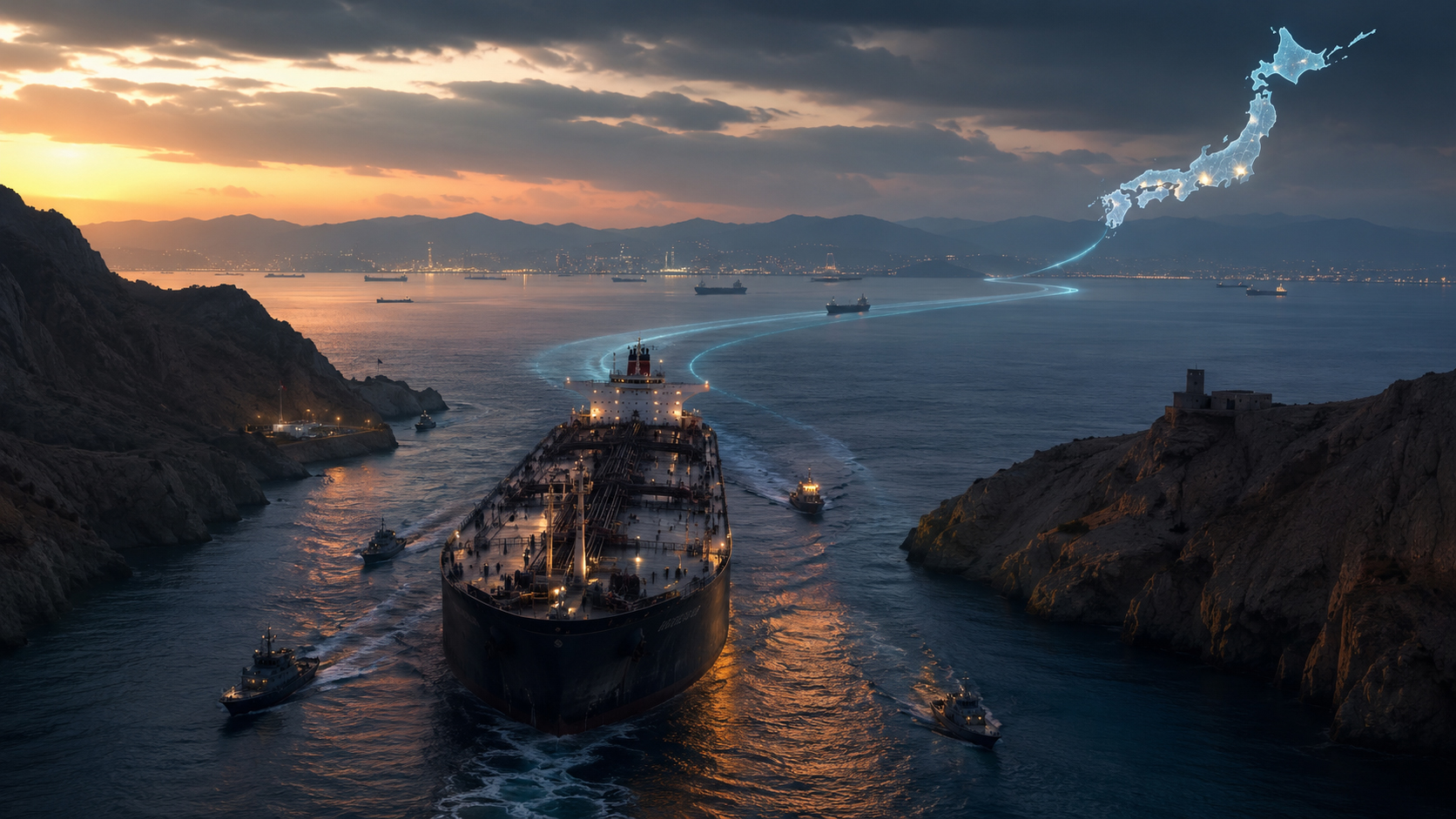
Japan’s energy security is often described in numbers: days of stockpiles, shares of Middle East crude, LNG import ratios, reserve releases and monthly cargo volumes. But the real picture is geographic. A tanker leaves the Persian Gulf, passes through the Strait of Hormuz, crosses the Indian Ocean and heads toward refineries that keep Japan’s transport, power, petrochemicals and factories moving.
On June 11, Prime Minister Sanae Takaichi said Japan had secured stable crude oil supplies through the end of March 2028 through a mix of alternative imports and stockpile releases. That announcement mattered. It reassured markets and industry that Japan would not immediately run dry. But it also revealed how much of the country’s industrial life still depends on a narrow waterway far from Tokyo.
What “secured” really means
When a government says supply has been secured, it is not only talking to oil companies. It is talking to electricity generators, airlines, truck fleets, chemical plants, markets and households. The point is to prevent a physical supply problem from becoming a panic problem.
But securing supply is not magic. Stockpiles are finite. Alternative cargoes cost money. Shipping distances change. Crude grades differ. Refineries are built around particular feedstocks. Moving from Middle Eastern barrels to U.S., Latin American or other grades is not simply a matter of changing the destination on a ship’s navigation system.
Why Hormuz matters
The Strait of Hormuz is the narrow passage between Iran and the Arabian Peninsula, linking the Persian Gulf to the Gulf of Oman and the Arabian Sea. It is the main export route for oil and gas from Saudi Arabia, the United Arab Emirates, Kuwait, Qatar, Iraq, Bahrain and Iran. Few bypasses exist.
The International Energy Agency says roughly one-quarter of global seaborne oil trade passed through the strait in 2025. It also notes that more than 110 billion cubic meters of LNG moved through Hormuz that year, with the vast majority of Qatari and UAE LNG exports using the route. Most of these energy flows go to Asia. Hormuz is therefore not only a Middle East issue. It is an Asian cost-of-living issue.
Japan’s vulnerability is not just Middle East dependence
Japan’s reliance on Middle Eastern crude is extremely high. Yet the deeper problem is not only where the oil comes from, but how it leaves. Multiple supplier countries do not fully diversify risk if their cargoes share the same maritime chokepoint.
And Hormuz is not just oil. LNG, aluminium, urea, ammonia, phosphates and sulphur all connect the strait to global supply chains. Those commodities flow into electricity, fertiliser, food prices, construction, energy technologies, refining and chemicals. A chokepoint crisis can begin at sea and end on a grocery bill.
Stockpiles buy time, not a new energy system
Japan has one of the world’s largest strategic oil inventory systems. The U.S. Energy Information Administration estimated that Japan held 263 million barrels in government-held strategic oil inventories as of December 2025, not including strategic commercial stocks required under Japanese law.
That is a strength. But reserves do not solve the structure of dependency. They buy time. If a shock is brief, the shield works well. If a shock drags on, the shield becomes a countdown. Each barrel released today reduces the cushion available tomorrow.

U.S. crude as a practical detour
Japan’s plan to increase U.S. crude purchases is both practical and political. The United States is an ally and a major producer. In a Middle East disruption, U.S. barrels can serve as both supply and alliance insurance.
But U.S. crude is not a universal substitute. Voyage times are different. Shipping costs differ. Refinery yields differ. Japanese refiners have long tuned operations around Middle Eastern crude. Diversification is necessary, but it requires technical work, blending, testing and sometimes investment.
The refinery is the hidden front line
Public attention usually goes to tankers, naval routes and prices. The refinery is less visible but just as important. Crude oil is not useful until it is transformed into gasoline, diesel, kerosene, jet fuel, fuel oil, naphtha, lubricants and chemical feedstocks.
Change the crude and the refinery equation changes. Heavy and light, sweet and sour, yield patterns and sulphur content all matter. Energy security is therefore not just a diplomatic phrase. It is a control-room problem inside Japanese refineries.
LNG and the electricity bill
For households, the Hormuz crisis is not only about gasoline. LNG risk can feed into power costs. Japan still depends heavily on thermal generation, and gas-fired power remains an important stabilizer in the electricity system. Not all LNG imports pass through Hormuz, but disruption to Gulf gas can affect prices across the wider market.
Higher energy prices spread thinly through almost everything: refrigerated warehouses, food processing, data centers, railways, hospitals, farms, flights and factories. The Strait of Hormuz can appear months later inside an electricity bill.
Nuclear, renewables, coal and reality
Every Middle East shock revives Japan’s energy debate. Reducing oil exposure ultimately means reducing imported fossil fuel dependence. In the power sector, that points toward nuclear restarts, renewables, grid upgrades, storage and efficiency. In transport, it points toward electrification, fuel efficiency, public transport and alternative fuels.
But every option carries constraints. Nuclear power faces safety review and local consent. Renewables face grid, storage and land-use challenges. Coal offers dispatchability but conflicts with decarbonization. LNG is cleaner than coal but still imported fuel. Japan’s energy policy is not a clean choice between ideal futures. It is a portfolio of constraints.
- Mine clearance and safety confirmation in the Strait of Hormuz.
- When Japanese-linked vessels resume normal operations.
- Whether U.S. and other alternative crude cargoes remain affordable.
- How quickly oil stockpile days decline if disruptions persist.
- Pass-through to power bills, jet fuel, logistics and food prices.
- Long-term refinery investment to handle a more diverse crude slate.
Safe sea lanes are not free
Japan is an island nation. Food, fuel, raw materials, components and finished goods move by ship. Freedom of navigation is not an abstract diplomatic principle. It is a condition of daily life.
But safe sea lanes are not free. Insurance, escort, international agreements, ports, reserves, alternative routes and energy transition all cost money. Japan is moving from an era of buying energy cheaply to an era of designing energy security deliberately.
Hormuz is far away. That is why it is close.
On a map, the Strait of Hormuz is far from Japan. In prices, it is close. In electricity bills, gasoline costs, airline tickets, fertiliser, food and factory schedules, it is closer still.
The government’s assurance on supply is important. But the real story is not that Japan survived one shock. It is that the country must now decide how to prepare for the next one. Hormuz is not a distant waterway. It is part of Japan’s energy lifeline.
Sources and references
This Japan.co.jp report is based on public reporting and data from Reuters, the International Energy Agency, the U.S. Energy Information Administration, Japan’s Ministry of Economy, Trade and Industry, and the Agency for Natural Resources and Energy.